
Articles & Guides
Tips, ideas and free printables — 303 guides and counting.
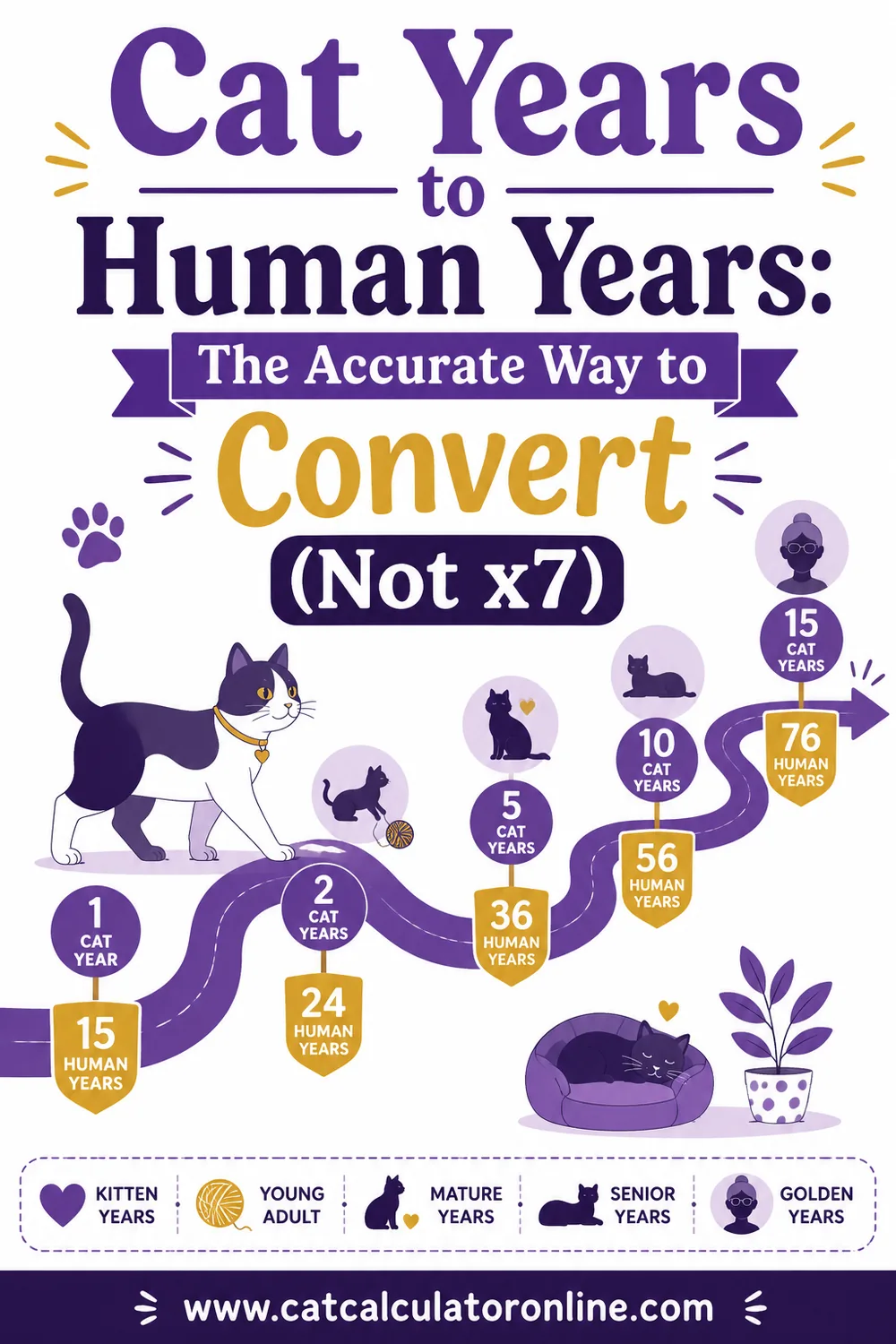
Convert cat years to human years the accurate way. See the vet-backed AAHA method, a full conversion chart, and why the 7-year rule is wrong for cats.
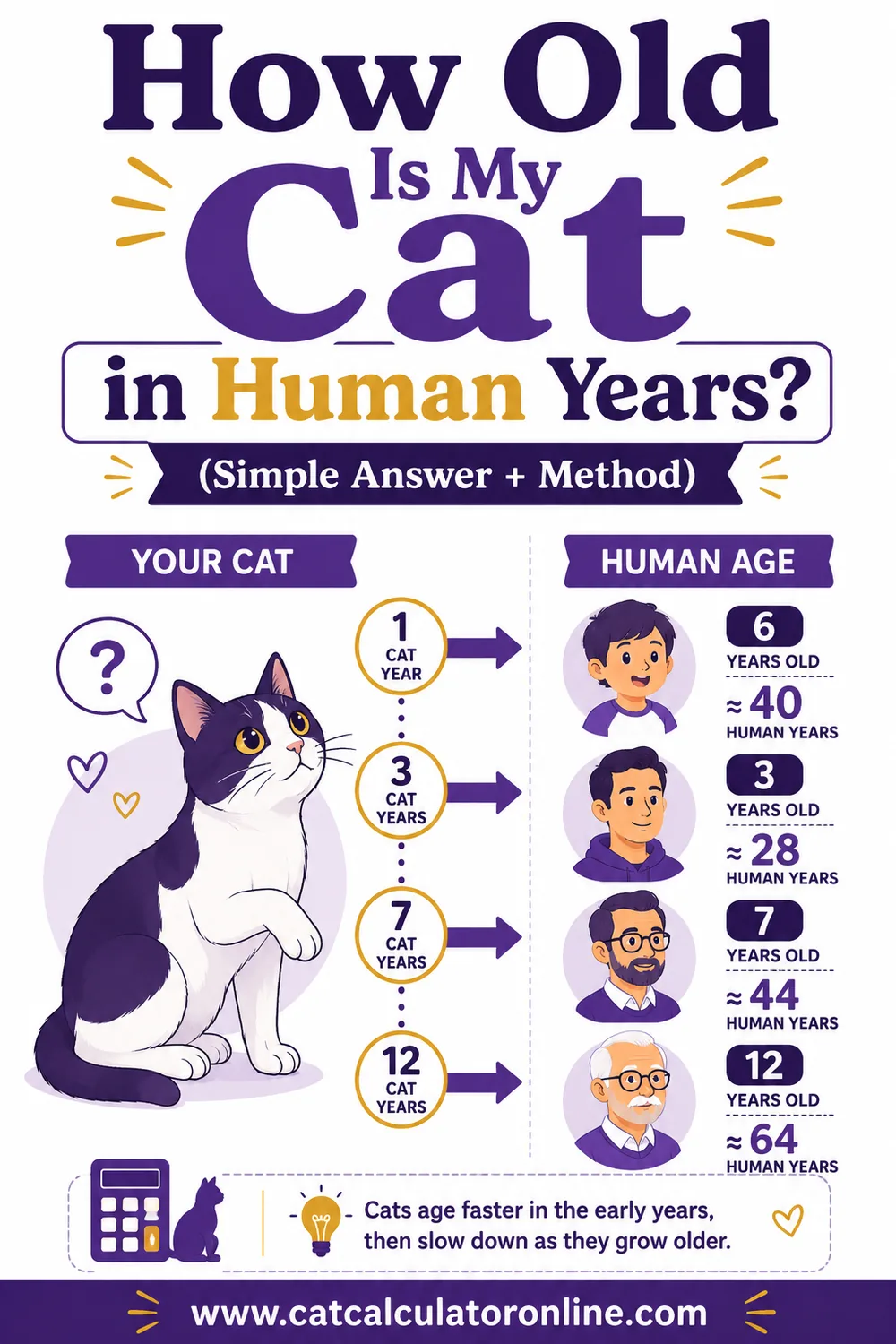
How old is your cat in human years? Get the simple answer, the easy formula to work it out, and what to do when you don't know your cat's birthday.
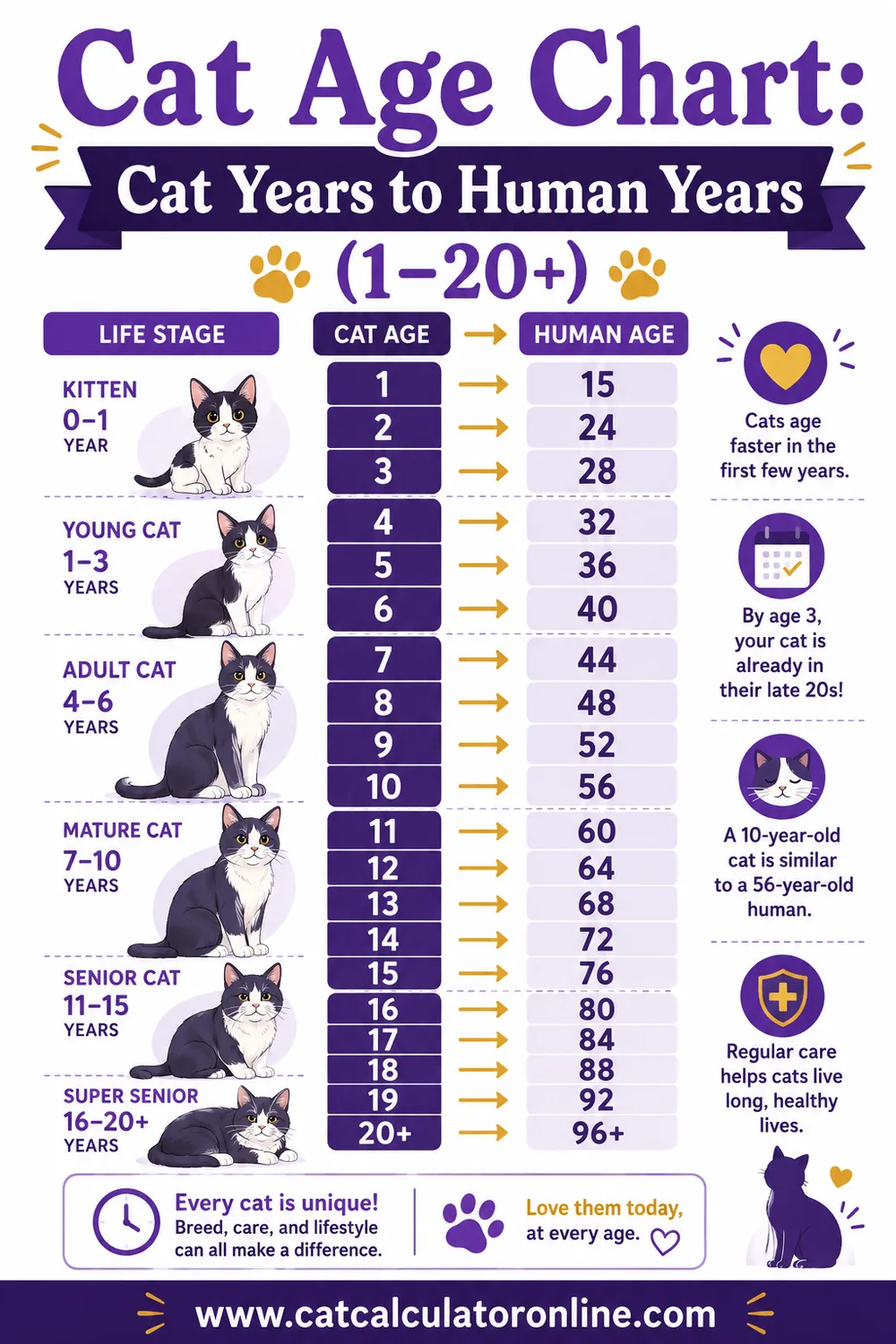
A complete cat age chart converting cat years to human years, ages 1 to 20, with the life stage for each. See where your cat lands and what care she needs.
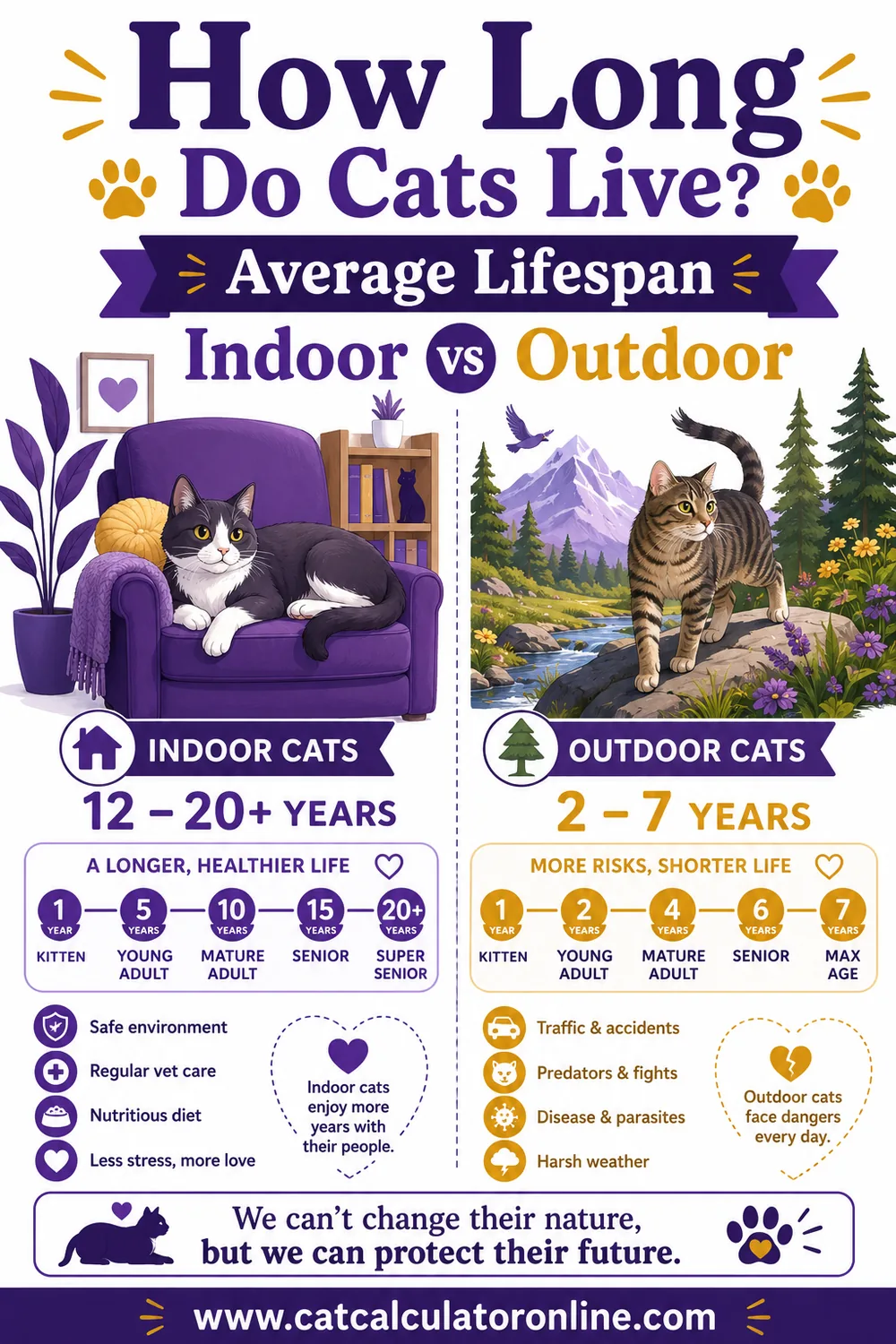
Most cats live 13–17 years, and many indoor cats reach 20. See average cat lifespan indoors vs outdoors, breed differences, the record holder, and how to add years.

Indoor cats live 13–17 years on average, and many reach 20. Here's why they outlive outdoor cats 2–3x, plus the daily habits that add healthy years.
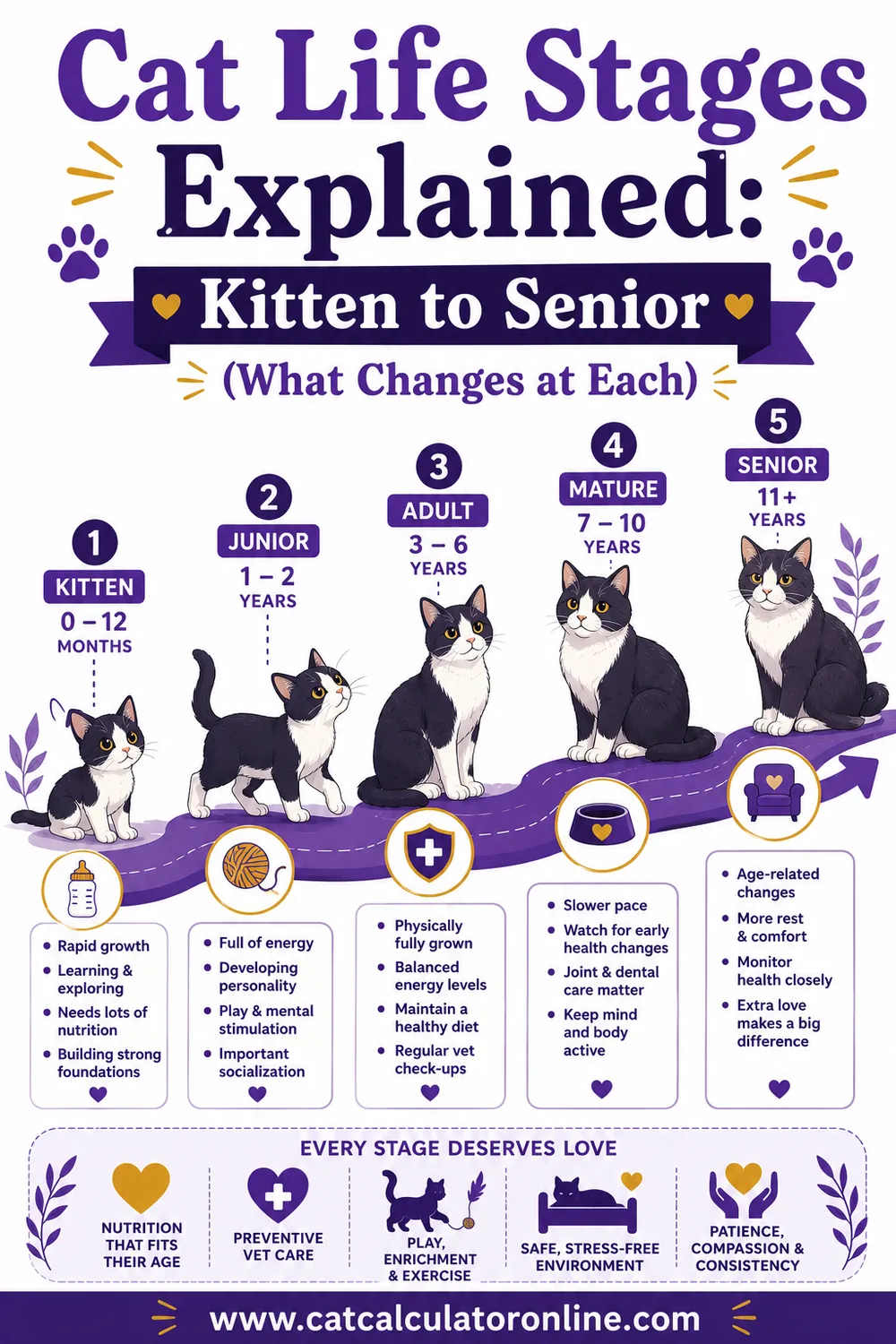
The 4 cat life stages — kitten, young adult, mature adult, senior — explained. What changes physically and behaviorally at each age, and the care each needs.
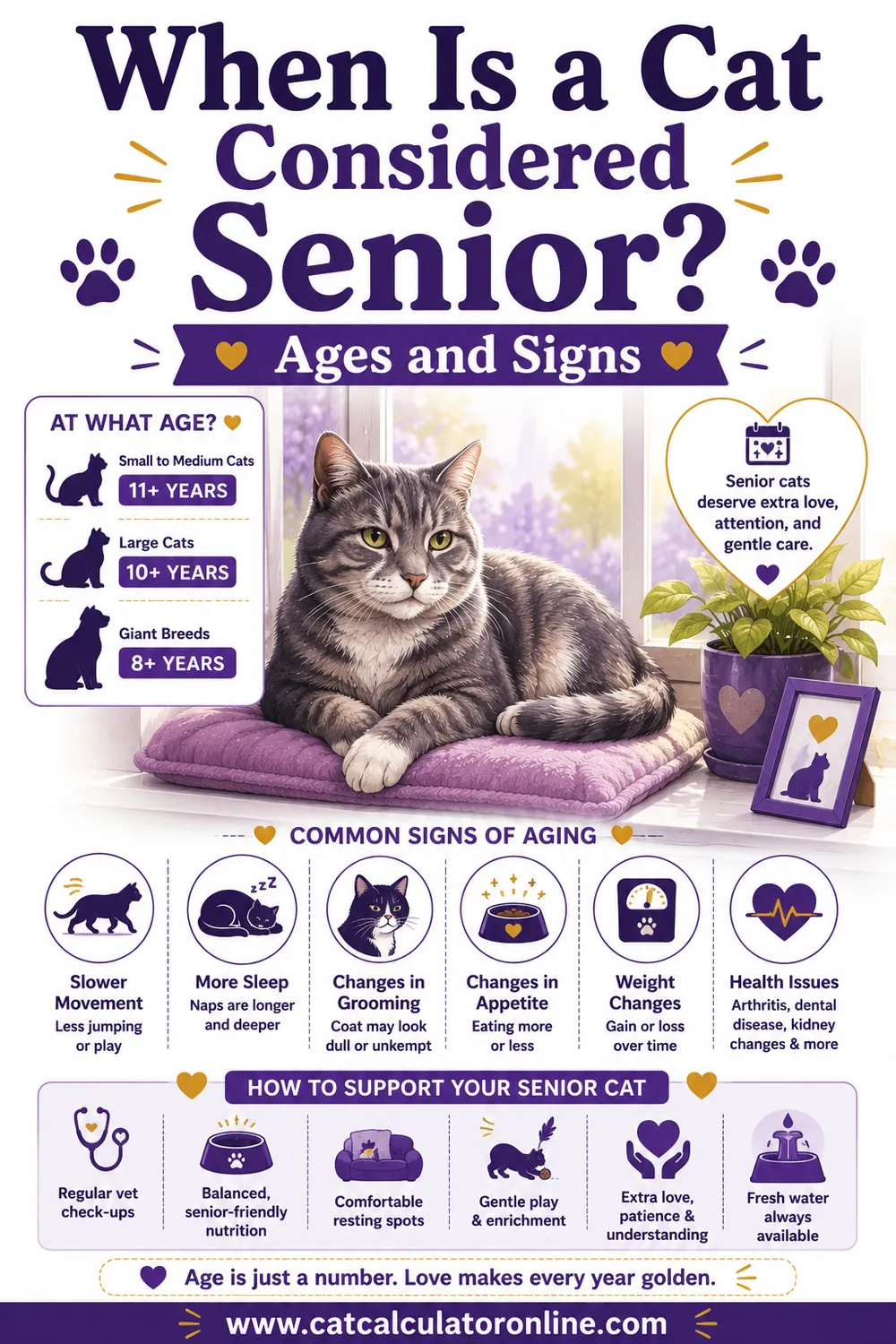
A cat is considered senior at about 10 years old, and mature from 7. See what changes, why twice-yearly vet visits matter, and how to adjust senior cat care.
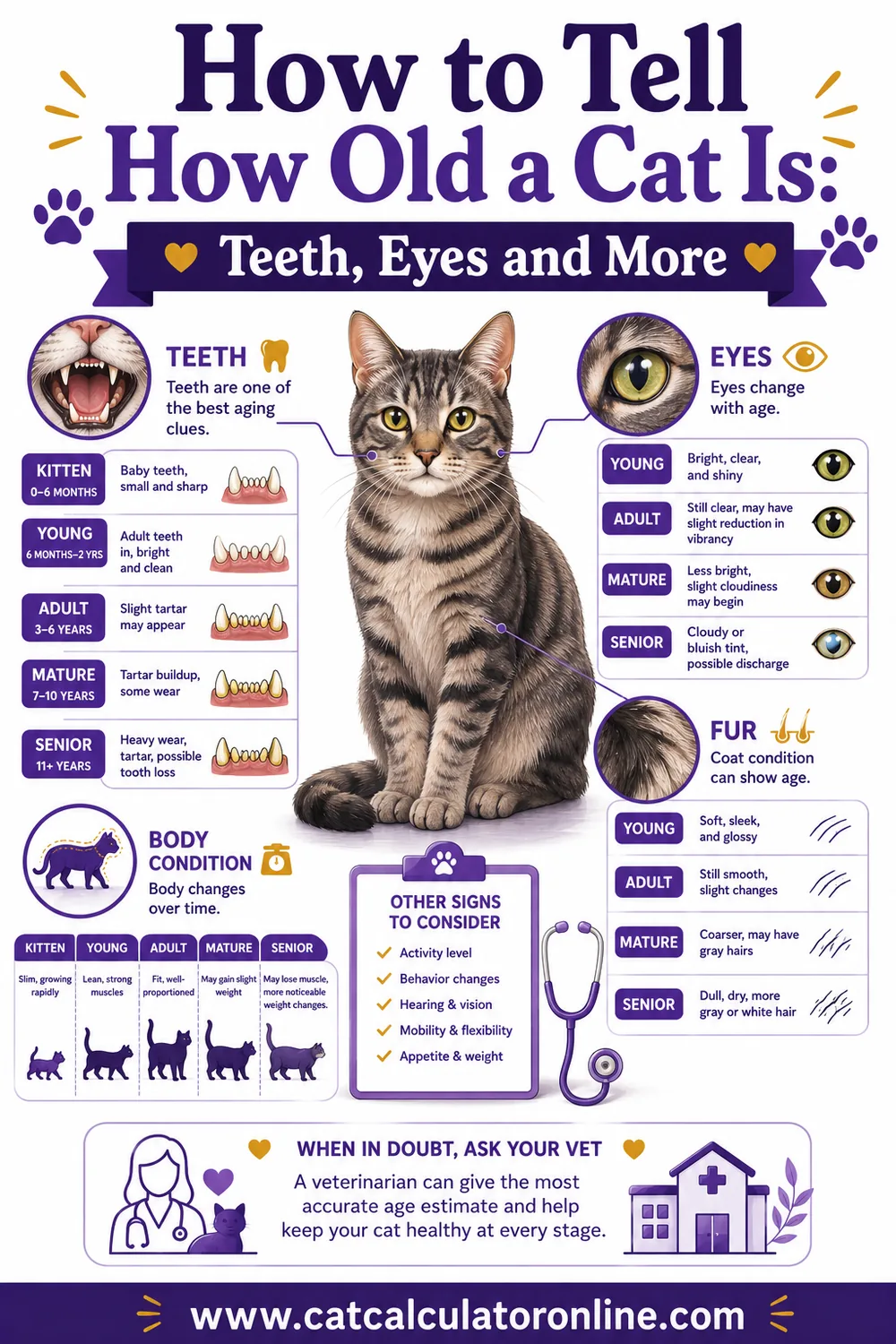
Not sure how old your cat is? Learn to estimate a cat's age from teeth, eyes, coat, and muscle tone — plus a kitten age-by-milestone chart and when to trust your vet.
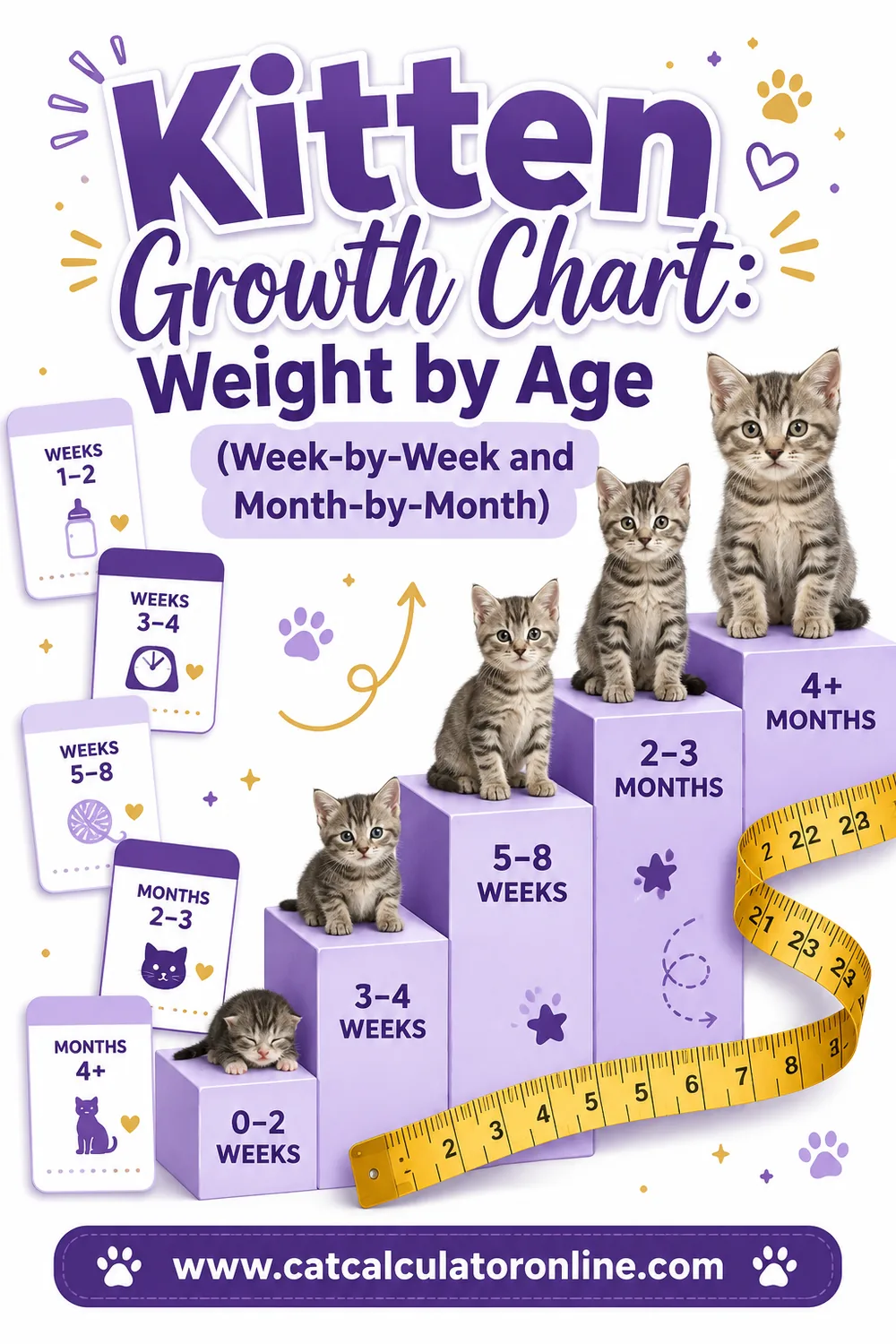
A kitten growth chart with typical weight by week and month, plus how to tell if your kitten is on track, how fast they grow, and when they stop.

How much should you feed your cat? A clear chart by weight, why bag guidelines overfeed, plus wet vs dry calories and how to check body condition.
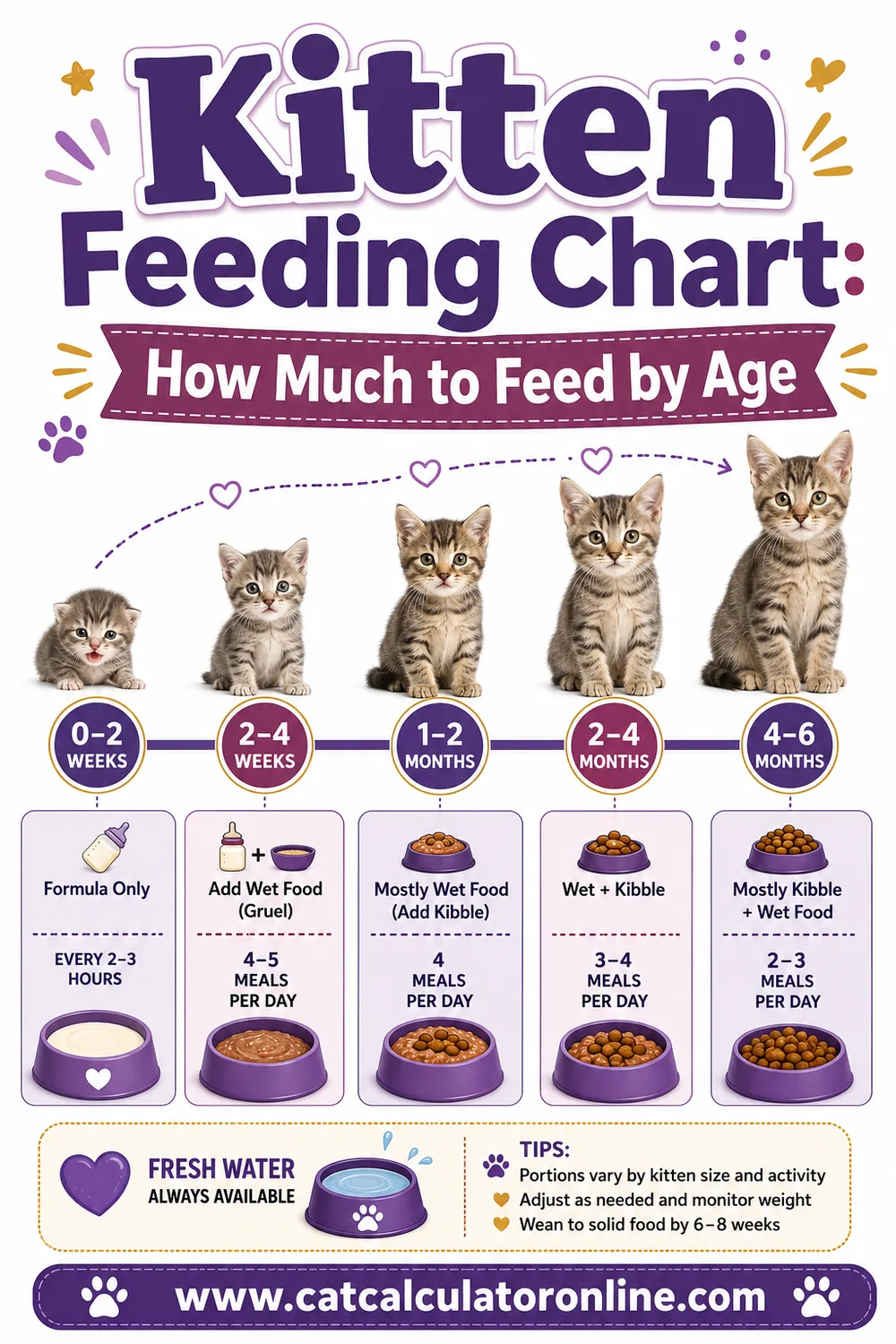
A kitten feeding chart with amounts and meals per day by age, from bottle-fed newborns to 12 months. Wet and dry portions, weaning steps, and a free tool.
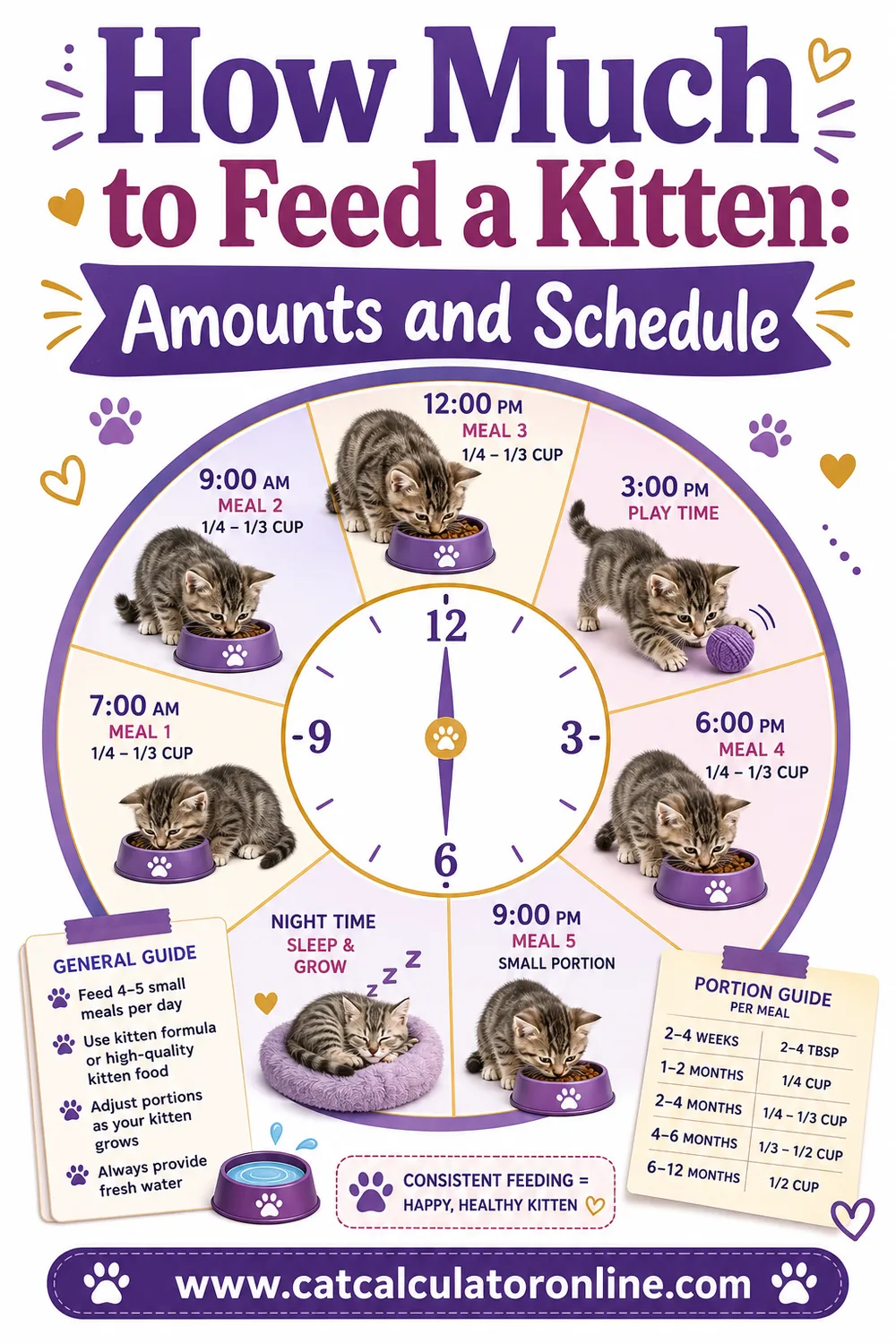
How much to feed a kitten per meal and per day, free-feeding vs scheduled meals, wet vs dry, and a simple schedule by age. Plus a free kitten feeding tool.
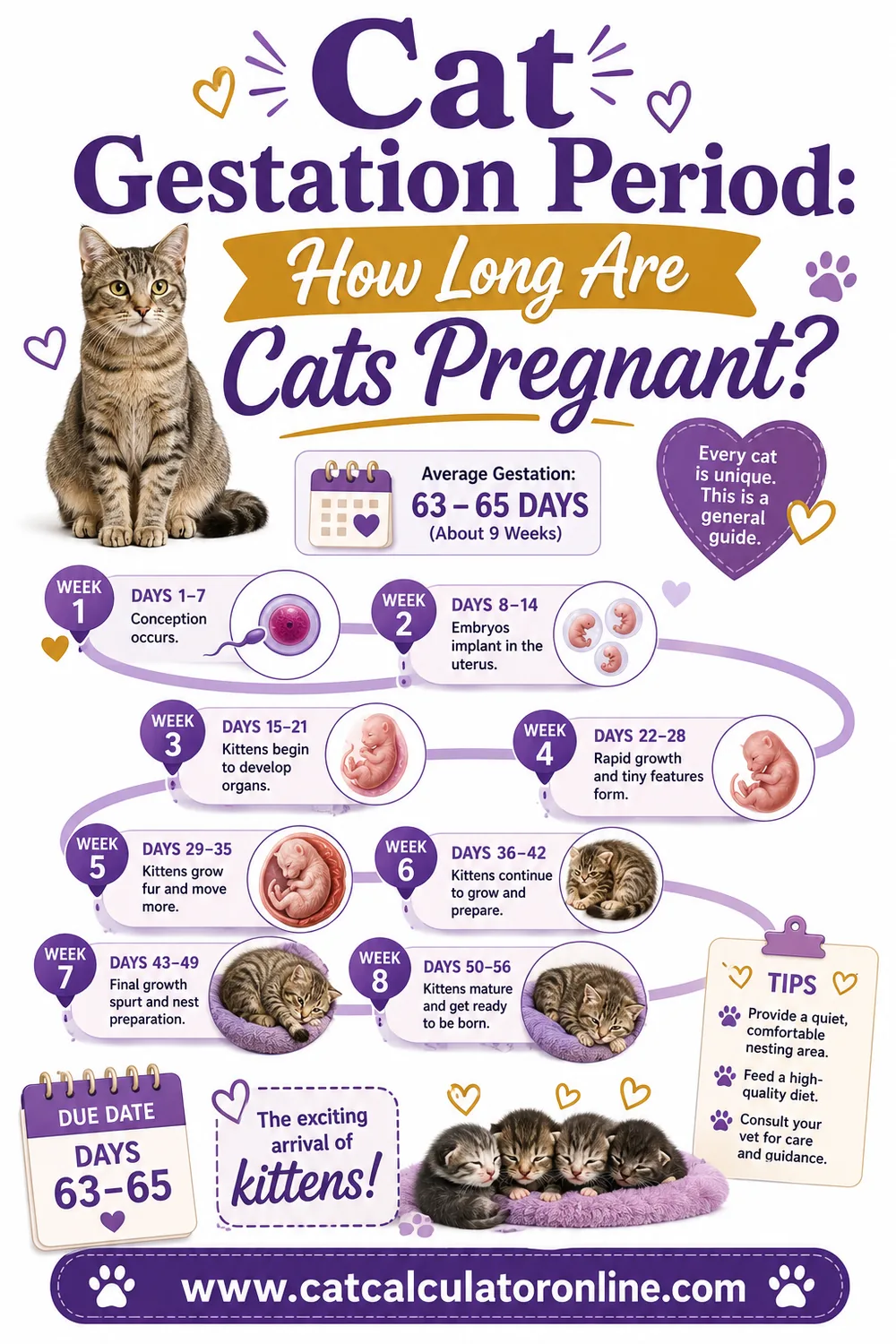
How long are cats pregnant? The cat gestation period is about 63–67 days. See the full week-by-week timeline, pregnancy signs, litter size, and labor cues.
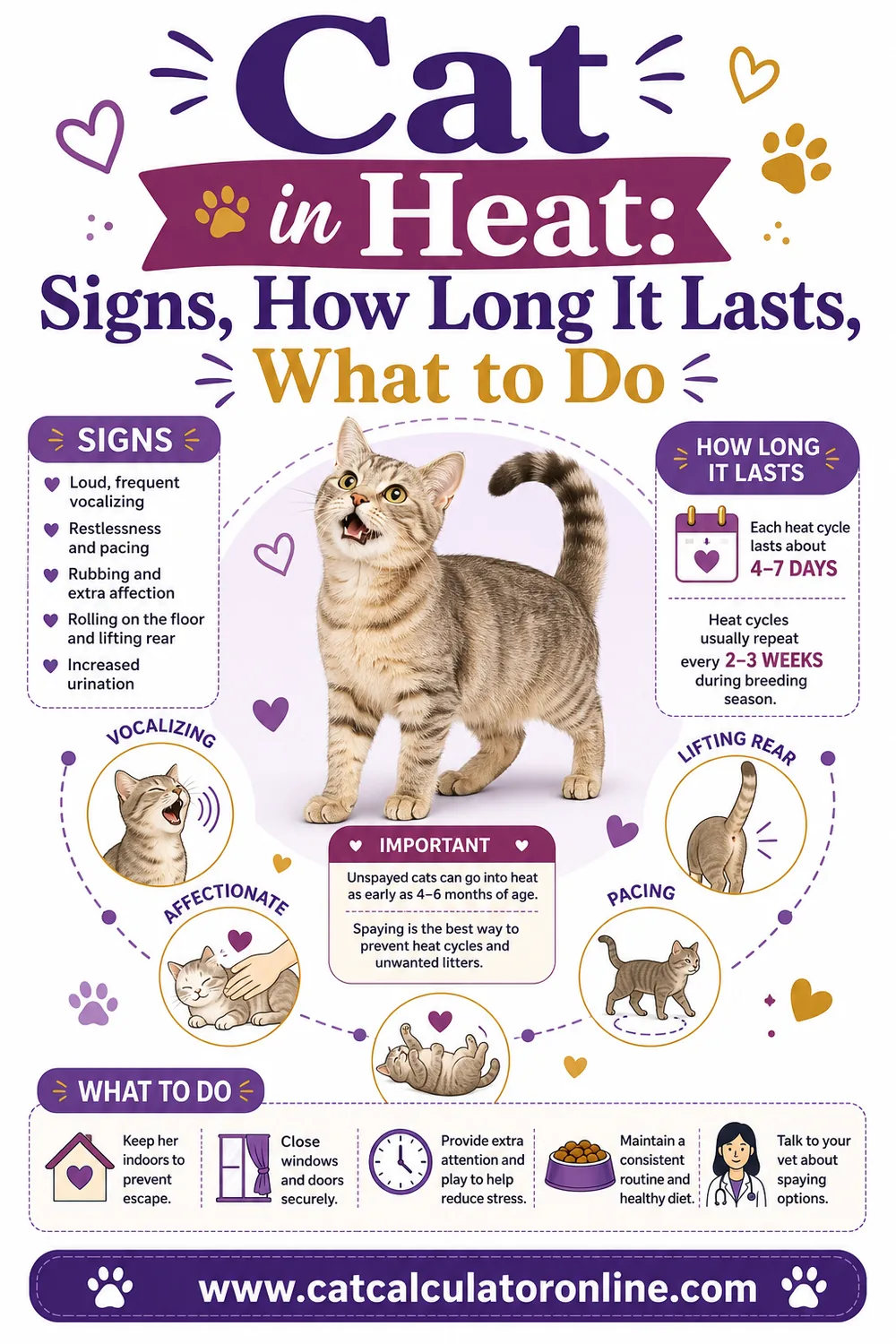
Is your cat in heat? Learn the signs (yowling, rolling, raised rear), how long a heat lasts, how often it comes back, and exactly what to do — and not do.

The complete new kitten checklist: every supply you need, when to book the first vet visit, how to kitten-proof your home, and a day-by-day first-week plan.

How much does a cat cost per year? Most owners spend $700–$1,300 after the first year. See the itemized breakdown for food, litter, vet care, and insurance.
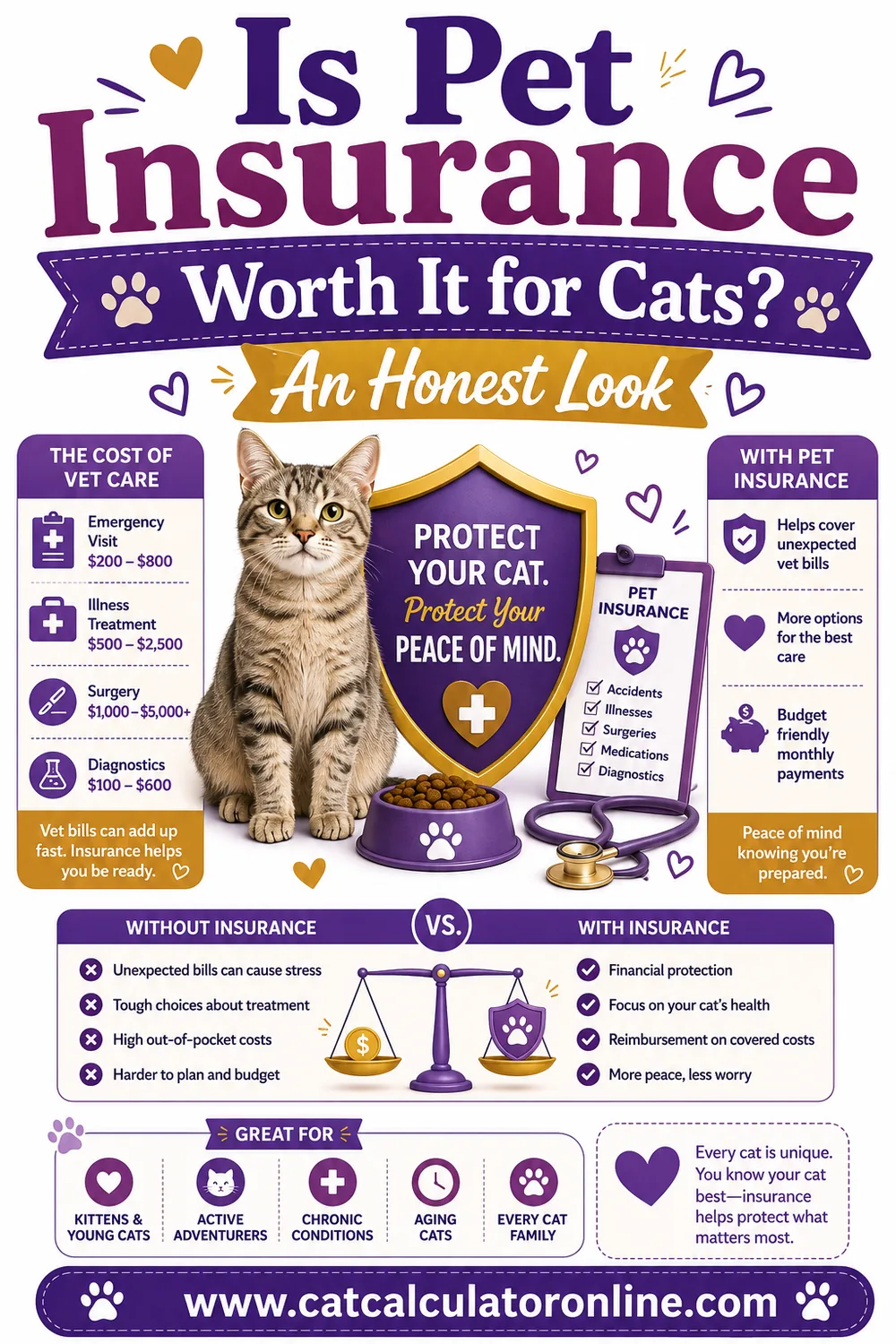
Is pet insurance worth it for cats? Plans average $25–$35 a month. Here's the honest math, what's covered, and how to decide between insurance and savings.

How much is pet insurance for a cat? Accident-and-illness plans average $25–$35 a month. See average costs by age and coverage, plus easy ways to lower your premium.
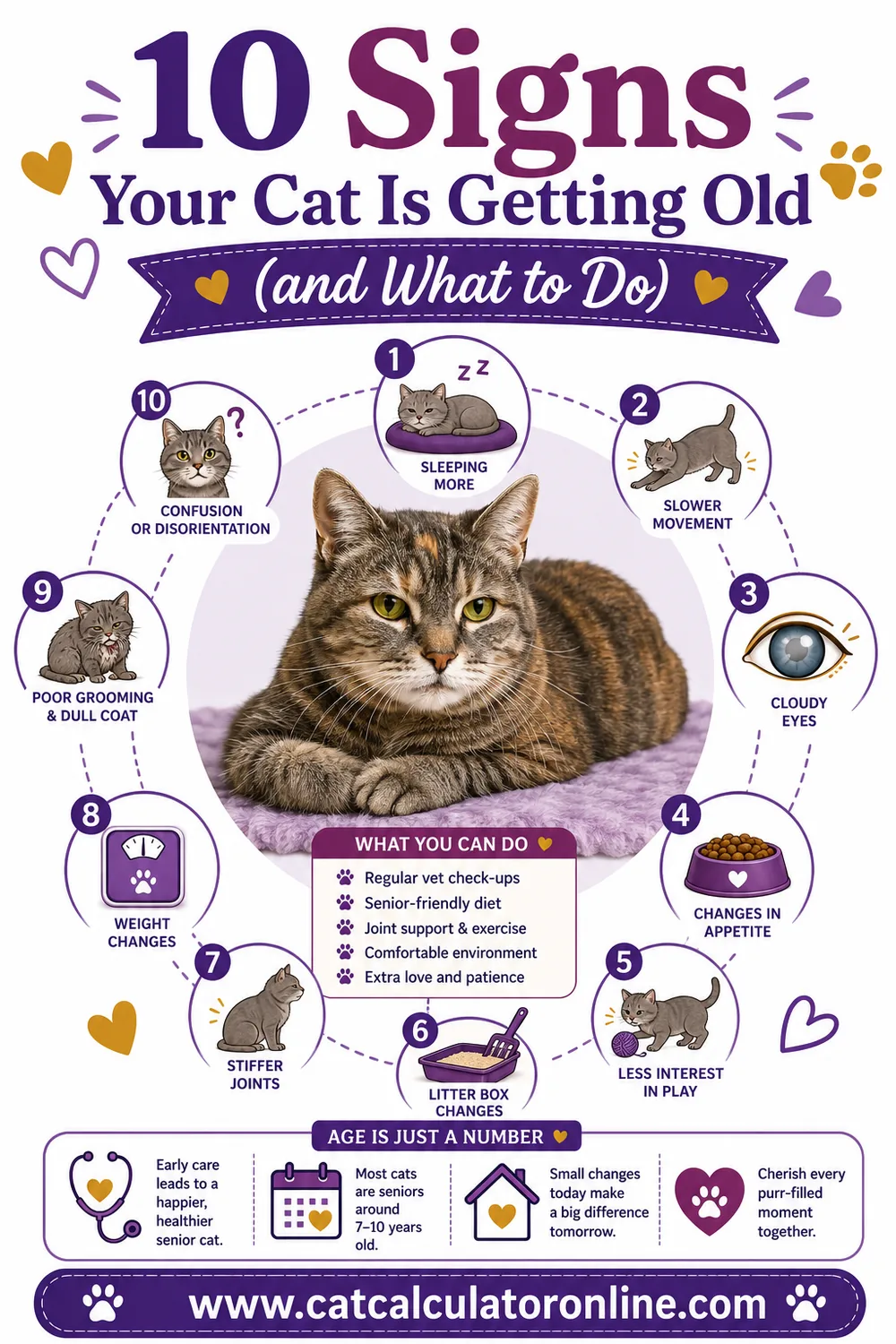
The physical and behavioral signs your cat is getting old — more sleep, stiffness, weight loss, thirst, cloudy eyes — and exactly when each one means see the vet.

The best cat names in one place: top popular picks, food names, color and coat names, mythology, pop culture, and funny ideas — 200+ names by theme, plus a random name generator.
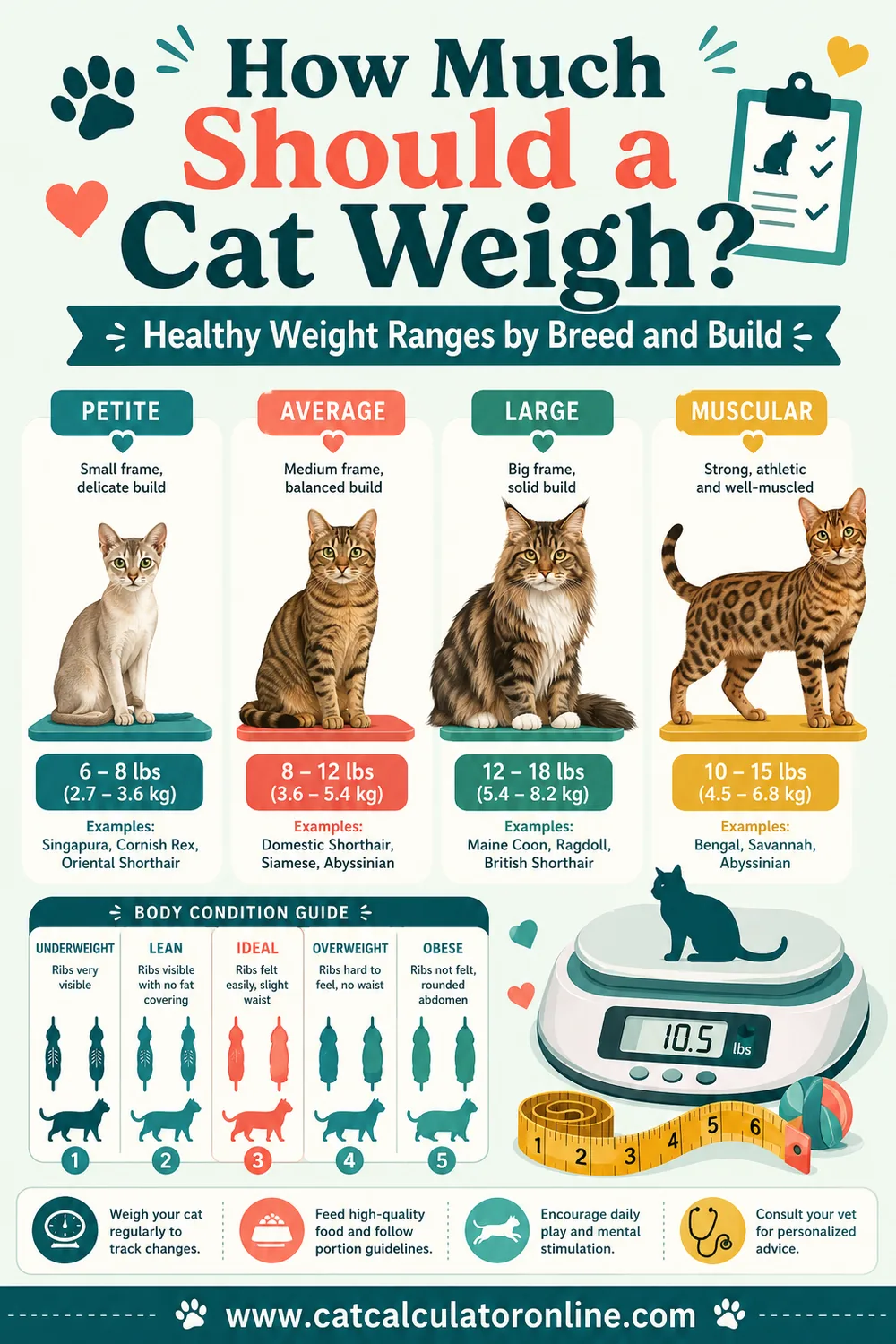
Most adult cats should weigh 8-12 lb, but breed and frame change that a lot. See healthy ranges by breed, plus the body condition score vets actually use.
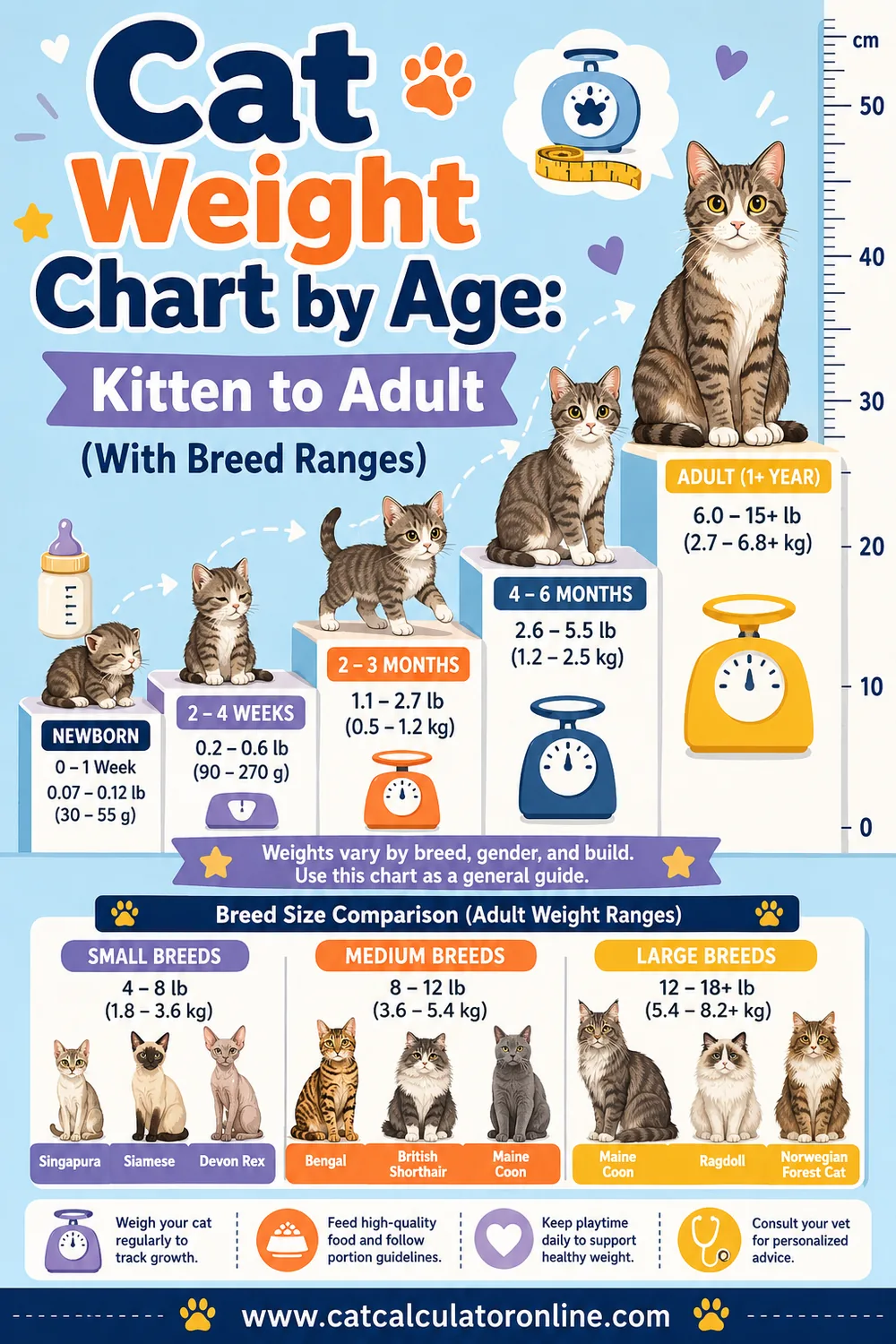
A cat weight chart by age, from newborn kittens to adults, plus healthy adult ranges by breed size and how to tell if your cat is on track.
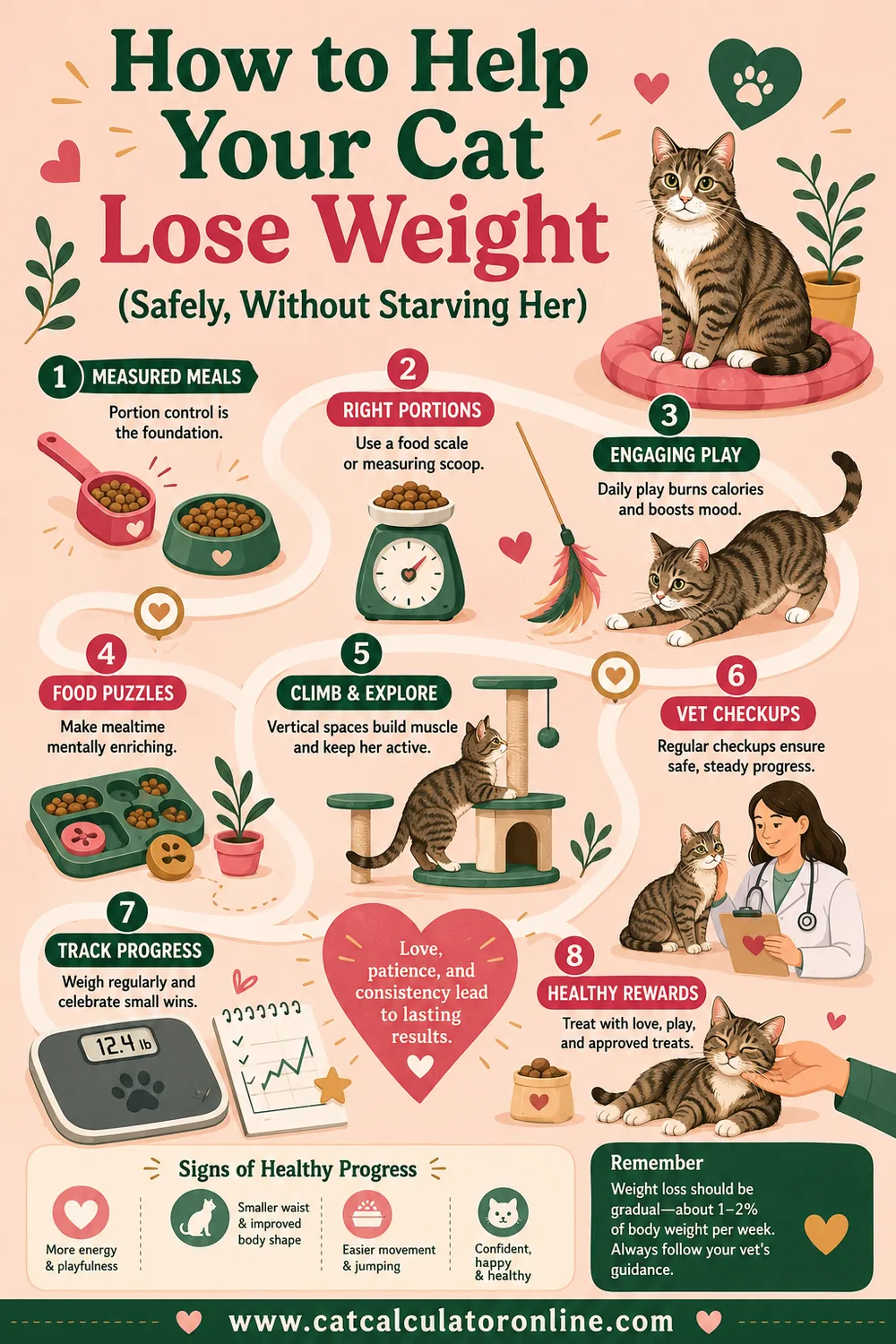
A safe cat weight loss plan: how fast cats can lose, calorie targets, portion control, wet food, play ideas, and the fatty liver risk you must avoid.
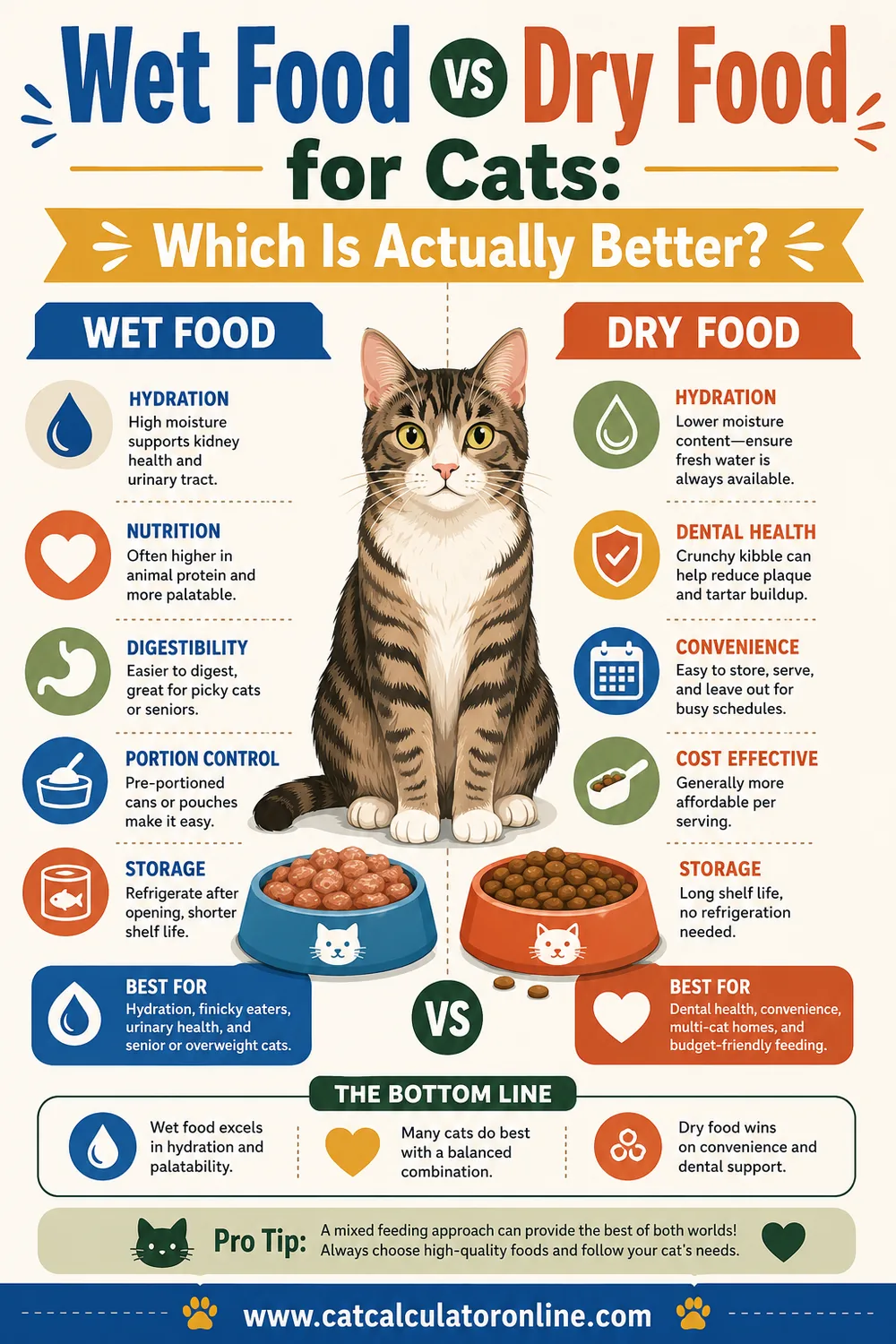
Wet vs dry cat food compared on hydration, cost, calories, dental health and convenience. See the full table, plus why dry food doesn't clean teeth.
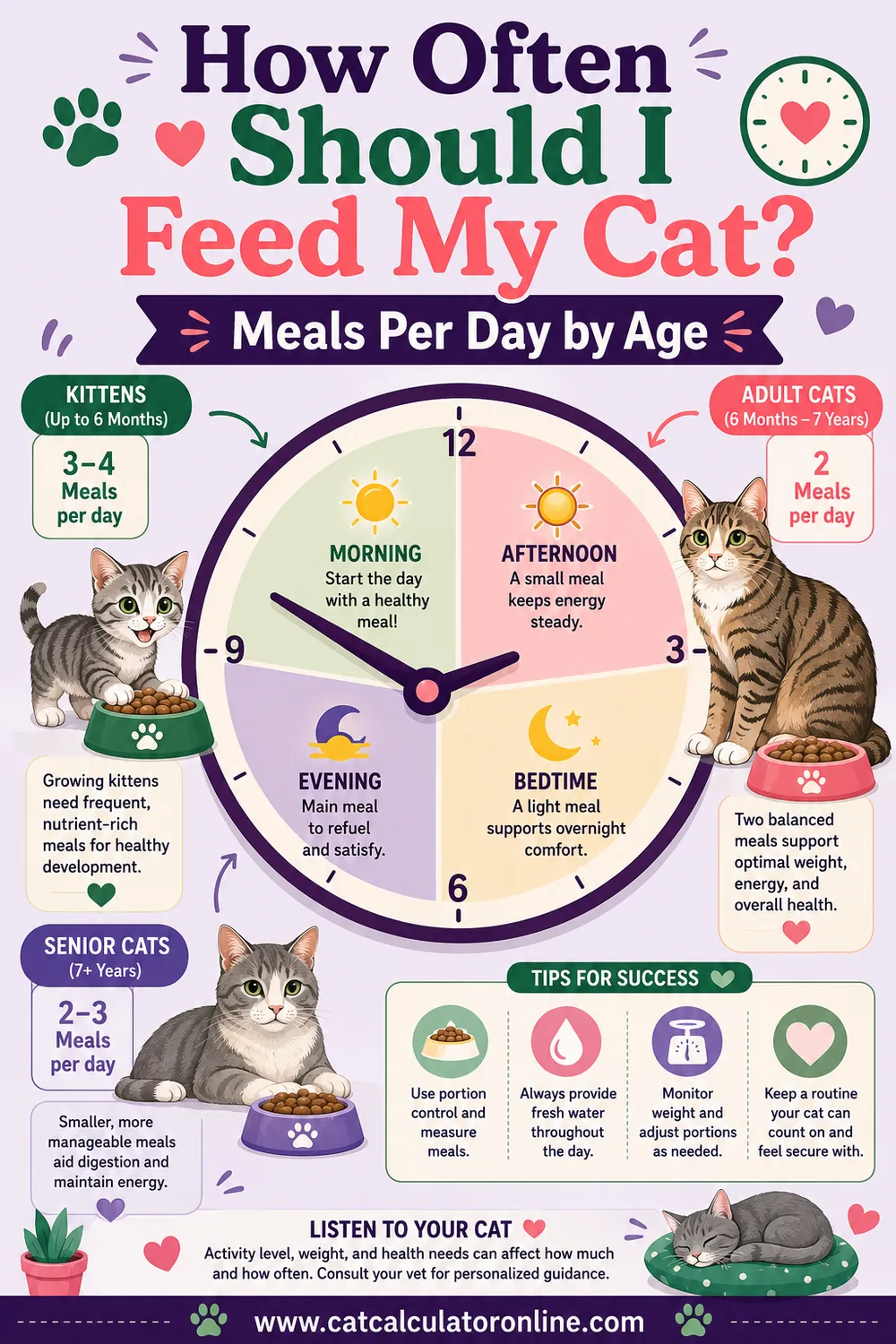
How often should you feed your cat? See meals per day by life stage, free-feeding vs scheduled meals, sample schedules, and the 24-hour fasting warning.
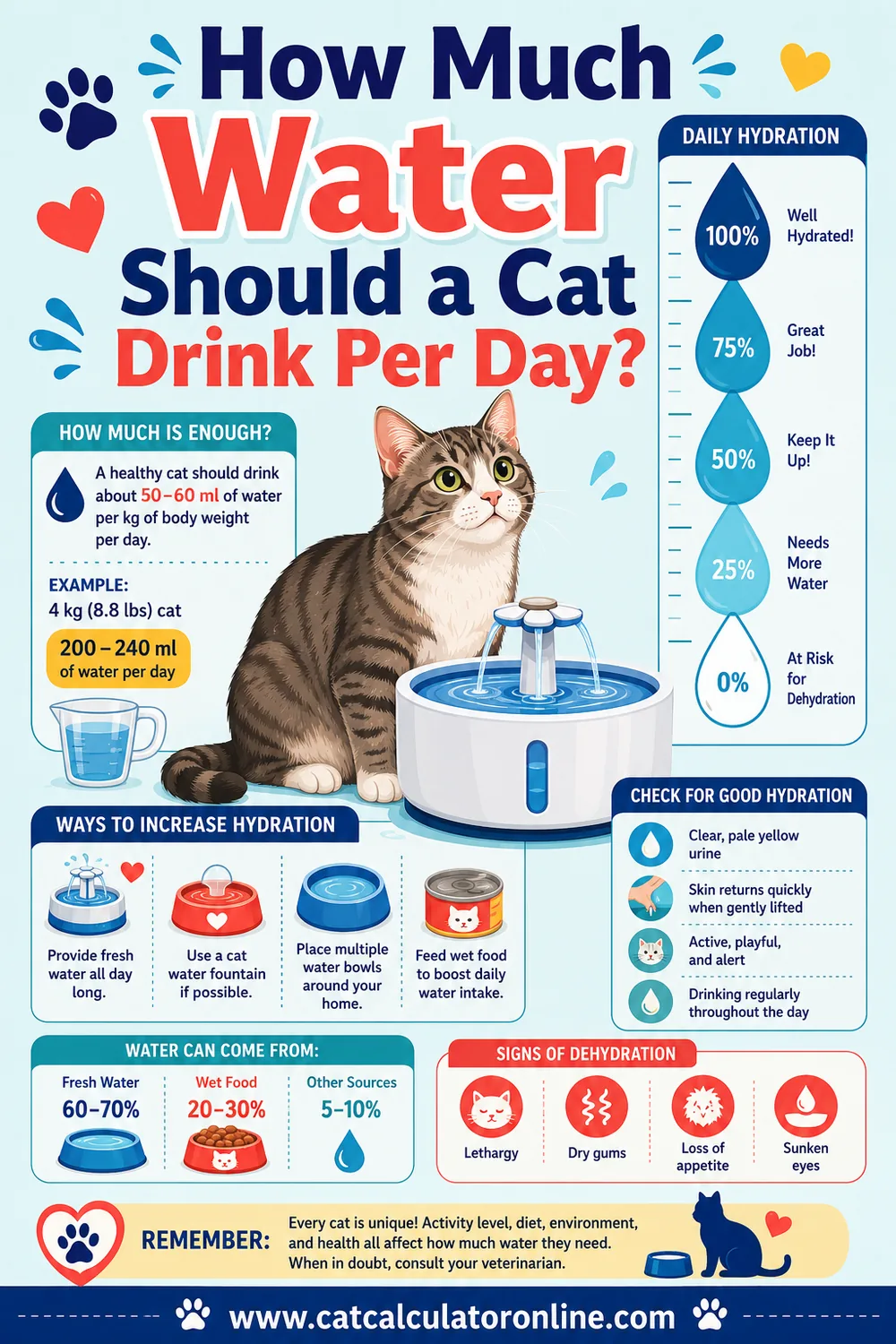
How much water should a cat drink daily? See amounts by weight, why cats under-drink, how wet food counts, and when a change in thirst means see the vet.
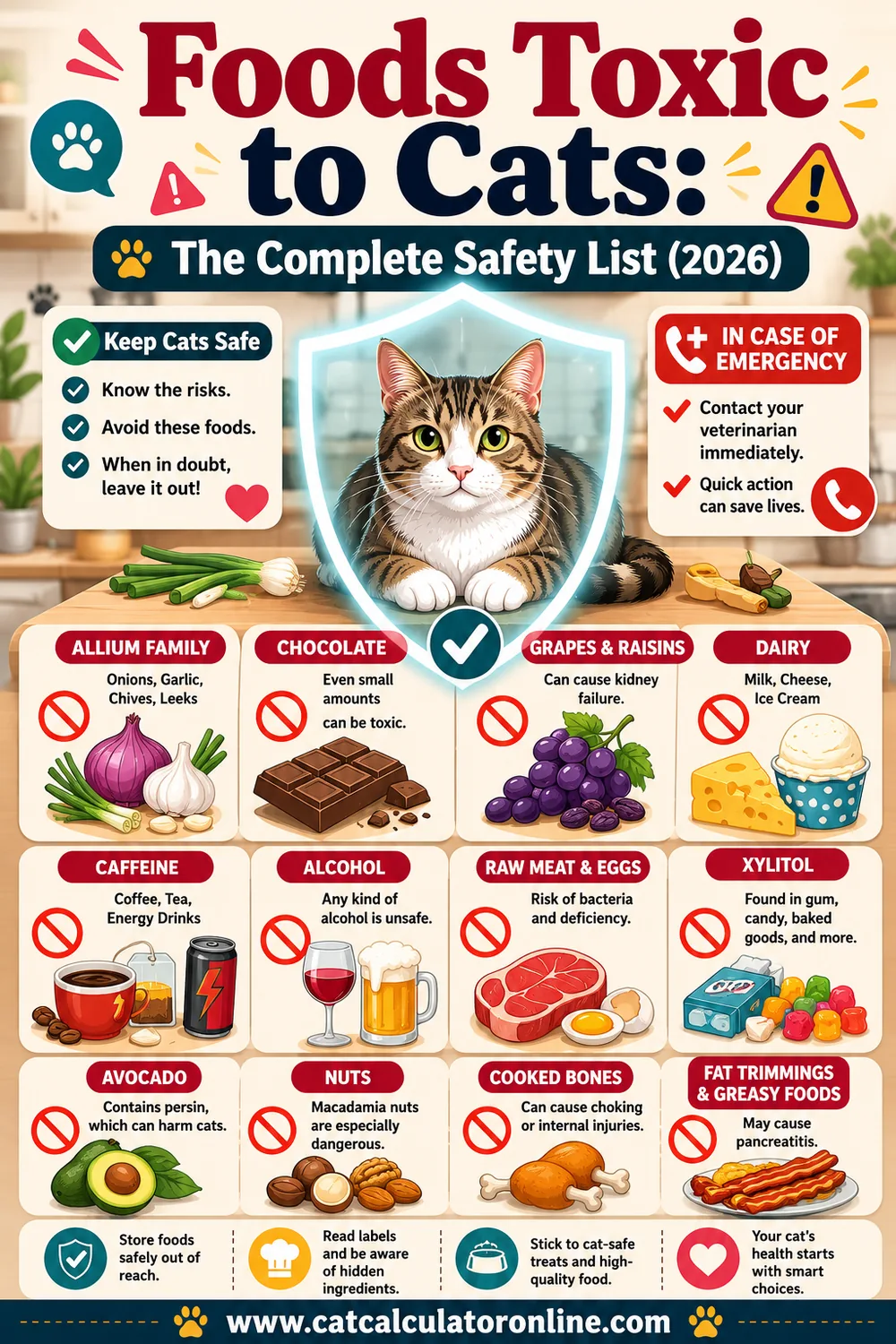
The complete list of foods toxic to cats, from onions and chocolate to lilies. See a safe vs. toxic table, warning signs, and what to do in an emergency.
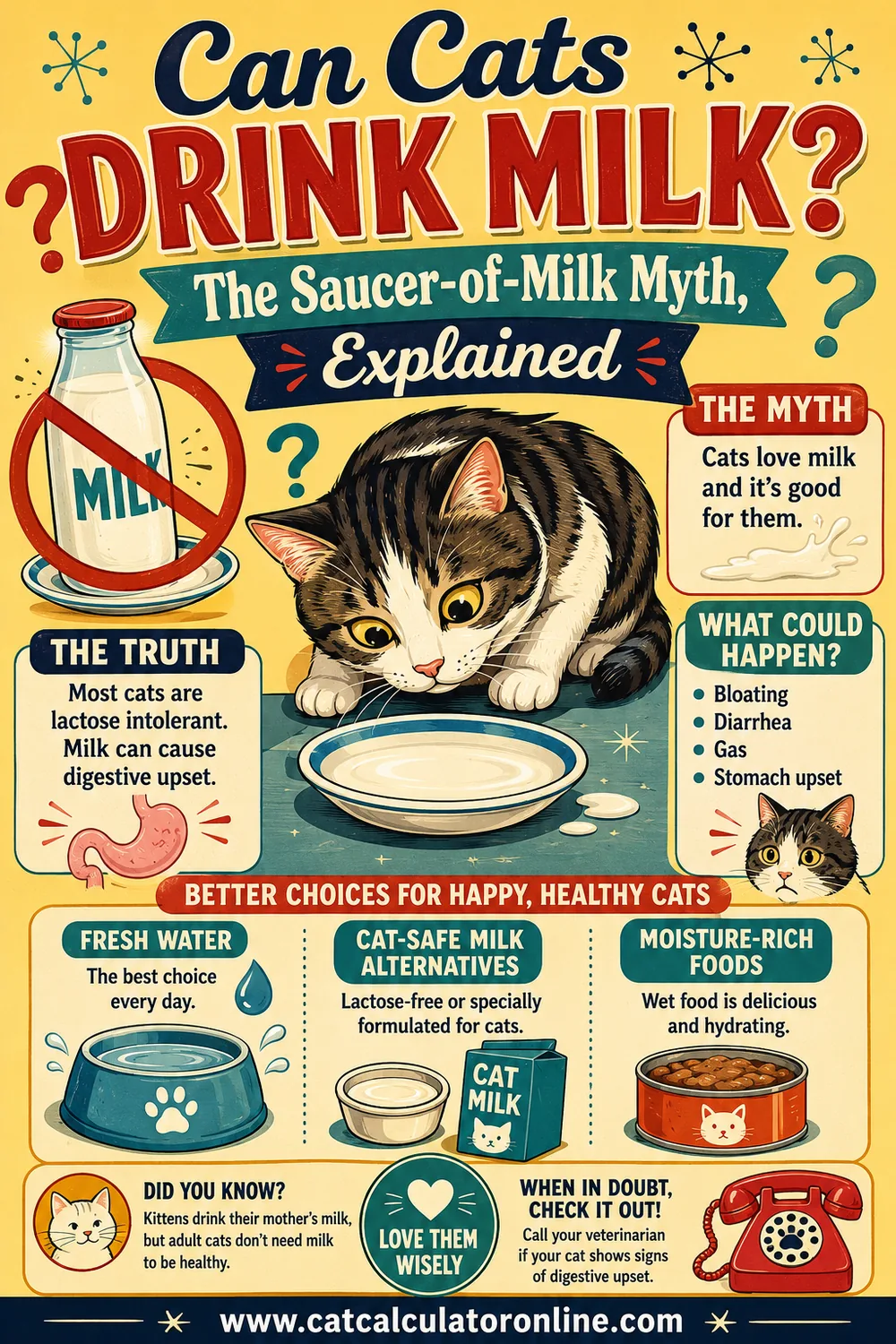
Can cats drink milk? Most adult cats are lactose intolerant, so cow's milk causes diarrhea. Here's what to give instead, plus kitten milk replacer advice.
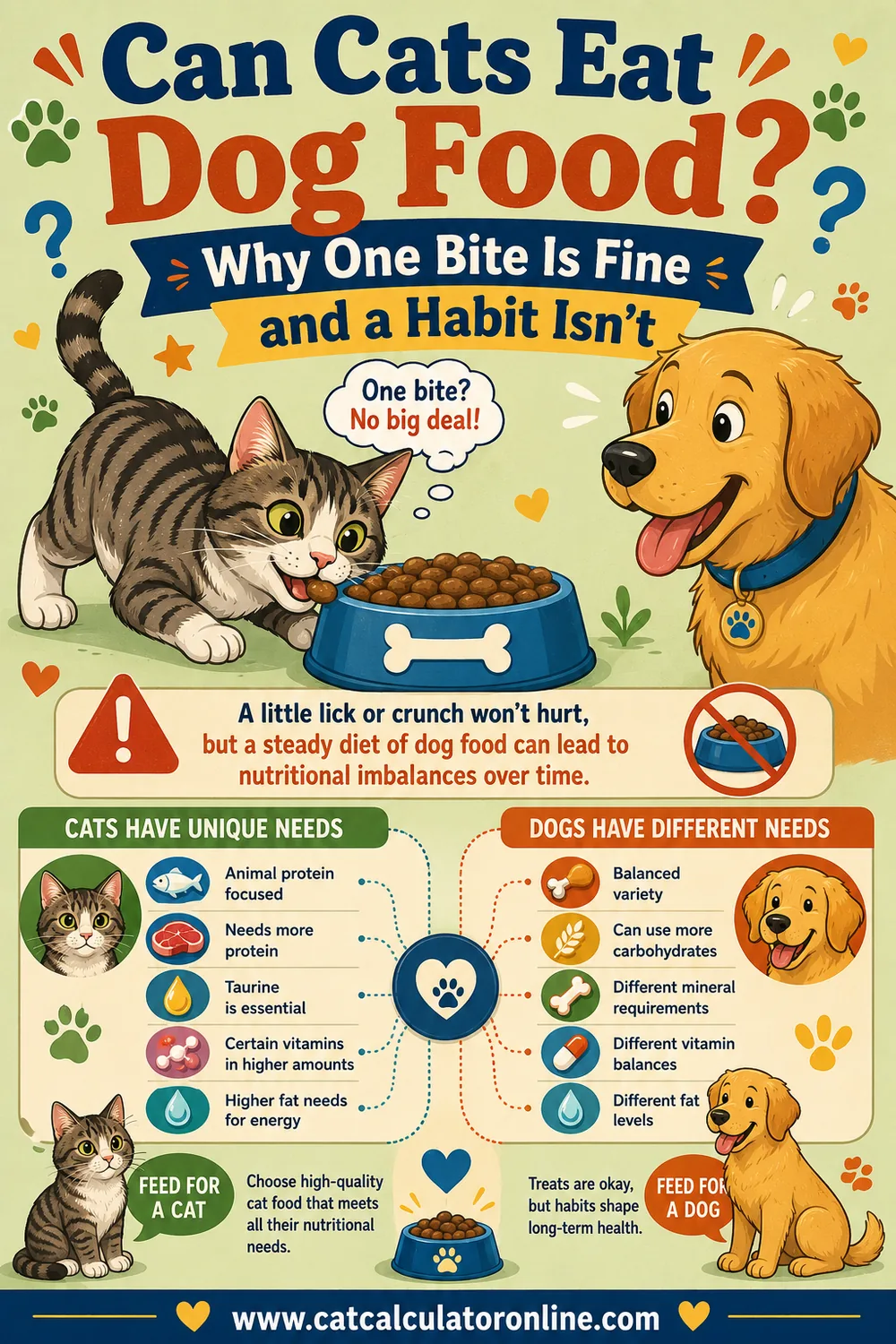
Can cats eat dog food? A stolen bite won't hurt, but long-term feeding causes taurine and vitamin A deficiency. Here's why cats need cat food, and what to do.
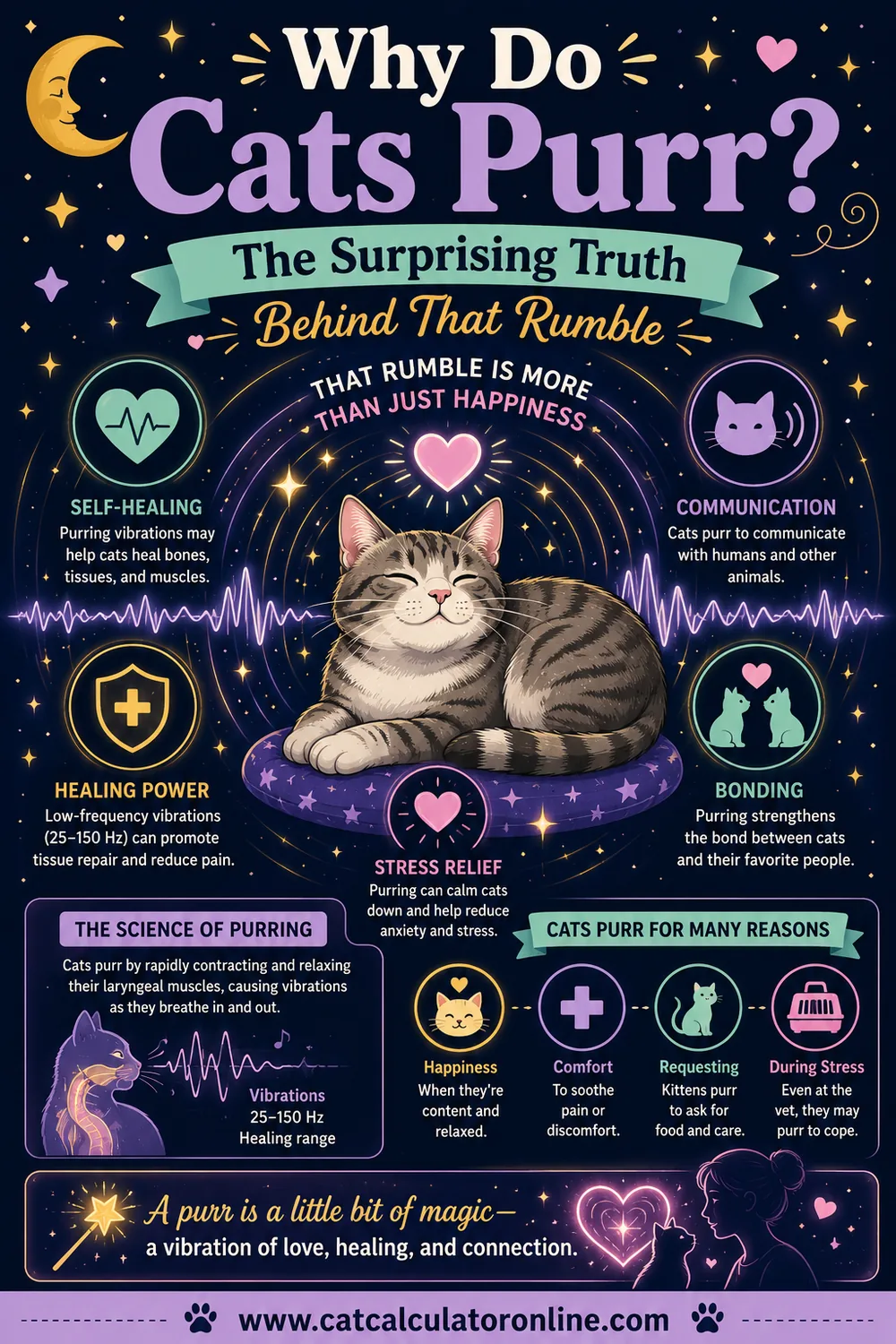
Why do cats purr? How purring actually works, the many meanings behind it, solicitation purring, the healing theory, and when a purr signals your cat is hurting.
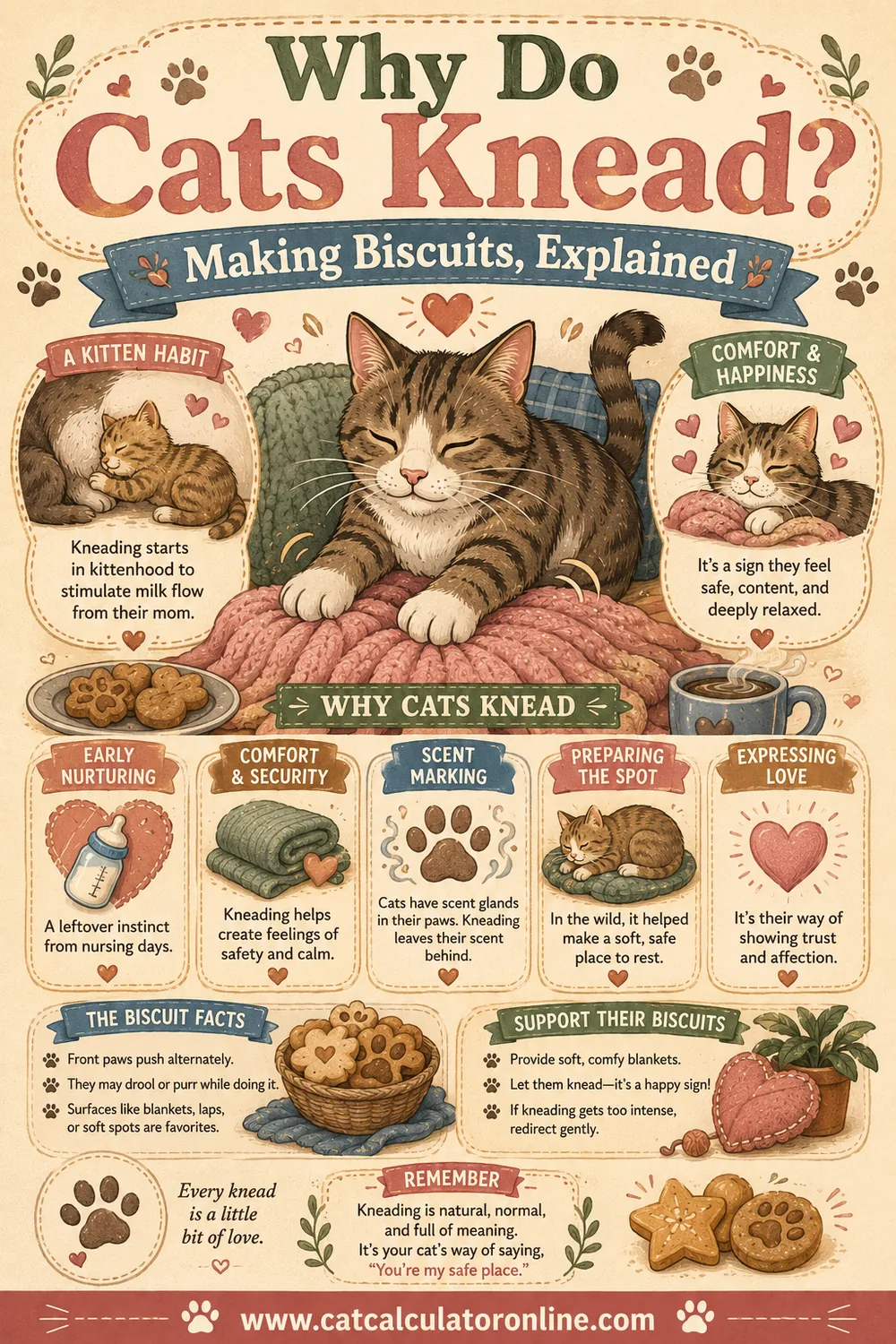
Why do cats knead? The nursing origin of making biscuits, the scent glands in their paws, why they do it on you, and what to do about those claws.
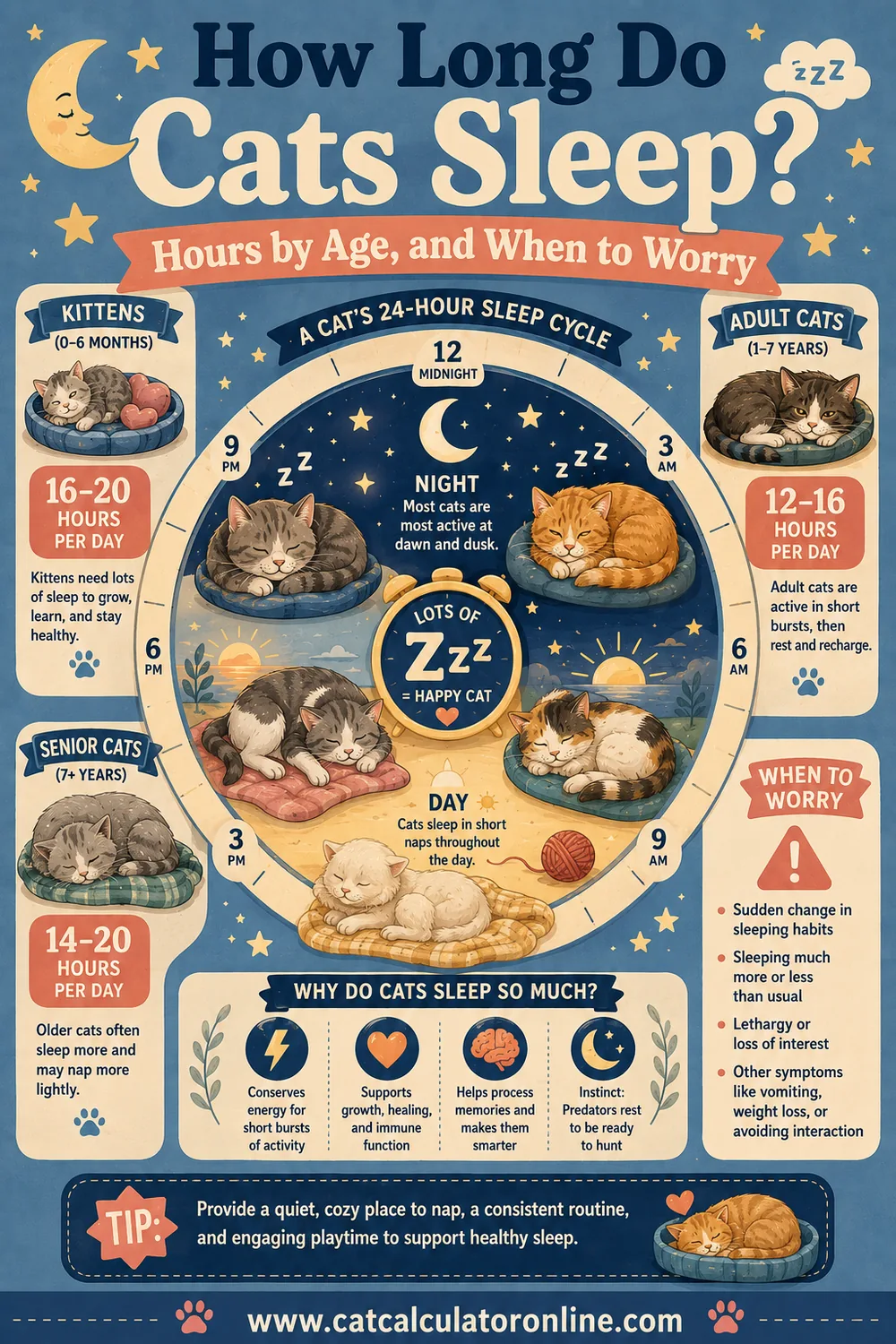
How much do cats sleep? Typical hours by life stage, why cats are crepuscular, the 4am zoomies explained, sleep positions, and when a change means see the vet.
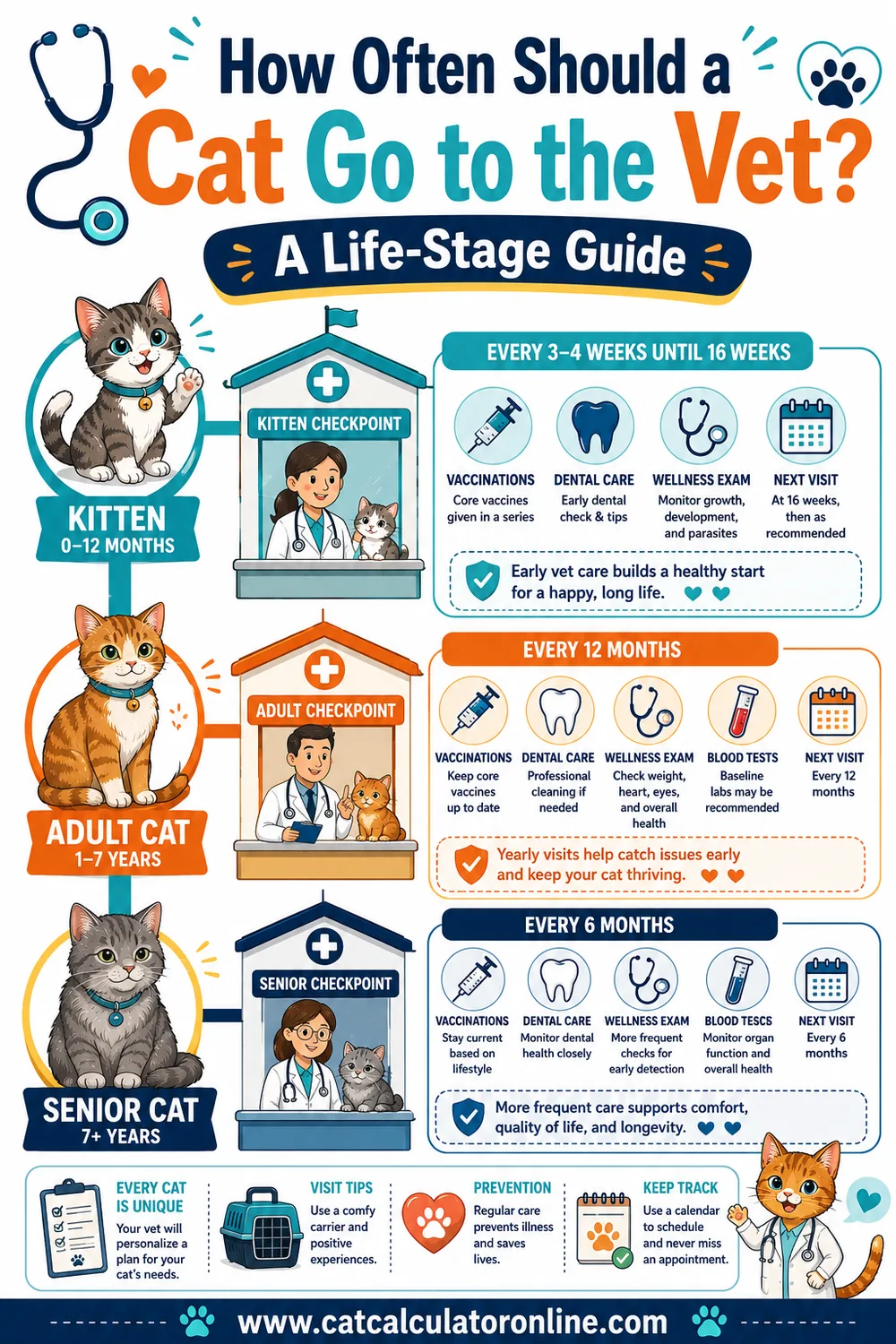
How often should cats go to the vet? Kittens every 3-4 weeks, adults yearly, seniors every 6 months. See the full life-stage schedule and what each visit covers.
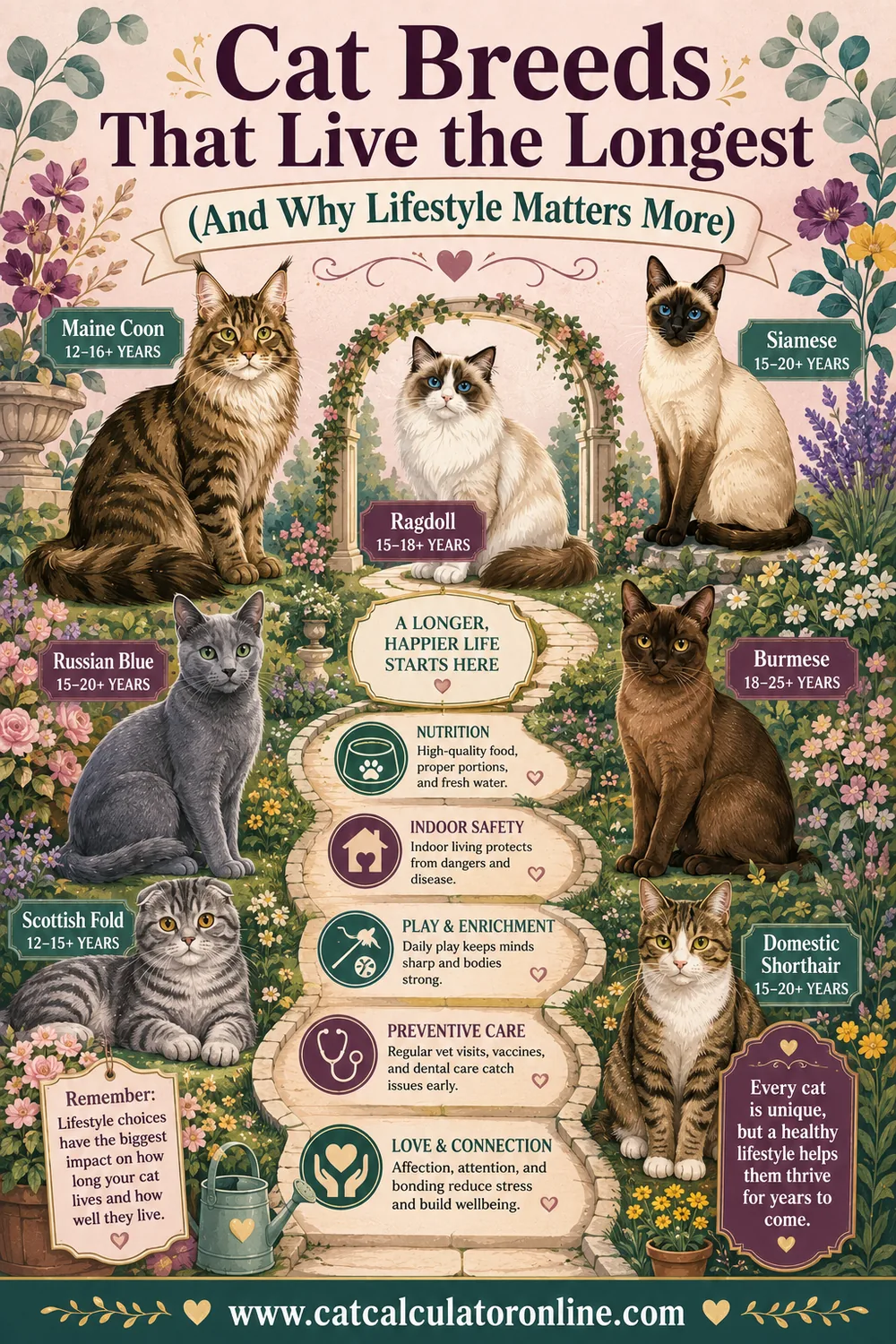
Which cat breeds live the longest? Siamese and Burmese often reach their late teens or 20+. See the breed longevity chart and why lifestyle beats breed every time.
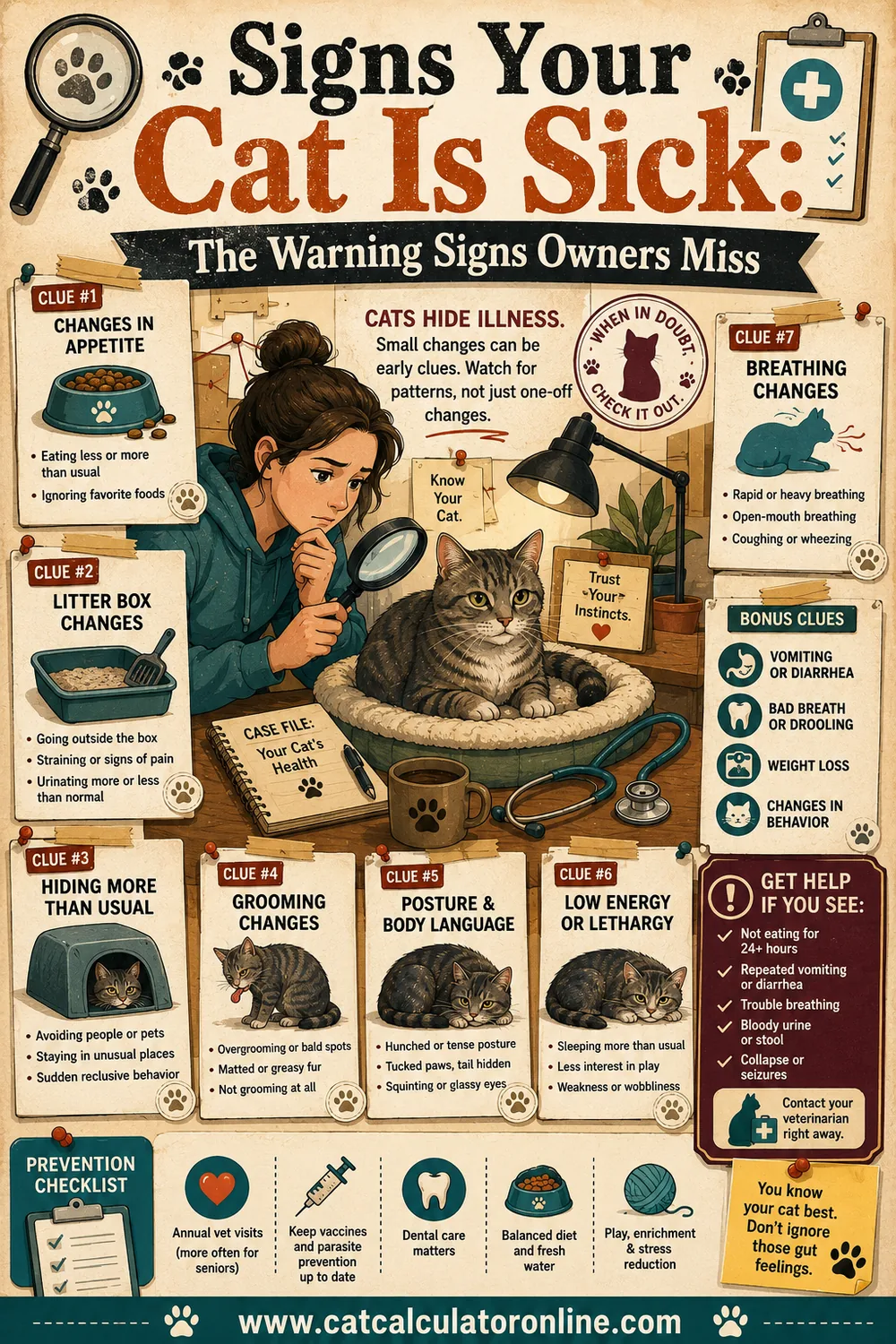
Cats hide illness by instinct. Learn the signs your cat is sick, what each symptom can mean, when to call your vet, and the red flags that need emergency care.
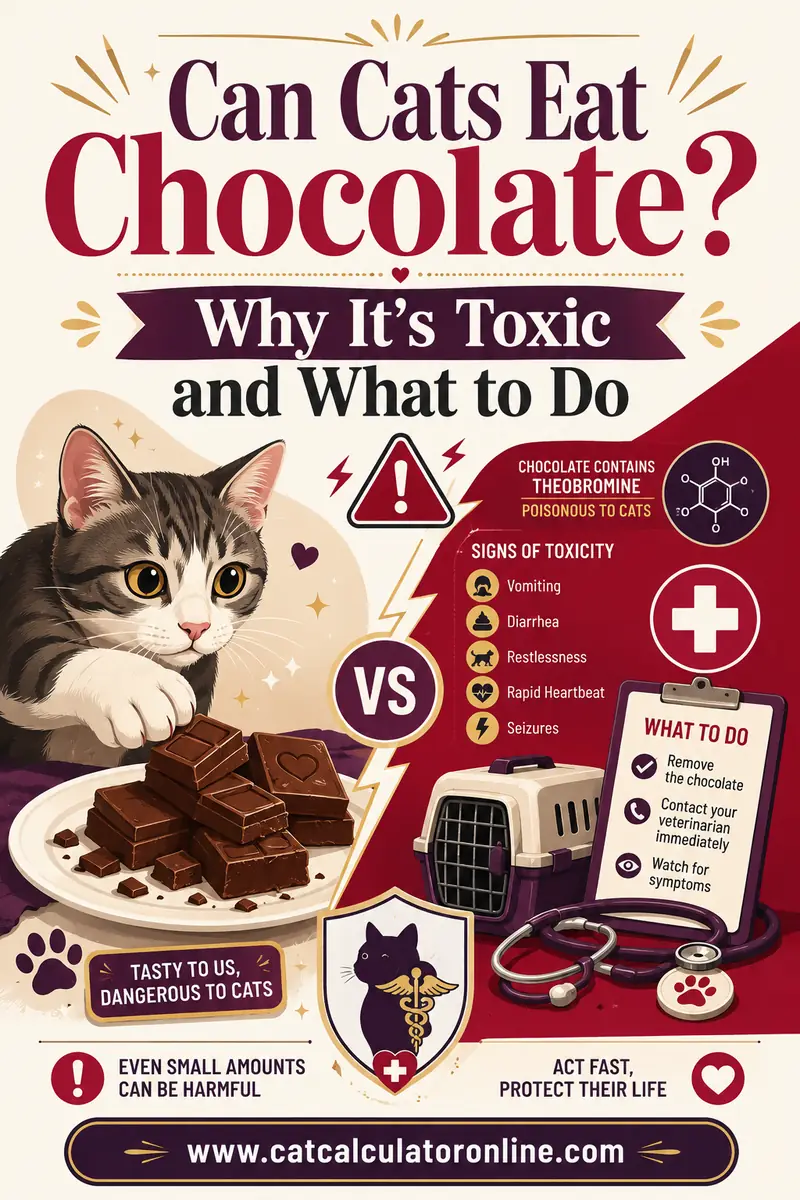
No — chocolate is toxic to cats. See which types are worst, the symptoms and timeline to watch for, and exactly what to do if your cat ate chocolate.
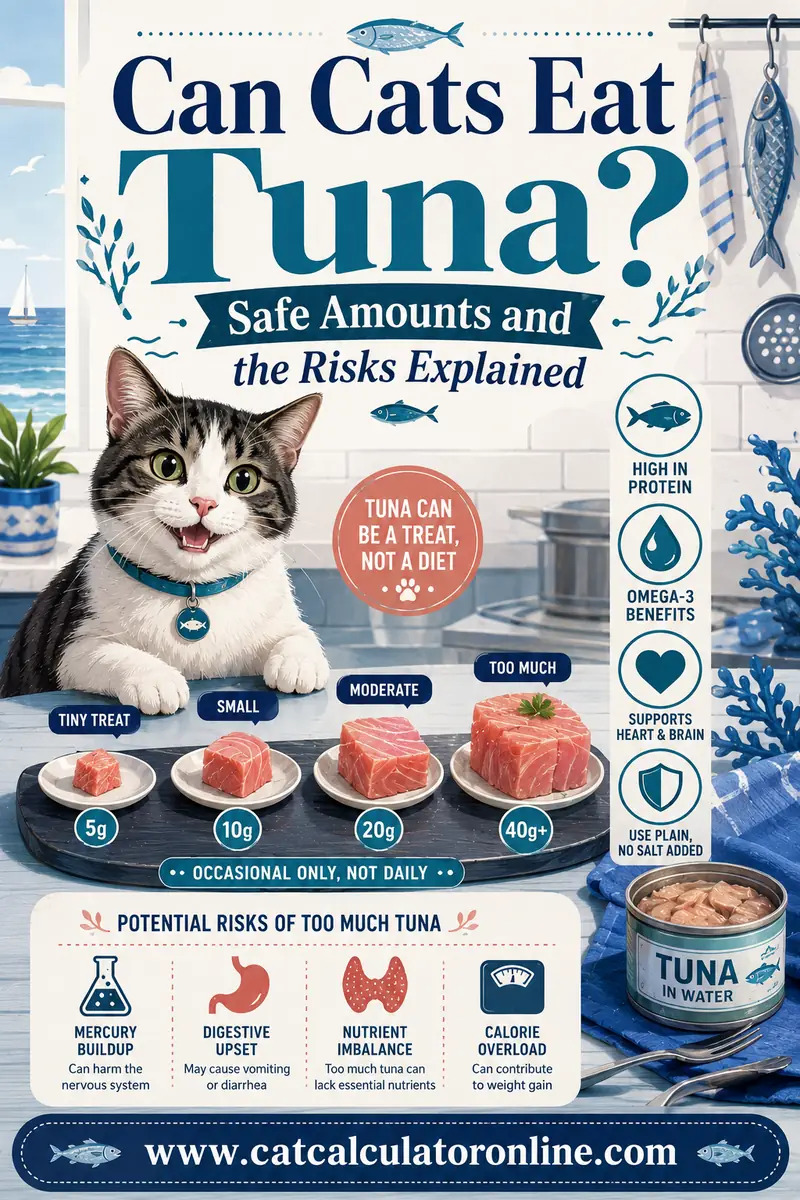
Yes, plain tuna is fine as an occasional treat — but never a diet. See safe amounts, water vs oil vs brine, mercury, steatitis and how often to feed it.
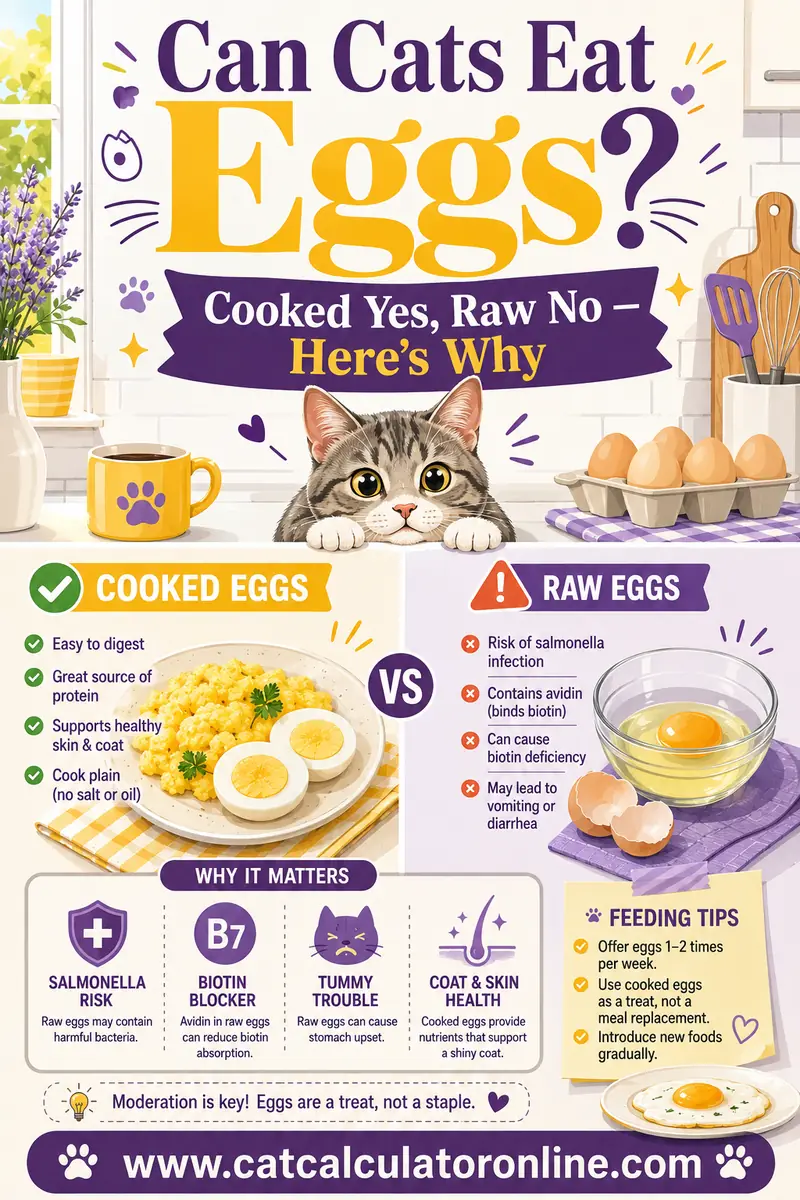
Yes — cooked eggs are safe and great protein for cats, but raw eggs are not. See portion sizes, the avidin and biotin issue, and how to prepare them safely.
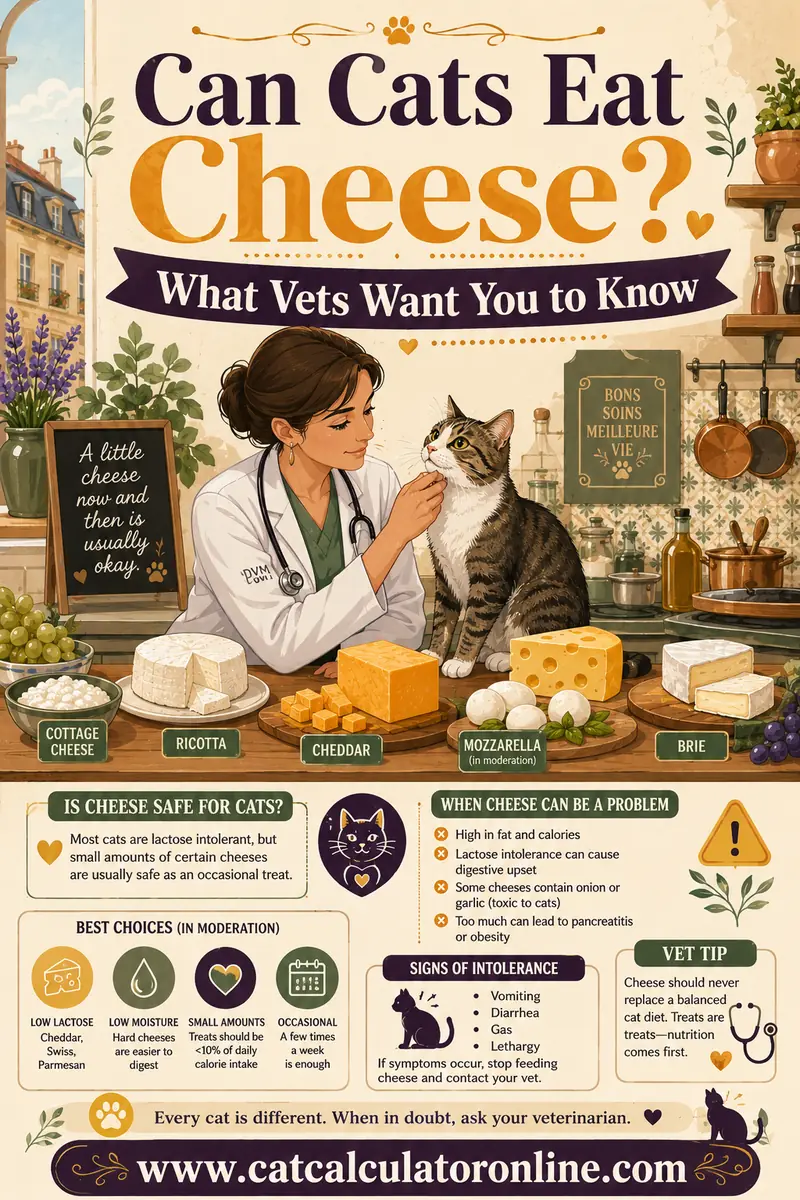
Can cats eat cheese? A tiny piece of hard cheese is usually tolerated, but most cats are lactose intolerant. See safe types, portion sizes and what to avoid.
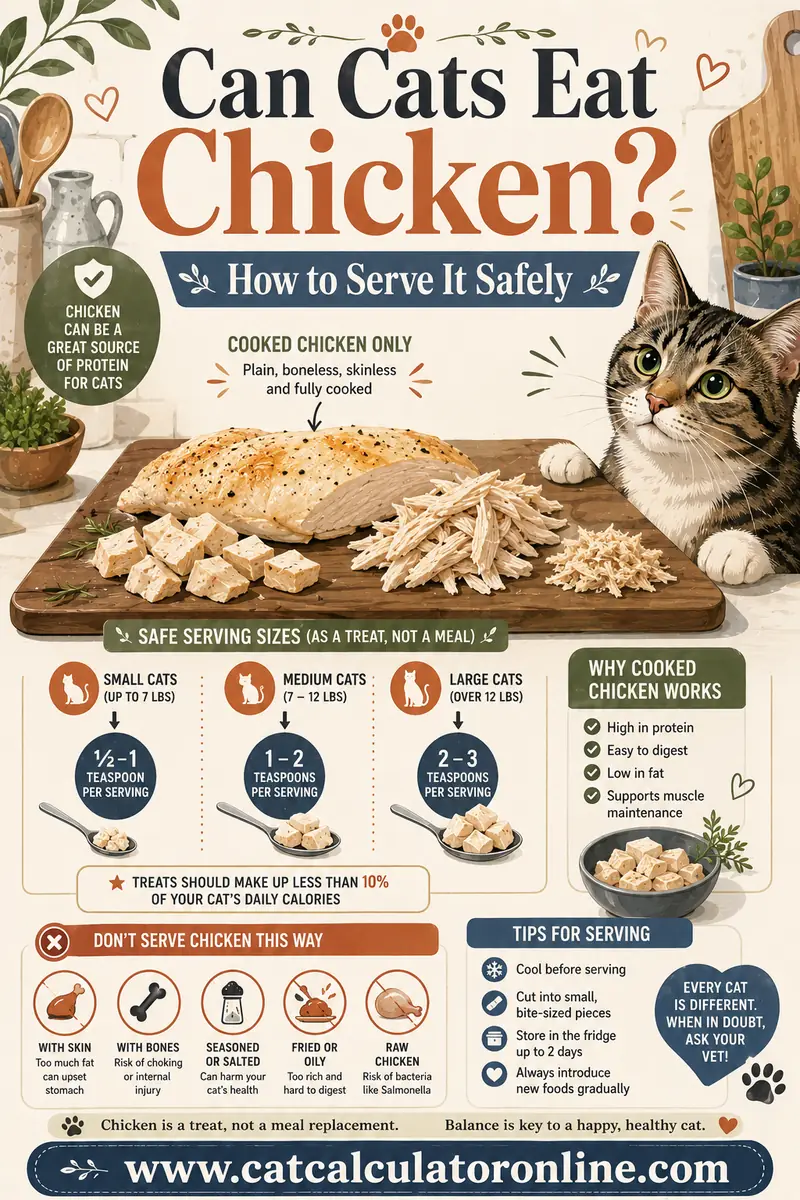
Can cats eat chicken? Yes — plain, cooked, boneless and unseasoned. Learn safe prep, why bones and seasoning are dangerous, and how much chicken is too much.

What human food can cats eat? A full safe, moderation and never table covering meat, fish, eggs, dairy, fruit and veg — plus the 10% treat rule vets recommend.
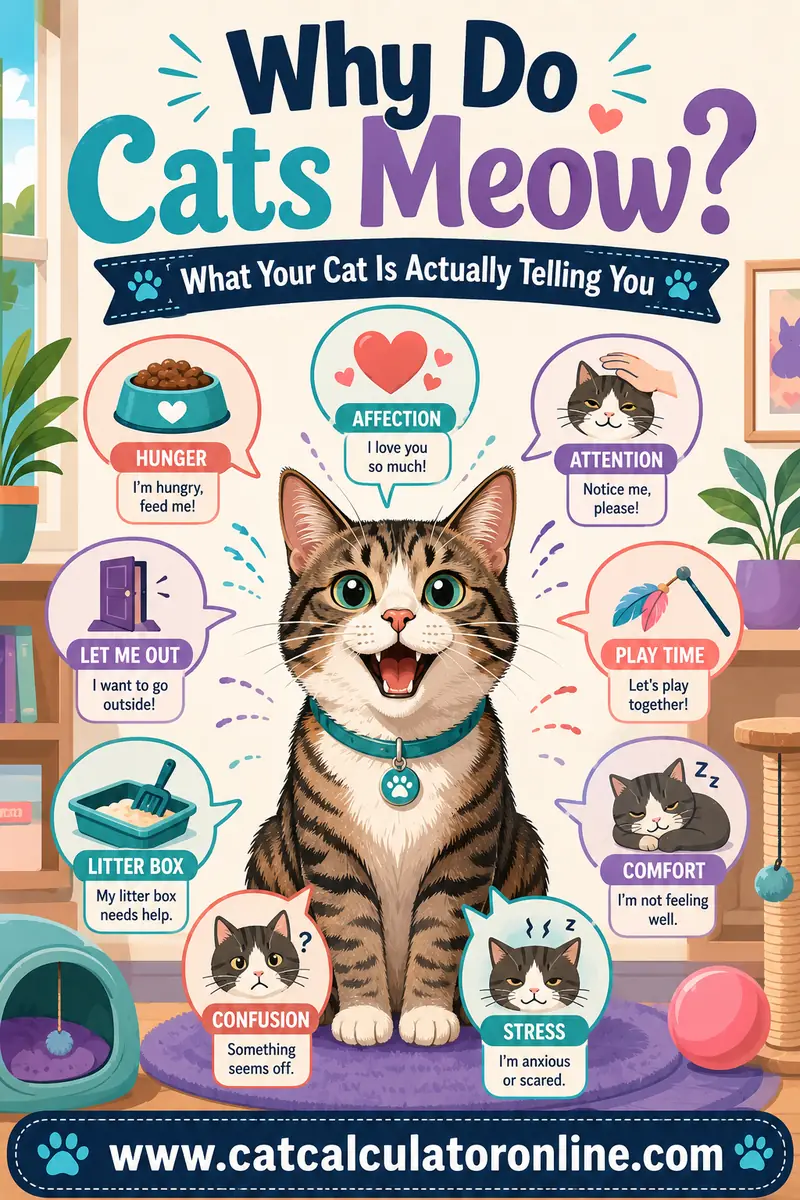
Why do cats meow? The surprising truth is they meow at people, not each other. Decode every meow type, breed differences, and when meowing means see the vet.
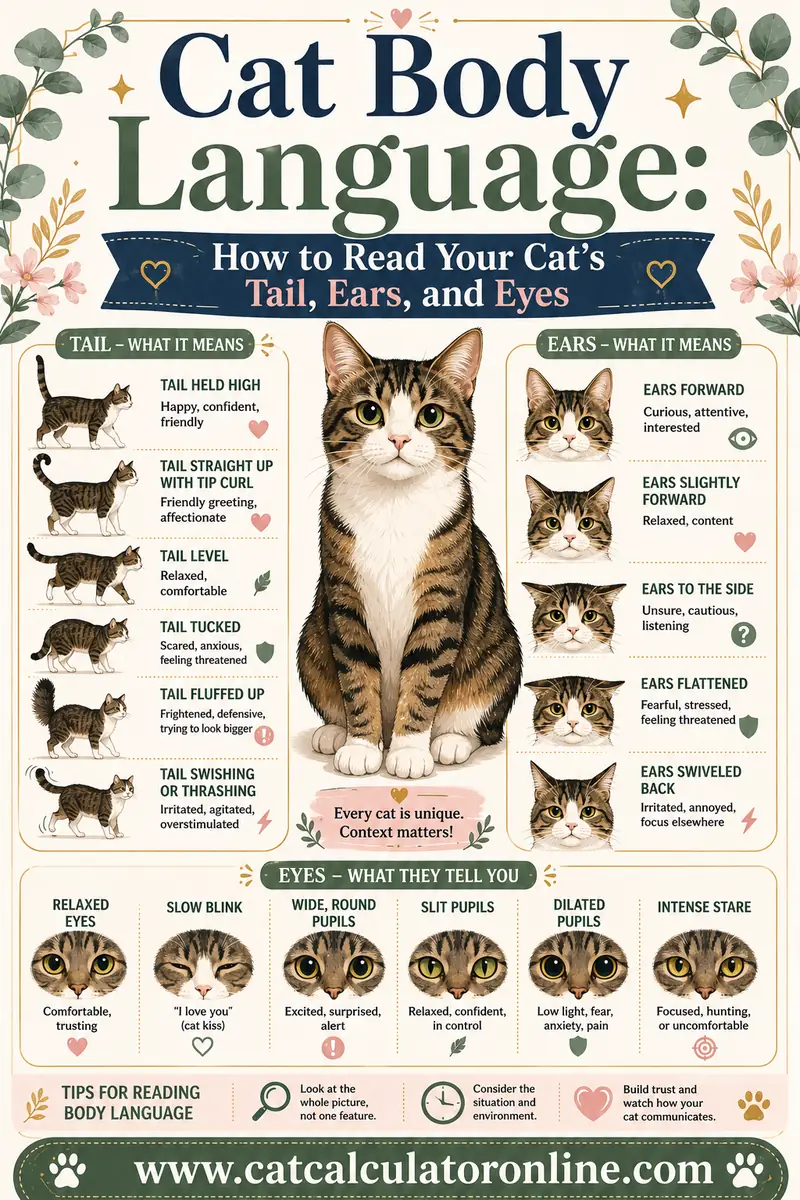
Cat body language decoded: what every tail position, ear angle, eye signal and posture means, why a thrashing tail is a warning, and how to read the whole cat.
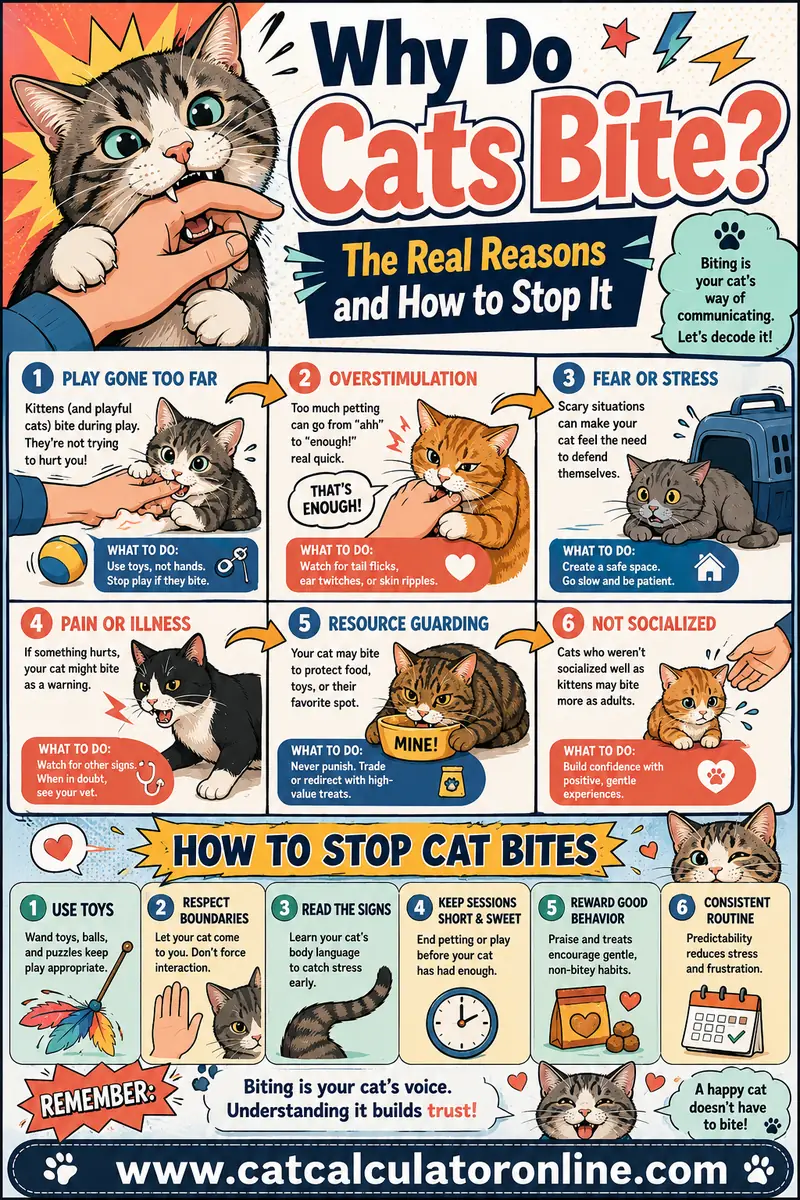
Why do cats bite? Play aggression, petting overstimulation, redirected aggression, fear and pain — plus the warning signs that come first and how to stop it.
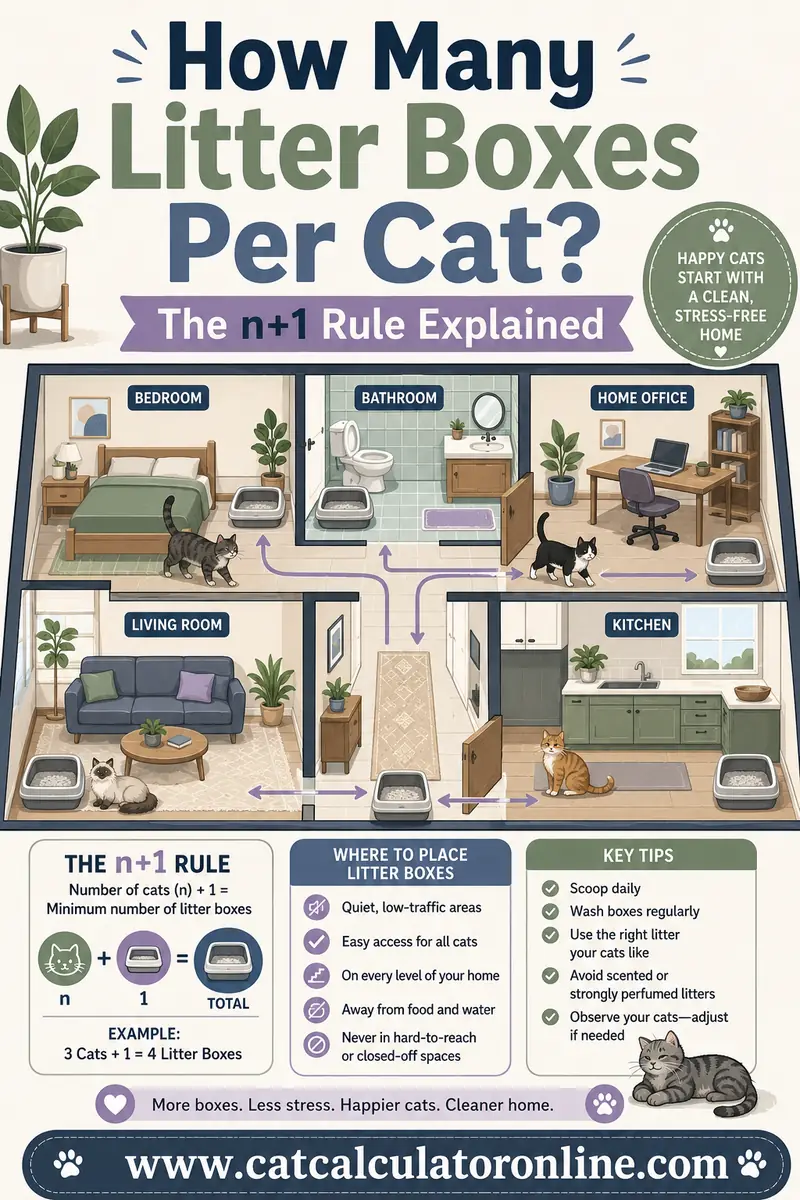
How many litter boxes per cat? The n+1 rule says one box per cat plus a spare. Get box counts, placement, size, litter depth and a cleaning schedule.
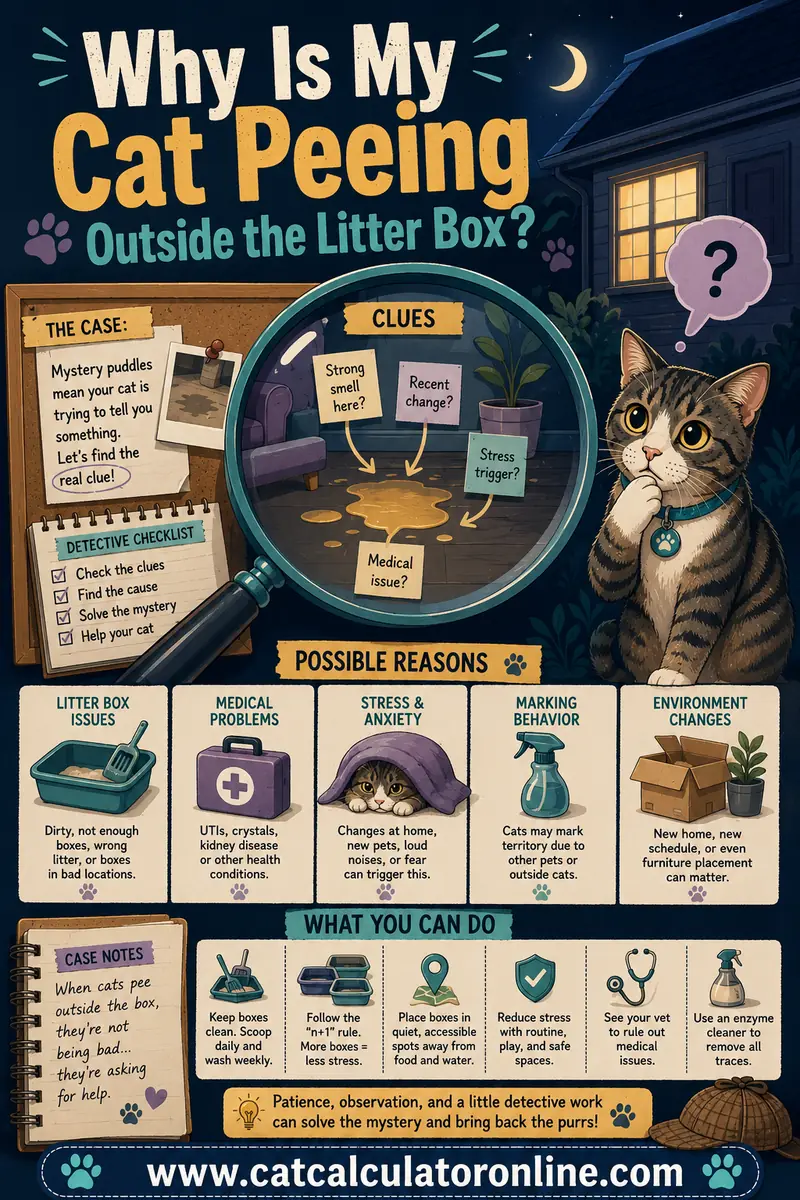
Cat peeing outside the litter box? Rule out medical causes first, learn the emergency warning sign, and work through every behavioral fix step by step.
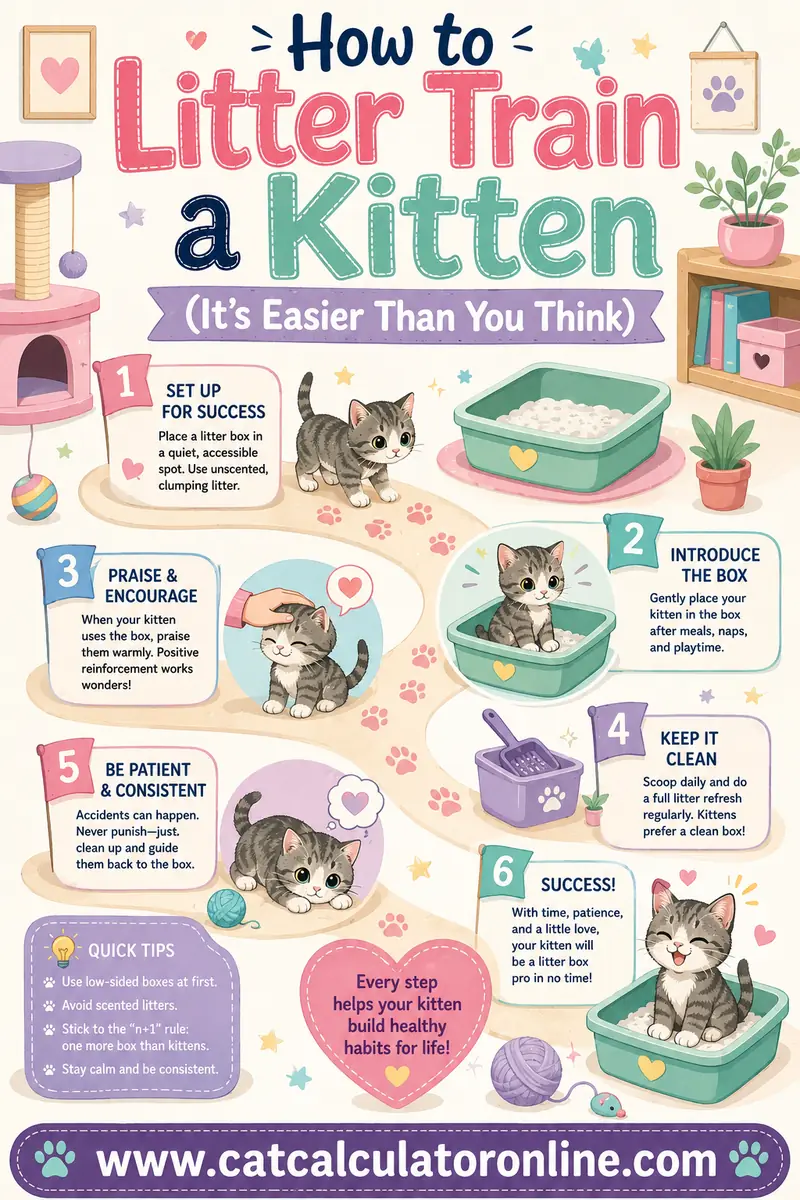
How to litter train a kitten: it's mostly instinct. Get the right box and litter, a simple timeline, what to do about accidents, and when to call the vet.
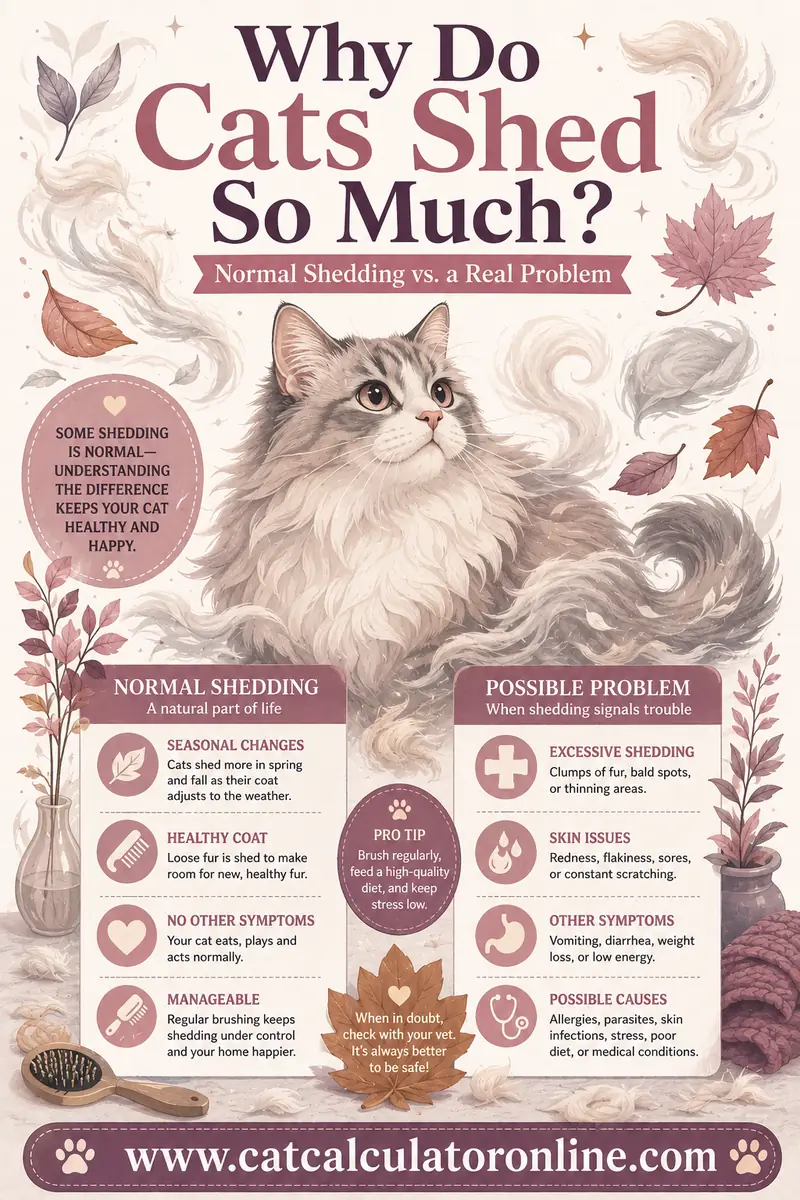
Why do cats shed so much? How normal cat shedding works, why indoor cats shed all year, what actually reduces the fur, and the coat changes that need a vet.
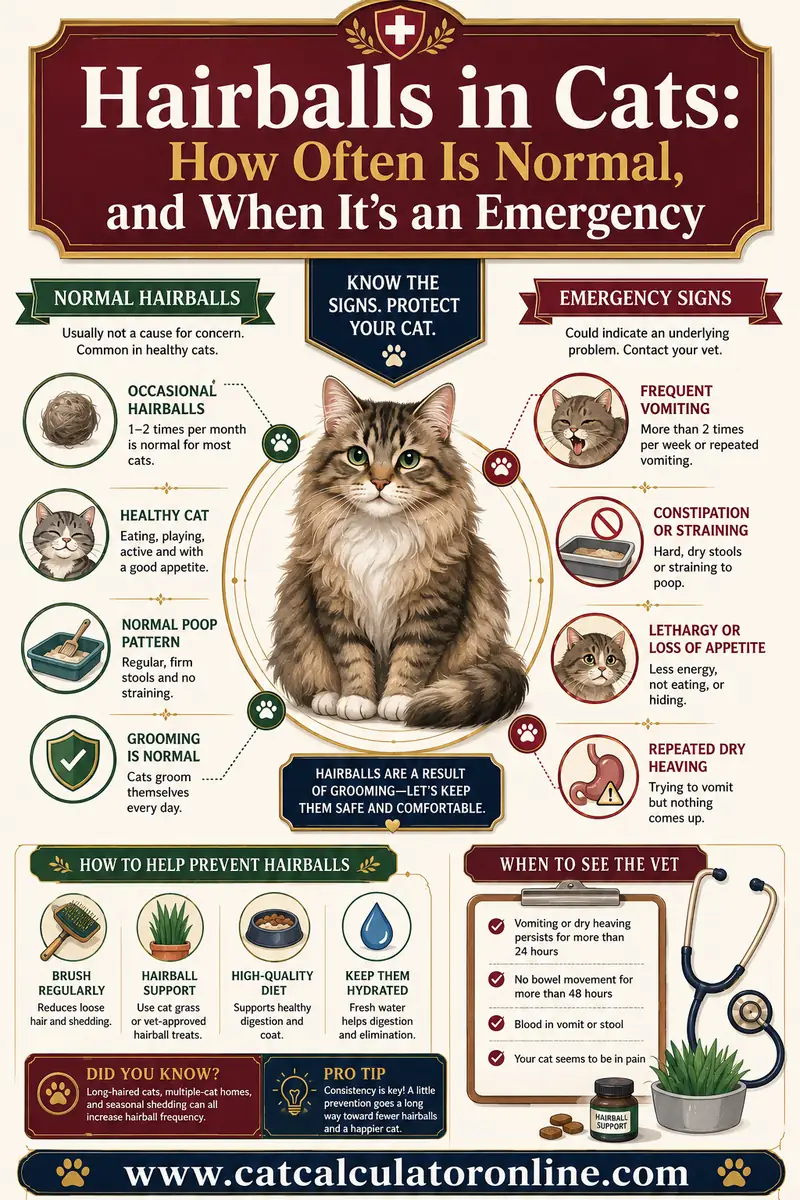
Hairballs in cats explained: what they actually are, how often is normal, what really prevents them, and the retching red flags that mean a blockage emergency.

Signs your cat loves you, explained: slow blinks, head bunting, tail-up greetings, kneading and more — plus the attachment research and what an aloof cat means.
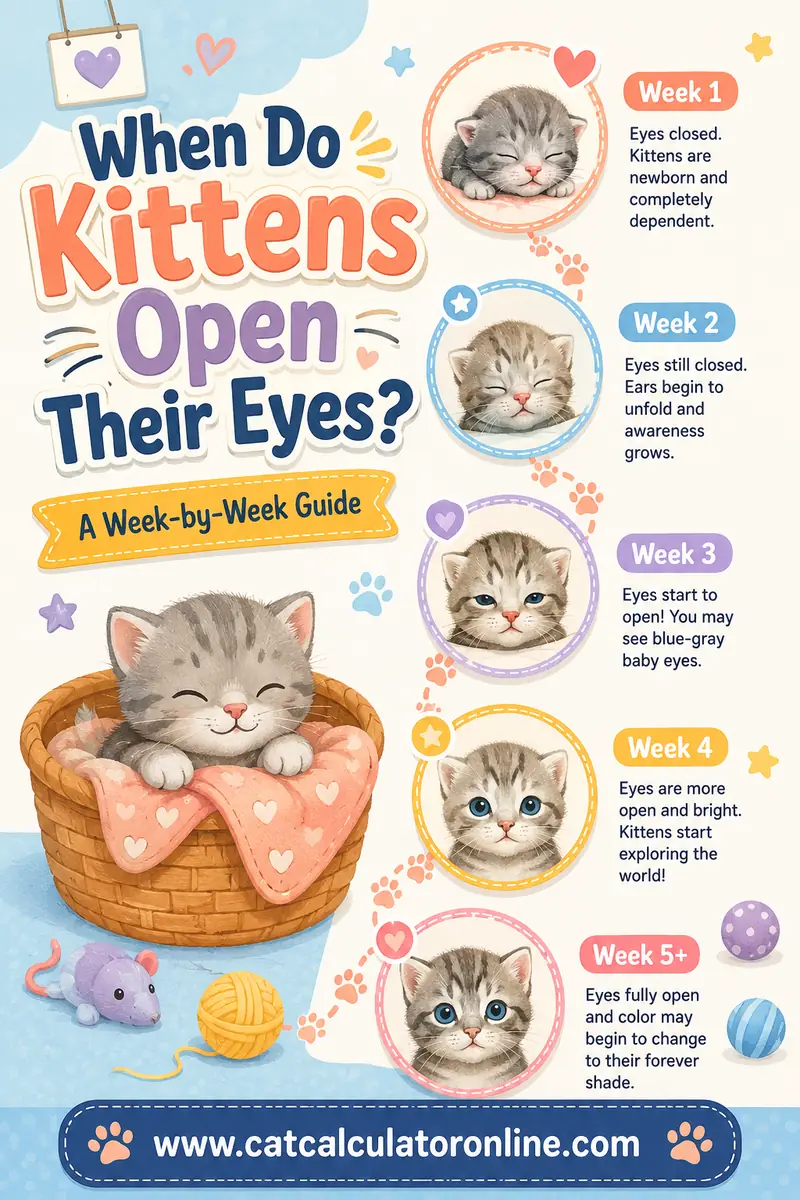
Kittens open their eyes around 7 to 14 days old, usually by day 10. Here's the full newborn timeline, why eye color changes, and when kittens are ready to leave mum.
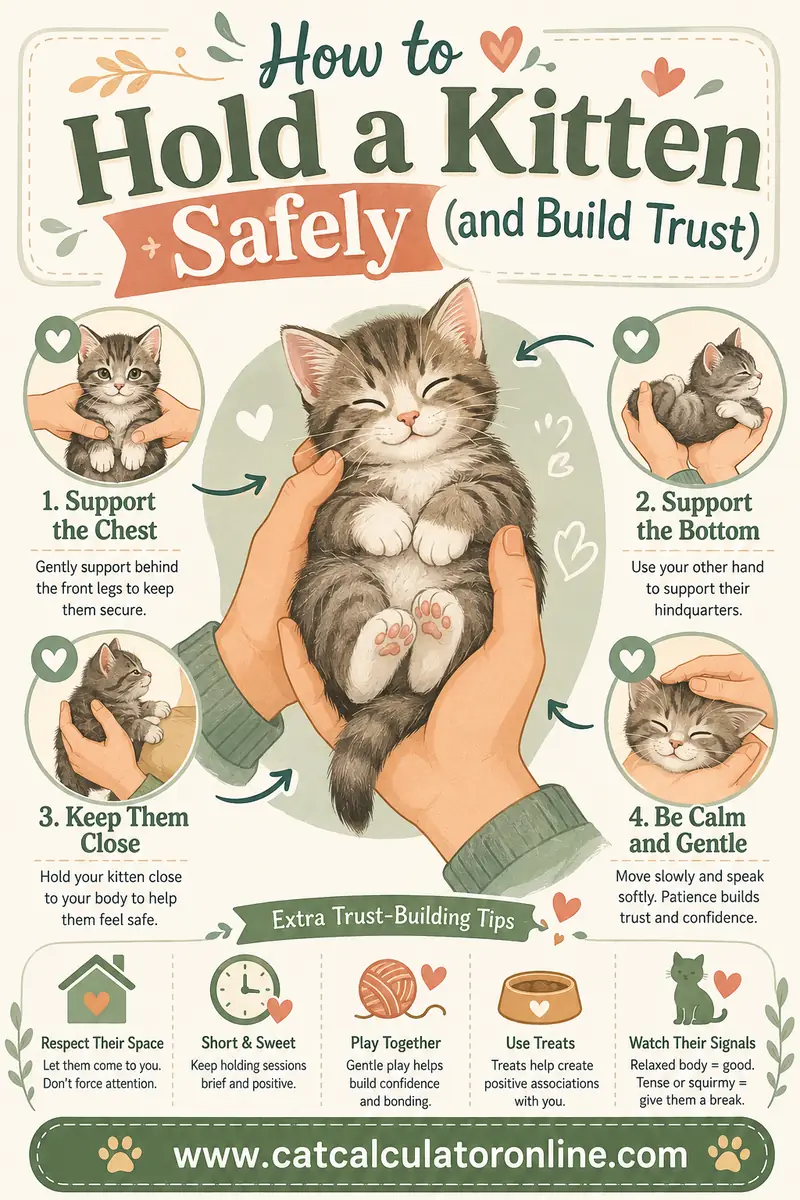
To hold a kitten safely, support its whole body: one hand under the chest, the other under the rump. Never lift by the scruff. Here's how to pick up and bond with a kitten.
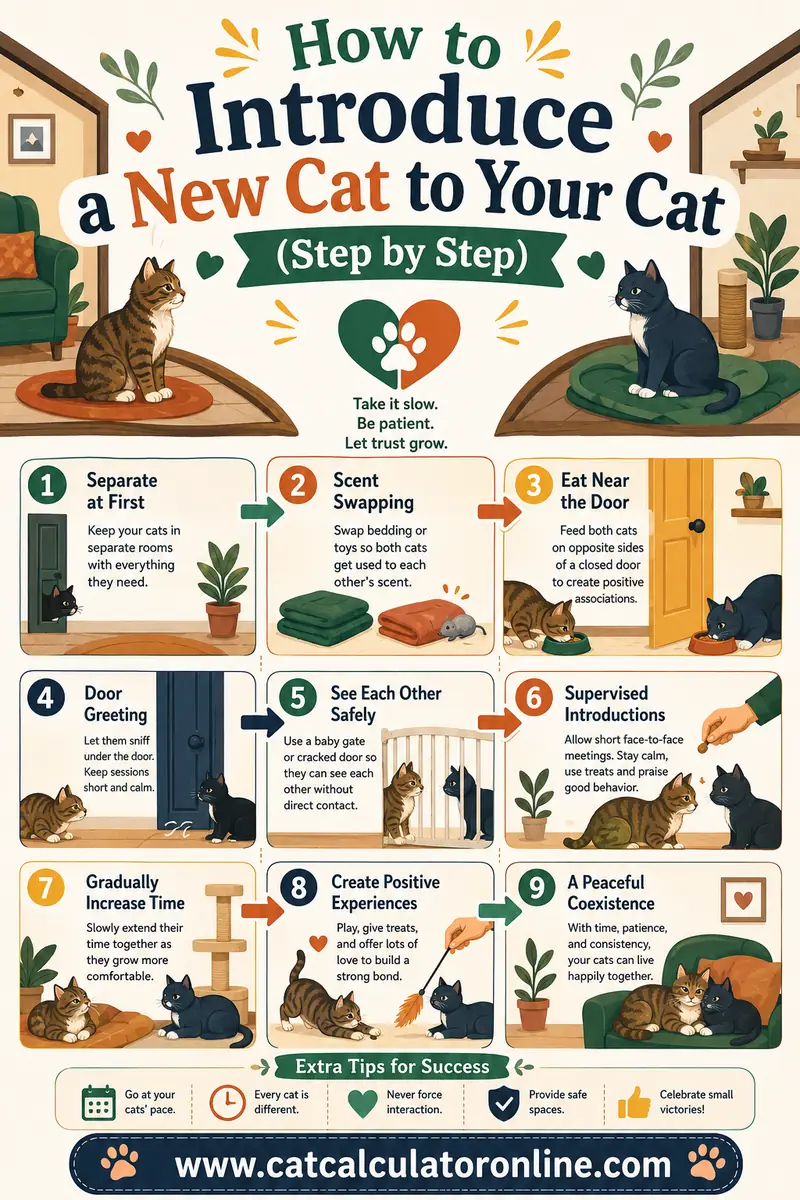
Introduce a new cat slowly over days to weeks: separate room first, then scent swapping, sight without contact, and short supervised meetings. Here's the full step-by-step process.
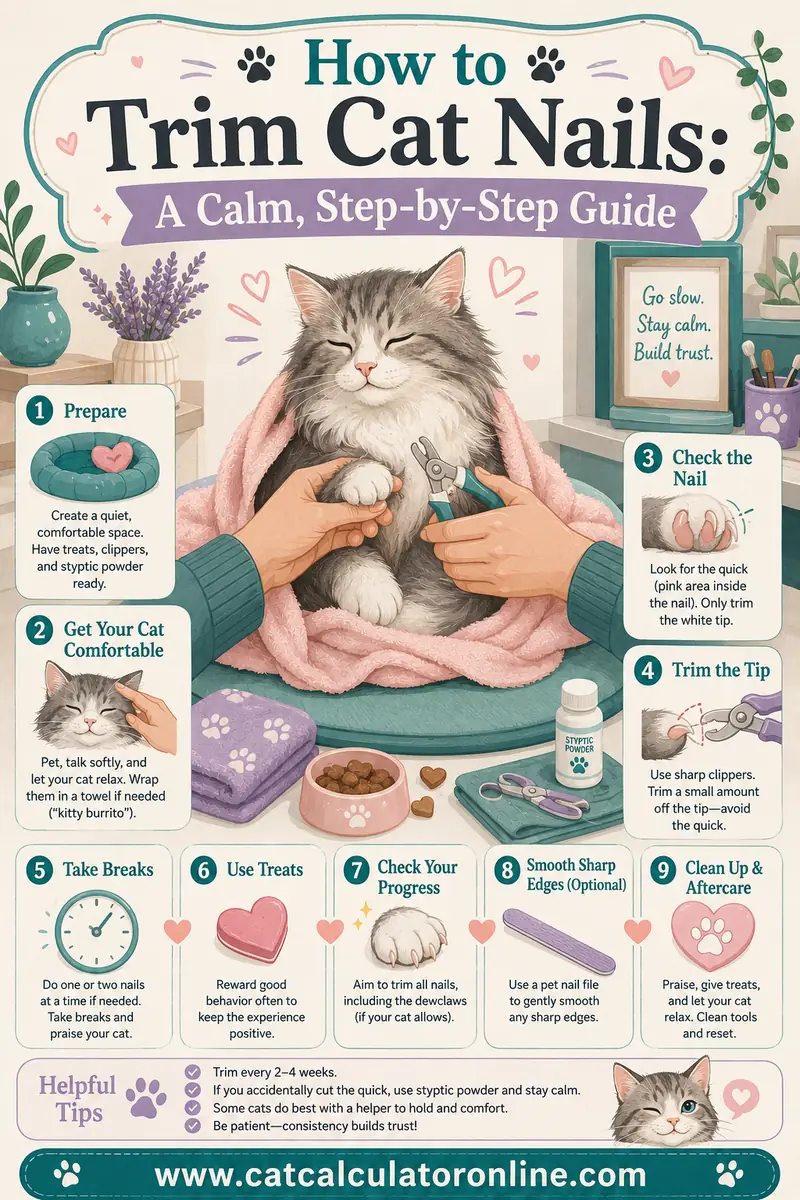
Learn how to trim cat nails safely at home: how often, how to avoid the quick, a simple technique, and what to do if you nick a claw. Calm, vet-informed steps.
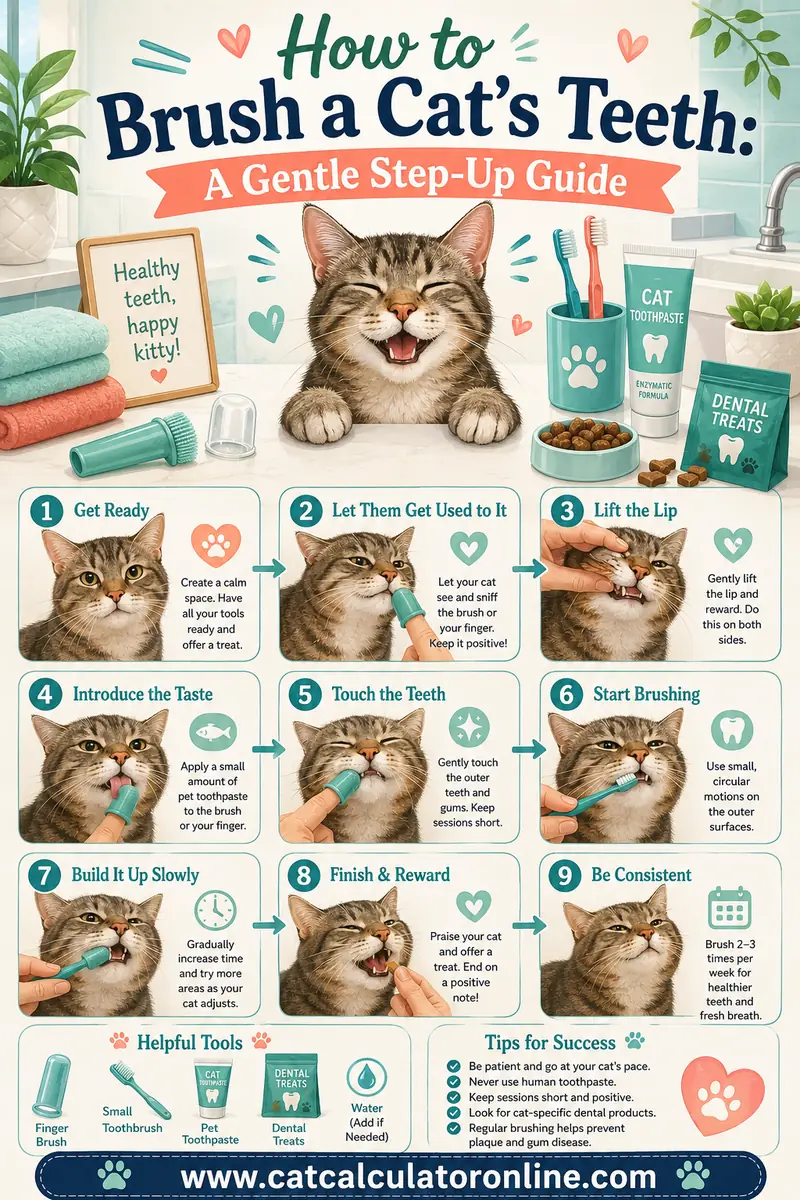
Learn how to brush a cat's teeth step by step, why it matters, which toothpaste is safe, dental-trouble signs to watch for, and when your cat needs a vet cleaning.
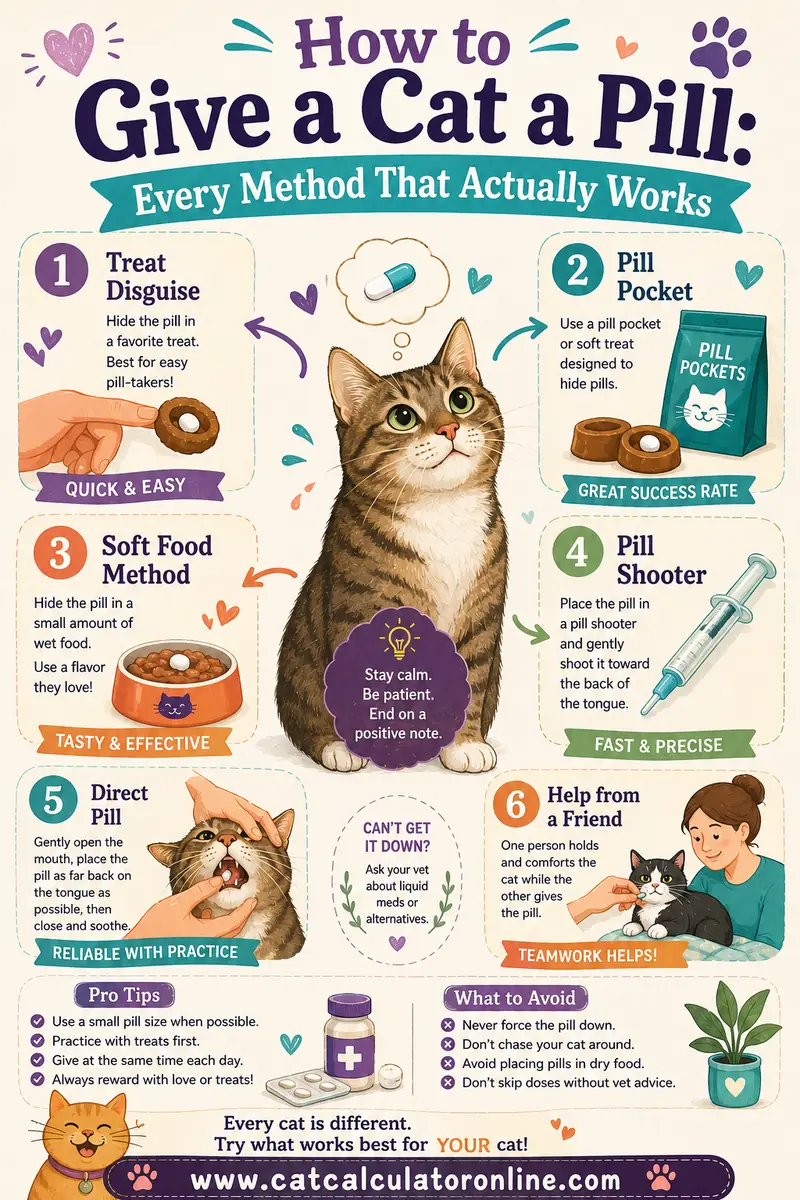
How to give a cat a pill without the fight: easiest-first methods, a safe direct technique, the water chaser, what never to give, and vet alternatives if you're stuck.
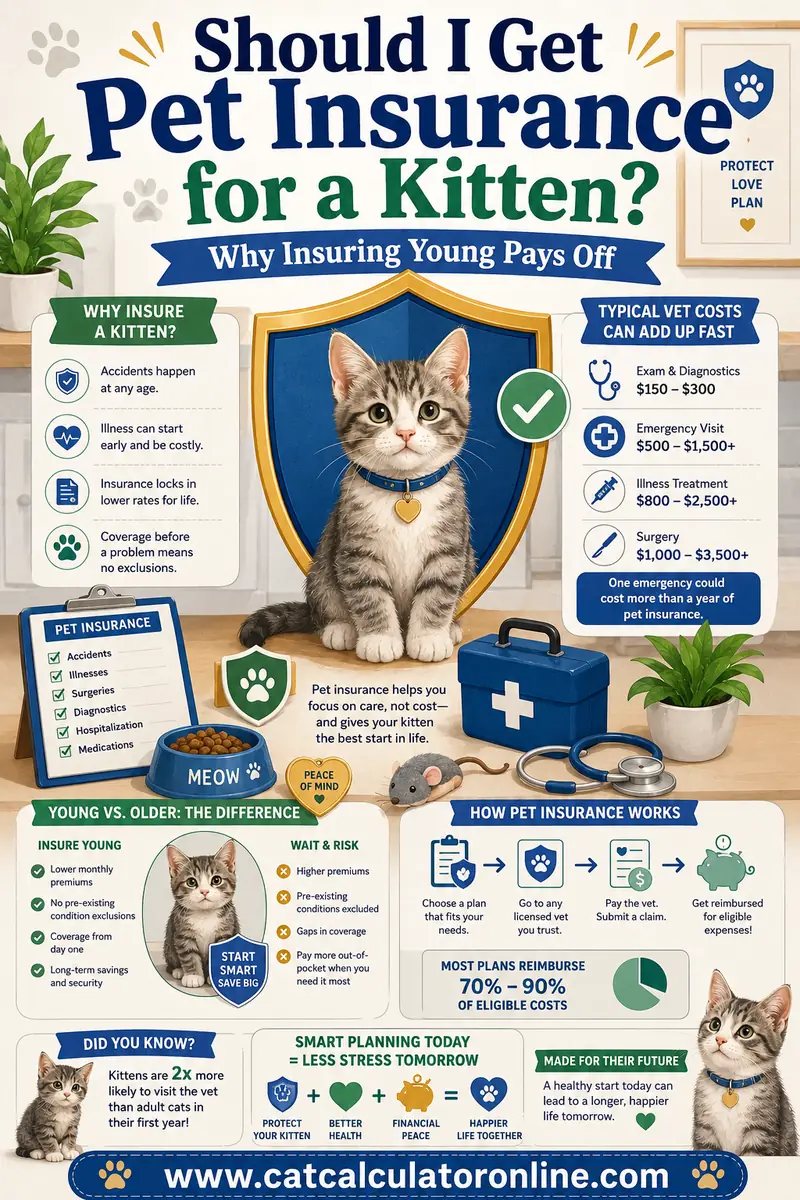
Should you insure your kitten? Enrolling young is the cheapest time and locks in cover before pre-existing exclusions. Here's the honest math and a decide table.
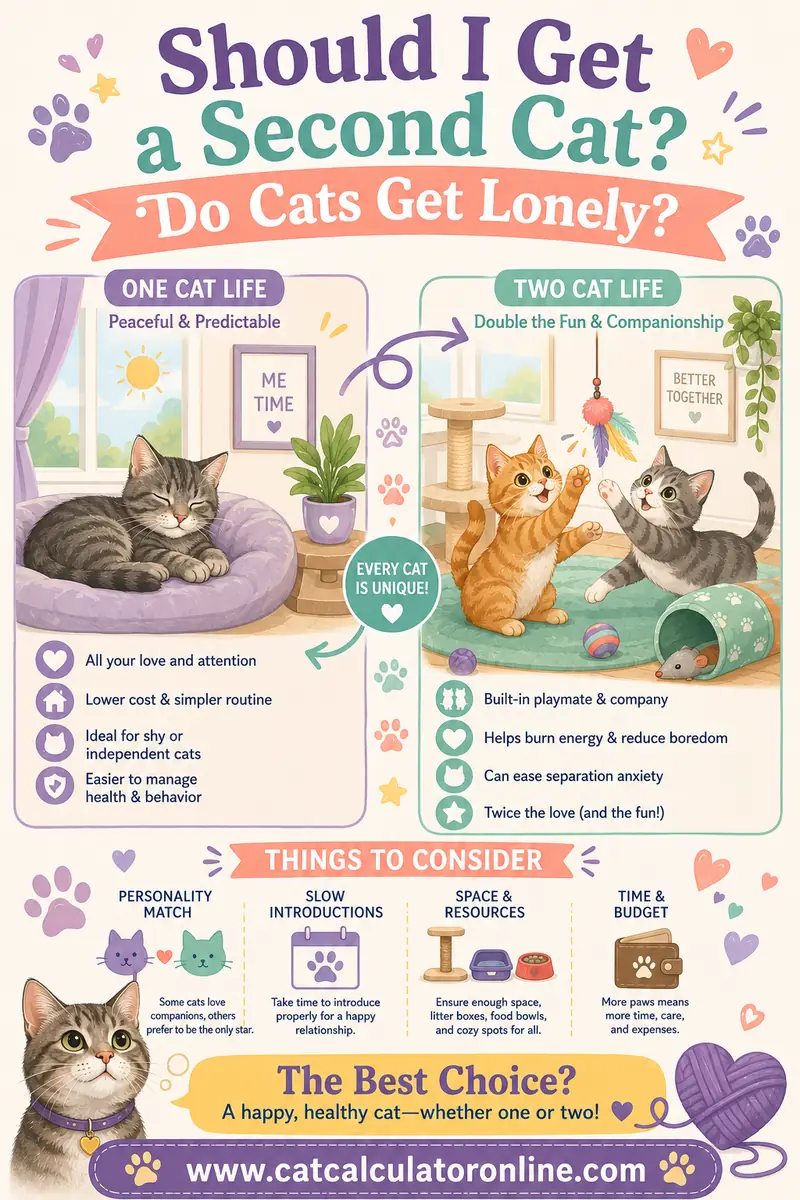
Do cats get lonely? Many do better in pairs — especially kittens and young cats. Here's who benefits, signs of loneliness, and how to match a second cat well.
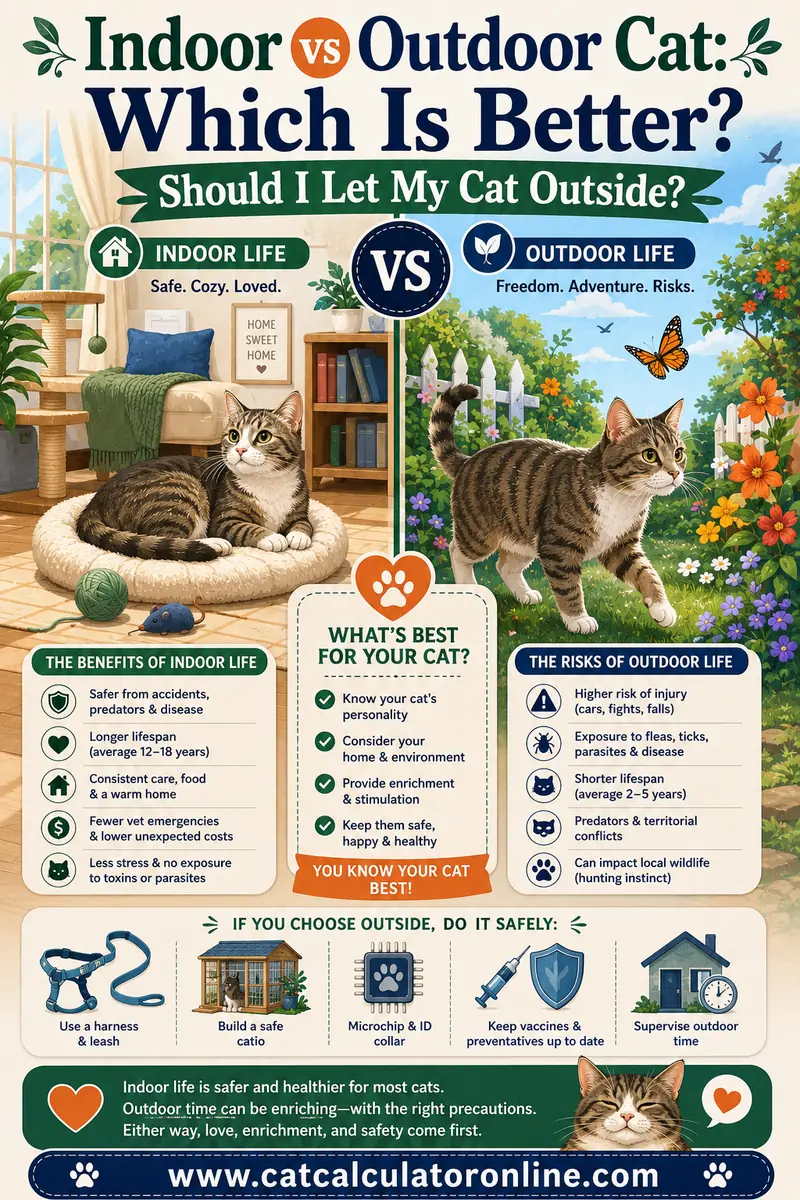
Indoor cats live 13–17+ years vs 2–5 outdoors. Here's the honest indoor vs outdoor comparison, the catio middle path, and how to keep an indoor cat happy.
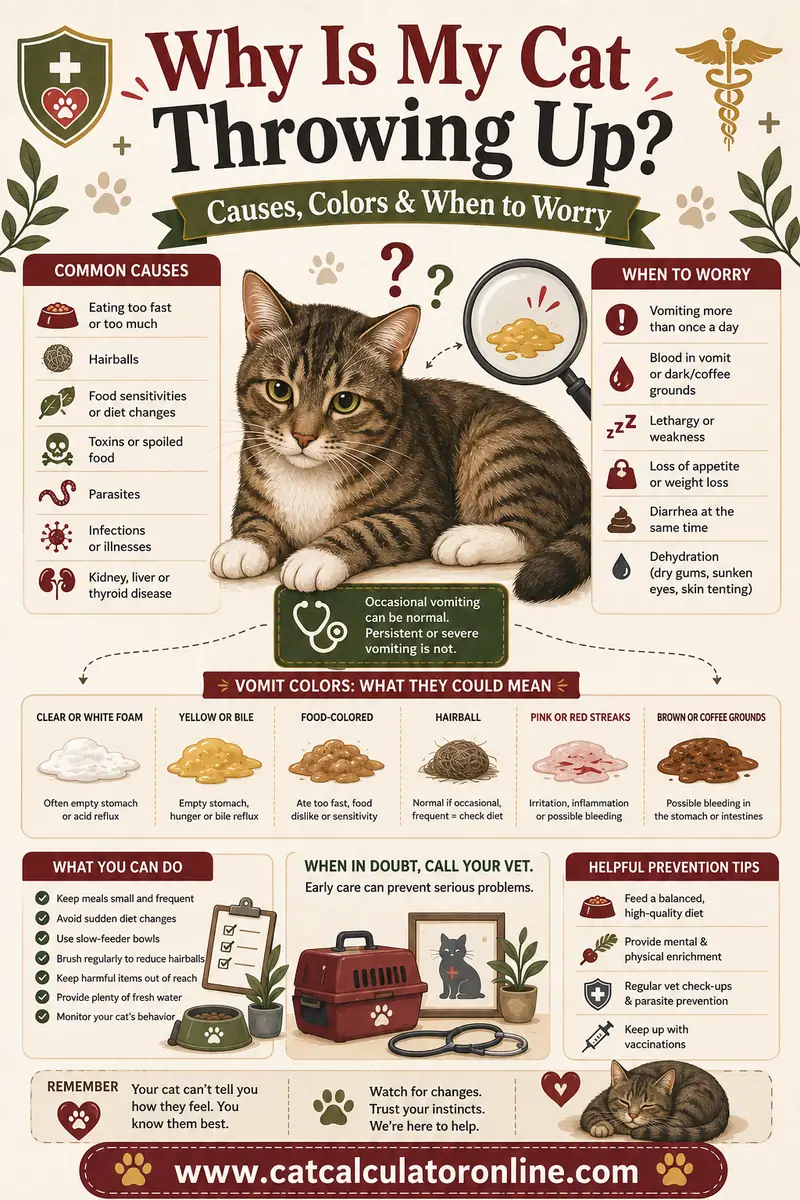
Why is my cat throwing up? An occasional hairball can be minor, but frequent vomiting isn't normal. Learn the common causes, what the color means, and the red flags.
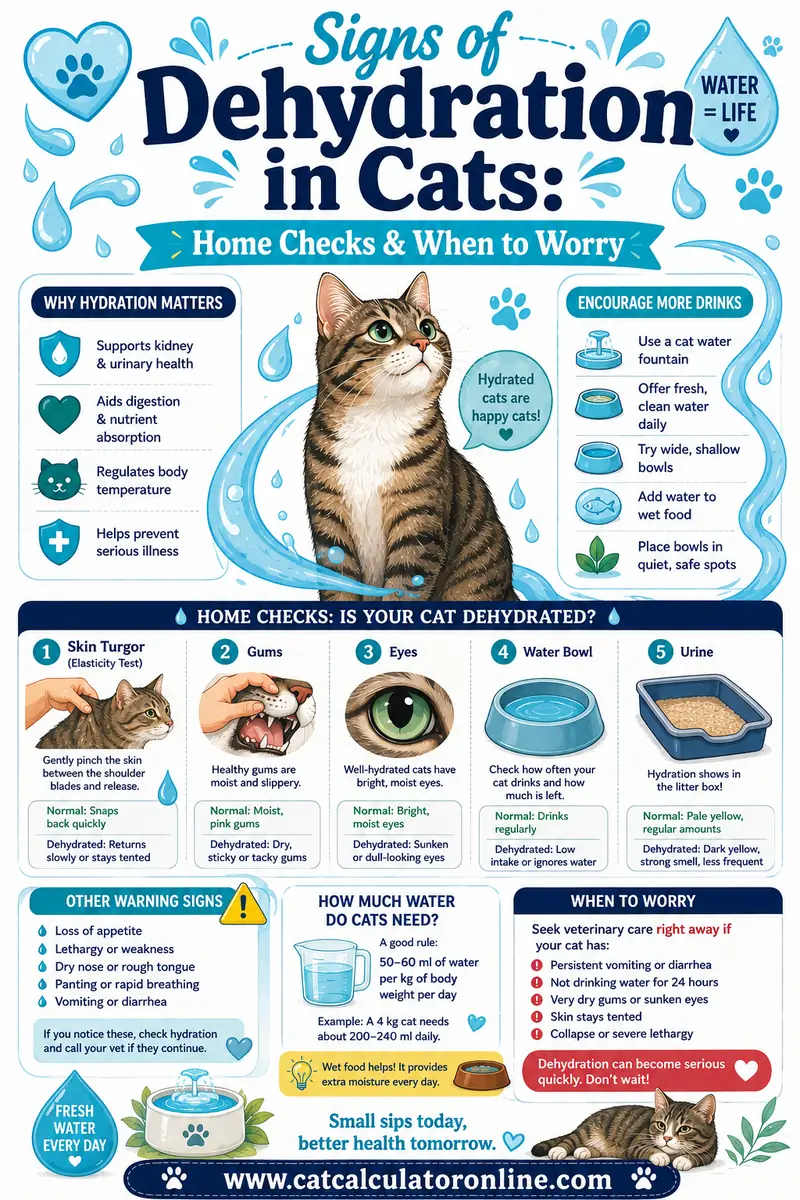
Signs of dehydration in cats include a slow skin-tent test, tacky gums, sunken eyes, and lethargy. Learn the home checks, common causes, and when it's an emergency.
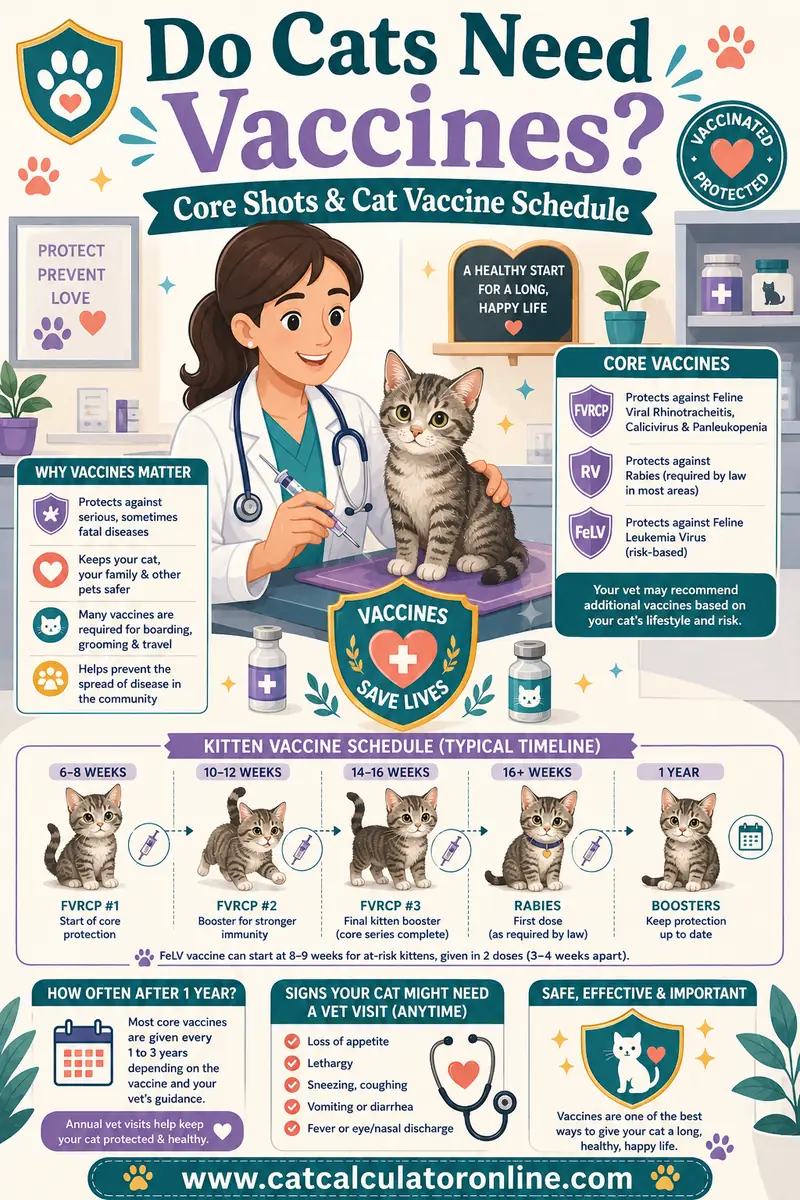
Do cats need vaccines? Yes — FVRCP and rabies are core for every cat, indoor ones too. See the kitten and adult cat vaccine schedule, core vs non-core, and reactions.
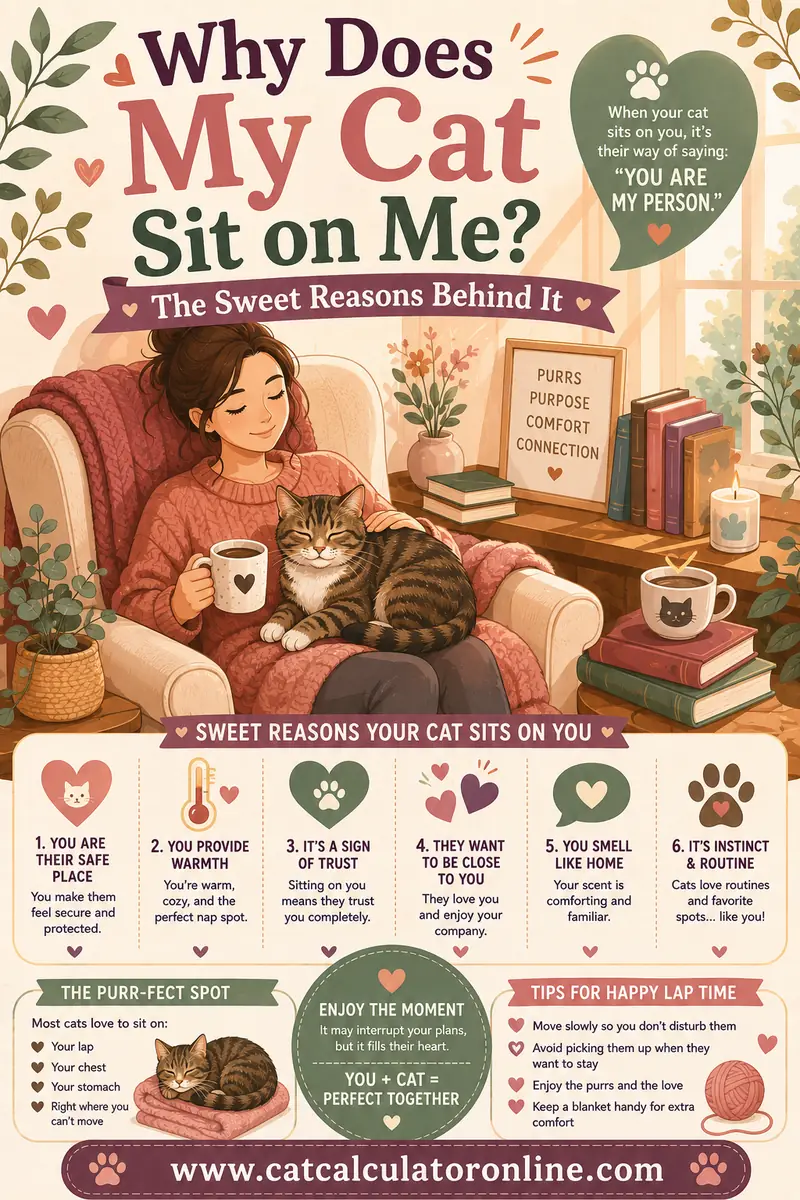
Why does my cat sit on me? The real reasons cats lie on you — warmth, trust, scent bonding, attention, and love — plus what to do if you'd rather they didn't.
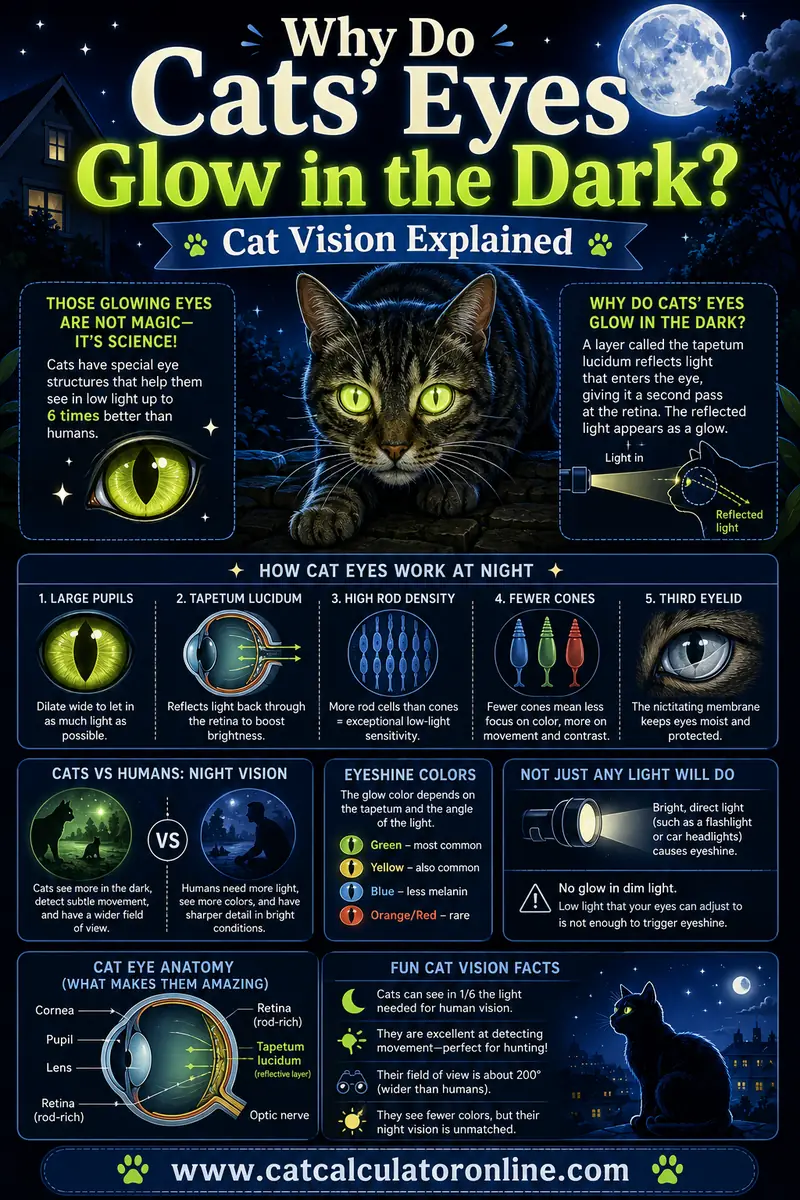
Why do cats' eyes glow in the dark? The tapetum lucidum explained, how well cats see at night, why they can't see in total darkness, and a cat-vs-human vision table.
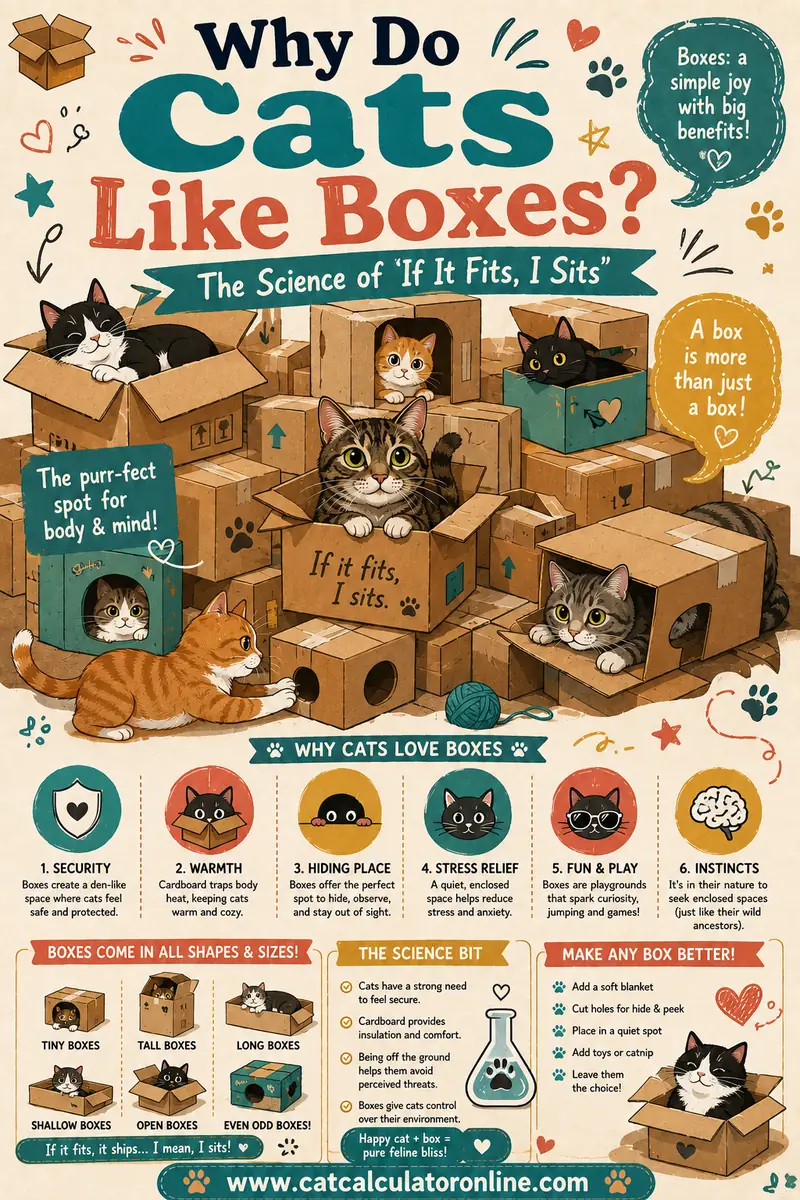
Why do cats like boxes and small spaces? Security, warmth, ambush instinct, and stress relief — plus the famous study, the taped-square trick, and when hiding is a worry.

Yes — plain, cooked, boneless salmon is a safe occasional treat for cats. See why raw and smoked salmon aren't, how much to serve, and how to prepare it.

Peanut butter isn't toxic to cats, but it's a bad treat — dense calories, a sticky choking risk, and some brands contain xylitol. Here's what to offer instead.

Yes, bananas are non-toxic to cats — a thin slice occasionally is fine. But they're high in sugar, most cats don't care, and some cats should skip them fully.

Plain baked bread won't hurt a cat in tiny amounts — but raw dough is an emergency. See which breads are safe, which are toxic, and what to do.

Plain cooked rice is safe for cats in small amounts — but nutritionally pointless. See which rice dishes are off-limits and when vets actually use rice.

A tiny piece of plain ham won't hurt most cats — but the salt and fat make it a poor treat. See which hams to avoid and what to offer instead.

Why does my cat lick me? What allogrooming really means, why cat tongues feel like sandpaper, when licking signals stress, and how to redirect it kindly.

Why do cats get the zoomies? What FRAPs are, why they strike at dawn, dusk, and after the litter box, how to burn that energy, and when to ask your vet.

Why does your cat follow you everywhere, even into the bathroom? The real reasons, from true attachment to dinner strategy, and when new clinginess needs a vet.

Why do cats hate water but love a running tap? The real reasons behind bath panic, the desert ancestry theory, and the four breeds that actually enjoy swimming.

Do cats dream? Almost certainly yes. What REM sleep research shows, why paws and whiskers twitch, whether cats get nightmares, and when twitching needs a vet.

Why does your cat stare at you? From slow-blink affection to snack surveillance to the 3am face stare — what each gaze means, and when staring needs a vet check.

Most cats stop growing between 10 and 18 months, but big breeds keep going until 3–4 years. See what happens at each stage and predict your kitten's adult size.
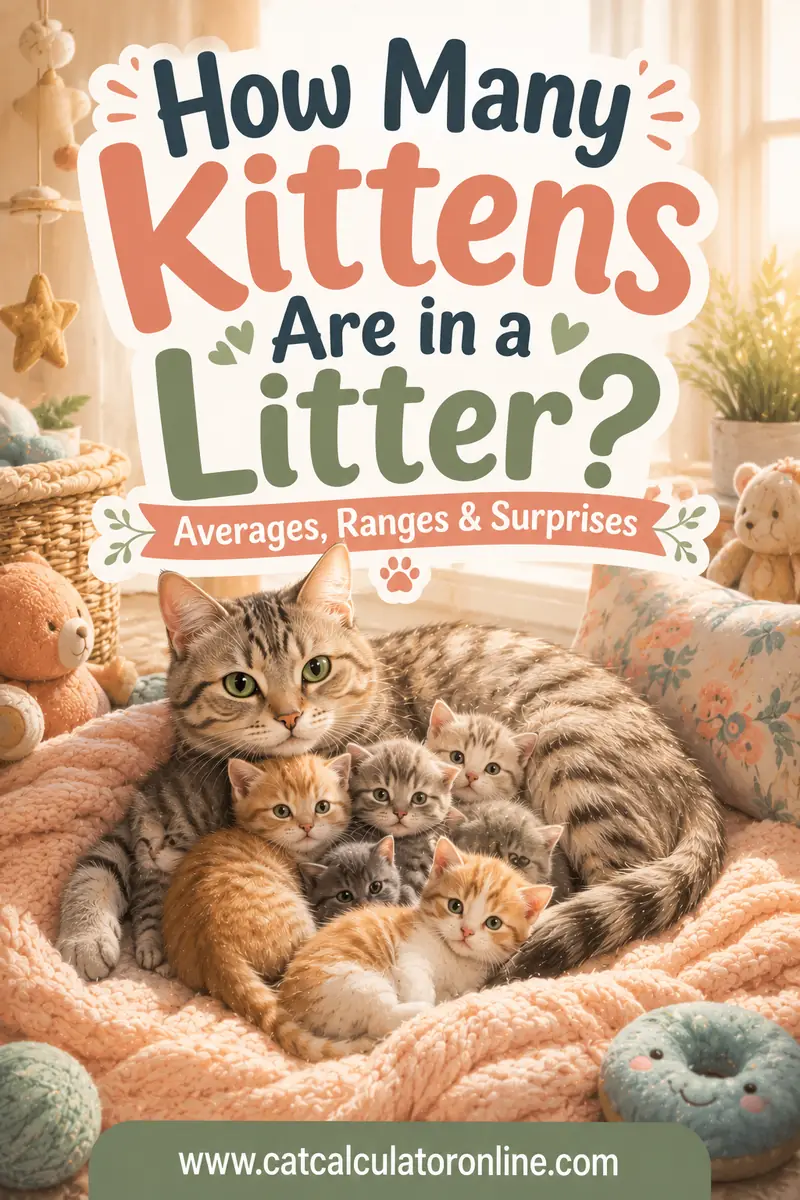
The average cat litter is about 4 kittens, with a normal range of 1–8. See what affects litter size, how a vet can count kittens before birth, and what to expect.

Kittens should stay with mom for at least 8 weeks — but 12–14 weeks is better. See what kittens learn each week, the risks of leaving early, and orphan care basics.

How long can you leave a cat alone? A work day is fine, 24 hours is the usual max, and longer trips need a sitter. Safe limits by age, plus a prep checklist.

How to travel with a cat by car or plane: carrier training weeks ahead, feeding timing, airline rules, hotel setup, and the sedation question answered honestly.

Do cats need baths? Almost never — cats clean themselves. Learn the real exceptions (Sphynx, toxins, seniors), how to bathe safely, and what to do instead.

Learn how to care for a senior cat: twice-yearly vet checks, arthritis-friendly changes at home, weight tracking, grooming help, and the changes to watch for.

Learn how to keep an indoor cat entertained: vertical space, daily hunting play, puzzle feeders, free cardboard fun, window TV and more — plus boredom signs.

How much playtime does a cat need? Aim for two or three 10–15 minute sessions a day. See how play changes by age, the best session structure, and toy tips.

How big do Maine Coons get? Males typically weigh 13–18 lb and can stretch to 40 inches long, reaching full size at 3–4 years. See the growth chart by age.

How long do Siamese cats live? Most reach 15–20 years and some pass 20. See what shapes Siamese lifespan, breed health notes, and how to add healthy years.

How big do Ragdolls get? Males typically reach 15–20 lb and females 10–15 lb, hitting full size around age four. See the Ragdoll growth chart and weight tips.

Do cats know their names? Yes — research shows cats recognize their own name, even from strangers. Here's the study, why they ignore you anyway, and how to teach it.

Can you train a cat? Absolutely. Cats learn fast with clicker training and treats. Here's what to teach, the 5-minute method, and why spray bottles backfire.

How smart are cats? Surprisingly smart. Object permanence, sharp memory, reading your cues, infant-like attachment — here's what science actually knows about cat intelligence.

Struggling to get your cat into a carrier? Learn the calm-day method, the towel wrap for urgent trips, and how to make the carrier a place she actually likes.

Moving house with a cat? Get a phase-by-phase plan: the safe-room setup, moving-day escape prevention, and how long to keep her indoors at the new address.

Introduce a cat and dog the safe way: separate first, swap scents, meet on-leash, then supervise. A step-by-step plan that actually keeps the peace.

Cat insurance typically runs $25-$35 a month for accident-and-illness cover. See what moves your quote up or down, by age, breed, plan settings and state.

What cat insurance covers in plain English: accidents, illness, cancer, dental disease, diagnostics and drugs, plus how to read a policy before you buy it.

The exclusions every cat insurance policy shares: pre-existing conditions, routine care, neutering, waiting periods and the fine print that surprises owners.

How cat insurance deductibles work: annual vs per-condition, what a $250 or $750 deductible really costs you, and how to pick the right one for your budget.

How cat insurance reimbursement works: 70/80/90% explained, what the payout really lands at, benefit schedules vs actual cost, and how fast the money arrives.

How cat insurance waiting periods work: the typical accident and illness windows, and why any condition appearing inside them stays excluded for life.

How pre-existing conditions work in cat insurance: what counts, the curable vs incurable split, bilateral clauses, and what cover is left for an older cat.
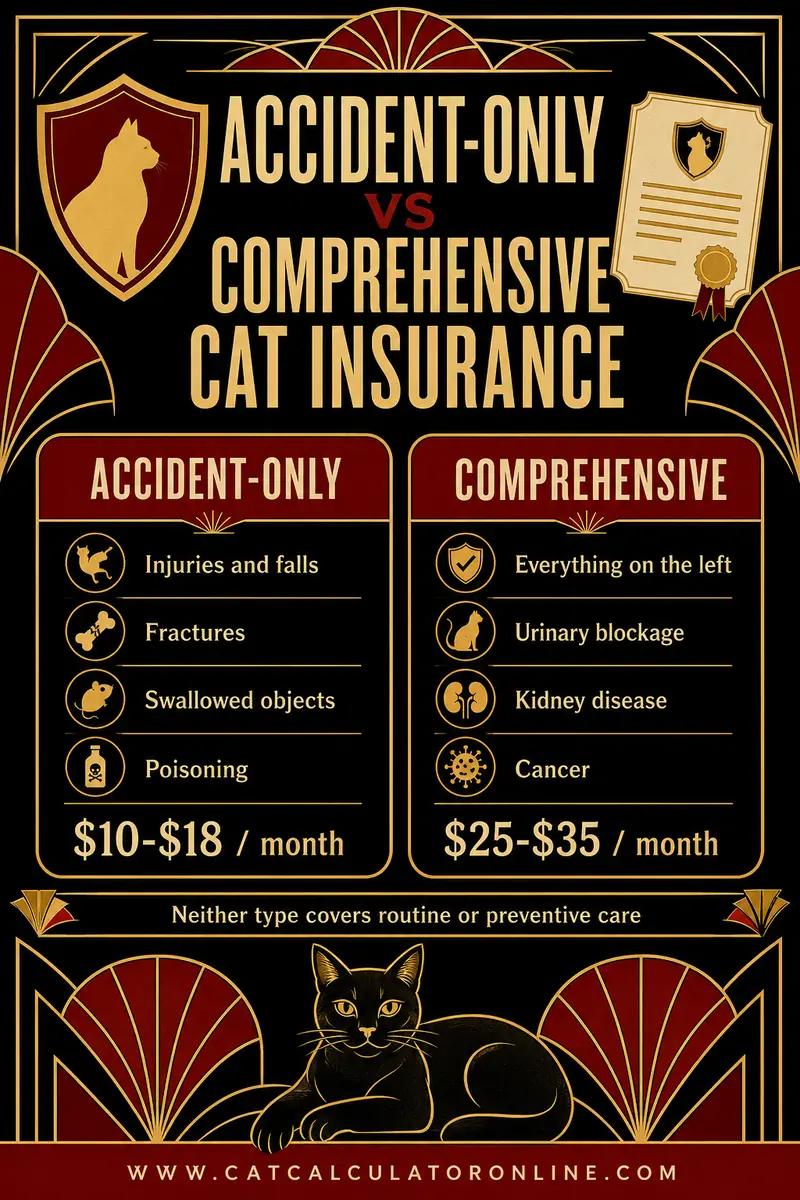
Accident-only or accident-and-illness cover for your cat? What each one pays for, the real cost difference, and which cats each type genuinely suits best.

How to choose cat insurance without guesswork: the questions that matter, how to compare quotes fairly, and the fine print that decides a policy's real value.

How to file a cat insurance claim: the documents you need, the usual timeline, what slows a claim down, and how to appeal if it's underpaid or declined.

Cat insurance cost by age, with honest US ranges: what kittens, adults and senior cats pay each month, why premiums keep climbing, and when to enrol early.

How breed affects cat insurance cost: why pedigrees quote higher, the hereditary conditions insurers price for, and what domestic shorthair owners can expect.
Wellness plans and cat insurance solve different problems. What each pays for, whether a wellness add-on returns its cost, and which your cat truly needs.

What a kitten really costs in year one: adoption, neutering, vaccines, supplies and food, with honest US ranges and the costs owners forget to budget for.
What a cat actually costs per month: food, litter, vet care and insurance broken down with honest US ranges, plus how the figure changes as your cat ages.
What feeding a cat really costs: dry, wet and mixed feeding compared with honest monthly figures, plus prescription diets and where the savings actually are.

What cat vet care really costs: routine visits, dental work, emergencies and common illnesses, with honest US ranges and ways to keep the bills manageable.

How to tell if your cat is overweight: the rib and waist checks you can do at home, what a healthy weight looks like by breed, and what to do about it next.
The cat body condition score explained: what each of the 9 points means, how to score your own cat at home, and why it beats the scale for judging weight.

What a healthy cat weight really is: typical ranges by breed and age, why the scale alone misleads, and how to find your own cat's true target weight.

How many calories a cat needs each day, with simple math by weight, age and lifestyle, plus how to turn that number into actual portions of real food.

How to use a cat weight calculator properly: what to enter, how accurate the result is, and how to turn a target weight into a plan that actually works.

Kitten growth stages week by week: what changes at every age from birth to twelve months, typical weights, and the milestones genuinely worth watching for.

How to predict your kitten's adult size: the 16-week doubling rule, what breed and paw size really tell you, and how accurate any prediction can really be.
How fast kittens grow: the 100 g per week rule, what gain to expect at each age, and what to do when a kitten is growing slower than the chart suggests.

A kitten weight by age chart from birth to twelve months, in grams and pounds, with breed adjustments and how to read the numbers without needless worry.

How to use a kitten weight calculator: what to enter, how to weigh a kitten accurately, what the result really tells you, and when to see a vet instead.
The signs a cat is pregnant, week by week: pinking up, weight gain, appetite and nesting, plus how vets confirm it and what you should do once you know.
Cat pregnancy week by week: what happens to the queen and kittens in each of the nine weeks, what to do at each stage, and the warning signs to watch for.
How to use a cat pregnancy calculator: which date to enter, how accurate the due date really is, and what to do when you don't know when your cat mated.

Chronic kidney disease in cats explained kindly: the early signs, how vets diagnose and stage it, what treatment involves, and what it costs to manage.

Hyperthyroidism in cats explained simply: why cats lose weight while eating more, how it's diagnosed, the four treatment options, and what each one costs.

Diabetes in cats explained warmly: the signs to watch for, what treatment really involves day to day, what it costs, and why remission is genuinely possible.
Dental disease in cats explained gently: why it's so common, the quiet signs of mouth pain, what treatment costs, and the prevention that genuinely works.

Urinary blockage in cats is a true emergency. The signs to act on immediately, why male cats are at risk, treatment costs, and how to lower the chance of it.

Arthritis in cats is far more common than most owners realize. The subtle signs, why cats hide the pain, treatment options, and easy changes that help at home.

A practical senior cat health checklist: what to check monthly, what your vet should check yearly, and the early signs of the conditions older cats develop.

The right litter box size for cats, why most shop-bought boxes are too small, covered versus open, and what to use for kittens, seniors and large breeds.
How often to change cat litter by type, why daily scooping matters more than full changes, how to wash the box, and what to do about persistent smells.
Cat litter types compared on odor control, dust, tracking and cost, which suits kittens and asthmatic cats, and how to switch without upsetting your cat.
Why a cat stops using the litter box: medical causes to rule out first, box and litter problems, stress triggers, and how to clean so it doesn't repeat.

How to stop a cat spraying: how to tell marking from toileting, why neutering matters, the stress triggers behind it, and how to clean so it doesn't repeat.

How often to groom a cat by coat length, why cats can't manage it alone, how to brush a cat that hates it, and what changes for seniors and overweight cats.
How to remove cat mats safely at home, why scissors cause serious skin injuries, when to call a groomer or vet, and how to stop matting coming back for good.
How to reduce cat shedding: brushing technique, diet and hydration, why indoor cats shed all year, and when heavy shedding is actually a health problem.

Which cat grooming tools to buy for short, long and dense coats, what each one actually does, what to avoid, and how to introduce a new tool to your cat.
How many cats is too many: the resource rules that actually matter, space and cost per cat, the warning signs of an overcrowded home, and when to stop.

How to stop cats fighting: telling play from real aggression, breaking up a fight safely, the resource fixes that work, and when to reintroduce from scratch.

How to choose a cat tree: the height and stability that matter, sisal versus carpet, what suits kittens and seniors, and where to put it so it gets used.

A room-by-room cat proofing checklist: toxic plants and foods, string and cords, window and balcony safety, and the everyday hazards owners most often miss.

One cat year is about 15 human years, not seven. Why the first year counts for so much, what a 1-year-old cat is like, and the vet-backed math behind it.

A 2-year-old cat is about 24 in human years. Why year two adds nine, what changes as adolescence ends, and where the steady four-a-year pattern begins.

A 3-year-old cat is about 28 in human years. Where the steady four-a-year pattern begins, what a cat in its prime is like, and the dental milestone at three.
A 4-year-old cat is about 32 in human years. What a cat in its prime looks like, why weight matters most now, and the baseline worth recording at this age.

A 5-year-old cat is about 36 in human years. What the halfway mark really means, why five is the last easy year, and the four things worth watching now.

A 6-year-old cat is about 40 in human years — the last year of young adulthood. What changes as middle age approaches and what to set up before seven.

A 7-year-old cat is about 44 in human years and has just entered middle age. What changes at the mature adult stage and what screening becomes worthwhile.

An 8-year-old cat is about 48 in human years. Solidly middle-aged — what screening should be routine by now, and which changes deserve a same-day phone call.

A 9-year-old cat is about 52 in human years — the last year before senior. What to set up now, what screening should show, and why nine is a preparation year.

A 10-year-old cat is about 56 in human years and is officially senior. What the senior stage means, why checks go twice yearly, and what to monitor from here.

An 11-year-old cat is about 60 in human years. Early senior: what joint change looks like, how to adapt the home, and which screening results now matter most.

A 12-year-old cat is about 64 in human years. What screening should be finding by now, why weight loss is the key signal, and how to keep a senior cat well.

A 13-year-old cat is about 68 in human years. What comfort really means at this age, the signals worth acting on, and how to keep a senior cat eating well.

A 14-year-old cat is about 72 in human years. Why appetite and thirst are the key signals, what six-monthly bloods should cover, and how to keep 14 comfortable.

A 15-year-old cat is about 76 in human years. What a genuinely old cat needs, how to judge quality of life honestly, and why many cats go well beyond fifteen.

A 16-year-old cat is about 80 in human years. What changes past the average lifespan, why small changes deserve a phone call, and how to keep 16 comfortable.

A 17-year-old cat is about 84 in human years. Why weight loss is near-universal at 17, how to keep food easy and warm, and what still deserves investigating.

An 18-year-old cat is about 88 in human years. What remarkable longevity looks like day to day, how to keep 18 comfortable, and what still deserves attention.

Converting human years to cat years runs the math backwards. Full table, the formula, why the answer compresses so fast, and where the comparison breaks down.

A cat age calculator adds 15 for year one, 9 for year two and 4 per year after. Where those numbers come from, why seven is wrong, and what the math can't do.

Female cats live slightly longer than males on average, but neutering matters far more than sex. Here is what the veterinary data really shows, and why.

Creme Puff reached 38 years and 3 days, the oldest cat ever verified. Meet the other record holders, and what they really tell you about your own cat.

The habits that actually add years to a cat's life: indoor living, healthy weight, dental care, neutering, and twice-yearly vet checks after age eleven.

Mixed-breed cats do outlive pedigrees on average, and hybrid vigor is a real genetic effect. Here is why it happens, and how big the difference really is.

Maine Coons typically live 10 to 15 years, shorter than most cats. Heart disease and hip problems explain why, and both can be screened for before you buy.

Ragdolls usually live 12 to 17 years. Their own heart mutation, FIP risk and famously trusting nature all shape that number more than most owners realize.

Norwegian Forest Cats usually live 12 to 16 years. As a natural landrace breed they start healthy, but one DNA test still matters more than any other.

Persians are usually quoted at 12 to 17 years, with UK vet records nearer 13 to 14. The flat face and a testable kidney gene explain most of the difference.

Bengal cats usually live 12 to 16 years. Two inherited conditions have DNA tests, a third does not, and boredom is a bigger risk than most owners expect.

Calico is a coat pattern, not a breed, so lifespan follows the cat underneath: 13 to 17 years for most. Male calico cats are the genuine exception here.

Domestic shorthairs typically live 13 to 17 years and indoor ones often reach 20. Here is the decade-by-decade timeline and what to watch at each stage.

Sphynx cats are quoted at 12 to 15 years, but veterinary records put them near the bottom of the breed table. Heart disease is the reason, and it is screenable.

British Shorthairs typically live 12 to 17 years and are a robust breed. Their real threat is not genetics but weight, and the coat hides it completely.
A lookup chart of typical lifespans for 40 cat breeds, with the main health watch point for each and an honest note on how shaky these figures really are.

The first three weeks of cat pregnancy show almost nothing reliable. What pinking up means, why a stopped heat is only a clue, and when a vet can confirm it.

Cat labor signs in order: the temperature drop, nesting, restlessness, appetite loss and visible straining, plus the timings that tell you to call a vet.

How long a cat takes to give birth: 6-12 hours of stage one, kittens every 10-60 minutes, and why a calm 24-36 hour pause mid-litter is normal in cats.
What to do when your cat gives birth: prepare the box, watch from a distance, count placentas, and the one moment intervening is actually the right call.

The exact thresholds for calling a vet during and after a cat birth: straining times, discharge colors, mastitis, metritis and the eclampsia emergency.

Caring for a pregnant cat: which worming and flea products are safe, why live vaccines wait, indoor rules, nesting box timing and litter tray hygiene.

Feed a pregnant cat kitten food from week four or five and keep her on it through nursing, when she may need two to three times her normal calories. No extras.

Cats can come back into heat while still nursing, sometimes within 2-4 weeks of giving birth. Why lactation does not prevent pregnancy, and what to do.

A queen can come back into heat 2 to 4 weeks after giving birth, often while still nursing. Why nursing does not prevent it, and when to book the spay.

What to do each week for newborn kittens: warmth first, daily weighing, toileting help, handling and hygiene. Warm a cold kitten before you ever feed it.
Estimate a found kitten's age from eyes, ears, teeth, weight and movement. A week-by-week ageing table, plus why the estimate sets worming and vaccine timing.

Kittens take wobbly first steps at 2.5 to 3 weeks and walk confidently by 4. What normal wobbling looks like, and which gait problems need a vet check now.

Kittens start on moistened food at 3.5 to 4 weeks and are fully solid-fed by 7 to 8. Readiness signs, what food to use, and why cow's milk never belongs.

A step-by-step weaning method from 3.5 weeks to 8: the gruel recipe, how fast to thin it, weaning orphans, and why you never separate the queen abruptly.

Kittens lose 26 milk teeth from 3 to 7 months and end with 30 adult ones. What is normal, why swallowing them is fine, and the one sign that needs a vet.

Warm first, then hydrate, then feed. The hand-rearing routine for orphaned kittens, including the toileting step most people miss, and when to ring for help.

Getting a kitten to use the litter box is mostly setup, not training. Tray height, litter type, placement, the first-week routine and the rare medical causes.
The kitten vaccination schedule explained: why the course starts at 6-8 weeks, repeats every 3-4 weeks to 16 weeks, and when a kitten is safe to go outside.

How to judge a wet cat food yourself: complete vs complementary, protein on a dry matter basis, texture, and why the best food is the one your cat actually eats.

A step-by-step method for choosing canned cat food: shortlist on the label, test three singles, transition slowly, and keep two options in rotation.

Most fussiness is texture, temperature or the bowl — not the flavor. What to change first, why cats form preferences young, and when fussiness is a symptom.

Before changing food, rule out hairballs, eating too fast and parasites. What limited-ingredient and hydrolysed diets do, and when vomiting needs a vet.

Senior cat food is barely regulated and many older cats need more protein, not less. What actually changes with age, and when a diagnosis should set the diet.

Grain-free does not mean carb-free — grains are replaced by potato or pea. True grain allergy is uncommon in cats. What the label means and who it suits.

Cats are obligate carnivores with a continuous protein requirement. What counts as high protein, how to compare labels properly, and which cats need less.

The three things that actually matter on a cat food label: complete vs complementary, the ingredient list, and calories. Plus why percentages mislead on wet food.

Most adult cats need roughly 200 to 250 calories a day, which is about three to four typical pouches. How to work out portions properly and adjust them.
Most adult cats need about 50 to 65 grams of dry food a day. Why cups are unreliable, how to weigh portions properly, and why water intake matters more here.

Combination feeding works well if the calories add up to one daily total. How to split wet and dry, why you should not mix them in one bowl, and common splits.
Change cat food over seven to ten days using a gradual mix. The day-by-day ratios, what to do with a fussy cat, and when a slow switch is not enough.

Free feeding suits cats that self-regulate and few do. Scheduled meals give portion control. The middle option most households end up using, and how to switch.

Gravity, timed dry and chilled wet feeders compared. Which type suits which cat, the multi-cat problem, and why a feeder is never a reason to leave a cat alone.

Constant hunger can be habit, boredom or genuine underfeeding — or a symptom. Eating more while losing weight is the combination that needs a vet, not a bigger bowl.
A cat that eats nothing for 24 to 48 hours needs a vet, not patience. The medical causes, the practical fixes, and why fasting is dangerous for cats.

Cats cannot safely fast the way dogs can. Why 24 to 48 hours is the threshold, what hepatic lipidosis is, and why overweight cats are at higher risk.

Dehydration develops faster than starvation. Why 24 hours without water needs a vet, how to check for dehydration at home, and how to get a cat drinking more.

A stolen mouthful is not dangerous. A diet of dog food causes real harm, because cats need taurine, vitamin A and arachidonic acid that dog food need not contain.

Cat food is not toxic to dogs, but it is far richer in protein and fat. A stolen bowl rarely harms; a habit risks pancreatitis, weight gain and loose stools.

A cat that has eaten dog food almost never needs treatment. What to watch for over 24 hours, when it does warrant a call, and how to stop it happening again.

Dogs eat cat food because it is fattier, meatier and coated in palatants made to tempt a fussy carnivore. Why the habit sticks, and the fixes that stop it.

Two bowls on the same floor never works. Separate cat and dog food by height, timing or a microchip feeder, and set the cat up somewhere quiet and dog-free.

No. Grapes and raisins cause acute kidney injury in dogs with no known safe dose, and the cat evidence is thin rather than reassuring. Treat them as unsafe.

No. Onions, garlic, chives and leeks damage a cat's red blood cells and cause anemia. Cooked and powdered forms are more concentrated, and signs are delayed.

Ripe tomato flesh is not toxic to cats, but leaves, stems and unripe fruit contain solanine. Sauces are the bigger risk because of onion, garlic and salt.

Most adult cats stop making lactase after weaning, so dairy means gas and diarrhea. Which products carry least lactose, which are genuinely risky, and why.

Cats can digest raw meat, but the risks are real: salmonella, campylobacter, toxoplasma and bone injury. Both sides of a contested debate, plus safe handling.

Yes — plain, cooked, boneless fish is a safe occasional treat for cats. Which types work, why raw and smoked do not, and how much is sensible each week.

Cats loving fish is cultural, not nutritional. What a fish-heavy diet risks — thiamine deficiency, steatitis, phosphorus and allergy — and where fish does help.

Some vegetables are safe for cats, none are necessary, and a few are dangerous. Why an obligate carnivore cannot live on plants, and where fiber really helps.

Most fruit is harmless to cats and pointless for them, because cats cannot taste sweetness. The safe list, the never list, and why grapes are the real hazard.
Ring a vet immediately, before symptoms start, and never try to make a cat vomit at home. What to do in the first hour, and the three facts to have ready.

Cat treats should be at most 10% of daily calories - roughly 20-25 kcal for a 9 lb cat. How to count them, subtract them from meals, and which are safe.

Average adult cat weight for 30 breeds, split by sex, with the frame sizes behind the numbers and why a breed average is never your own cat's target weight.
Unexplained weight loss in a cat is a vet visit, not a diet win. The common medical causes, what a 5% loss means, and the signs that need same-day attention.

How to help an underweight cat gain safely: find the cause first, the calorie math, what to feed, how fast is safe, and the mistakes that make things worse.

No cat breed is truly hypoallergenic. Here is what the Siberian, Balinese and Russian Blue claims are worth, and what genuinely lowers your Fel d 1 exposure.

Siberian cats are not hypoallergenic. Some do produce less Fel d 1, but the evidence is thin and they shed heavily. What to check before you pay the premium.

Bengal cats are not hypoallergenic. They produce normal Fel d 1 in saliva and skin. Here is where the myth came from and what actually cuts your exposure.

Which cat breeds genuinely shed the least, why coat structure matters more than length, and why low shedding never means low allergen. Breed-by-breed list.

A practical plan for living with a cat allergy: the bedroom rule, HEPA filtration, cleaning that works, and the treatments worth asking your doctor about.

Cat allergies are caused by Fel d 1, a protein in saliva and skin, not by fur. Here is where it comes from, why it spreads, and what genuinely reduces it.

Every hairless cat breed compared, why so many are gray, what weekly bathing really involves, and the reason hairless still does not mean hypoallergenic.
The adult cat vaccination schedule: what happens after the 12-month booster, why intervals run 1-3 years, indoor cats, senior cats and lapsed vaccinations.

What cat vaccinations cost: $40-$100 a booster, $120-$250 a kitten series, what the exam fee adds, FeLV and rabies extras, and whether wellness plans save.

Neutering at around four months now beats the traditional five to six, because it comes before the first heat. Timing, the fast, recovery and the calorie drop.
The real signs a cat is nearing the end: withdrawal, appetite loss, cold ears, breathing changes. How to score her quality of life and when to call your vet.

Cats hide pain by instinct. The signs owners miss, how to use the Feline Grimace Scale at home, why purring proves nothing, and the painkillers that kill cats.
What cats actually get ill with at each age, from kitten flu to senior kidney disease, plus the screening that catches each one early and when to call a vet.
How often to worm a cat: kittens every 2 weeks from 3 weeks old, then monthly to 6 months, then by lifestyle. Hunters need far more than indoor cats do.

An unmated cat comes back into heat every 2 to 3 weeks, and indoor cats often cycle all year round. Why the gap is so short, and how many heats to expect.

Yowling, rolling, treading and a raised rear are mating behavior, not pain or illness. What every heat behavior means, and the signs that are something else.
One heat lasts about 4 to 10 days, then returns within a week or three. Unless she mates and does not conceive, which buys a quiet 5 to 6 weeks instead.

You cannot shorten a heat, so comfort is the job. Warmth, a quiet dark den, hard play and door discipline help. Most sold remedies do not, and human pills harm.
Most cats have a first heat at 5 to 9 months, and some at 4. Body weight matters more than the calendar, and a kitten can be pregnant before she looks grown.
Excessive meowing is usually learned and reversible, but a sudden increase in a cat over 10 is a medical question first. How to tell the two apart, and fix it.
Newborn kittens sleep about 90% of the day and 12-week-olds still sleep 18 to 20 hours. Hours by age, why sleep drives growth, and when sleepy means unwell.

Headbutting is scent marking, not just affection: your cat is labeling you as safe territory. What bunting means, and why head pressing is a different thing.

The gift and hunting lesson explanations are folklore, not evidence. Cats carry prey somewhere safe, and your home is it. What actually reduces the hunting.
Scratching is claw care plus scent and visual marking, not damage or spite. Why cats pick the sofa, why punishment backfires, and what declawing really is.
You cannot stop scratching, only move it. A post 30 in tall, rock solid, sisal, placed against the spot she already uses - plus how to make the sofa boring.

Purring is not proof - cats purr when frightened too. The signals that really show contentment, the boring ones that matter most, and what an unhappy cat does.

Do cats get lonely? Domestic cats are facultatively social, so many do. What the evidence really shows, the signs owners miss, and what actually helps them.

Hiding is how cats cope, and a cat with a hiding place recovers faster than one without. The timelines that are normal, and when hiding means call the vet.

Most missing cats are hiding a few houses away, silent and frozen. Search close and slow with a flashlight, check every shed, and update the microchip details today.

One small room beats the run of the house. Why her own smell is what makes a place safe, how long hiding should last, and the point where you call the vet.

Fly your cat in the cabin if you possibly can. Carrier sizes, fees, health papers, the security screening danger point, and why cargo is riskier for flat faces.

The highest impact change is leaving the carrier out all year. Plus the car trick, pre visit medication, cat friendly clinics and reintroducing her afterwards.

Start months before the birth, not on the day. Scent, sound and nursery rules that work, the toxoplasmosis facts, and why shutting the cat out backfires badly.

Spaying a cat costs more than neutering because it is abdominal surgery. US price ranges, what a good quote includes, and how to get a real local figure.

A dental quote is always an estimate, because nobody knows how many teeth come out until the cat is asleep. US ranges, X-rays, and how to read a quote.

Emergency cat bills stack up in three layers: the after-hours consult, then diagnostics, then hospitalisation per night. US ranges and how to ask first.

Microchipping a cat costs about $25-$80, or less bundled with neutering. The part that fails is registration: an unregistered chip returns nobody at all.

Cat boarding runs about $25-$50 a night in the US, more at holidays. What drives the nightly rate, the vaccine deadlines, and the extras that appear later.

Boarding is priced per cat, a sitter is priced per visit. That one difference decides it: for a single cat it is close, but from two cats the sitter wins.

Ten things that genuinely reduce a cat's vet costs: written estimates, staged diagnostics, generic scripts, low-cost clinics and the false economies to avoid.
What a blood panel, urine test, X-ray and ultrasound cost for a cat, what each one is actually for, and how to read a diagnostic quote without the panic.

The flea dirt test settles it in two minutes: comb debris onto damp white paper and see if it smears reddish-brown. Plus where to look and what else itches.
Treat the cat, every other pet and the house at once, and expect 8-12 weeks. Never use a dog flea product on a cat - permethrin causes fatal seizures.

Spot-on, tablet, collar or shampoo? How each cat flea treatment works, how long it lasts, what it misses, and the dog-product warning that can kill a cat.

Most of a flea infestation is in your carpet, not on your cat. Vacuuming, hot washing, growth regulators and a realistic 8-12 week plan that actually works.

Indoor cats do get fleas - carried in on shoes, on a dog, or left by a previous tenant. A risk-based answer, with the six factors that decide it for your cat.

Use a tick tool and twist straight out. Never burn, smother or use alcohol - it makes the tick regurgitate. What to watch for afterwards and when to call a vet.

Dark coffee-ground debris and furious scratching is the classic ear mite picture. Why every pet must be treated, and what else causes itchy ears in cats.

Ringworm in cats is a fungus, not a worm, and it spreads to people. What it looks like, why a Wood's lamp is not enough, and how long treatment really takes.
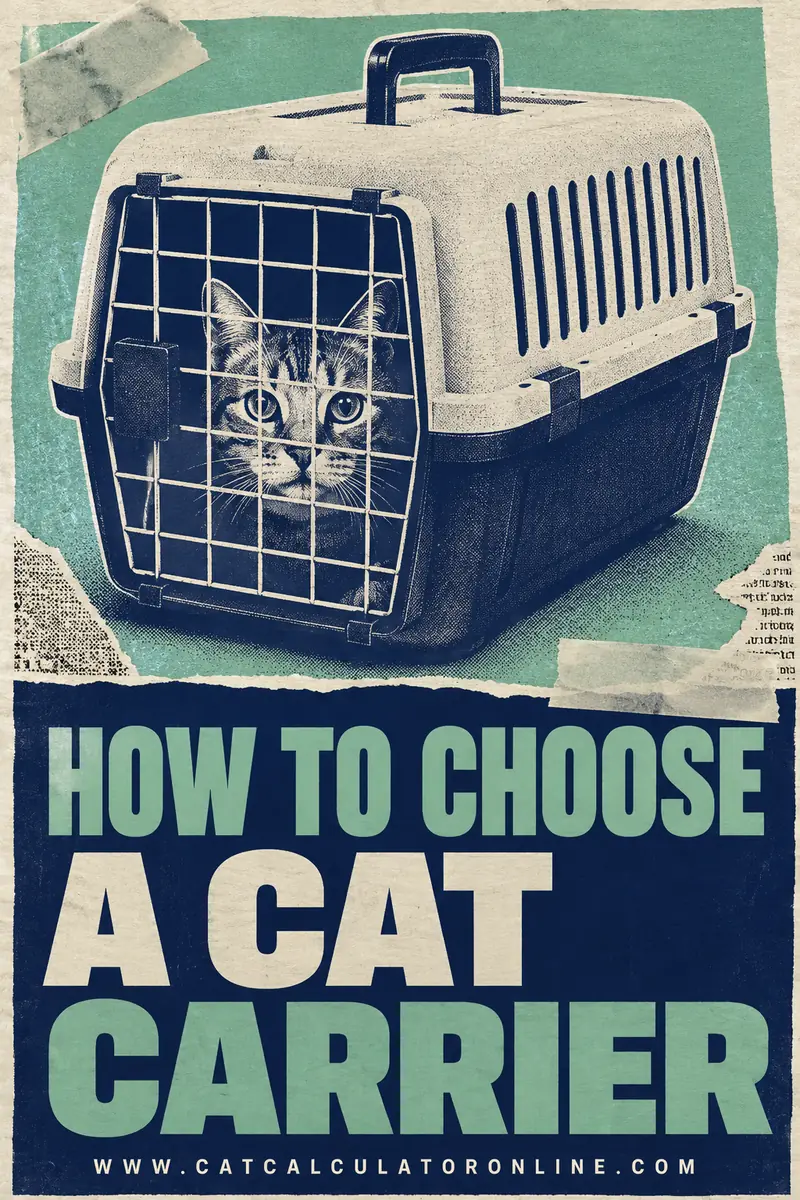
The carrier feature that matters most is a top that opens or lifts off. Sizing rules, hard versus soft sides, car safety, airline limits and what to skip.

Automatic litter boxes suit some homes and are wrong for others. Size limits, nervous cats, running costs, and the daily health check you quietly lose.

Cats are poor drinkers by design. What a fountain can and cannot do, which cats benefit most, how often to clean it, and the cheaper things to try first.
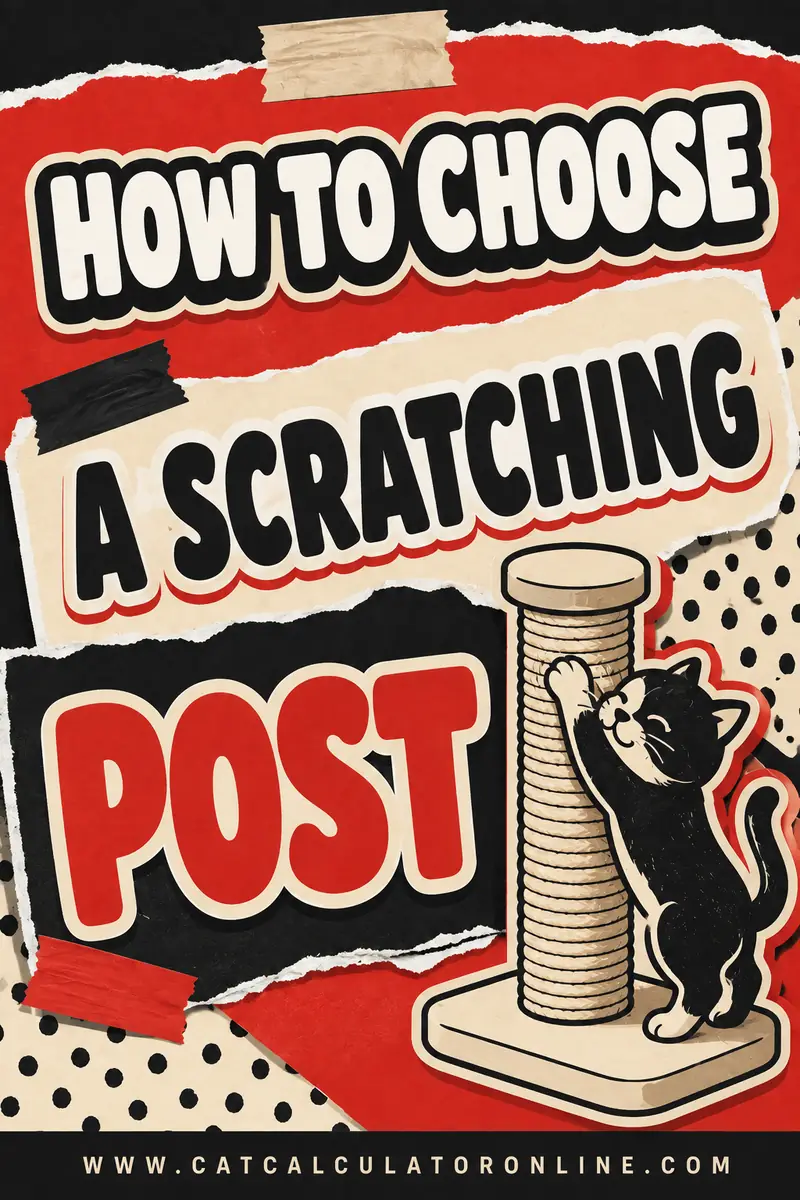
The specs that decide whether a post gets used: 30 in tall, heavy enough not to wobble, sisal rope not carpet, and both vertical and horizontal options.

Microchip, magnetic or plain: what each flap actually stops, how to size a tunnel for a thick wall or a door, curfew modes, and cats that never learn.

Harness fit is the whole job: H-style or vest, never a collar. The flop-and-freeze stage, a realistic week-by-week plan, and the cats that never enjoy it.

A catio gives outdoor life without the traffic and the fights. Buy versus build, real sizes and costs, escape-proofing, shade and shelter, and access.

A full checklist for a cat first aid kit, plus the things that must never go in it: human painkillers, hydrogen peroxide and antiseptics that harm cats.

US cat adoption fees run $25-$250, and the fee usually bundles neutering, vaccines and a microchip worth far more. Here is what is included and what is not.

US pedigree kitten prices by breed, and the health testing, cesareans and small litters that drive them. Plus why a cheap pedigree kitten is a warning sign.

The priciest cat breeds in the US, from Savannah to Khao Manee, with the real reasons behind each price and the hybrid ownership laws buyers find out too late.

Maine Coon kittens cost $1,200-$3,000, more for show lines. What drives the price, the health tests to insist on, and the real yearly cost of keeping one.

Kitten scams follow one pattern: no video call, wire or gift card payment, stolen photos and surprise fees. Here is the rule that stops nearly all of them.

The questions that matter before you take a cat home: health testing, seeing the mother, collection age, FeLV and FIV status, history and the return policy.
Are cat years the same as dog years? No. Here's how the two species really age, why breed size matters for dogs but not cats, plus a side-by-side chart.
Are there cat years like dog years? Yes as a conversion, not as a real unit. What a cat year is, the staged chart, and why the x7 rule fails.
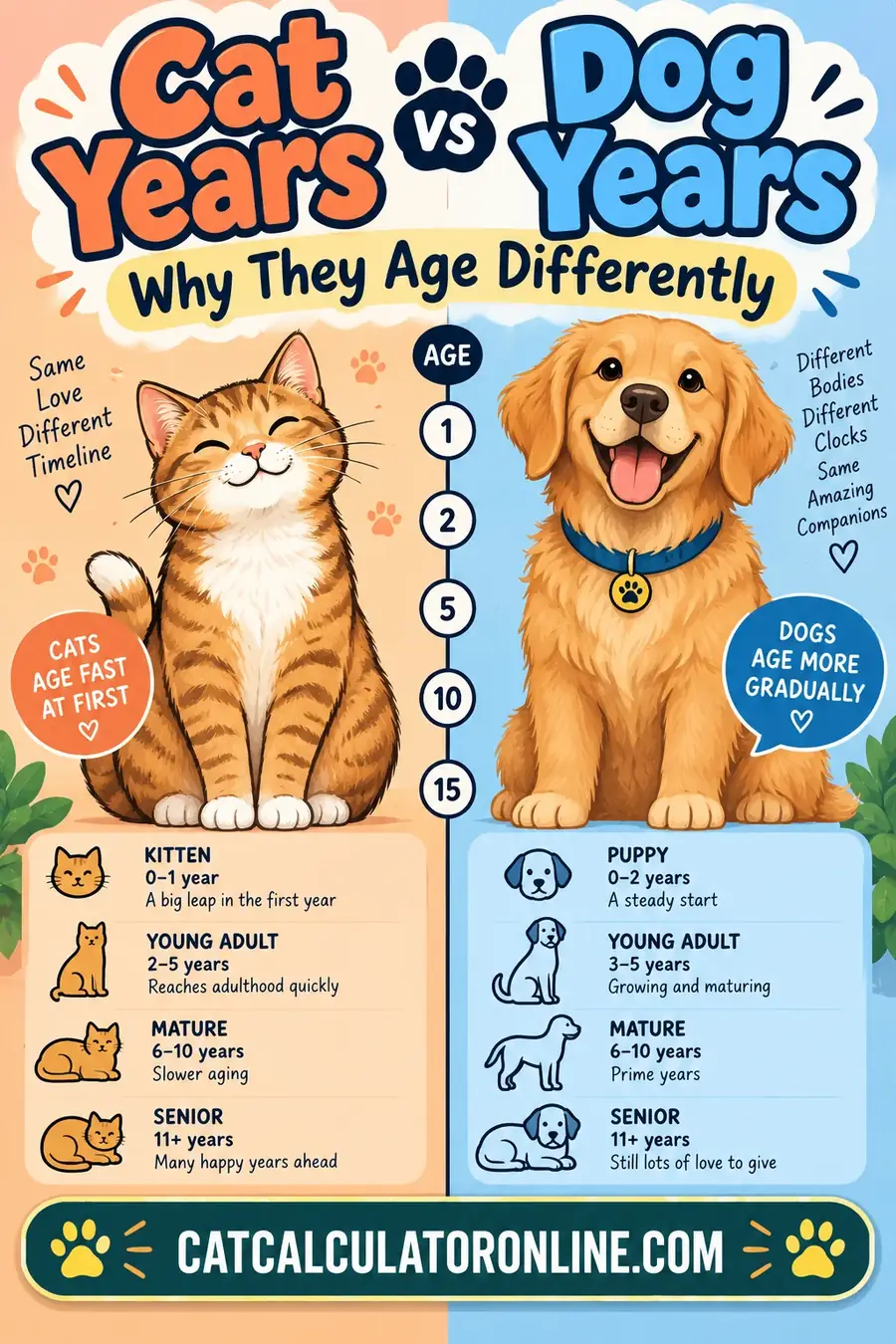
Cat years and dog years use different formulas - here
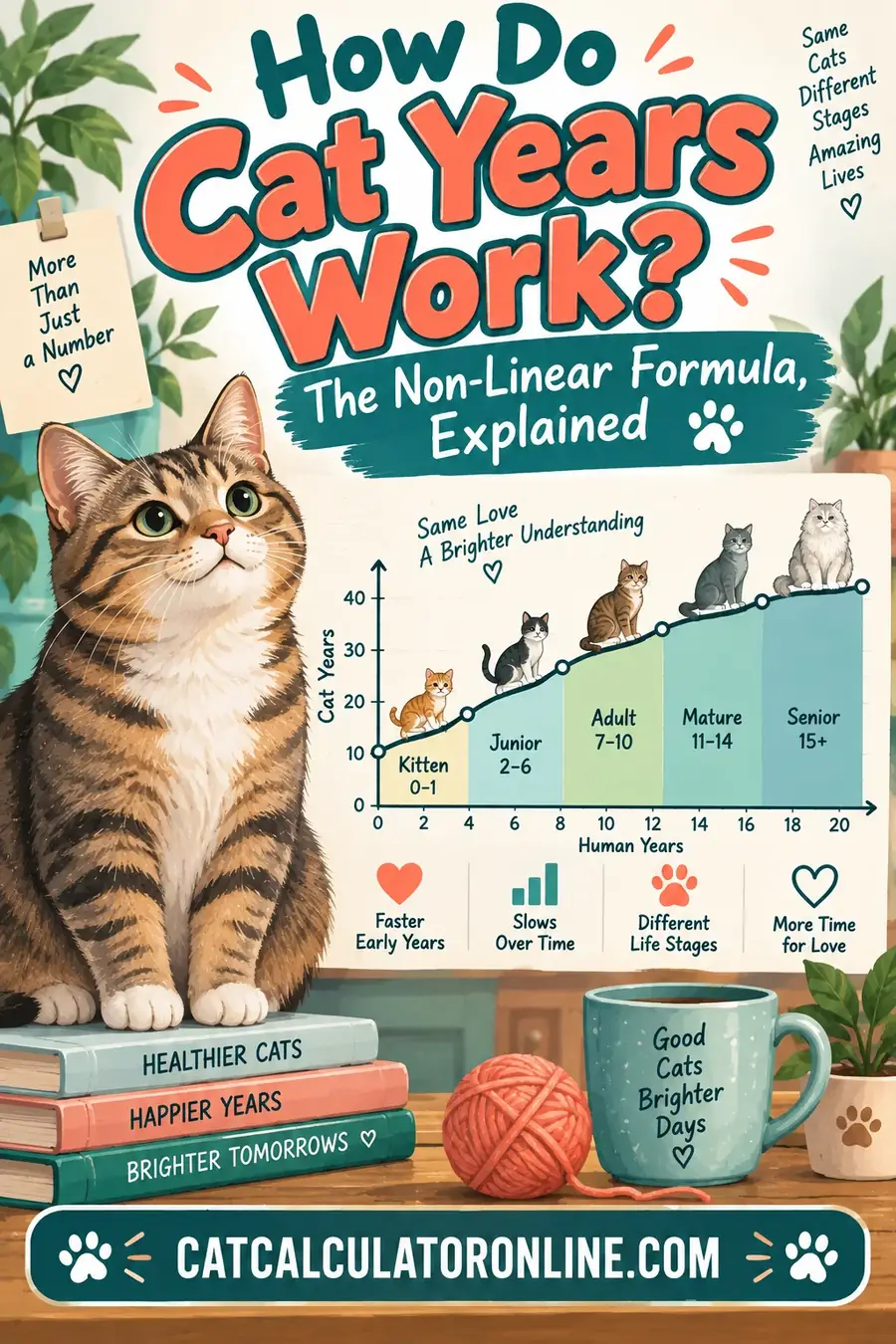
How cat years actually work - the real formula vets use, a full conversion chart, and why the multiply-by-seven rule is wrong.
How many years can a cat live? Indoor cats commonly reach 12-18, some pass 20. Life stages, what shortens a cat's life and what extends it.
Cat years are real, but the popular "multiply by 7" rule isn
No guides match your search — try another word.