6 Cat Years in Human Years
A six-year-old cat is about 40 in human years — and it's the last year of young adulthood. At seven a cat formally enters the mature adult stage, which is the feline equivalent of middle age and the point at which veterinary advice genuinely changes. Six is therefore a transition year: nothing has happened yet, and everything worth setting up before things start happening should be set up now. This page covers the math, what the boundary at seven actually means, and the short list worth doing in this final easy year. Any age converts instantly with the cat age calculator.
How Do You Get 40?
The same arithmetic as every year from three onward.
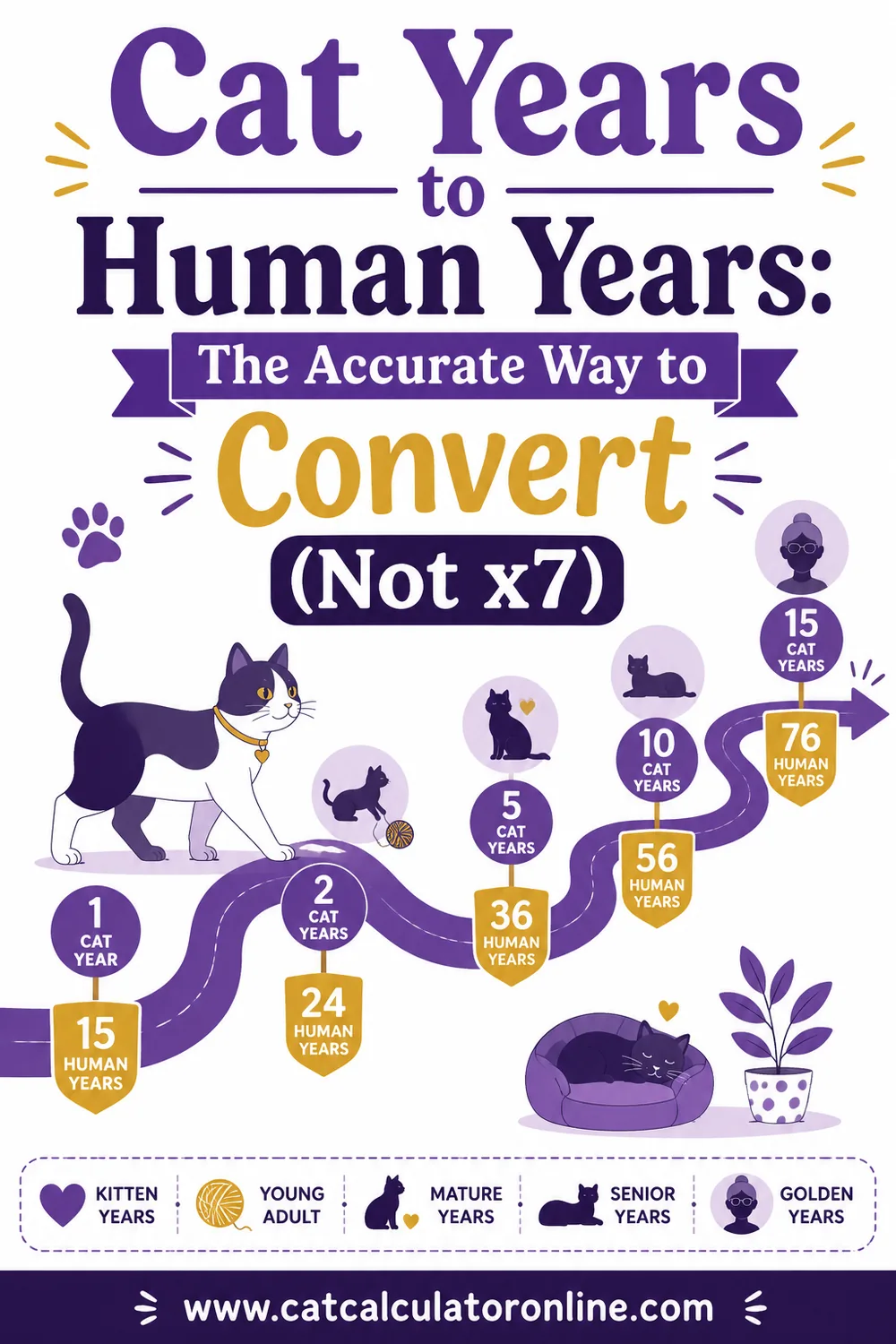
15 for year one, 9 for year two, 4 for every year after. By six that's 24 + (4 × 4) = 40.
| Cat's age | Human years | Stage |
|---|---|---|
| 4 | 32 | Young adult |
| 5 | 36 | Young adult |
| 6 | 40 | Young adult — final year |
| 7 | 44 | Mature adult |
| 8 | 48 | Mature adult |
| 9 | 52 | Mature adult |
| 10 | 56 | Senior |
| 12 | 64 | Senior |
The number is pleasingly tidy — six cat years lands exactly on forty human years, which is a useful mnemonic and also a fair description of where the cat actually is. Forty is not old. It is the age at which sensible people start having check-ups they didn't previously bother with.
The years either side are covered in 5 cat years in human years and 7 cat years in human years, and the method itself in how a cat age calculator works.
What Happens at Seven That Doesn't Happen at Six?
The AAHA feline life-stage framework draws its line here, and the change is real rather than administrative.
| Stage | Age | Human years | What's different |
|---|---|---|---|
| Young adult | 1–6 | 15–40 | Annual check; no routine screening |
| Mature adult | 7–10 | 44–56 | Screening bloodwork; weight and dental focus |
| Senior | 10+ | 56+ | Twice-yearly checks; kidney and thyroid monitoring |
What actually changes at seven:
- Routine bloodwork becomes worthwhile, because the conditions it screens for — early kidney disease, hyperthyroidism, diabetes — start appearing in this decade
- Blood pressure checks become relevant, since hypertension in cats is common and silent
- Dental disease is near-universal, and the question shifts from whether to treat to when
- Weight problems become harder to reverse, as activity and joint comfort decline
- Arthritis becomes prevalent — a large majority of cats have degenerative joint changes by twelve, and it starts well before that
None of it is dramatic, and that's exactly why the boundary is worth knowing. Nothing visible happens on a cat's seventh birthday. The change is in what a sensible owner starts paying attention to, and six is when to get ready for it. The full framework is in cat life stages explained.
What Should You Set Up During This Year?
Five things, all cheap or free, all much easier now than in three years.
1. Get baseline bloodwork done. A full panel — kidney values, thyroid, liver enzymes, blood glucose, plus a urine sample — while the cat is demonstrably healthy. The value isn't in what it finds now, which is probably nothing. It's that at eleven, when a result comes back "within normal limits", you'll be able to see whether it's normal for your cat or a significant shift from where it used to sit. That comparison is only possible if the baseline exists.
2. Deal with the teeth. If your vet has been mentioning tartar or gingivitis, this is the year to act. Anaesthesia carries the lowest risk in a healthy, younger cat with normal kidney values — and postponing a dental until eleven means doing it in a cat with more risk factors and more advanced disease. Home brushing should also be established by now if it isn't.
3. Correct weight while it's still easy. A six-year-old cat that's 15% overweight can still exercise, still play, still jump. The same cat at ten with early arthritis can't do any of those things as well, and the weight becomes self-reinforcing. Slow, vet-supervised reduction now is far more achievable.
4. Set the home up for later. Steps or a low stool to favorite perches. A litter box with one low side. Food and water at a height that doesn't require jumping. None of this is needed yet — and installing it before it's needed means the cat learns to use it while still agile, rather than being asked to adapt while sore and stiff.
5. Decide the money question. Insurance, a dedicated savings pot, or accepting the risk. Any of the three is defensible; drifting into old age without having decided is what causes difficult choices later, usually at the worst possible moment and with a sick cat on the consulting table.
What Should You Be Watching in a Six-Year-Old?
The same four signals as at five, with slightly more attention.
Joint comfort, which is the one owners most often miss. Cats almost never limp. They adapt — and the adaptations look like preferences. A cat that used to sleep on the wardrobe and now sleeps on the bed hasn't changed its taste; it's likely finding the jump harder. Watch for: staging jumps through intermediate furniture, hesitating and measuring before jumping, landing heavily, sleeping lower, reduced grooming over the lower back and hips, and irritability when handled around the spine. The detail is in arthritis in cats.
Drinking volume. Increased thirst is the single most useful early signal in a cat, pointing at kidney disease, hyperthyroidism or diabetes. If you don't know what normal is, you can't spot the change — so notice now.
Weight trend over twelve months, not month to month. Both directions matter: gain is the common problem, but unexplained loss in a middle-aged cat is more urgent and is a classic early hyperthyroid sign.
Grooming and coat. A cat that starts looking slightly scruffy is usually telling you something hurts — joints, mouth, or both.
Appetite pattern. Increased appetite alongside weight loss is the textbook hyperthyroid combination and appears in exactly this age band.
Behavior changes, including increased vocalisation at night, which has several possible causes worth investigating rather than dismissing as personality. Hyperthyroidism, hypertension, declining hearing and early cognitive change can all present this way, and all are more treatable when caught early.
Litter box habits. Both output and location. A cat that starts going beside the box rather than in it is frequently telling you the sides have become painful to climb, not that it has developed an attitude — which is exactly the misreading that delays an arthritis diagnosis by years.
Does Anything About Care Change This Year?
Genuinely, no — and that's worth saying plainly, because six-year-old cats attract a certain amount of unnecessary intervention.
Food doesn't need changing. There's no "mature" formulation that a healthy six-year-old requires. Portion size may need reviewing if activity has dropped, but the food itself is fine if the cat is in good condition.
Supplements aren't indicated in a healthy cat. Joint supplements have their place in a cat with diagnosed arthritis; they don't prevent it in a cat without it.
Check-ups stay annual until the mature adult stage, unless something specific warrants more.
Activity requirements are unchanged. Two short interactive play sessions a day, every day. A six-year-old cat that has stopped playing entirely is worth investigating rather than accepting as maturity — loss of interest in play is one of the more reliable early indicators that something hurts.
What does change is your attention, not your spending. The single most valuable thing at six is knowing your cat's normals well enough that a deviation at nine is obvious. Weight, thirst, appetite, litter box output, grooming, jumping ability, and how it behaves on an ordinary Tuesday.
Write the normals down. It sounds excessive and it takes ten minutes. In four years it will be the most useful thing in the file, and no vet can reconstruct it retrospectively. The complete age table is in cat years to human years.
What Does the Vet Visit Look Like at Six?
Still a routine annual appointment, and there are specific things worth asking for.
The examination itself covers weight and body condition, teeth and gums, heart and lungs, abdominal palpation, lymph nodes, coat and skin, eyes and ears. For a healthy cat it takes ten to fifteen minutes.
Ask for the weight history, not just today's number. A practice that's been recording since kittenhood has a trend line, and the trend matters more than any single reading.
Ask specifically about the mouth. Not "are the teeth okay" but "what grade of dental disease is this, and would you recommend a scale and polish this year". Vets often soften the message unless pressed, and the honest answer changes the decision.
Ask about joints. Mention anything you've noticed about jumping or perching. Feline arthritis is badly under-diagnosed precisely because owners don't report the subtle signs and cats don't limp.
Ask about baseline bloods if you haven't had them. Frame it as wanting a reference range rather than as suspecting a problem.
Discuss blood pressure if the practice offers it. Feline hypertension is common, silent, and damages eyes and kidneys before anything visible happens.
Bring the numbers with you. Your own monthly weight log, roughly how much the cat eats and drinks, and anything that's changed. Ten minutes of owner observation is frequently more diagnostically useful than the physical exam, because you've watched the cat for a year and the vet has watched it for ten minutes.
And book the next one. The single most common reason a condition gets caught late is a check-up that quietly slipped from annual to whenever-something-seems-wrong.
Frequently Asked Questions
How many human years is 6 cat years?
About 40. The method is 15 for the first year, 9 for the second and 4 for each year after — giving 24 at age two, plus four more years at four each.
Is a 6-year-old cat middle-aged?
Not yet, but close. Under AAHA guidelines six is the final year of young adulthood, with the mature adult stage — the feline equivalent of middle age — beginning at seven.
What changes when a cat turns seven?
Routine screening bloodwork and blood pressure checks become worthwhile, dental disease is near-universal, weight problems get harder to reverse, and arthritis becomes increasingly common. Nothing visible changes; what changes is what's worth monitoring.
Should a 6-year-old cat have blood tests?
It's a good idea, even though it's not medically required. A baseline panel taken while your cat is healthy gives you a personal reference range, which makes results at ten or twelve far easier to interpret.
Does a 6-year-old cat need special food?
No. There's no mature formulation a healthy six-year-old requires. Portion size may need reviewing if activity has declined, but the food itself is fine if the cat's weight and condition are good.
Can cats have arthritis at six?
Yes, and it's frequently missed because cats rarely limp. They adapt instead — choosing lower perches, staging jumps through intermediate furniture, and grooming less over the back and hips.
Six cat years is about 40 human years, and it's the last year before the mature adult stage begins. Nothing needs treating and quite a lot is worth arranging: baseline bloods, teeth sorted, weight corrected, steps installed, and a written record of what normal looks like. Convert any age with the cat age calculator.