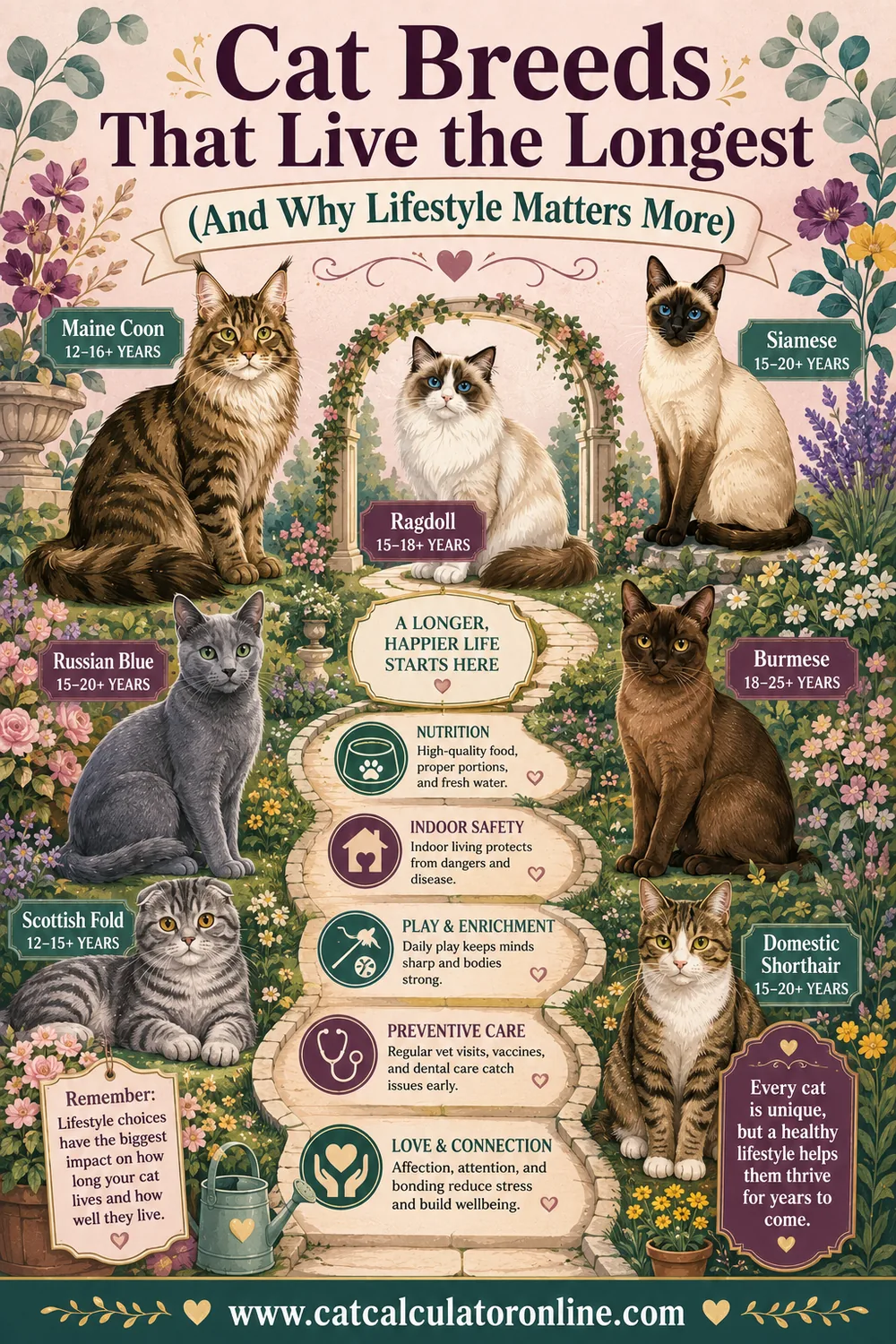
Cat Breed Lifespan Chart (30+ Breeds)
This is a lookup chart for 40 cat breeds, and before you scroll to it, one thing is worth knowing: every number on it is an estimate from a small dataset, not a measurement. Nobody counts every cat of a breed. These ranges come from insurance claims, veterinary practice records and breed club surveys, each capturing a different slice of the population — which is why breed sources usually quote higher figures than veterinary studies do. Use the chart to compare breeds against each other and to see which health problems to ask a breeder about. Do not use it to predict how long one particular cat will live, because lifestyle beats breed by a wide margin. Convert your own cat's age with our cat age calculator.
How To Read This Chart
Three caveats, and they matter more than any individual row.
These are ranges, not averages, and different sources disagree. Breed clubs describe cats owned by experienced enthusiasts who health test. Veterinary record studies include every cat of that breed who walks into a practice, including those bought with no testing behind them. The second group always looks worse.
Sample sizes for rare breeds are tiny. For a Singapura or a Korat, the entire published evidence might be a few hundred cats across several countries. Treat those rows as informed guesses.
Lifestyle outweighs breed, comprehensively. Indoor cats commonly live 12 to 18 years while cats with free outdoor access average dramatically less. That single difference is larger than the gap between the top and bottom of this chart.
One more thing the chart cannot show: the spread within a breed. Two Ragdolls from the same litter, one indoors and lean and one roaming and heavy, can differ by more years than any two breeds in the table — which is the point our Ragdoll lifespan guide opens with.
The Full Cat Breed Lifespan Chart
| Breed | Typical lifespan | Main health watch point |
|---|---|---|
| Abyssinian | 12 to 16 years | Kidney amyloidosis, retinal atrophy (DNA test) |
| American Shorthair | 15 to 20 years | Heart disease; generally very robust |
| Balinese | 15 to 20 years | Amyloidosis, asthma; a longhaired Siamese |
| Bengal | 12 to 16 years | Retinal atrophy and PK deficiency (both DNA testable), HCM |
| Birman | 14 to 16 years | HCM, kidney problems in some lines |
| Bombay | 15 to 20 years | Skull shape in some lines; generally sturdy |
| British Shorthair | 12 to 17 years | Obesity, HCM, polycystic kidney disease (DNA test) |
| Burmese | 16 to 18 years | Diabetes risk, hypokalaemia (DNA test) |
| Burmilla | 12 to 16 years | Polycystic kidney disease (DNA test) |
| Chartreux | 12 to 15 years | Hip dysplasia, patellar luxation |
| Cornish Rex | 12 to 16 years | Cold sensitivity, skin and heart issues |
| Devon Rex | 12 to 16 years | Congenital myasthenic syndrome (DNA test), HCM |
| Domestic longhair | 13 to 17 years | Age-related disease; matting if not groomed |
| Domestic shorthair | 13 to 17 years | Obesity, dental disease, age-related disease |
| Egyptian Mau | 12 to 15 years | HCM, occasional asthma |
| Exotic Shorthair | 12 to 15 years | Flat-face breathing, PKD (DNA test), eye ulcers |
| Havana Brown | 12 to 15 years | Small gene pool; few specific conditions |
| Himalayan | 12 to 15 years | Flat-face breathing, PKD (DNA test) |
| Japanese Bobtail | 14 to 18 years | Generally robust; few breed conditions |
| Korat | 15 to 19 years | Gangliosidosis (DNA test) |
| Maine Coon | 10 to 15 years | HCM (DNA test plus scans), hip dysplasia, SMA |
| Manx | 12 to 15 years | Spinal defects linked to taillessness |
| Munchkin | 12 to 15 years | Skeletal problems from the dwarfism gene |
| Norwegian Forest Cat | 12 to 16 years | GSD IV (DNA test), HCM, hips |
| Ocicat | 12 to 18 years | HCM, PK deficiency in some lines |
| Oriental Shorthair | 12 to 16 years | Amyloidosis, asthma, dental disease |
| Persian | 12 to 17 years | Flat-face breathing, PKD (DNA test), eye ulcers |
| Ragamuffin | 12 to 16 years | HCM, PKD in some lines |
| Ragdoll | 12 to 17 years | HCM (DNA test), FIP in young cats |
| Russian Blue | 15 to 20 years | Bladder stones; otherwise very healthy |
| Savannah | 12 to 15 years | HCM, PK deficiency; legal limits on early generations |
| Scottish Fold | 11 to 15 years | Painful cartilage and joint disease in all folded cats |
| Selkirk Rex | 13 to 16 years | PKD and HCM from Persian and BSH ancestry |
| Siamese | 15 to 20 years | Amyloidosis, asthma, some cancers |
| Siberian | 12 to 18 years | HCM; generally hardy |
| Singapura | 11 to 15 years | PK deficiency (DNA test), very small gene pool |
| Somali | 12 to 16 years | Retinal atrophy and PK deficiency (DNA tests) |
| Sphynx | 12 to 15 quoted, lower in records | HCM at high rates, skin and dental disease |
| Tonkinese | 14 to 18 years | Asthma, gingivitis |
| Turkish Angora | 12 to 18 years | Deafness in blue-eyed whites, heart disease |
| Turkish Van | 12 to 17 years | HCM, deafness in some white cats |
The Long-Lived Group And What They Share
Look at the top of the chart and a pattern jumps out.
Siamese, Balinese, Oriental, Burmese, Tonkinese, Korat and Russian Blue are all small to medium, fine-boned cats with no exaggerated features. No shortened face, no giant frame, no folded cartilage, no missing coat. Structurally they are close to what a cat looks like when nobody is designing it.
They also come from older breeding traditions with reasonably wide gene pools, which keeps recessive disease genes from concentrating the way they do in newer breeds built from a handful of founders.
Even here, though, the specific conditions are worth naming. Siamese and Oriental lines carry a risk of amyloidosis — an abnormal protein deposits in the liver or kidneys — and asthma is more common in them than in most breeds. Our Siamese cat lifespan guide covers what that looks like day to day.
And the ranking is not a shopping list. Our page on the cat breeds that live the longest goes into which breeds top the tables and why lifestyle still overrides all of it.
The Shorter-Lived Group And Why
The bottom of the chart divides into three clear categories, each with a mechanism.
The giants. Maine Coons sit lowest among the popular breeds, at 10 to 15 years. Larger body size correlates with shorter life across mammals, and the breed also carries a well-documented heart mutation. Our Maine Coon lifespan guide explains both.
The flat faces. Persians, Exotic Shorthairs and Himalayans have shortened skulls with the same soft tissue inside, which narrows the airway and crowds the teeth, and prominent eyes in shallow sockets that injure easily. The full picture is in our Persian cat lifespan guide.
The structurally altered. Scottish Folds deserve a direct sentence: the gene that folds the ears affects cartilage throughout the body, so every folded cat has some degree of a painful joint and bone disease. Several countries restrict or discourage breeding them for that reason. Manx cats carry spinal risks tied to taillessness, and Munchkins carry skeletal risks tied to the dwarfism gene.
And the Sphynx sits apart. The quoted range is 12 to 15, but veterinary record analyzes place hairless cats near the bottom of breed life-expectancy tables, driven mainly by an unusually high rate of heart disease.
Which Breeds Have A DNA Test Worth Asking For
This is the most actionable column in the whole chart, so here it is on its own.
| Condition | Breeds where it is tested | What the test does |
|---|---|---|
| PKD1 (kidney cysts) | Persian, Exotic, Himalayan, British Shorthair, Burmilla | Definitive yes or no; dominant, so one copy causes disease |
| HCM A31P | Maine Coon | Lowers risk; does not rule the disease out |
| HCM R820W | Ragdoll | Lowers risk; does not rule the disease out |
| GSD IV | Norwegian Forest Cat | Prevents affected kittens entirely |
| PRA-b | Bengal | Prevents inherited blindness entirely |
| PK deficiency | Bengal, Somali, Abyssinian, Singapura, Maine Coon | Prevents inherited anemia entirely |
| Congenital myasthenic syndrome | Devon Rex, Sphynx | Prevents affected kittens entirely |
| Hypokalaemia | Burmese | Prevents affected kittens entirely |
Recessive conditions are the clean ones. Two carriers should never be mated, and a breeder who tests simply does not produce affected kittens. Ask for written results on both parents.
Heart disease is the messy one. Even where a DNA test exists, cats without the mutation still develop HCM, so cardiac ultrasound remains the real screening tool for every breed where it is a concern.
Why Breed Is A Weak Predictor Anyway
Having built the chart, it is only fair to say how little it decides.
Mixed-breed cats outlive pedigrees by roughly one to two years on average, because unrelated parents rarely carry the same faulty recessive gene. Our page on whether mixed-breed cats live longer works through the genetics.
The conditions that kill most cats are not inherited at all. Chronic kidney disease, hyperthyroidism, diabetes, dental disease, arthritis and cancer are age-related. They affect every breed and every mixed-breed cat, and a long-lived cat meets more of them, not fewer.
Obesity is the commonest health problem in owned cats and it ignores pedigree entirely. You should be able to feel a cat's ribs easily under a flat palm, with a visible waist from above, whatever the breed.
And the single biggest number on this page is not in the table. Indoor cats commonly live 12 to 18 years while cats with free outdoor access average dramatically less, and the causes are traffic, infectious disease and predation rather than old age.
Choosing A Breed With Longevity In Mind
If lifespan genuinely is part of your decision, here is how to use the chart properly.
Prefer unexaggerated shapes. A normal muzzle, normal legs, normal ears and a moderate body size will do more for a cat's health than any specific breed name on the list.
Prioritize the breeder over the breed. A screened Persian from a breeder with written PKD results and open nostrils is a better bet than an unscreened cat from a breed higher up the chart. Where you buy from matters more than what you buy.
Ask for the paperwork before you meet the kittens. It is much harder to walk away once a kitten is asleep on you. Request DNA certificates and recent cardiac ultrasound reports by email first.
Then do the things that outweigh all of it. Keep her indoors or build a catio, keep her lean, brush her teeth, and from about eleven book two vet visits a year with bloods, urine and blood pressure. Our guide on how to help your cat live longer ranks every lever by how much it is actually worth.
And call a vet the same day for: straining in the litter box without producing urine, open-mouthed or labored breathing, sudden hind-leg weakness, sudden blindness, collapse, or a refusal to eat lasting 24 hours.
Frequently Asked Questions
Which cat breed lives the longest?
Siamese, Balinese, Burmese, Russian Blue, Bombay and American Shorthair are consistently at the top, commonly reaching 15 to 20 years with some passing 20. They share a moderate body size, fine bone structure and no exaggerated facial or skeletal features.
Which cat breeds have the shortest lifespans?
Sphynx cats sit lowest in veterinary record analyzes, mainly because of a high rate of heart disease. Maine Coons average 10 to 15 years because of size and an inherited heart mutation, and flat-faced breeds such as Persians and Exotics sit below average.
How accurate are cat breed lifespan figures?
They are estimates from small datasets rather than measurements. Breed club surveys, insurance claims and veterinary records each cover a different population, which is why published figures disagree. Use them to compare breeds, not to predict one individual cat's lifespan.
Do pedigree cats live shorter lives than mixed-breed cats?
On average, slightly. Mixed-breed cats outlive pedigrees by roughly one to two years because unrelated parents rarely carry the same recessive fault. The gap between individual breeds is far larger than the gap between pedigree and mixed-breed as categories.
Are Scottish Folds unhealthy?
The gene that folds their ears affects cartilage throughout the body, so every folded cat carries some degree of a painful bone and joint condition. Several countries restrict or discourage breeding them, and the condition cannot be bred out while the fold remains.
What health tests should I ask a cat breeder for?
Ask for written DNA results on both parents for the conditions relevant to that breed, plus recent cardiac ultrasound reports where heart disease is a concern. Request them by email before visiting, since walking away is much harder once you have met the kittens.
Use this chart the way a vet would: as a prompt for which questions to ask, not as a prediction. It tells you that a Persian needs a PKD certificate, that a Maine Coon needs both a DNA result and a heart scan, that a Bengal has two conditions you can simply test away, and that a Scottish Fold's ears come with a cost nobody can breed out. What it cannot tell you is how long your cat will live, because the numbers that decide that are not in the table — indoors or out, lean or heavy, teeth brushed or not, and whether her bloods get checked twice a year once she passes eleven. Start by working out her age in human terms with the cat age calculator.