Maine Coon Lifespan: How Long Do They Live?
Most Maine Coons live somewhere between 10 and 15 years, which is shorter than the average cat — and the reason is not a mystery. Two things work against them. The first is size: Maine Coons are the largest domestic breed, and across cat breeds the giants tend to live shorter lives than the small, fine-boned ones. The second is a specific inherited heart condition, hypertrophic cardiomyopathy, which runs strongly in the breed and often gives no warning at all. Both of those are partly manageable, and a well-bred indoor Maine Coon reaching 15 or 16 is not unusual. Work out where your own cat sits with our cat age calculator.
How Long Do Maine Coons Actually Live?
Start with the honest caveat, because breed lifespan figures are shakier than they look.
The usual quoted range is 10 to 15 years, with some sources stretching it to 12 to 16. All of these come from relatively small datasets — breed club surveys, insurance claims and veterinary records — and each one measures a slightly different population of cats. A range with reasons behind it is more useful than a confident single number.
Where the numbers do agree is on the direction. Maine Coons sit below the overall feline average rather than above it, and large studies using veterinary records tend to give figures lower than the ones breed clubs publish. That gap is worth knowing about when a breeder quotes you 16 to 18.
What shifts an individual cat within the range is mostly not genetic. An indoor, neutered, lean Maine Coon whose heart has been screened has a very different outlook from an overweight outdoor one, even from the same litter.
And the breed has one advantage worth naming. Maine Coons are late maturers who are not physically finished until three to five years old, and they stay playful well into middle age. A twelve-year-old Maine Coon often behaves like a much younger cat, which makes early illness easier to spot.
Why The Biggest Breed Is Not The Longest-Lived
The size-lifespan trade-off is one of the more reliable patterns in domestic animals, and Maine Coons sit at the sharp end of it.
Within a species, bigger individuals tend not to live longer. It is stark in dogs, where a Great Dane rarely reaches the age a terrier takes for granted. In cats the effect is milder because the size range is so much narrower, but it points the same way: the small, fine breeds like Siamese top the longevity lists and the giants do not.
A bigger body carries more of everything. More tissue for cancers to arise in, more load on the joints, more work for a heart that is not proportionally larger. None of that is dramatic on its own; together it shaves years off the average.
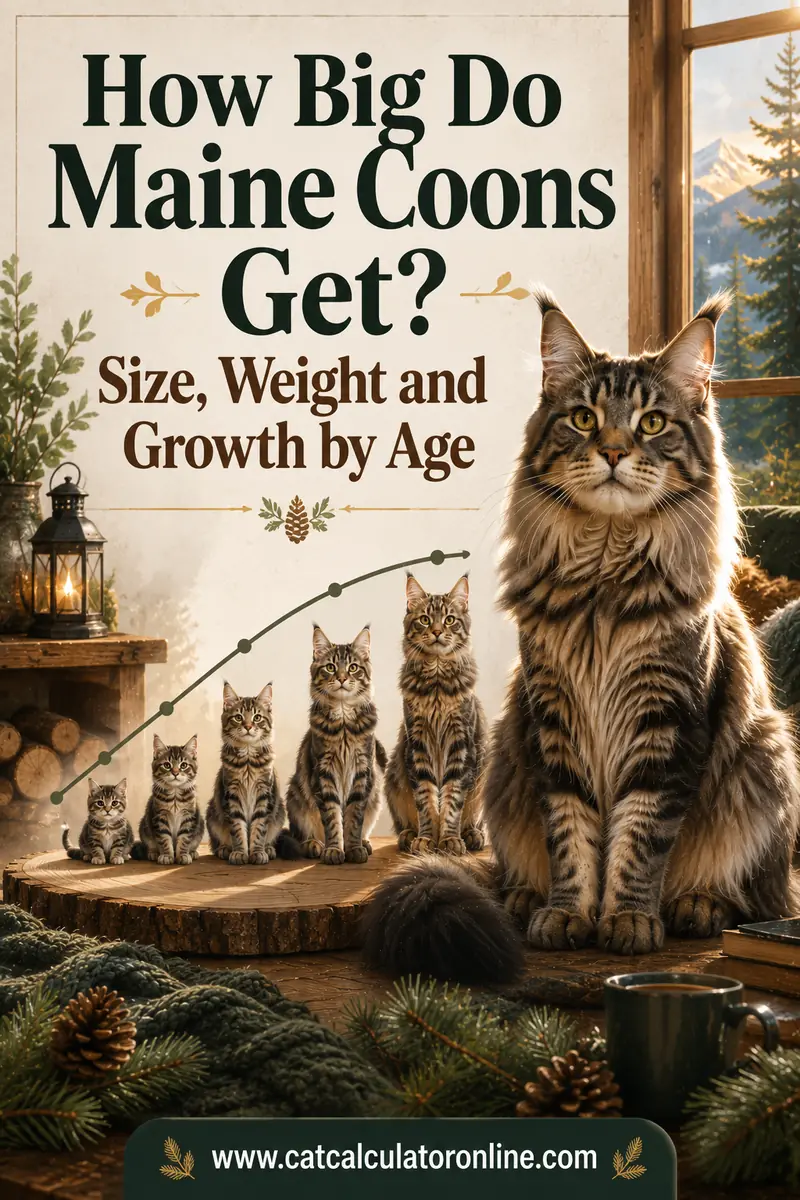
Male Maine Coons commonly reach 13 to 18 lb (6 to 8 kg), with some well over 20 lb (9 kg); females usually sit at 8 to 12 lb (3.6 to 5.4 kg). Those are lean weights, not maximums. Our guide on how big Maine Coons get has the growth curves by age.
Compare that with the Norwegian Forest Cat, the other big semi-longhair. Similar build, similar climate origins, similar joint and heart concerns — and a broadly similar lifespan pattern, as our Norwegian Forest Cat lifespan guide sets out.
HCM: The Heart Condition That Defines The Breed
If you own a Maine Coon, this is the section that matters most.
Hypertrophic cardiomyopathy thickens the muscular wall of the heart, so the chamber holds less blood and fills less easily. It is the commonest heart disease in cats generally, and Maine Coons are one of the breeds where it clearly runs in families.
Maine Coons have their own mutation, and it is DNA testable. The A31P variant of the MYBPC3 gene was identified in this breed specifically, and a cheek swab will tell you whether a cat carries one copy, two, or none. Cats with two copies are at meaningfully higher risk.
Here is the nuance most breeders will tell you and most websites will not: a clear DNA test does not mean a cat will never develop HCM. Plenty of DNA-negative Maine Coons still develop the disease, which means other genes are involved that we have not identified. The DNA test reduces risk; it does not remove it.
That is why screening by ultrasound matters. A cardiologist scanning the heart can see thickening directly. Breeding cats are typically scanned annually. For a pet cat, it is worth asking your vet whether a scan is sensible, particularly if a murmur is heard or a relative has been diagnosed.
Two emergencies to recognize. Sudden hind-leg paralysis with crying and cold back paws is an arterial blood clot, and it is agonising — go straight to a vet. Fast or open-mouthed breathing at rest suggests fluid on the lungs, which is also same-day urgent.
Hip Dysplasia And Joints
Hip dysplasia is a dog problem in most people's minds. In Maine Coons it is a real feline one.
The hip joint develops as a loose, poorly fitting socket, so the surfaces grind rather than glide. Over years that produces arthritis. Maine Coons have the highest reported rates of any cat breed, plausibly because their size loads the joint more heavily.
Cats almost never limp with it. They redistribute. What you actually see is a cat who has quietly stopped jumping onto the worktop, who takes the stairs one at a time, who lands heavily, or who has started using a lower spot to sleep. Owners usually put it down to age.
It is very treatable. Weight control, joint supplements, environmental changes such as steps and low-sided litter boxes, and modern pain relief all help enormously. Our guide to arthritis in cats covers what to ask for.
Breeders can screen. Hip X-rays scored against a recognized scheme are available, and a breeder who scores their breeding cats is doing something meaningful. Ask.
The Two DNA-Testable Conditions
These are the easy wins, because the tests are cheap, accurate and widely used.
Spinal muscular atrophy (SMA) is a recessive condition that shows up at three to four months. Affected kittens develop a swaying hind end and lose muscle over the hips, because the nerve cells supplying those muscles die off. It is not painful and not fatal, and affected cats can live reasonably normal indoor lives — but they cannot jump properly and should never be outdoors.
Pyruvate kinase deficiency affects red blood cells. Without enough of the enzyme, red cells break down early and the cat becomes anemic, often intermittently. Signs are vague: lethargy, pale gums, poor appetite. Also recessive, also DNA testable.
Both need two copies to cause disease, which is the whole point of testing. A carrier cat is entirely healthy. Breeders test so they never mate two carriers together, and that alone prevents affected kittens.
What to ask for as a buyer: written DNA results for HCM (A31P), SMA and PK deficiency on both parents, plus a recent cardiac ultrasound on the breeding cats. A breeder who has these will produce them happily.
Maine Coon Lifespan By Circumstances
| Situation | Realistic expectation | The reason |
|---|---|---|
| Indoor, neutered, lean, screened lines | 13 to 16 years | Most controllable risks removed |
| Indoor, neutered, overweight | 10 to 13 years | Joint load, diabetes risk, harder anaesthetics |
| Indoor with untested HCM background | Highly variable | Heart disease can strike young and silently |
| Outdoor access | Dramatically shorter on average | Traffic, fights, disease, and a big slow cat is not agile |
| Affected by HCM, diagnosed early | Often years of good life | Medication and monitoring do help |
| Affected by HCM, found late | Poor | Clots and heart failure present suddenly |
The pattern in that table is the point. Almost every row is decided by owner choices rather than by breed.
Weight: The Lever You Actually Control
With a giant breed, "he is just big-boned" hides a lot.
Judge by feel, not by the number on the scale. Run a flat palm along his side. You should feel the ribs easily under a thin covering. From above, there should be a visible waist behind the ribcage. A 17 lb (7.7 kg) Maine Coon can be perfectly lean; a 17 lb Siamese is obese. Our guide to average cat weight by breed puts the ranges side by side.
Maine Coons hide fat in their coat and their frame. A dense double coat and a long body disguise a couple of extra pounds completely. Hands beat eyes here, every time.
Extra weight is worse in this breed than in most. It loads hips that may already be poorly formed, and it makes a heart that may already be thickened work harder. Those two risks compound rather than add.
Slim down slowly, and never by withholding food. A cat who stops eating can develop a dangerous liver condition within days. Aim for roughly 0.5 to 2 percent of body weight lost per week, with measured portions and a vet-supervised plan.
What To Watch At Home
Maine Coons are stoic, sociable cats who mask illness well. These are the checks worth building into normal life.
Count sleeping breaths once a month. With your cat properly asleep and settled, count chest rises for 30 seconds and double it. Under about 30 breaths a minute is normal. Consistently above that, especially with any effort, is the earliest home sign of heart failure and is worth a vet call.
Weigh him monthly and write it down. Half a pound of loss is about five percent of body weight in an average cat, and it is invisible to the eye. In an older cat, unexplained loss is a symptom rather than a success.
Watch what he has stopped doing. Abandoned high perches, hesitating before a jump, or sleeping on the floor instead of the shelf usually mean joints, not personality.
Groom him properly. That coat mats behind the ears, in the armpits and along the trousers, and matted skin gets sore and infected. Ten minutes twice a week beats an hour of untangling.
Call the vet the same day for: sudden hind-leg weakness or crying, open-mouthed or labored breathing, collapse, refusing food for 24 hours, or straining in the litter box without producing urine. For everything else, our guide on how to help your cat live longer covers the routine that matters most, and our cat breed lifespan chart shows how the breed compares.
Frequently Asked Questions
How long do Maine Coon cats live?
Most Maine Coons live 10 to 15 years, slightly below the feline average. Indoor living, a lean body condition and buying from lines screened for heart disease all push a cat toward the upper end. Individual outcomes vary widely.
Why do Maine Coons have shorter lifespans than other cats?
Two reasons. They are the largest domestic breed, and across cat breeds larger body size tends to correlate with a shorter life. They also have a high inherited rate of hypertrophic cardiomyopathy, a heart-muscle disease that can strike suddenly.
Can Maine Coon heart disease be tested for?
Partly. A DNA test detects the breed-specific MYBPC3 A31P mutation, and responsible breeders use it. But DNA-negative Maine Coons still develop hypertrophic cardiomyopathy, so cardiac ultrasound by a specialist remains the definitive screening tool.
Do Maine Coons get hip dysplasia?
Yes, more than any other cat breed. It rarely shows as a limp. Instead a Maine Coon stops jumping onto high surfaces, lands heavily, or picks lower resting spots. It is very manageable with weight control, pain relief and easier access around the house.
What is a healthy weight for a Maine Coon?
Male Maine Coons commonly weigh 13 to 18 lb (6 to 8 kg) and females 8 to 12 lb (3.6 to 5.4 kg), with some males considerably heavier. Judge condition by feel: ribs easily felt under a flat palm and a visible waist from above.
At what age is a Maine Coon considered senior?
Cats are generally classed as senior from about eleven, and that applies to Maine Coons too, though many owners notice slowing earlier because of joint wear. Twice-yearly vet checks with bloodwork from eleven are the single most valuable habit.
A Maine Coon is one of the great cats to live with — huge, gentle, oddly dog-like, and never quite as grown up as her size suggests. The trade-off is a lifespan that runs a little short, driven by size and by one specific heart disease. You cannot change the size. You can absolutely change the rest: buy from lines with DNA and cardiac screening on paper, keep her indoors or in a secure catio, keep her lean enough that you can feel the ribs with a flat hand, and count her sleeping breaths once a month so that a heart problem is found early rather than suddenly. From about eleven, book two vet visits a year with bloodwork. Check her age in human terms with our cat age calculator.