Accident-Only vs Comprehensive Cat Insurance
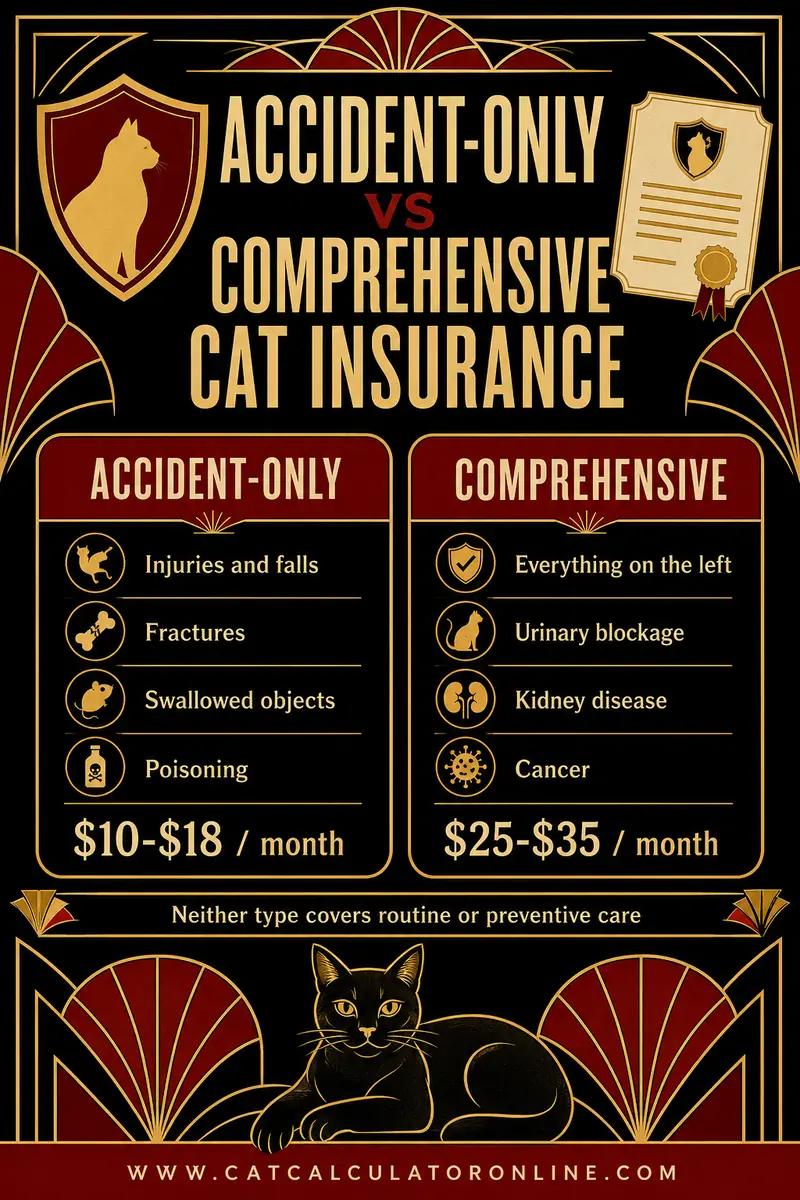
Accident-only cover pays for injuries — falls, fractures, swallowed string, toxin ingestion — and typically costs $10 to $18 a month. Comprehensive cover, properly called accident-and-illness, adds everything your cat is statistically far more likely to need: urinary blockage, kidney disease, hyperthyroidism, diabetes, cancer and dental disease, usually for $25 to $35 a month. That extra $15 or so buys protection against the majority of what cats actually claim for, which is why accident-only suits a narrower set of situations than its price suggests. The cat cost calculator helps you see how either premium fits your cat's yearly budget.
What Does Each Type of Policy Cover?
The dividing line is simple: **accident-only pays when something happens to your cat; comprehensive also pays when something goes wrong inside your cat.**
| Accident-only | Accident + illness | |
|---|---|---|
| Fractures and injuries | ✅ | ✅ |
| Swallowed objects | ✅ | ✅ |
| Toxin ingestion | ✅ | ✅ |
| Bite wounds and abscesses from fights | ✅ | ✅ |
| Urinary blockage and FLUTD | ❌ | ✅ |
| Chronic kidney disease | ❌ | ✅ |
| Hyperthyroidism | ❌ | ✅ |
| Diabetes | ❌ | ✅ |
| Cancer | ❌ | ✅ |
| Heart disease | ❌ | ✅ |
| Dental disease | ❌ | ✅ |
| Infections and viruses | ❌ | ✅ |
| Vomiting, diarrhea, IBD | ❌ | ✅ |
| Routine care (both) | ❌ | ❌ |
| Pre-existing conditions (both) | ❌ | ❌ |
Neither type covers routine care or anything pre-existing — those exclusions are universal, and they're set out in what cat insurance covers.
One nuance worth knowing: the boundary is occasionally blurry. An abscess from a cat fight is usually treated as accident-related, since the injury caused it. But if that abscess leads to a systemic infection, the follow-on treatment may be classed as illness. Ask a prospective insurer how they handle infection arising from injury.
How Much Does Each One Cost?
For a healthy adult domestic shorthair in the US:
| Policy type | Typical monthly | Typical annual |
|---|---|---|
| Accident-only | $10–$18 | $120–$216 |
| Accident + illness | $25–$35 | $300–$420 |
| Difference | ~$15/month | ~$180/year |
So the upgrade costs roughly $180 a year for an adult cat. That figure is worth holding onto, because it's the number every other comparison in this article turns on.
The gap widens with age. Accident-only premiums stay remarkably flat across a cat's life — a twelve-year-old is no more likely to fall off a shelf than a three-year-old — while accident-and-illness premiums climb steeply, because illness claims rise sharply with age. By the senior years the difference can be $50 a month or more, which is exactly when the illness cover is most valuable. The full curve is in cat insurance cost by age.
That divergence explains something that otherwise looks odd: accident-only becomes relatively cheaper as your cat ages, and simultaneously less adequate.
What Do Cats Actually Claim For?
This is the question that settles the decision, and the answer is lopsided.
The conditions that dominate feline veterinary spending are almost all illnesses:
- Urinary tract disease, including the blocked-bladder emergency disproportionately common in male cats
- Chronic kidney disease, the most common serious diagnosis in older cats
- Hyperthyroidism, very common past ten
- Diabetes
- Cancer, with lymphoma the most frequent
- Dental disease, including tooth resorption
- Gastrointestinal disease, including IBD and pancreatitis
- Heart disease, notably hypertrophic cardiomyopathy
Accidents certainly happen — foreign bodies, falls, road traffic injuries, fight wounds — and they can be expensive. But they're a minority of what most cats need over a lifetime, and they're concentrated in cats with outdoor access.
Here's the asymmetry in plain terms. An accident-only policy protects against events that are dramatic but uncommon. A comprehensive policy protects against those plus the conditions that are quiet, expensive and near-inevitable as a cat ages. Paying less to exclude the likely category is the structural weakness of accident-only cover.
When Does Accident-Only Genuinely Make Sense?
It isn't a bad product — it's a narrow one. Four situations where it's a reasonable choice:
Your cat is past the age cap for illness cover. Many insurers stop accepting new accident-and-illness enrollments somewhere in the low-to-mid teens but will still sell accident-only. For a fifteen-year-old newly adopted cat, accident-only may be the only cover available, and some protection beats none.
You have substantial savings and want catastrophe protection only. If you could comfortably absorb $3,000 of illness treatment but would rather not face a surprise $4,000 surgical bill, accident-only is a coherent, cheap hedge.
Your budget genuinely won't stretch further. $12 a month you can sustain for years beats $32 a month you cancel after eight months. Continuous cheap cover has real value; lapsed good cover has almost none.
Your cat has extensive pre-existing exclusions. If a twelve-year-old already has kidney disease and hyperthyroidism on record, much of what comprehensive cover would add is excluded anyway. The upgrade buys less than it would for a healthy cat.
Where it rarely makes sense: a healthy young indoor cat whose owner can afford the difference. That cat's realistic future costs are overwhelmingly illness-shaped, and it's at the age where illness cover is cheapest and everything is still coverable.
Does an Indoor Cat Need Only Accident Cover?
This is the most common reasoning behind choosing accident-only, and it gets the risk backwards.
Indoor cats do have fewer accidents — no traffic, no territorial fights, fewer falls. That's real. But indoor life doesn't reduce illness risk at all, and on a couple of measures it slightly increases it: indoor cats are more prone to obesity, which is linked to diabetes, and they live considerably longer than outdoor cats, which means more years in the age bracket where kidney disease, hyperthyroidism and cancer appear.
So the logic inverts. An indoor cat is the profile for which accident-only cover makes least sense, because it strips out the category the cat is most likely to need while economising on the category it's least exposed to.
An outdoor cat, by contrast, faces genuine accident risk on top of the full illness risk — which argues for comprehensive cover, not for accident-only.
What Does the Upgrade Actually Buy You?
Put the $180 a year against realistic bills. These are typical US treatment ranges for common feline conditions that accident-only excludes entirely:
| Condition | Typical cost | Years of the $180 gap it equals |
|---|---|---|
| Urinary blockage | $1,500–$3,000 | 8–17 years |
| Dental extractions | $800–$2,000 | 4–11 years |
| Hyperthyroidism treatment | $500–$2,500 | 3–14 years |
| Diabetes (per year) | $1,000–$2,500 | 6–14 years |
| Kidney disease (per year) | $1,000–$3,000 | 6–17 years |
| Cancer (full course) | $4,000–$10,000+ | 22–55 years |
A single blocked-bladder emergency — genuinely common, and the reason many cat owners first discover what an emergency clinic charges — costs more than a decade of the premium difference.
That doesn't make comprehensive cover automatically correct. Insurance is a transfer of risk, not a money-making scheme, and a cat that stays healthy for sixteen years will have cost you more in premiums than it returned. But it does mean the upgrade is priced sensibly relative to what it covers, which is more than can be said for many insurance add-ons.
Is There Anything in Between?
Yes, and it's worth knowing about before defaulting to the cheaper tier.
Accident-and-illness with a high deductible. Rather than dropping illness cover entirely, take comprehensive cover with a $750 or $1,000 deductible. You keep protection against kidney disease and cancer while cutting the premium substantially. For most owners weighing accident-only on cost grounds, this is the better structure — you're economising on when cover starts rather than on what's covered at all.
Accident-and-illness with a lower reimbursement percentage. Dropping from 90% to 70% reduces the premium while keeping the full range of conditions eligible. Less good than raising the deductible, since the percentage costs you on every claim forever, but still better than excluding illness.
Time-limited or benefit-schedule illness cover. Cheaper comprehensive policies that cap each condition at a fixed amount or cover it for only twelve months. These genuinely do include illness, but weakly — check the caps before assuming they solve the problem.
The general principle: narrow the cover's depth before you narrow its breadth. A policy that covers everything shallowly usually protects a cat better than one that covers half of it well, because you can't predict which half you'll need. The trade-offs are laid out in how to choose a cat insurance plan.
What Does an Accident-Only Claim Actually Pay?
Worth walking through, because "covered" and "reimbursed in full" are different things on both policy types.
Your cat swallows a length of ribbon and needs surgery. The invoice comes to $3,200. You hold an accident-only policy with a $250 deductible and 80% reimbursement.
The foreign body is unambiguously an accident, so the claim is eligible. You pay the $250 deductible, then 20% of the remaining $2,950 — that's $590. The insurer reimburses $2,360 and your share is $840, plus the year's premiums of roughly $170.
That's a good outcome, and it shows accident-only doing exactly what it's built for. On this claim it performed identically to a comprehensive policy at the same settings.
Now change one detail. Same cat, same year, but instead of swallowing ribbon it blocks and needs emergency catheterisation and hospitalisation for $2,400. On accident-only, the reimbursement is zero. The condition is an illness, so no deductible applies, no percentage applies, and the policy simply doesn't engage.
Those two scenarios are the whole argument in miniature. Accident-only isn't weaker cover for the things it covers — the payout arithmetic is the same. It's that the list of things it covers excludes most of what happens to cats.
How Do the Two Compare Over a Whole Life?
Monthly figures hide the shape, so it's worth summing across a cat's life. Take a cat insured continuously from kitten to sixteen.
Accident-only premiums stay fairly flat, since injury risk barely changes with age — call it $12 a month early, rising gently to perhaps $20 in the senior years. Across sixteen years that's roughly $2,700 in lifetime premiums.
Accident-and-illness premiums climb steeply: around $20 a month as a kitten, $30 through the young adult years, $45 in the mature years, and $70–$90 through the senior stretch. That comes to roughly $7,500 in lifetime premiums.
So comprehensive cover costs about $4,800 more across a cat's life. Whether that's money well spent depends entirely on what the illness cover ends up absorbing.
For a cat that develops nothing serious, it's $4,800 spent on protection you never drew on. For a cat that has one urinary blockage at four ($2,500), dental extractions at nine ($1,400), and kidney disease management from twelve to sixteen ($1,500 a year), the illness claims alone total around $9,900 — of which a standard policy would reimburse a substantial majority.
The second scenario is not the unlucky case. It's a fairly ordinary feline life. That asymmetry — where the "typical" outcome favors the more expensive policy — is unusual among insurance products and is the strongest argument for comprehensive cover in cats specifically.
What Should You Ask Before Buying Either Type?
Six questions that apply to both tiers and expose most of the difference between a good policy and a cheap one:
- Is illness cover included, and is it lifetime or time-limited? A comprehensive policy that stops covering a condition after twelve months solves much less than it appears to for chronic feline disease.
- How is an infection arising from an injury classified? This is the genuine gray area between the two tiers, and answers vary.
- What's the annual limit, and is it per year or per condition for life? A per-condition lifetime cap exhausts permanently.
- Is dental disease covered, and are there conditions attached? Many insurers require evidence of routine dental checks before paying.
- What's the upper age limit for new enrollment, on each tier? Accident-only often accepts cats that illness cover won't.
- Does the policy pay on actual vet cost or a benefit schedule? A schedule paying $400 toward a $2,600 bill is a very different product regardless of tier.
Ask these before comparing prices rather than after. Two quotes $10 apart frequently differ on three of these six points, and the cheaper one is usually cheaper for a reason you'd want to know about.
Can You Switch From Accident-Only to Comprehensive Later?
Usually yes, but rarely on the terms you'd hope for, and this is the trap in "start cheap and upgrade later".
When you add illness cover, the insurer treats that cover as new. Two things follow:
- New waiting periods apply to the illness portion, typically 14–30 days.
- A fresh pre-existing screen runs against your cat's full record. Anything that appeared while you held accident-only is excluded from the new illness cover — permanently.
So a cat insured accident-only from age two, upgraded at age seven, brings five years of accumulated veterinary notes to the upgrade. Every one of them is now a potential exclusion on the illness cover you're finally buying.
Some insurers handle in-house upgrades more generously than others, and it's worth asking directly rather than assuming. But the general rule holds: the cheap-now-upgrade-later plan usually costs more in lost cover than it saves in premiums.
If you expect to want illness cover eventually, starting with it is nearly always better than arriving at it. The wider case is weighed in is cat insurance worth it.
Frequently Asked Questions
What is the difference between accident-only and comprehensive pet insurance?
Accident-only covers injuries — fractures, swallowed objects, toxin ingestion, wounds. Comprehensive, or accident-and-illness, adds illness cover: urinary disease, kidney disease, hyperthyroidism, diabetes, cancer and dental disease. Neither covers routine care or pre-existing conditions.
Is accident-only cat insurance worth it?
It's worth it in specific situations: a senior cat past the age cap for illness cover, an owner with savings who wants catastrophe protection only, or a budget that genuinely can't stretch further. For a healthy young cat whose owner can afford the difference, it excludes the category cats most commonly claim for.
How much more does comprehensive cat insurance cost?
Roughly $15 a month more for an adult cat — about $180 a year. The gap widens with age, because accident-only premiums stay fairly flat while illness premiums climb. A single urinary blockage typically costs more than a decade of that difference.
Does accident-only insurance cover a cat swallowing string?
Yes. A linear foreign body is an accident, and surgery to remove it — often $2,000–$4,000 — is normally covered by accident-only policies. That's one of the clearest cases where this cheaper tier does real work.
Can I upgrade from accident-only to full cover later?
Usually, but the illness portion is treated as new cover: fresh waiting periods apply and a new pre-existing screen runs against your cat's whole record. Anything that appeared while you held accident-only is likely to be excluded, which is why starting with comprehensive cover is generally better.
Do indoor cats only need accident cover?
No — arguably the opposite. Indoor cats have fewer accidents but the same or slightly higher illness risk, partly because they live longer and reach the ages where kidney disease, hyperthyroidism and cancer appear. Accident-only strips out the category an indoor cat is most likely to need.
The honest summary: accident-only is real cover for a narrow slice of risk, and comprehensive is cover for the slice cats actually live through. If cost is the reason you're considering the cheaper tier, look at a high-deductible comprehensive policy first — it usually protects your cat better for a similar premium. Whichever you choose, put the figure into the cat cost calculator alongside food, litter and routine care, or check the current premium bands in how much cat insurance costs per month.