Cat Years vs Dog Years: Why They Age Differently
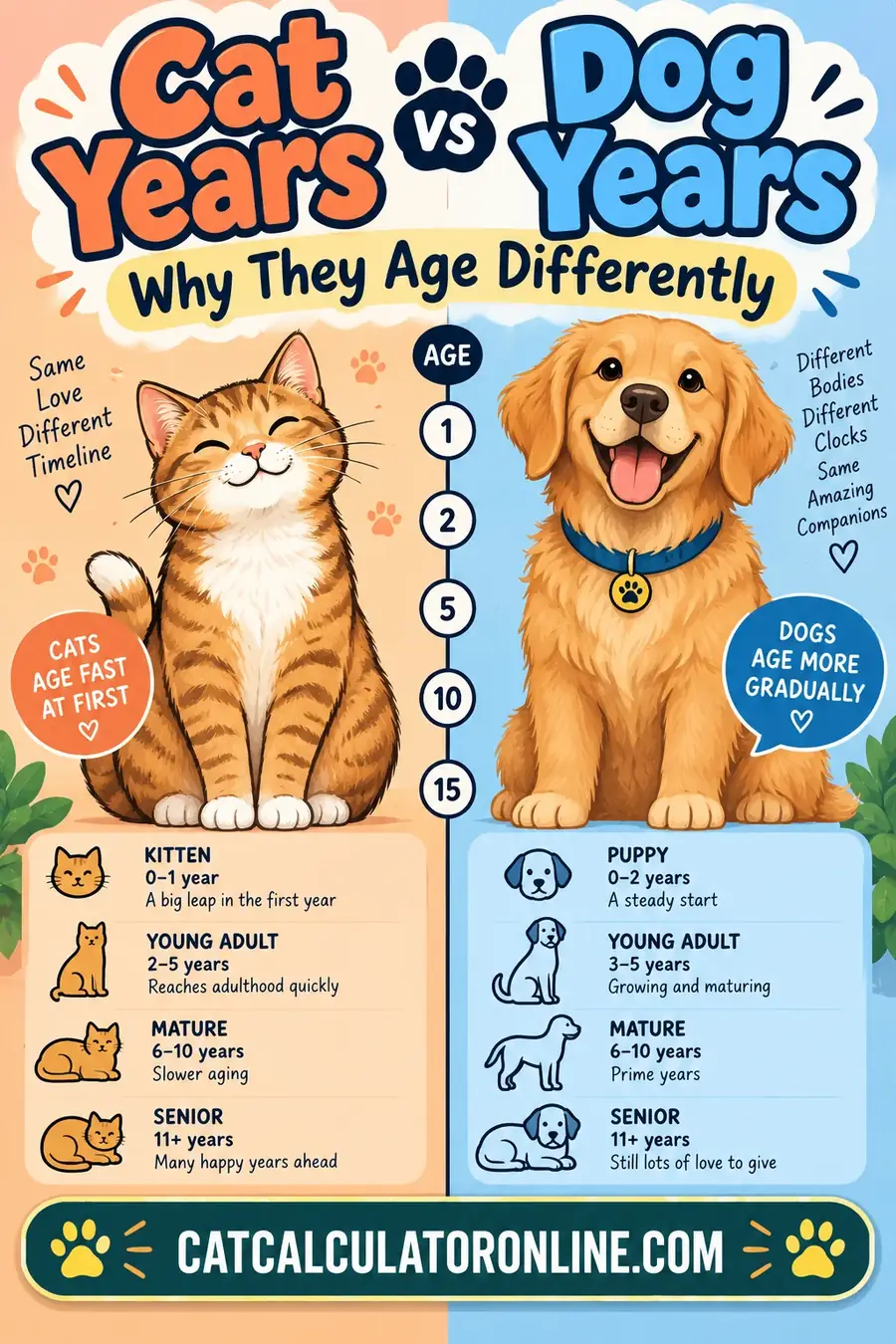
Cats and dogs both age fast early and slow later, but the key difference is size: a dog's aging rate depends heavily on how big it is, while a cat's barely does. A Chihuahua and a Great Dane age at meaningfully different rates. A Siamese and a Maine Coon roughly don't.
That single difference explains most of why the two conversions don't match.
Side-by-Side Chart
| Age | Cat | Small dog | Large dog |
|---|---|---|---|
| 1 year | 15 | 15 | 15 |
| 2 years | 24 | 24 | 24 |
| 4 years | 32 | 32 | 37 |
| 6 years | 40 | 40 | 49 |
| 8 years | 48 | 48 | 61 |
| 10 years | 56 | 56 | 73 |
| 12 years | 64 | 64 | 85 |
| 15 years | 76 | 76 | 97+ |
Cats and small dogs track closely. Large dogs diverge sharply from about year three onward.
Why Size Matters for Dogs
Dogs vary in adult weight by a factor of around fifty — from roughly 4 pounds to over 200. No other domestic species has that range.
The leading explanation for why large dogs age faster is growth rate. A Great Dane goes from about a pound at birth to over 100 pounds within eighteen months. That's an extraordinary amount of cell division in a short window, and it's associated with higher rates of cellular damage and cancer risk across the animal's lifetime.
Large breeds also tend to develop age-related joint and cardiac conditions earlier. The practical result: a 7-year-old Great Dane is treated as geriatric while a 7-year-old Chihuahua is comfortably middle-aged.
Why Size Barely Matters for Cats
Domestic cats vary in adult weight roughly from 6 to 20 pounds — a factor of about three, compared with fifty for dogs. That's simply not enough variation to produce the same effect.
There are mild breed tendencies. Some larger breeds like Maine Coons trend slightly shorter-lived; some smaller ones like Siamese trend longer. But the difference is measured in a year or two, not the five-to-seven-year gap between dog size classes.
The practical upshot: one cat formula works for essentially all cats. Dogs need three.
Lifespan Comparison
| Typical range | |
|---|---|
| Indoor cat | 12-18 years, often 20+ |
| Outdoor cat | Substantially less, commonly cited at 2-5 in high-risk areas |
| Small dog (under 20 lb) | 12-16 years |
| Medium dog (20-50 lb) | 10-14 years |
| Large dog (50-90 lb) | 8-12 years |
| Giant dog (90+ lb) | 6-10 years |
Indoor cats out-live nearly every dog category, which is partly biology and substantially environment — an indoor cat avoids traffic, predators, fights and most infectious disease exposure in a way that even a well-cared-for dog does not.
What's the Same
The early curve. Both species pack roughly 15 human-equivalent years into year one and reach about 24 by year two. Both reach sexual maturity and near-full size within that window.
The mechanism. Rapid development to reproductive maturity, then a slower adult phase. This is the general mammalian pattern, humans included.
The myth. "Multiply by seven" is wrong for both, and for the same reason — it treats aging as linear when it plainly isn't.
When Each Becomes "Senior"
This is where the difference has practical consequences:
| Animal | Senior at roughly |
|---|---|
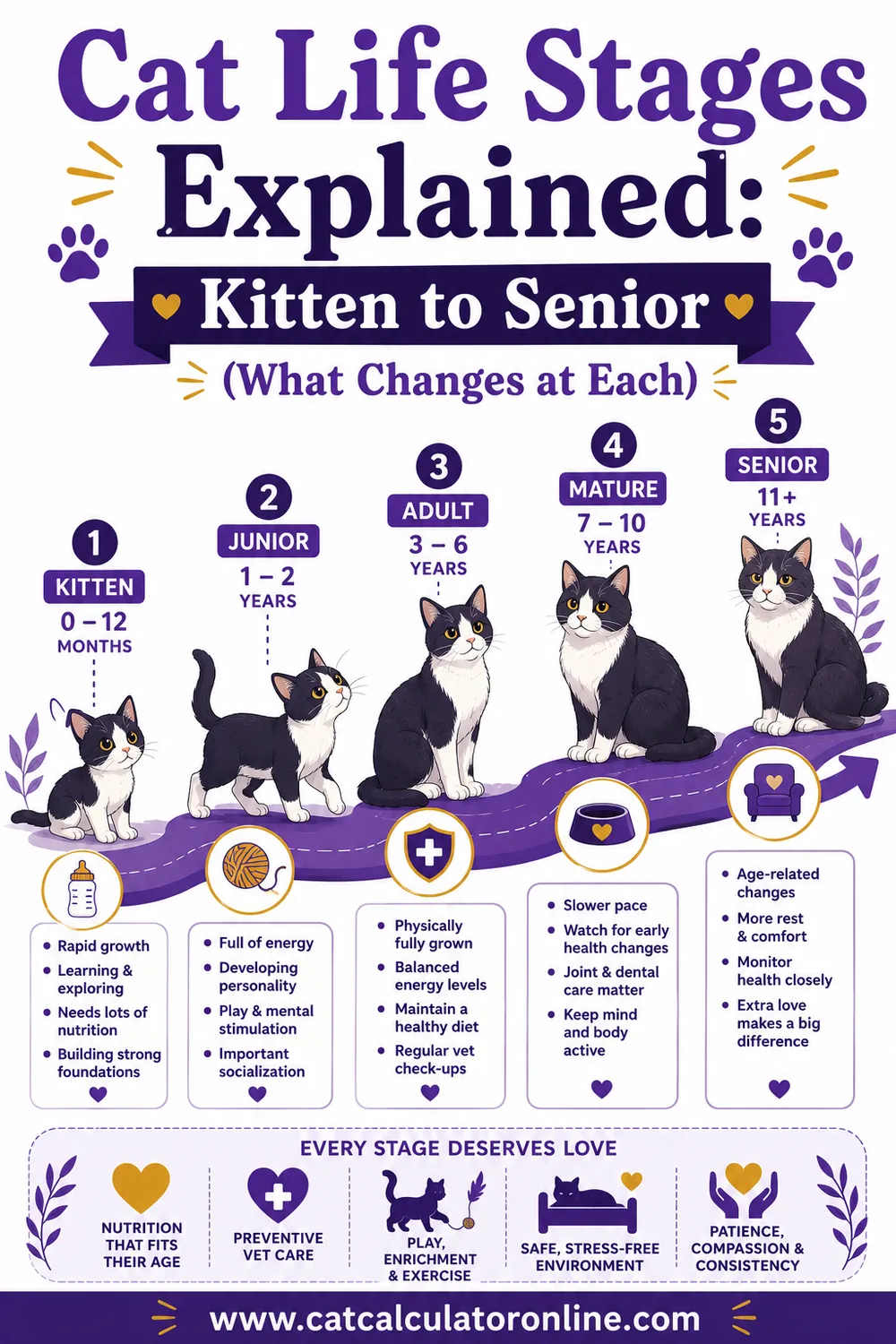
| Cat | 11-12 years |
| Small dog | 10-12 years |
| Medium dog | 8-10 years |
| Large dog | 7-8 years |
| Giant dog | 5-6 years |
A giant-breed dog may need senior-level veterinary screening at five while a cat of the same age is squarely in her prime. Owners of both species in the same household frequently get this wrong in one direction or the other.
For exact figures on either, a cat age calculator handles the cat side, and the dog years explanation covers the size-adjusted dog formula.
Households With Both
A few things worth knowing if you have both:
Don't apply the same aging assumptions. A 9-year-old cat and a 9-year-old Labrador are at different life stages — she's mature, he's approaching senior.
Senior diets and screening schedules differ. Cats are obligate carnivores with different protein requirements, and senior cat nutrition addresses kidney function in a way senior dog food doesn't.
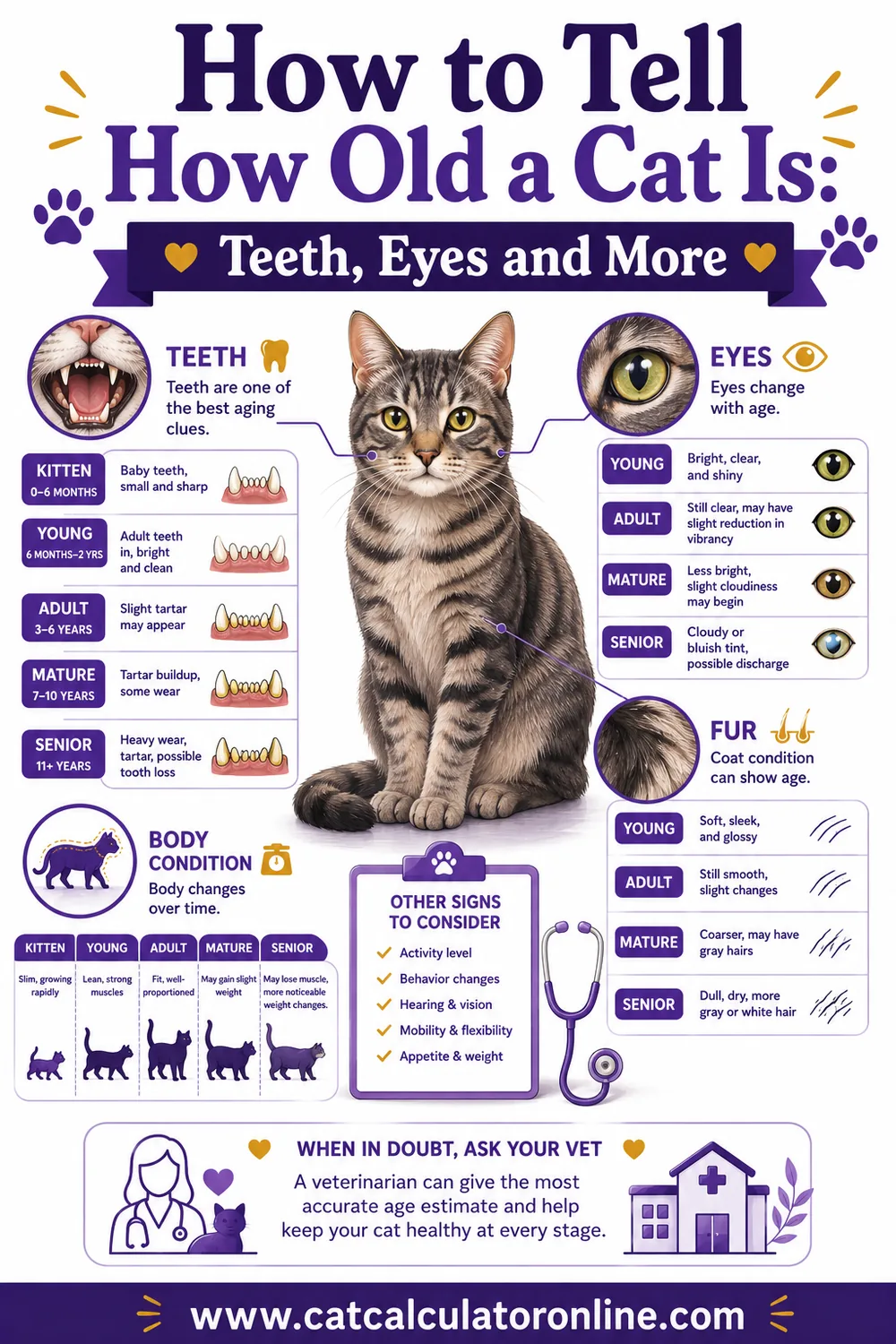
Aging signs differ too. Dogs often show age through mobility — stiffness, slower stairs. Cats hide decline much more effectively and often show it first through subtle changes in grooming, jumping, drinking or litter box habits. A cat that stops jumping to a favorite perch is telling you something.
Why the Two Species Diverge
The underlying biology is worth a paragraph, because it explains the whole difference.
Dogs vary enormously in adult size. Selective breeding has produced adult weights from roughly four pounds to over two hundred — a fiftyfold range within a single species, which is essentially unique among domestic animals. That range is what creates the size-dependent aging effect.
Cats don't. Domestic cats span roughly six to twenty pounds, a threefold range. There simply isn't enough variation for a comparable effect to emerge, which is why one conversion formula serves all cats and dogs need three.
The mechanism appears to be growth rate. Large dogs achieve enormous size in a short window, involving vastly more cell division than a small dog undergoes. That's associated with higher lifetime cancer incidence and earlier onset of age-related conditions. Cats, growing to a fairly consistent size regardless of breed, don't experience the same divergence.
Both species front-load development in the same way, which is why the first two years look nearly identical across cats, small dogs and large dogs. The divergence begins in adulthood, not in puppyhood or kittenhood.
Practical Differences in Care
Senior thresholds differ substantially. A cat is generally considered senior around 11-12. A giant-breed dog may be senior at five or six. Owners with both frequently misjudge one of them.
Aging signs differ. Dogs typically show age through mobility — stiffness, reluctance on stairs, slower walks. Cats conceal decline far more effectively and often show it first through subtle changes: reduced grooming, no longer jumping to a favorite perch, changes in drinking or litter box habits.
Screening priorities differ. Senior cat screening focuses heavily on kidney function and thyroid levels, the two most common serious conditions in older cats. Senior dog screening weights differently, with more emphasis on cardiac and joint issues depending on breed.
Nutrition differs. Cats are obligate carnivores with different protein requirements, and senior cat diets address renal considerations in ways senior dog food doesn't. The two are not interchangeable.
Dental disease affects both, and is under-treated in both. It's among the most common conditions in cats and small dogs alike, and among the most consequential for overall health.
A Combined Reference
| Human equivalent | Cat is | Small dog is | Large dog is |
|---|---|---|---|
| 24 | 2 years | 2 years | 2 years |
| 32 | 4 | 4 | ~3.5 |
| 40 | 6 | 6 | ~4.5 |
| 48 | 8 | 8 | ~6 |
| 56 | 10 | 10 | ~7 |
| 64 | 12 | 12 | ~8.5 |
| 76 | 15 | 15 | ~10 |
Reading across a row shows the divergence clearly: at the point a cat and a small dog are both around 56 in human terms, a large dog reaching the same equivalent is three years younger in calendar terms.
Households With Both
Practical points for anyone keeping cats and dogs together, since the aging difference has day-to-day consequences.
Don't assume equivalent ages. A nine-year-old cat and a nine-year-old Labrador are at genuinely different life stages. She's mature; he's approaching senior. Their screening schedules should differ accordingly.
Feed them separately, and not just for behavior reasons. Cat food is higher in protein and formulated for obligate carnivores; dog food lacks taurine at the levels cats require. Long-term cross-feeding causes real problems in both directions.
Watch the senior cat's access. An aging cat with reduced mobility needs escape routes and elevated resting places that remain reachable. A boisterous younger dog in the same house makes this more important, not less.
Expect the cat to hide decline. Dogs advertise discomfort; cats conceal it. In a mixed household it's easy for the more demonstrative animal to absorb the attention while the cat quietly stops jumping onto a favorite shelf.
Litter box height matters for older cats. Arthritic cats stop using boxes with high sides, and the resulting accidents get misread as behavioral.
The Numbers in One Place
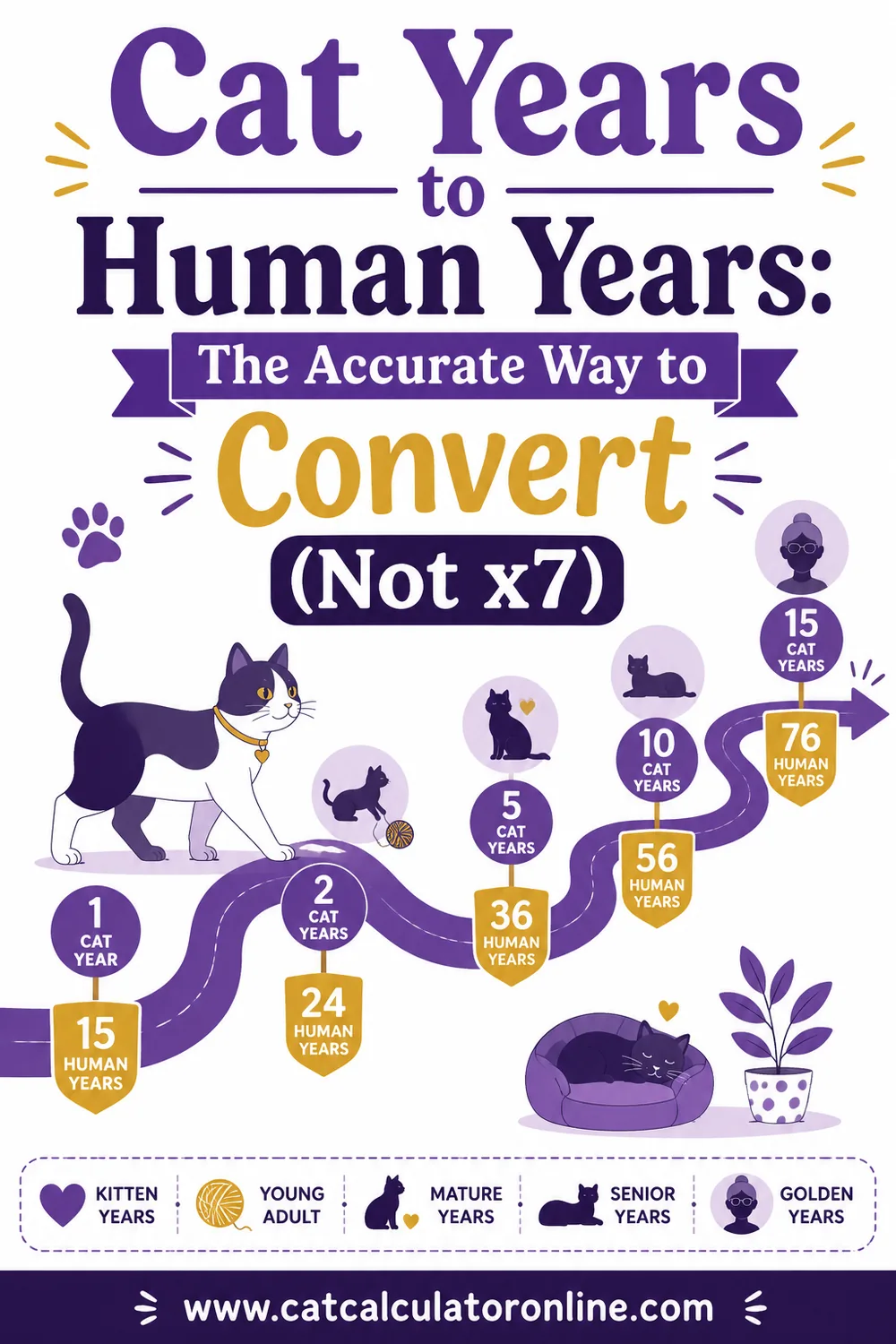
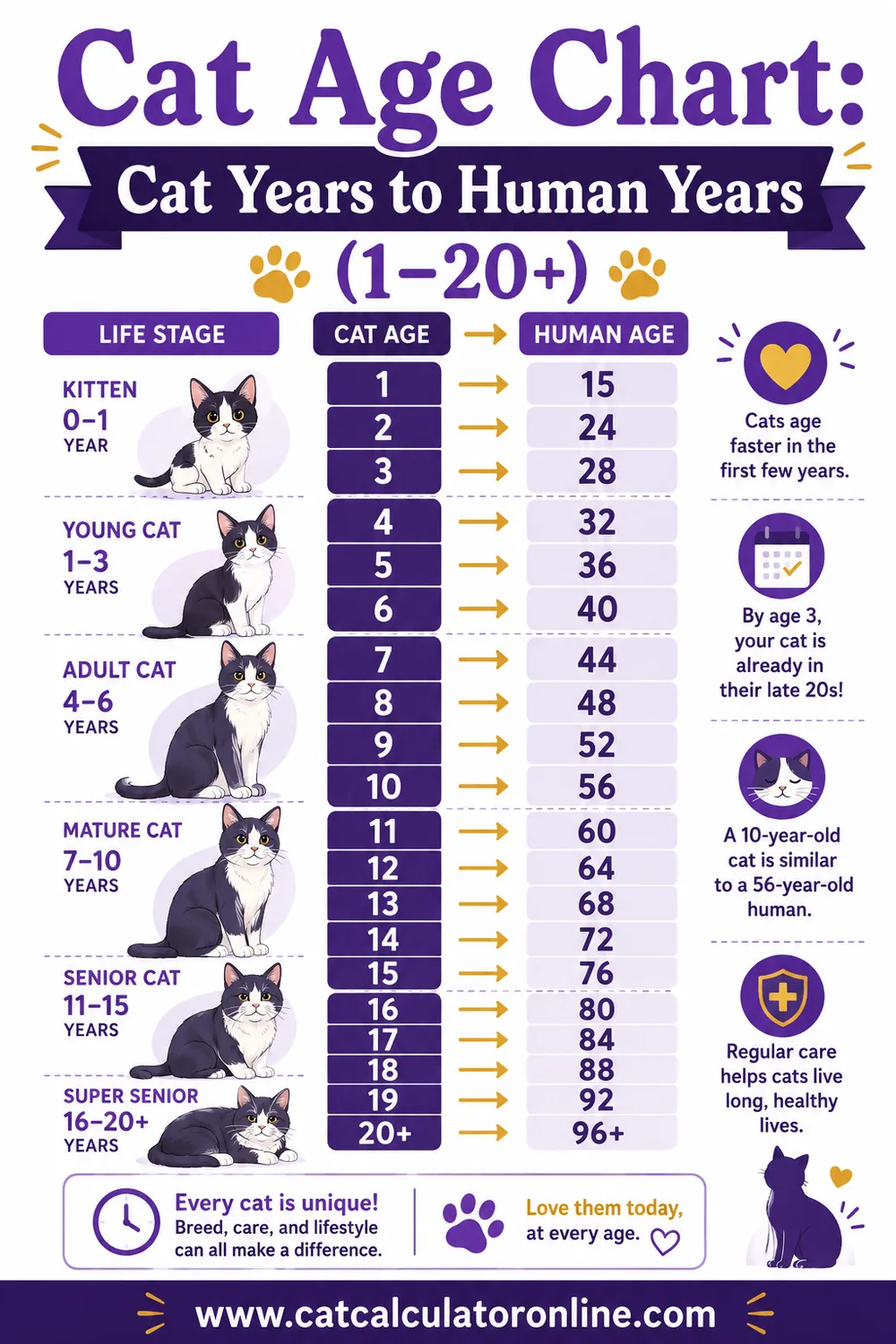
Cat: 15 at year one, 24 at year two, then +4 annually.
Small dog (under 20 lb): 15, then 24, then +4 annually. Effectively identical to a cat.
Medium dog (20-50 lb): 15, then 24, then roughly +5 annually.
Large dog (50-90 lb): 15, then 24, then roughly +6 annually.
Giant dog (90+ lb): 15, then 24, then roughly +7 to +9 annually.
The shared first two years across every category is the part people find most surprising, and it's the clearest evidence that early development is a separate process from adult aging.
Which Species Lives Longer, and Why
The short answer is cats, and the reasons are a mix of biology and circumstance.
Body size. Within mammals generally, larger species live longer. Within a species, the reverse frequently holds — and dogs demonstrate this unusually clearly. Cats sit at a size where the trade-offs are favorable.
Metabolic and reproductive factors. Cats reach maturity fast and then age slowly, a pattern associated with longer overall lifespans in small mammals.
Lifestyle. This is the largest single factor and it's environmental rather than biological. An indoor cat faces almost none of the mortality risks a dog faces on daily walks, at parks, and around traffic.
Veterinary intervention. Both species benefit, though cats are historically taken to a vet less frequently than dogs — which slightly offsets their biological advantage in practice.
Selective breeding pressure. Dogs have been bred for extreme size and shape variation in ways that carry health costs. Cats have been bred far less intensively for physical extremes, and the breeds that have been show similar health penalties.
Quick Reference
Cat: 15 at year one, 24 at year two, +4 annually thereafter. One formula for all breeds.
Dog: 15 at year one, 24 at year two, then +4 to +9 annually depending on adult size.
Senior threshold: cats around 11-12; small dogs 10-12; large dogs 7-8; giant breeds 5-6.
The reason they differ: dogs span a fiftyfold range in adult weight and cats span a threefold range. Size drives the divergence, and cats don't have enough of it.
Are Cat Years the Same as Dog Years?
Short answer: the same idea, different arithmetic.
Are there cat years like dog years? Yes — both species use the same kind of conversion, and both curves have the same shape. A fast first year worth about 15 human years, a second year worth about 9 more, then a slower steady climb. If you already know the dog version, you know the structure of the cat one.
Are cat years the same as dog years in practice, though? No, for one reason above all: size. Adult dogs range from 4 pounds to 200, and the aging rate changes across that range, so a dog conversion needs a size band before it can give you a number. Cats vary by a few pounds, so one flat rate after year two covers almost every cat you will meet.
The practical difference in a household with both:
- After year two, a cat gains about 4 human-equivalent years annually.
- A small dog gains about 4 to 5; a large dog 6 to 9.
- So a cat and a small dog age at nearly the same rate, while a large dog pulls away quickly.
At age 10 that means a cat near 56, a small dog near 64, and a giant breed already past 80.
Frequently Asked Questions
Do cats live longer than dogs? On average, yes — particularly indoor cats, who commonly reach 12 to 18 years and sometimes past 20. Only the smallest dog breeds approach that range, and large breeds fall well short.
Why do large dogs age faster than small dogs? The leading explanation is their extremely rapid growth to a much larger adult size, which involves far more cell division and is associated with higher cancer risk and earlier onset of age-related conditions.
Does breed size affect how cats age? Only slightly. Domestic cats vary in size far less than dogs do, so one conversion formula works for essentially all breeds, with minor tendencies — Maine Coons a little shorter-lived, Siamese a little longer.
At what age is a cat considered senior compared to a dog? Cats are generally considered senior around 11 to 12 years. Dogs vary enormously by size — a giant breed may be senior at five or six, while a small breed isn't until 10 to 12.