How Much Is Pet Insurance for a Cat? Average Costs by Age and Coverage
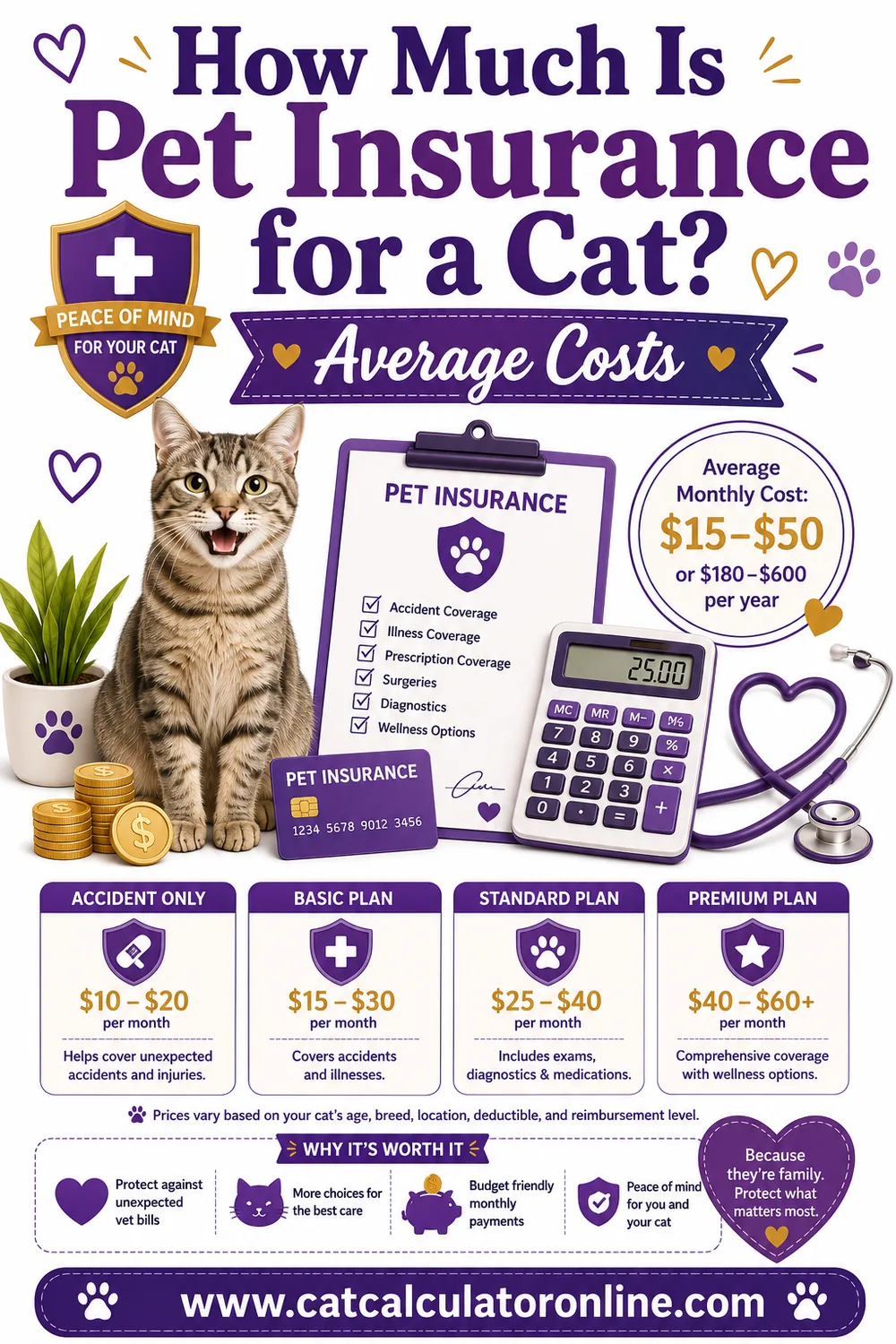
Pet insurance for a cat averages about $25–$35 per month for accident-and-illness coverage in the US — roughly $300 to $450 a year. Accident-only plans, which skip illness, run much cheaper at about $10–$15 per month. Cats are generally cheaper to insure than dogs, but your exact price still depends on your cat's age, breed, where you live, and the deductible and reimbursement levels you pick.
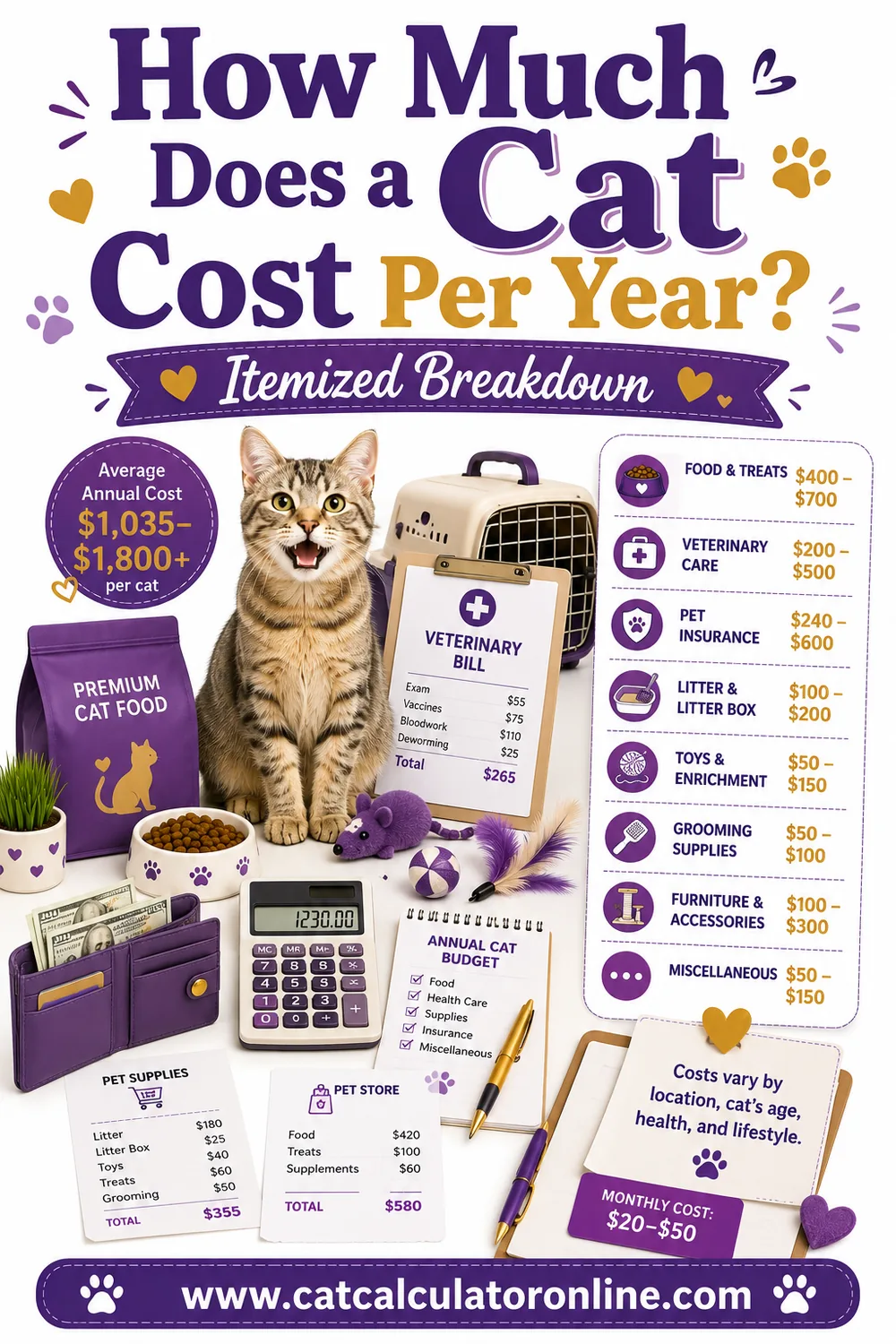
If you want to see how a premium fits into the full picture of what your cat costs you each year, the free cat cost tools put it in context. And below, the mini-tool lets you tap a coverage type or age to see the typical monthly range before you request a single quote.
🐱 Typical monthly cat insurance premium
Tap a coverage type or cat age to see the usual range:
Tap a button above to see the typical monthly range. These are averages — get real quotes for your cat.
Average Pet Insurance Cost for Cats
For the standard product — an accident-and-illness plan with common settings (around 80% reimbursement, a $250 deductible, and a mid-range annual limit) — most US cat owners see quotes in the $25–$35 per month band. That's roughly $300 to $450 a year. Accident-only plans, which cover injuries but nothing for sickness, are far cheaper at about $10–$15 per month, though they won't touch the infections, kidney disease, cancers, and dental problems that drive most vet bills as cats age.
| Plan type | Typical monthly cost | What it covers |
|---|---|---|
| Accident-only | $10–$15 | Injuries: broken bones, swallowed string, bite wounds |
| Accident + illness | $25–$35 | Injuries plus sickness, cancer, urinary and kidney issues |
| Accident + illness + wellness | $35–$55 | Adds routine-care reimbursement (exams, vaccines, dental cleaning) |
Treat these as orientation ranges, not promises. The same cat can get quotes that differ noticeably between insurers, which is exactly why understanding the factors below — and comparing a few real quotes — matters.
Average Cost by Age and Coverage
Age is the single biggest driver of a cat's premium, because older cats simply claim more. Here's how a typical accident-and-illness plan tends to move:
| Cat's age | Accident + illness (typical/mo) | Accident-only (typical/mo) |
|---|---|---|
| Kitten (under 1 yr) | $20–$28 | $9–$13 |
| Young adult (1–6 yrs) | $22–$35 | $10–$14 |
| Mature adult (7–10 yrs) | $35–$50 | $12–$18 |
| Senior (10+ yrs) | $45–$70+ | $15–$22 |
The pattern is clear: enrolling a kitten or young cat locks in the lowest price and gets you covered before anything becomes a pre-existing condition. Wait until your cat is a senior and you'll pay two to three times as much for the same plan — if an insurer will take a new senior enrollment at all, since some cap the age at which you can first sign up.
How Cat Insurance Reimbursement Works
Pet insurance doesn't work like human health insurance. In almost every case, you pay the vet first, then file a claim and get reimbursed. The flow looks like this:
- You visit any licensed vet, ER, or specialist and pay the bill yourself.
- You file a claim with your insurer (usually a photo of the itemized invoice through an app).
- The insurer applies your deductible, then reimburses the covered percentage of what's left.
- The money comes back to you by direct deposit or check, typically within days to a couple of weeks.
Three settings decide how much you actually get back:
- Deductible — what you pay out of pocket each year before reimbursement starts (commonly $100, $250, or $500).
- Reimbursement rate — the percentage of the remaining covered cost you get back (usually 70%, 80%, or 90%).
- Annual limit — the most the plan will pay out in a policy year (from a few thousand dollars up to unlimited).
Here's a quick example. Say your cat needs a $1,000 procedure, and you have a $250 deductible with 80% reimbursement. You subtract the $250 deductible, leaving $750. The insurer pays 80% of that — $600 — and you're left paying $400 total. Change any of those three dials and the math shifts.
The Factors That Set Your Premium
Age
As the table above shows, age matters most. Kittens and young cats are cheapest; premiums climb through the mature-adult years and rise steeply once a cat is a senior. Your premium generally goes up at renewal even in a claim-free year, both because your cat is a year older and because vet costs keep inflating. Budget for the price you'll pay at age 12, not just today's quote.
Breed
Cats vary less by breed than dogs do, but it still counts. Purebreds with documented health predispositions cost more to insure — think Persians and other flat-faced breeds (breathing and eye issues), Maine Coons (heart conditions), and Bengals. The common domestic shorthair and longhair — the everyday "mixed-breed cat" — is usually the cheapest to cover.
Location
Insurance is priced against local vet costs, so your ZIP code moves the number. Owners in high-cost metros like New York, San Francisco, and Seattle often pay noticeably more than owners in lower-cost states for identical coverage, simply because the same surgery costs more downtown.
Deductible, Reimbursement, and Limit
These are the dials you actually control:
- Higher deductible = lower premium. Moving from a $100 to a $500 deductible cuts the monthly price, since you're covering more of the small stuff yourself.
- Lower reimbursement rate = lower premium. A 70% plan costs less than a 90% plan, but leaves you paying a bigger share at claim time.
- Lower annual limit = lower premium, though jumping from a $5,000 to an unlimited limit often costs surprisingly little and protects against exactly the big events insurance exists for.
A sensible default for many cat owners: 80% reimbursement, a $250 deductible, and a $10,000-or-higher annual limit. Adjust from there based on how much cash cushion you keep.
What Cat Insurance Doesn't Cover
Every plan has exclusions, and knowing them upfront saves painful surprises:
- Pre-existing conditions. Anything your cat showed signs of before coverage started (or during the waiting period) is excluded. This is the number-one reason to enroll while your cat is young and healthy.
- Waiting periods. Coverage doesn't start the instant you pay. Accidents often have a short waiting period of a few days; illnesses commonly wait around 14 days; some orthopedic conditions wait longer.
- Routine and preventive care — vaccines, spay/neuter, flea prevention, dental cleanings — unless you add a wellness plan.
- Cosmetic or elective procedures and, on most plans, breeding-related costs.
Always read the specific policy. Two plans at the same monthly price can exclude very different things.
How to Lower Your Cat Insurance Cost
Without gutting the coverage that makes insurance useful:
- Enroll while your cat is young. This is the single most valuable move — it starts you at the bottom of the age curve and keeps future conditions coverable before they can be labeled pre-existing.
- Raise the deductible to $250 or $500, and keep that amount in savings instead of paying for a low-deductible plan.
- Skip the wellness add-on unless the math clearly favors it — it mostly pre-pays predictable costs with a fee attached.
- Ask about discounts. Multi-pet discounts (often 5–10%), annual-pay discounts, and employer benefit programs are common.
- Compare at least three quotes for your exact cat. Spreads of $10–$20 a month between insurers for the same coverage are routine.
- Consider accident-only on a tight budget. At $10–$15 a month it covers the sudden traumatic stuff, and partial protection genuinely beats none.
One caution: switching insurers later restarts pre-existing-condition exclusions. Anything diagnosed under your old policy becomes pre-existing under the new one, so hopping between carriers to save a few dollars can quietly erase your most valuable coverage.
Is the Premium Worth It?
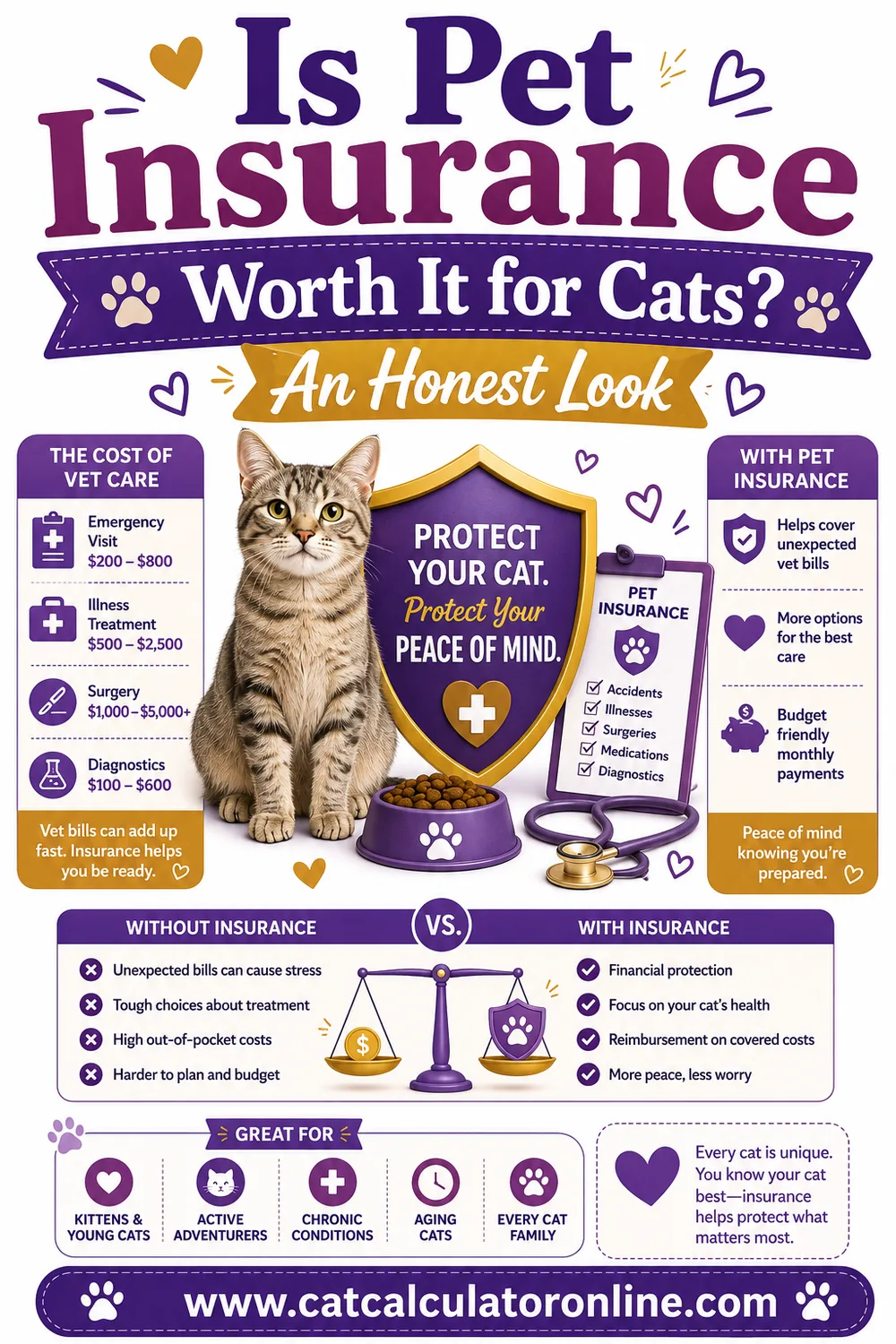
That's a separate question from what it costs, and it comes down to how you'd handle a surprise $2,000–$5,000 bill. If an unexpected emergency would strain your finances, the monthly premium buys real peace of mind. If you have a solid savings cushion and the discipline to leave it alone, self-insuring — setting aside what you'd have paid in premiums — can work too. We walk through that decision in full, including the self-insurance math, in is pet insurance worth it for cats. And to see how a premium sits alongside food, litter, and vet care, the yearly cost breakdown puts the whole budget in one place.
FAQ
How much is pet insurance for a cat per month?
Most US cat owners pay about $25–$35 per month for accident-and-illness coverage. Kittens and young cats can come in around $20–$28; senior cats and flat-faced breeds can run $45–$70 or more. Accident-only plans are much cheaper at roughly $10–$15 a month.
Why is cat insurance cheaper than dog insurance?
Cats tend to have fewer size-related and breed-specific health issues, lower average vet bills, and less variation between breeds. That generally makes them cheaper to insure — dog premiums commonly run $40–$70 a month versus $25–$35 for cats.
Does cat insurance get more expensive as my cat ages?
Yes. Expect increases at most renewals, accelerating in the senior years. By age 12 a premium is often two to three times its kitten-age level, both because your cat is older and because vet costs keep rising. Factor the senior-years price into your decision, not just today's quote.
What does cat insurance not cover?
Pre-existing conditions, anything inside the waiting period, and — unless you add a wellness plan — routine care like vaccines, spay/neuter, and dental cleanings. Cosmetic and elective procedures are typically excluded too.
What deductible should I choose for my cat?
If you have a few hundred dollars of cushion, a $250 deductible usually hits a good balance: cheaper than a $100 deductible while keeping coverage kicking in reasonably fast. Pick the highest deductible you could comfortably pay tomorrow.
Can I use any vet with cat insurance?
Effectively yes. Because most plans reimburse you rather than paying the vet directly, you can use any licensed vet, emergency clinic, or specialist. You pay the bill, file the claim, and get the covered portion back.
Get a Number You Can Trust
Now you can read any cat insurance quote intelligently: age, breed, ZIP, deductible, reimbursement, and annual limit — that's the whole formula. Get two or three real quotes for your cat, pick sensible dials, and slot the result into your budget. Then explore the rest of our free cat calculators and guides to see the complete picture of what your cat needs at every life stage.