Hairless Cat Breeds
Two things surprise people about hairless cats. The first: almost none of them are truly bald. A Sphynx is covered in a fine peach-fuzz down you can feel more easily than you can see, which is exactly why the skin markings show through so clearly — the gray, blue and black patterns people search for are pigment in the skin, not color in a coat. The second: a hairless cat is not a low-maintenance cat. It swaps brushing for weekly bathing, sunburn management and a bigger appetite. This page covers every established hairless breed, what living with one really involves, and why "hairless" and "hypoallergenic" are not the same word. If you are pricing one up, start with the cat cost calculator.
Are Hairless Cats Actually Hairless?
Not quite, and the difference matters for how they feel and how they are cared for.
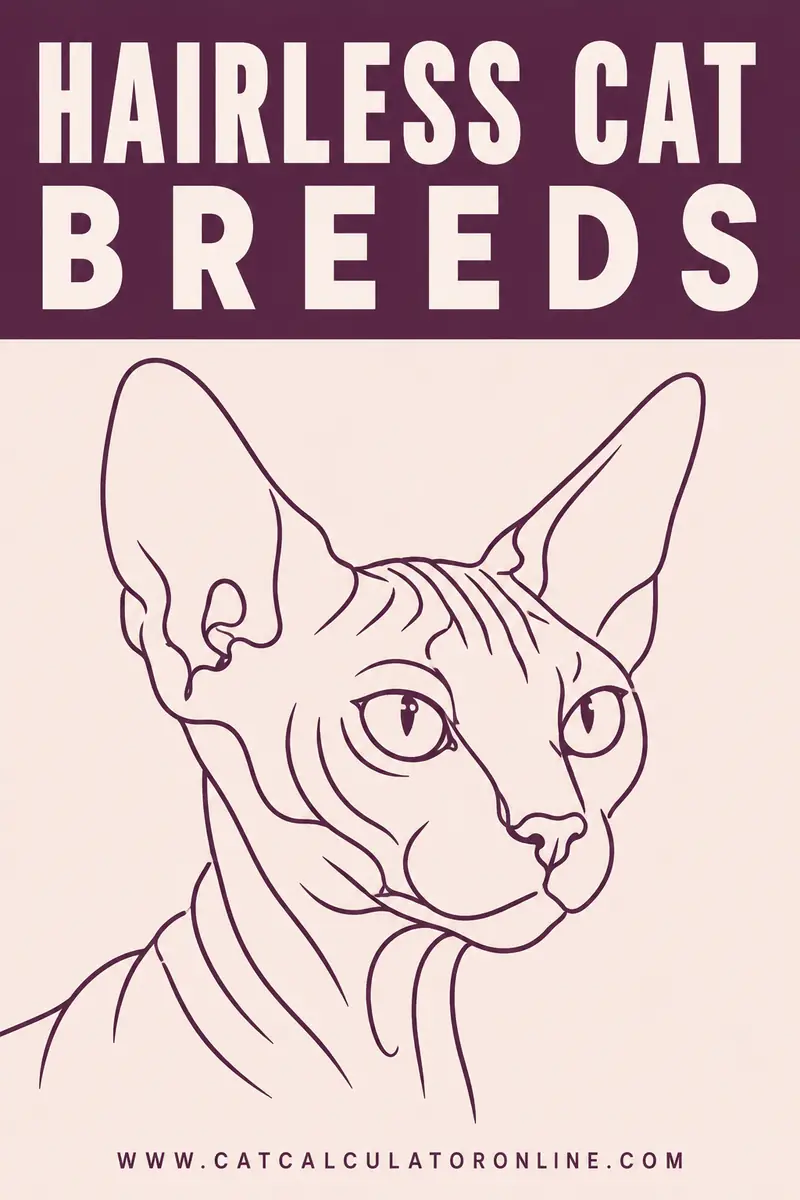
Most carry a fine vellus down. Run a hand over a Sphynx and it feels like warm chamois leather or a peach — that texture is a very short, soft fuzz roughly the thickness of the down on your own forearm. True bald skin is unusual, and some breeds vary from one litter to the next.
Whiskers and eyelashes are often missing or broken. Sphynx cats frequently have short, curled or absent whiskers. It looks odd and it is normal for the breed, though whiskers are genuine sensory equipment and their absence is one of the ethical arguments raised against hairlessness.
The hairlessness comes from a mutation in a keratin gene. In the Sphynx it is recessive, which is why two hairless parents reliably produce hairless kittens. In the Donskoy it is dominant, which behaves quite differently in breeding and is why the two lines should not be confused.
They are not cold-blooded, whatever the internet says. A hairless cat feels hot to the touch because there is no coat between your hand and its skin. Body temperature is the normal feline range, around 100.5–102.5°F (38–39°C). What they lack is insulation, not warmth.
Which is why they seek heat constantly. Radiators, laps, under duvets, on top of the router. A hairless cat in a cool house will genuinely be uncomfortable, and many owners keep the heating higher than they otherwise would.
Which Hairless Breeds Are There?
Fewer than the internet suggests, and several are variations on the Sphynx.
| Breed | Origin | Genetics | Notes |
|---|---|---|---|
| Sphynx | Canada, 1966 | Recessive | The standard hairless cat, widely recognized |
| Donskoy | Russia, 1987 | Dominant | Coat can be born and then lost |
| Peterbald | Russia, 1994 | Dominant, from Donskoy | Oriental build, coat varies bald to brush |
| Ukrainian Levkoy | Ukraine, 2000s | Recessive plus folded ear | Rare, not widely recognized |
| Bambino | US, 2005 | Sphynx plus Munchkin | Short legs, contested on welfare grounds |
| Elf cat | US, 2000s | Sphynx plus American Curl | Curled ears, experimental |
| Dwelf | US, 2000s | Sphynx, Munchkin, Curl | Three mutations, widely criticised |
| Minskin | US, 1998 | Sphynx plus Munchkin | Fur points on face, ears, legs, tail |
| Lykoi | US, 2010 | Separate mutation | Partial coat, molts to near-bald in cycles |
The Sphynx is the one you will actually meet. It accounts for the overwhelming majority of hairless cats in homes, is recognized by every major registry, and has the deepest gene pool. Our page on Sphynx cat lifespan covers what to expect health-wise over a life.
Peterbald and Donskoy are the Russian branch. The Peterbald in particular is a strikingly elegant cat with the long wedge head of an Oriental. Its coat can range from completely bald through a velour or flock texture to a wiry brush, and confusingly some individuals gain or lose coat over the first two years.
Be cautious with the multi-mutation breeds. Bambino, Dwelf and Minskin combine hairlessness with dwarfism, folded ears or both. Stacking structural mutations raises legitimate welfare concerns, and several registries decline to recognize them for that reason. That is worth knowing before you fall in love with a photograph.
The Lykoi is a different thing altogether. It has a patchy roan coat rather than none, and cycles through periods of molting to near-bald and regrowing. It is genuinely hairless only some of the time.
Why Are So Many Hairless Cats Gray?
Because without a coat, you are looking straight at the cat's skin pigment.
The color you see is the pattern the cat would have had. A hairless cat carrying the dilute black gene shows up as gray — usually described as blue in cat registries, and often written as gray in American sources. Tabby markings, tortoiseshell patches, colorpoints and white spotting all appear as visible pigment on the skin.
Gray and pink dominate the photographs for a simple reason. Blue and blue-and-white are common colors in the founding Sphynx lines, and gray skin with pink undertones photographs beautifully against a blanket. There is no genetic link between hairlessness and any particular color.
Pigment deepens with sun exposure. A hairless cat that suns itself by a window can visibly darken over a summer, then fade again in winter. It works exactly like a suntan, with exactly the same risks.
Skin color has no bearing on temperament or health. If a breeder prices a gray kitten above a pink one, that is fashion, not substance.
Freckles and moles are normal. Hairless cats commonly develop pigmented spots with age. Any spot that changes shape, grows, bleeds or ulcerates should be seen by a vet, in the same way you would take a mole seriously on yourself.
What Does Daily Care Actually Involve?
This is where the "low-maintenance" idea falls apart.
Weekly bathing is not optional. A normal cat's coat wicks skin oil away and distributes it along the hairs. With no coat, that oil sits on the skin, collects dirt, and transfers to your bedding and furniture as brown greasy marks. Most hairless cats need a bath roughly weekly with a gentle, cat-safe shampoo. Our guide on whether cats need baths covers technique, and hairless breeds are the main exception to the usual answer of no.
Ears fill with wax fast. Without protective hair in the ear canal, wax and debris build up visibly within days. Weekly cleaning with a vet-recommended ear cleaner is part of the routine.
Nail beds need wiping too. Oil and grime accumulate in the skin folds around the claws. A cotton pad at nail-trimming time deals with it.
Skin folds need checking. Around the neck, armpits and groin. Trapped moisture in a fold can turn into a yeast or bacterial infection, which shows as redness, an odd smell or the cat scratching a specific spot.
Sun protection is a real requirement. Hairless skin burns, including through window glass on a bright day. Limit sunbathing, use blinds, and ask your vet before applying any sunscreen — many human products contain ingredients unsafe for cats, and cats lick.
Expect to buy jumpers, and expect a bigger food bill. Keeping warm without insulation costs energy, so hairless cats often eat noticeably more than a coated cat of the same weight. That is normal. A hairless cat that suddenly stops eating, or starts losing weight, still needs a vet.
Are Hairless Cats Hypoallergenic?
No — and this is the myth that sends people home with a cat they cannot live with.
Hairless cats produce Fel d 1 exactly like any other cat. The protein is made in the salivary glands and in the oil glands of the skin, not in fur. A Sphynx has both, in full working order. The mechanism is explained in what actually causes cat allergies.
They still groom themselves thoroughly. Every lick lays saliva onto bare skin, where it dries and flakes off. If anything the delivery is more direct than it is on a coated cat.
Dander is the airborne fraction, and hairless cats still make dander. Flakes of skin carrying Fel d 1 stay suspended in room air for hours. No coat does not mean no skin.
Some allergic owners genuinely do better with them, though. The weekly bath removes a large amount of surface allergen, and there is no shed hair carrying it onto clothes and cushions. Others do worse, because bare oily skin transfers allergen straight onto every surface the cat touches. Both experiences are real, and neither is predictable in advance.
So test the individual cat before you commit. At least an hour with the specific animal, on two visits, without taking an antihistamine first. The wider picture is in hypoallergenic cat breeds, and if low shedding rather than allergy relief is what you are after, cat breeds that don't shed much has better options.
What Health Issues Should You Ask a Breeder About?
Hairless breeds carry a few specific risks, and a good breeder will raise them before you do.
Hypertrophic cardiomyopathy is the big one. HCM, a thickening of the heart muscle, occurs at higher rates in Sphynx cats than in the general cat population. Responsible breeders screen breeding cats by echocardiogram — ask to see the scan dates and results, not just a verbal assurance.
Skin conditions are common. Yeast infections in folds, acne on the chin, and greasy seborrhoea all turn up more often than in coated cats. Most are manageable with routine care and prompt treatment.
Dental disease appears early in some lines. Sphynx and related breeds are over-represented for gingivitis and early tooth loss. Get teeth checked at every annual visit.
Cold stress is a genuine welfare issue. A hairless cat should not be an outdoor cat. Beyond the temperature problem, there is no coat protecting the skin from scratches, bites and sun.
Call a vet promptly for: red or weeping skin, a fold that smells, a burn-like patch after sun exposure, a spot that changes or bleeds, labored breathing, sudden lethargy, or a cat that goes off its food for more than a day. Breathing difficulty or sudden weakness in the back legs is an emergency — the second can signal a blood clot associated with heart disease.
What Do Hairless Cats Cost?
More to buy and more to run than most people budget for.
Sphynx kittens from registered breeders commonly sell for around 1,500–3,500 USD, with health-screened lines at the upper end. Peterbald and Donskoy are usually in a similar bracket and harder to find outside eastern Europe and Russia.
Ongoing costs run above average. More food, regular shampoo and ear cleaner, jumpers and heated beds, a higher heating bill, and more frequent skin-related vet visits. Insurance premiums for Sphynx cats are often higher because of the HCM risk.
Budget for cardiac screening. An annual or biennial echocardiogram is a sensible precaution in a Sphynx and is not cheap.
Compare that with the general picture. Our page on how much a cat costs per year gives the baseline for an ordinary cat, and a hairless breed sits comfortably above it.
Adoption is worth investigating. Sphynx cats do end up in breed-specific rescue, often because their care needs were underestimated. An adult in rescue is cheaper, already health-assessed, and lets you meet a finished cat before committing.
Is a Hairless Cat Right for You?
They are extraordinary animals, but they suit a specific household.
They are relentlessly sociable. Sphynx cats in particular are famously people-focused, follow you room to room, sleep under the covers and object loudly to being left. If you want an independent cat, this is the opposite of that.
They need a warm, indoor home. Steady heating, soft warm places, no outdoor access. A draughty flat is not fair on them.
They need an owner who will do the routine. Weekly bath, weekly ears, folds checked, sun managed. It takes maybe twenty minutes a week, but it is twenty minutes every week for fifteen years.
They are wonderful with the right person. Warm to hold, comic, endlessly affectionate, and genuinely striking to look at. Owners rarely go back to coated cats.
Just do not choose one for allergy reasons. That is the single most common mistake made with this group of breeds, and it is the one that ends in a rehoming. If allergy is the driver, read living with a cat allergy first and build the plan around your house rather than around the cat.
Frequently Asked Questions
Are hairless cats completely bald?
Usually not. Most hairless breeds, including the Sphynx, carry a fine downy fuzz that feels like warm chamois or peach skin. Whiskers are often short, curled or absent. Truly bare skin does occur, and some breeds such as the Peterbald vary from fully bald to a brush-like coat.
Why are so many hairless cats gray?
Because with no coat you are seeing the cat's skin pigment directly. A hairless cat carrying the dilute black gene shows as gray, called blue in cat registries. Tabby, tortoiseshell and colorpoint patterns all appear on the skin too. There is no genetic link between hairlessness and color.
Are hairless cats hypoallergenic?
No. Sphynx and other hairless cats produce Fel d 1, the protein most cat-allergic people react to, in their saliva and skin glands, and they still groom themselves thoroughly. Weekly bathing removes some surface allergen, so a few allergic owners cope better, but many do not.
How often do hairless cats need a bath?
Roughly weekly for most. With no coat to absorb and distribute skin oil, it builds up on the skin and transfers onto bedding and furniture as greasy brown marks. Use a gentle cat-safe shampoo, dry the cat thoroughly, and clean the ears and nail beds at the same time.
Do hairless cats get cold?
Yes. Their body temperature is normal for a cat, around 100.5–102.5°F (38–39°C), but they have no insulation, so they lose heat quickly and seek out warm spots constantly. They need a heated indoor home, warm bedding, and often jumpers. They should not be outdoor cats.
How much does a Sphynx cat cost?
Sphynx kittens from registered breeders usually sell for around 1,500–3,500 USD, with health-screened lines at the top of that range. Running costs are above average too — more food, weekly grooming supplies, higher heating, and insurance premiums raised by the breed's heart disease risk.
Hairless cats are one of the few groups where the popular reputation gets almost everything backwards. They are not bald, they are not cold-blooded, they are not low-maintenance, and they are certainly not hypoallergenic. What they are is warm, wrinkled, extremely sociable and quite demanding: a weekly bath, weekly ear cleaning, folds checked, sunburn avoided, and a household warm enough that a cat with no coat can be comfortable. Ask any breeder about heart screening and get real dates and results. If you want one for the personality, they are hard to beat. If you want one for an allergy, the cat cost calculator and a proper allergy plan will serve you better than the breed will.