Automatic Cat Feeders: What to Know
An automatic feeder solves one specific problem well: delivering measured meals at times you are not there. That makes scheduled feeding practical for people who work, and it fixes pre-dawn waking better than anything else available. What a feeder does not do is make it acceptable to leave a cat alone for days, and choosing the wrong type — a gravity feeder for a cat that overeats, or a dry-food unit for a cat that needs wet — creates problems rather than solving them. This page covers the three types, which cat each suits, the multi-cat complication, and what to check before buying. Portion figures to program in are in the cat food calculator.
The Three Types
Gravity feeders. A hopper of dry food that refills a bowl as the cat eats. No power, no timer, no portion control. This is free feeding with extra steps, and it suits only cats that genuinely self-regulate. For any cat prone to gaining, it is the worst possible choice — the trade-offs are in free feeding vs scheduled feeding for cats.
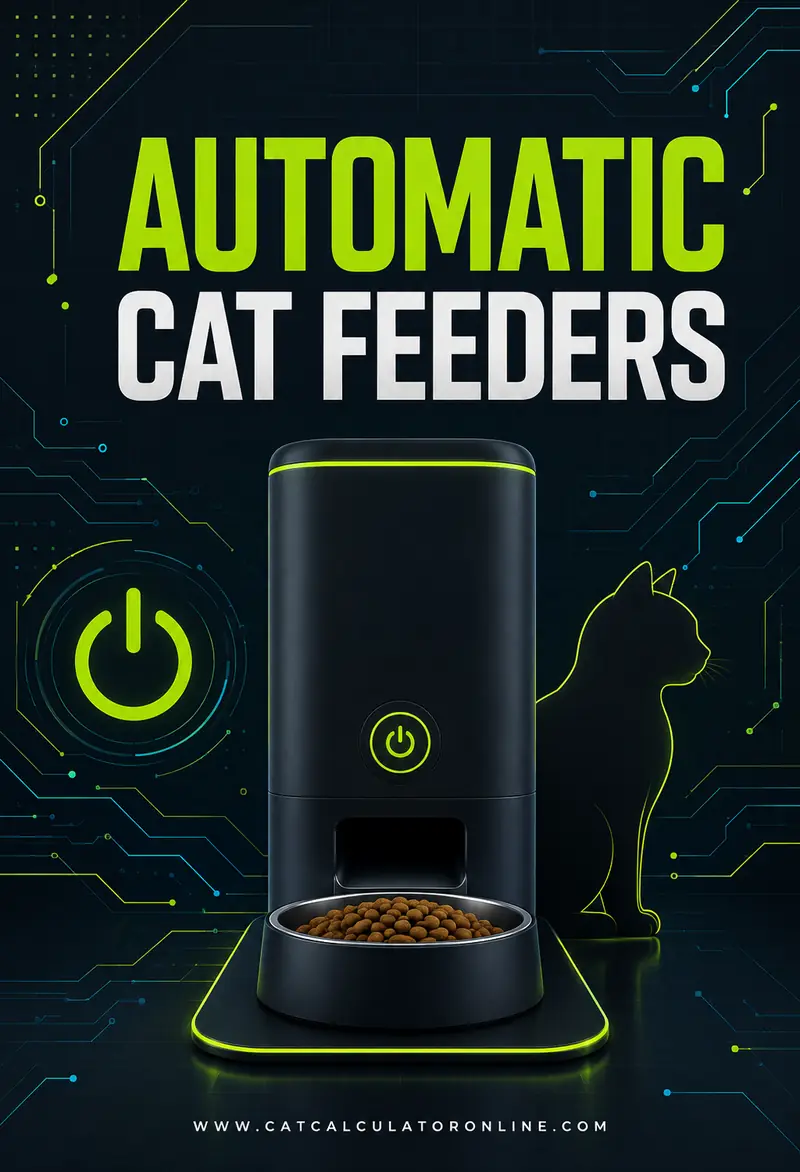
Timed dry feeders. A hopper with a motorised dispenser and a programmable schedule. You set the portion size and the times, and the unit dispenses. This is the genuinely useful category and what most people mean by an automatic feeder.
Chilled wet feeders. A rotating tray or a set of compartments with lids that open on a timer, plus an ice block underneath. They keep wet food acceptable for a limited period — realistically one meal ahead, sometimes two. Anything beyond that is optimistic in a warm room.
| Type | Portion control | Food | Best for | Watch out for |
|---|---|---|---|---|
| Gravity | None | Dry only | Lean, self-regulating single cats | Free feeding by another name |
| Timed dry | Full | Dry only | Working households, 5am wakers | Small-portion accuracy |
| Chilled wet | Full | Wet | One delayed meal | Cats refusing cold food |
| Microchip | Full | Either | Multi-cat homes, prescription diets | Cost; needs gradual introduction |
Microchip feeders sit across the categories. They read the cat's own microchip or a collar tag and open only for the right animal. Expensive, and the only reliable answer for a multi-cat household where one cat is on a prescription diet.
What a Feeder Is Actually Good For
Being specific about this saves buying the wrong thing.
Meals while you are at work. The main use, and it makes three or four smaller meals a day practical for the first time in a household that is out from eight until six.
Pre-dawn waking. The single best use. A cat that wakes you at five for food is being rewarded every time you get up. A feeder that dispenses at five breaks the association entirely — the food arrives, and it has nothing to do with you. This works better than any other approach.
Portion consistency. The unit dispenses the same amount every time, which removes the scoop-estimation problem that causes so much slow weight gain.
Splitting a daily total. Four small meals from the same allowance leaves a cat feeling fed more often, which reduces begging without adding calories.
Slowing down a fast eater, since smaller portions more often are easier to keep down than two large ones.
Covering a single evening out, or a late shift.
What it is not for: replacing a person for days at a time.
Why a Feeder Is Not a Cat-Sitter
Worth stating plainly, because feeders get bought for exactly this reason.
A feeder dispenses food. That is all it does.
It cannot tell you the cat has stopped eating. Some units log dispensing rather than consumption, so a cat that is unwell and not eating looks identical to a cat that is fine. A cat that eats nothing for a couple of days is at genuine risk of hepatic lipidosis, and nobody is there to notice.
It cannot check the litter tray, which is where urinary blockages — a life-threatening emergency in male cats — first show themselves.
It cannot refill the water, or notice a spilled bowl. A cat left with a tipped water bowl and a working feeder is in a worse position than one left with neither.
It cannot notice vomiting, hiding, or injury.
It can jam or fail. Hoppers bridge, batteries die, power goes off. A feeder that has stopped dispensing looks exactly like a feeder that has finished dispensing.
So the rule is: a feeder handles the timing of meals. Someone still needs to physically see the cat at least once a day if you are away, and more often for kittens, older cats, or any cat with a medical condition.
Choosing a Timed Dry Feeder
What actually matters in the specification.
Portion accuracy. Stated portion sizes are frequently approximate. Weigh what your unit actually dispenses over several cycles before trusting the number, and adjust the setting until it matches the portion you calculated.
Small portion capability. Cats eat small amounts — often 15–25 g per meal. Many feeders were designed with dogs in mind and cannot reliably dispense portions that small. Check the minimum.
Kibble size compatibility. Small or oddly shaped kibble jams; very large kibble bridges in the hopper. Check the manufacturer's stated range against your food.
Battery backup as well as mains. A feeder that only runs on mains fails silently in a power cut.
A cat-proof lid. Cats are extremely good at opening hoppers, and a cat that works out how to release the whole supply has eaten several days of food at once. Locking lids and weighted bases matter.
Number of meals per day. Four or more gives useful flexibility.
Ease of cleaning. Anything that cannot be taken apart accumulates stale fat from the kibble coating, which eventually makes the food unappetising.
And noise. Some units are loud enough to startle a nervous cat away from the bowl entirely.
Wet Food Feeders: The Honest Limits
They exist, they work, and they work less well than the marketing implies.
Wet food spoils quickly at room temperature — a few hours at most. The ice block in a chilled feeder extends that, but not indefinitely, and its effectiveness drops sharply in a warm room.
Realistically, one meal ahead is reliable. Two is possible in a cool room with a fresh ice block. Beyond that you are gambling with food safety and, more practically, with whether the cat will eat it at all.
Cats dislike cold food. Smell drives feline appetite, and food straight off an ice block smells of very little. Many cats will refuse it, which is a common and disappointing discovery after buying one.
Which makes them best for a single delayed meal — a lunchtime portion, or an evening meal when you are back late — rather than for a full day.
A practical alternative is to feed wet food at the times you are present, morning and evening, and use a timed dry feeder for the middle of the day. That gets you the water content of wet food alongside the convenience of automation, and the split arithmetic is in mixing wet and dry cat food.
The Multi-Cat Problem
The situation where ordinary feeders fail.
A feeder dispenses into a bowl; it does not decide who eats from it. In a multi-cat household the confident cat eats first and often eats both portions.
The usual outcome is one cat gaining and another quietly losing condition, and because both bowls empty, everything looks fine.
Two feeders in separate rooms helps, though a determined cat will simply visit both.
Microchip feeders are the real solution. They read the cat's own implanted chip or a collar tag and the lid opens only for that animal. They are expensive, but they are the only reliable way to manage a prescription diet, a weight-loss plan, or a diabetic cat in a house with other cats.
They also work in reverse, protecting a slow eater's food from being stolen.
Introduce them gradually, propped open at first so the cat learns the bowl is safe before the lid starts moving. A cat startled by a closing lid may avoid the feeder entirely.
Setting It Up Properly
The steps that decide whether it works.
Calculate the daily portion first, from the cat's weight and the food's calorie content — the method is in how much dry food to feed a cat.
Divide it by the number of meals and set the unit accordingly.
Weigh what it actually dispenses for several cycles and correct the setting.
Introduce it gradually. Run it while you are home for a few days so the cat associates the noise with food arriving rather than with something alarming.
Position it away from the litter tray, away from noisy appliances, and somewhere the cat is not cornered.
Keep feeding by hand sometimes. A cat fed only by machine loses the daily interaction that is often how owners notice something is wrong.
Check and clean it weekly, and check the batteries monthly.
And weigh the cat monthly, because a feeder makes intake consistent, not necessarily correct. If the weight drifts, adjust the portion — the assessment is in is my cat overweight.
Common Mistakes
Buying a gravity feeder for a cat that overeats. It is free feeding, not portion control.
Trusting the stated portion size without weighing what actually comes out.
Buying a dog-oriented feeder that cannot dispense small enough portions.
Expecting a wet feeder to cover a whole day. One meal ahead is the realistic limit.
Leaving a cat alone for days with a feeder. It cannot notice a cat that has stopped eating.
No battery backup.
A hopper the cat can open.
Using one feeder for several cats and assuming each gets its share.
Never cleaning it, which lets stale kibble oil build up.
Stopping hand-feeding entirely, which removes the daily check that catches a change in appetite — and appetite changes are among the earliest illness signals, covered in why won't my cat eat.
Frequently Asked Questions
Are automatic cat feeders a good idea?
For delivering measured meals at times you cannot be there, yes — they make scheduled feeding practical for people who work and they are the best fix for a cat that wakes you before dawn. They are not a substitute for someone checking on the cat.
Can I leave my cat alone with an automatic feeder?
For a day, yes. Not for several days. A feeder cannot tell whether the cat is actually eating, cannot check the litter tray, cannot refill spilled water, and can jam. Someone should see the cat at least once a day.
Do automatic feeders work with wet food?
Chilled units with an ice block work for one meal ahead, sometimes two in a cool room. Beyond that the food is not reliably safe or appealing — and many cats refuse wet food served cold.
Will an automatic feeder stop my cat waking me at 5am?
Usually yes, and it is the most effective solution available. A feeder that dispenses at that time removes the connection between waking you and food appearing, which is what maintains the behavior.
Which feeder works for a multi-cat household?
A microchip feeder, which reads the cat's own chip or collar tag and opens only for that cat. Ordinary feeders dispense into a bowl any cat can reach, so the confident cat commonly eats both portions.
How do I know what portion to set?
Work out the daily calorie requirement from your cat's weight, divide by the food's calories per gram, then divide by the number of meals. Then weigh what the unit actually dispenses, because stated portions are often approximate.
An automatic feeder is a timing tool. Used well — a timed dry unit, portions verified on kitchen scales, positioned sensibly, introduced gradually — it makes measured feeding realistic for a working household and solves pre-dawn waking outright. Used as a substitute for a person, it fails, because it cannot tell you the cat has stopped eating. Choose a timed dry model over a gravity one, accept that wet feeders manage one meal ahead, and use a microchip feeder if you have more than one cat. Work out the portion to program with the free cat food calculator.