How to Choose a Cat Insurance Plan
Choosing a cat insurance plan comes down to four decisions: accident-only or accident-and-illness, how high a deductible, what reimbursement percentage, and how large an annual limit. Everything else is detail. The most common mistake is comparing monthly prices before those four settings are matched across quotes, which makes a narrow policy look like a bargain. Set the structure first, compare second, and read the exclusions before the marketing — and use the cat cost calculator to see how the premium sits alongside everything the policy won't cover.
What Are the Four Decisions That Define a Plan?
Every quote you'll see is a combination of the same four dials. Get these right and the rest is housekeeping.
| Decision | Options | What it controls |
|---|---|---|
| Cover type | Accident-only / accident + illness | What is covered at all |
| Deductible | $100–$1,000 | When cover starts each year |
| Reimbursement | 70% / 80% / 90% | How much of each bill comes back |
| Annual limit | $2,500 – unlimited | The ceiling in a bad year |
They aren't equally important. Cover type and annual limit decide whether the policy protects you in a genuine crisis. Deductible and reimbursement decide how much it costs along the way.
A useful way to hold it in your head: cover type and annual limit are about breadth and depth of protection; deductible and reimbursement are about price. When you need to save money, move the price dials — not the protection dials.
That single principle prevents the most expensive mistake in the market, which is buying a cheap policy that excludes illness or caps out at $2,500, and discovering the gap during a cancer diagnosis.
Should You Choose Accident-Only or Comprehensive?
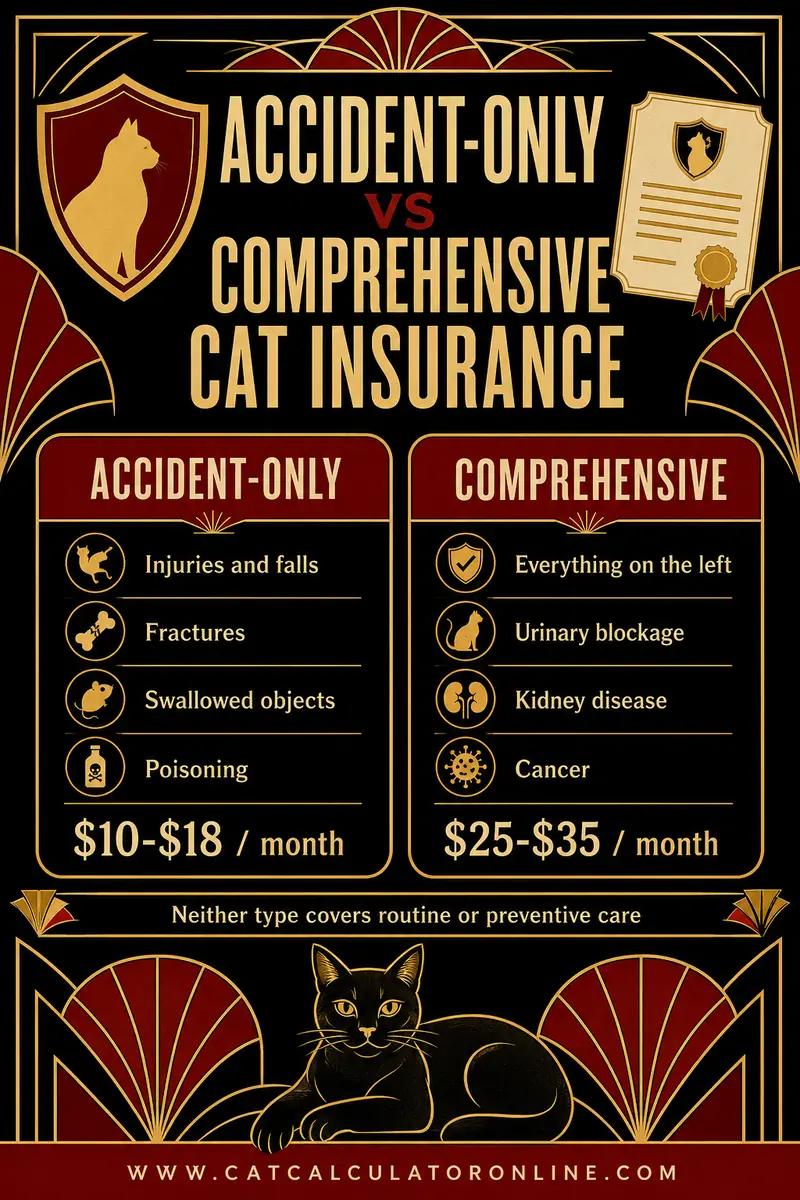
For most cats, accident-and-illness. The conditions cats actually claim for — urinary blockage, kidney disease, hyperthyroidism, diabetes, cancer, dental disease — are all illnesses, and accident-only excludes every one of them.
Accident-only genuinely suits a narrow set of situations: a senior cat past the age cap for illness cover, an owner with substantial savings wanting catastrophe protection only, or a budget that truly won't stretch. The full comparison is in accident-only vs comprehensive cat insurance.
The gap is roughly $15 a month, or about $180 a year, for an adult cat. One urinary blockage typically costs more than a decade of that difference.
If cost is what's pushing you toward accident-only, try this instead: take comprehensive cover with a $750 or $1,000 deductible. You keep protection against kidney disease and cancer while cutting the premium substantially. Economise on when cover starts, not on what's covered at all.
How Do You Pick the Right Deductible?
Answer one honest question: could you produce $1,000 tomorrow without it damaging anything?
If yes, a higher deductible ($750–$1,000) is usually better value. You pay less every month for twelve months a year, absorb the small and mid-size bills yourself, and keep strong protection against the destabilising ones.
If no, a lower deductible ($250–$500) earns its higher premium. A policy that only starts helping after $1,000 is no help at all if $1,000 is exactly what you don't have.
Two refinements worth applying:
- Factor in your cat's age. A young healthy cat may go years without claiming, which favors a high deductible during the cheap years. A senior cat likely claims annually, so you'd meet a high deductible every year — reducing the saving considerably.
- Check whether it's annual or per-condition. This detail can change your costs by thousands. An annual deductible is paid once per policy year across everything; a per-condition deductible is paid separately for each diagnosis. For a senior cat with three chronic conditions, that's three deductibles a year, every year. The mechanics are in cat insurance deductibles explained.
Ask that second question directly before buying. It takes ten seconds and it's often buried in the policy document rather than shown on the quote page.
What Reimbursement Percentage Should You Choose?
80% is the sensible default, and 90% is worth paying for if you can.
The reason to lean higher than instinct suggests is asymmetry: the deductible costs you once per policy year at most, but the reimbursement percentage costs you on every dollar of every claim, for as long as you hold the policy. For a cat that develops a chronic condition — and most cats eventually do — that compounds across years of treatment.
On a $3,000 eligible bill after a $500 deductible:
| Reimbursement | Insurer pays | You pay |
|---|---|---|
| 70% | $1,750 | $1,250 |
| 80% | $2,000 | $1,000 |
| 90% | $2,250 | $750 |
The $500 spread between 70% and 90% on this single claim is often more than a full year of the premium difference.
So the rule when economising: raise the deductible before you lower the reimbursement percentage. You'll feel the deductible once a year; you'll feel a lower payout percentage forever. The full arithmetic, including how the deductible is subtracted before the percentage applies, is in how reimbursement works.
How High Should the Annual Limit Be?
Higher than feels necessary. This is the setting owners most often under-buy and most often regret.
Your annual limit is the maximum the insurer pays across a policy year. Hit it and reimbursement stops entirely until renewal, regardless of how much treatment continues.
A cat diagnosed with lymphoma in March on a $5,000 limit, with treatment running $9,000 across the year, exhausts the cap and leaves you paying $4,000 out of pocket — despite holding an 80% policy that implied you'd pay $1,800.
Practical guidance:
- $2,500 is too low. A single serious diagnosis exhausts it.
- $5,000 is workable for a young cat but thin for a senior.
- $10,000 or unlimited is where the policy genuinely does its job.
Watch for limits that behave worse than an annual cap. A per-condition lifetime limit exhausts permanently rather than resetting each year, which is a poor fit for a cat that may live a decade with kidney disease. Sub-limits do the same thing on a smaller scale — dental capped at $500 against a $1,600 extraction bill leaves you covered in name only.
Does the Policy Cover Chronic Conditions for Life?
This is the single most consequential question in the whole market, and it's rarely on the comparison page.
Lifetime-style policies cover a condition for as long as the policy stays continuously in force. Diagnosed at eleven with kidney disease, your cat is still covered at twelve, thirteen and fourteen, subject to the annual limit resetting.
Annual or time-limited policies cover a condition only within the year it appeared, or for a fixed twelve-month window. At renewal it's reclassified as pre-existing and excluded permanently. The premium looks similar. The product is fundamentally different.
For cats this is close to decisive, because the most common serious feline diagnoses are all lifelong: chronic kidney disease, hyperthyroidism, diabetes, heart disease, inflammatory bowel disease. A policy that stops paying after twelve months protects you against the diagnosis and abandons you for the decade of management that follows.
Three questions that settle it:
- Does cover for a condition continue at renewal, indefinitely, while the policy remains in force?
- Is the annual limit per year, or a lifetime cap per condition?
- Can the insurer add an exclusion to my existing policy at renewal?
A good insurer answers all three plainly. Vague answers to the first or third tell you what you need to know.
How Do You Compare Quotes Fairly?
Most comparison is done wrong, because the cheapest quote is usually a different product rather than a better deal.
Hold all four settings constant across every quote. Same cover type, same deductible, same reimbursement percentage, same annual limit. Only then does the monthly price mean anything. A policy can undercut its rivals by $8 a month simply by excluding hereditary conditions, exam fees and prescription diets.
Then compare the things that don't appear in the price:
- Exam and consultation fees — covered or not? It's $50–$90 a visit and adds up fast with a chronic condition.
- Hereditary and congenital conditions — included on good policies, excluded outright on cheap ones. For a pedigree cat that's the difference between real and decorative cover.
- Prescription therapeutic diets — a real cost for kidney and urinary cats, handled inconsistently.
- Dental disease — covered, and are there conditions attached, such as requiring annual dental checks?
- Actual cost or benefit schedule — does the policy pay a percentage of your real bill, or a fixed amount per condition? A schedule paying $400 toward a $2,600 bill is a very different product.
- Curable pre-existing conditions — is there a symptom-free window after which a resolved condition becomes coverable, and how long?
The full standard exclusion list is in what cat insurance does not cover. Reading it takes ten minutes and tells you more than any comparison table.
When Is the Right Time to Buy?
As early as possible, while nothing is wrong. This matters more than any other decision on this page.
Anything your cat has already shown signs of is excluded permanently, so every week you wait is a week for something to appear in the record that a policy will never cover. A kitten insured at eight to ten weeks has an empty chart, clears the waiting period during its healthiest weeks, and has every future condition coverable.
Enrolling early does not lock in a low price — premiums reprice upward at every renewal regardless. What it locks in is coverage, which turns out to be the more valuable thing. The mechanics of what gets excluded and when are in cat insurance and pre-existing conditions.
Two related points:
- Many insurers cap new accident-and-illness enrollments somewhere in the low-to-mid teens. The option to buy full cover expires before your cat does.
- Once enrolled, virtually all policies renew for life. Insurers don't cancel you for a cat getting old or for claiming. That guarantee is a real asset, and it's why continuous cover beats any strategy involving gaps.
What Should You Avoid When Choosing?
Six mistakes that account for most buyer's remorse:
- Buying on monthly price alone. The cheapest quote is nearly always cheaper for a reason sitting in the exclusions.
- Choosing a low annual limit to save a few dollars. It undoes the point of the policy in exactly the scenario you bought it for.
- Taking accident-only for an indoor cat because it "doesn't go outside". Indoor cats have fewer accidents but the same or higher illness risk, and they live longer — reaching the ages where kidney disease and cancer appear.
- Adding a wellness rider by default. These bundle predictable costs and typically return roughly what you pay in, minus margin. Paying routine costs directly and putting the difference toward a lower deductible is usually better.
- Planning to "start cheap and upgrade later". Adding illness cover later triggers new waiting periods and a fresh pre-existing screen against everything accumulated since.
- Misstating your cat's age, breed or lifestyle to lower a premium. It's the fastest route to a voided policy, not just a declined claim.
Does Your Cat's Age or Breed Change the Right Plan?
Yes, in ways that shift the sensible defaults rather than rewriting them.
Kittens. The easiest case and the best value you'll ever get. Premiums are at their lifetime low and the medical record is empty, so every future condition stays coverable. Take comprehensive cover with a high annual limit; a moderate deductible is fine since claims are unlikely in the early years. This is the one age where the decision is close to obvious.
Young adults (1–6). Still an excellent window. Quotes are modest and most cats' records are short. If you're going to insure at all, enrol before the chart grows — one noted symptom is all it takes to lose a category permanently.
Mature adults (7–10). The last comfortable window. Premiums are noticeably higher, and this is when the first chronic conditions start appearing. Check the record honestly before applying, and prioritize a lifetime-style policy over a cheap premium — this is the age bracket where the twelve-month-cover trap does real damage.
Seniors (11+). A genuine judgement call. Premiums are high, existing conditions are excluded, and enrolment caps loom. A healthy senior with a short chart can still get real value, since the biggest claims often haven't appeared yet. A senior with three diagnoses already on file may be better served by a dedicated savings account.
Pedigree cats deserve one extra check regardless of age: confirm the policy covers hereditary and congenital conditions. Maine Coons and Ragdolls carry documented heart-disease risk, Persians polycystic kidney disease, Abyssinians progressive retinal atrophy. Cheaper policies exclude this category outright, which for these breeds hollows out the cover while looking competitive on price. Breed predisposition alone is never treated as pre-existing — but a policy that excludes hereditary conditions produces the same practical outcome.
Multi-cat households should note that each cat is insured separately, with its own deductible and its own annual limit. Two cats on $500 deductibles means $1,000 of household exposure before either policy pays. Multi-pet discounts of 5–10% are common but reduce the premium, not the deductibles.
What's the Quickest Way to Decide?
If you want a defensible default without agonising over it, this combination suits most healthy adult cats:
- Accident and illness, lifetime-style, on actual vet cost
- $500 deductible, annual rather than per-condition
- 80% or 90% reimbursement
- $10,000 or unlimited annual limit
- No wellness rider
- Bought now, while the medical record is as short as it will ever be
From there, adjust in one direction only. If the premium is uncomfortable, raise the deductible to $750 or $1,000. If it's still uncomfortable, raise it further before touching the reimbursement percentage, and touch the annual limit last of all.
Then put the final figure into the cat cost calculator alongside food, litter, routine vet care and the exam fees the policy may not cover. A premium that looks fine in isolation sometimes looks different next to the $300–$700 a year of routine costs that arrive whether you're insured or not.
Frequently Asked Questions
What should I look for in a cat insurance plan?
Start with four things: accident-and-illness cover rather than accident-only, an annual deductible you could genuinely absorb, 80–90% reimbursement, and an annual limit of $10,000 or unlimited. Then check that the policy covers chronic conditions for life rather than for twelve months.
Is a higher deductible or higher reimbursement better?
Prioritize the reimbursement percentage. The deductible costs you once per policy year, while the percentage applies to every dollar of every claim for the life of the policy. When cutting cost, raise the deductible first and leave the payout percentage as high as you can afford.
How much cat insurance do I actually need?
Enough to absorb a genuine emergency without destabilising you. In practice that means illness cover included, an annual limit of at least $10,000, and no per-condition lifetime caps. A urinary blockage runs $1,500–$3,000 and a full cancer course can exceed $10,000.
Are wellness add-ons worth adding to a cat insurance plan?
Usually not. They bundle predictable costs — vaccines, checkups, flea treatment — and typically return roughly what you pay in, minus the insurer's margin. They're a budgeting tool rather than insurance. Paying those directly and lowering your deductible is generally better value.
Does the cheapest cat insurance quote mean the worst cover?
Not automatically, but check why it's cheaper. Policies commonly undercut rivals by excluding hereditary conditions, exam fees or prescription diets, by using a benefit schedule instead of actual cost, or by capping conditions at twelve months. Match all four settings across quotes before comparing price.
Can I change my cat insurance plan later?
You can usually adjust the deductible, reimbursement percentage and annual limit at each renewal with your existing insurer, and that rarely triggers new waiting periods. Switching to a different insurer does — it restarts every waiting period and re-runs the pre-existing screen against your cat's whole record.
Choosing a plan is mostly about resisting the pull of the monthly price. Set the four dials deliberately, confirm the policy covers chronic conditions for life, read the exclusions before the brochure, and buy while your cat's medical record is still short. Do those four things and you'll have a policy that behaves the way you expected on the day it matters — then check the total against your cat's real yearly costs in the cat cost calculator.