The Healthy Weight Range for Cats
Most adult domestic cats sit healthily between 8 and 12 lb (3.6–5.4 kg), but that range is close to useless for an individual cat, because breed changes it enormously — a Siamese may be ideal at 7 lb and a Maine Coon at 18 lb. The genuinely useful number is your own cat's weight at around twelve months, when it has finished growing but hasn't started gaining. Combined with body condition, that gives you a real target rather than a population average. The cat ideal weight calculator works it out from your cat's own details.
What Is a Healthy Weight by Breed?
| Breed | Female | Male |
|---|---|---|
| Domestic shorthair / longhair | 7–11 lb | 9–13 lb |
| Siamese | 6–9 lb | 8–11 lb |
| Abyssinian | 6–9 lb | 8–11 lb |
| Devon Rex / Cornish Rex | 5–8 lb | 7–10 lb |
| Russian Blue | 7–10 lb | 9–12 lb |
| Sphynx | 6–9 lb | 8–12 lb |
| Bengal | 8–12 lb | 10–15 lb |
| British Shorthair | 8–12 lb | 11–17 lb |
| Persian | 7–10 lb | 9–13 lb |
| Ragdoll | 10–15 lb | 12–20 lb |
| Norwegian Forest Cat | 9–14 lb | 12–18 lb |
| Maine Coon | 10–16 lb | 13–20 lb |
Two patterns run through the whole table.
Males are consistently heavier than females, typically by 2–4 lb in the same breed. That's normal sexual dimorphism, not a sign anything's wrong.
The spread within a breed is wide, because frame size varies between individuals just as it does in people. A small-framed Maine Coon at 12 lb can be perfectly healthy while a large-framed one is lean at 18 lb.
Which is exactly why a chart can tell you what's typical but not what's right for your cat. For that you need condition, not comparison.
Why Doesn't the Scale Tell the Whole Story?
Because weight measures mass, and health depends on what that mass is made of.
Consider two 13 lb cats. One is a large-framed British Shorthair male with good muscle, easy-to-feel ribs and a visible waist — perfectly healthy. The other is a small-framed domestic shorthair female carrying 3 lb of excess fat with no waist at all. Identical numbers, completely different situations.
This is why vets pair weight with body condition score, a 9-point scale where 5 is ideal, assessed by feel rather than by scale. It asks whether this particular cat is carrying the right amount of fat for its own frame, which is the question that actually matters. The full method is in cat body condition score explained.
The practical approach uses both:
- Body condition tells you whether your cat is at a healthy weight now.
- The scale tells you which direction things are moving, and by how much.
Neither alone is enough. A cat can hold a steady weight while losing muscle and gaining fat — common in older cats — and only condition scoring catches it.
How Do You Find Your Cat's Ideal Weight?
Three methods, in descending order of usefulness.
1. Your cat's own adult weight. If you know what your cat weighed at around twelve months, when growth finished and gain hadn't started, that's your target. It accounts for frame, breed and individual variation automatically. Large breeds like Maine Coons are the exception — they keep filling out to three or four years, so use their weight at that point instead.
2. Work backward from body condition. Each point above 5 on the BCS scale represents roughly 10% excess weight. A 12 lb cat scoring 7 is carrying about 20% too much, implying an ideal near 10 lb. The arithmetic is current weight ÷ (1 + excess).
3. Breed averages, as a last resort. Useful when you have no history — an adopted adult cat of unknown background — but treat the result as a starting point for a conversation with your vet rather than a target.
Whichever you use, confirm it with your vet before acting on it. They can assess frame size and muscle in a way no chart or calculator can, and they'll spot if a weight is being driven by something medical.
Does Age Change the Healthy Range?
Substantially, and the pattern is worth knowing in advance.
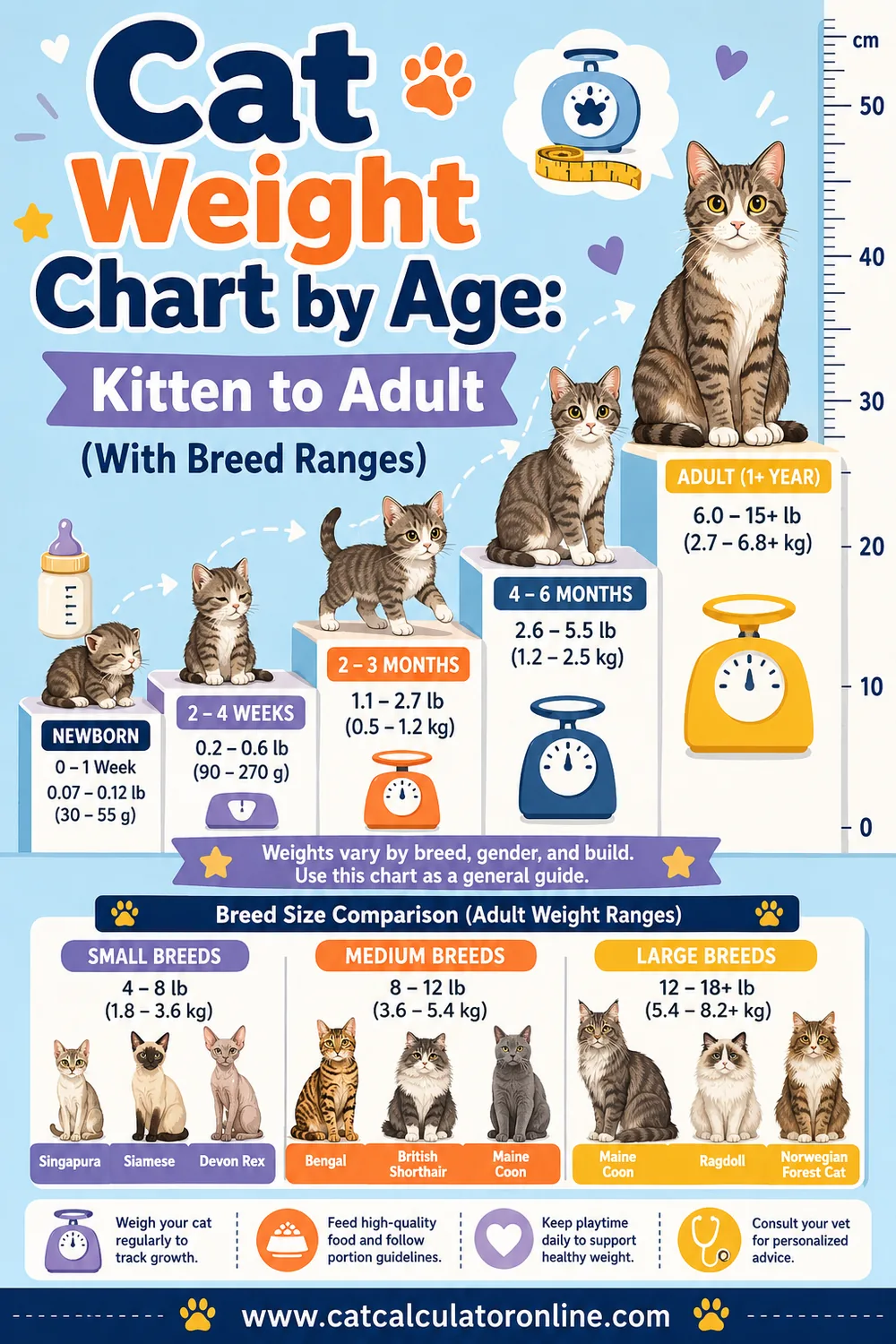
Kittens (0–12 months). Growing constantly, so there's no fixed target — you're tracking a curve rather than a number. Growth roughly follows 100 g per week in the early months, with most cats reaching near-adult size by ten to twelve months. Tracking guidance is in the cat weight chart by age.
Young adults (1–6). This is where your cat's healthy adult weight is established and should broadly hold. Most weight gain begins here, particularly in the year after neutering, when calorie needs drop by roughly 20–30% while portions often don't.
Mature adults (7–10). Frequently the heaviest years. Activity declines, metabolism slows slightly, and gains accumulated earlier are still being carried. This is the most valuable stage to intervene, because the associated conditions usually haven't appeared yet.
Seniors (11+). Many cats start losing weight and muscle here, and this is not a good sign. Unexplained weight loss in an older cat is one of the most common early indicators of hyperthyroidism, chronic kidney disease, diabetes or dental pain. A senior slimming down without a deliberate diet needs a vet visit, not congratulations.
That reversal is the single most important age-related point. Through middle age you're watching for creeping gain; past eleven, loss is the finding that matters more and responds far better to early investigation.
What About Large and Small Breeds?
The extremes need their own framing, because standard ranges mislead badly at both ends.
Large breeds — Maine Coon, Ragdoll, Norwegian Forest Cat, Savannah. These are genuinely big animals, and a healthy Maine Coon male at 18 lb is not an overweight cat. Two things matter here: they mature slowly, often continuing to fill out until three or four years, so a two-year-old that seems small may simply not be finished. And their size makes body condition assessment essential — a heavy coat plus a large frame conceals a great deal, so the hands-on rib check is the only reliable approach.
Small breeds — Singapura, Devon Rex, Cornish Rex, Siamese and other orientals. Fine-boned and slender by design. A Siamese at 13 lb is carrying serious excess even though the same number is unremarkable for a domestic shorthair. Owners of slim breeds sometimes worry their cat looks too thin when it's actually correct — the visible waist and easily felt ribs that would signal a problem in a stockier cat are simply normal here.
For both extremes the same rule applies: judge condition, not the number. A Maine Coon and a Devon Rex at ideal body condition score identically at 5 out of 9, despite a 12 lb difference between them.
Mixed-breed cats with obvious large-breed ancestry sit somewhere in between, and this is where owners most often misjudge. A domestic longhair with Maine Coon somewhere in its background may be genuinely big-framed rather than overweight — but it may equally be an ordinary cat with a lot of coat. The coat is the confounder: long fur adds visual bulk without adding a gram, which is why the hands-on rib check matters far more than the overhead silhouette for any fluffy cat. If you can feel the ribs easily and there's a waist under the fur, the cat is fine regardless of what the outline suggests.
What If Your Cat Is Underweight?
The conversation about cat weight is dominated by excess, but being under a healthy weight is often the more urgent finding — because in cats it's usually a symptom rather than a feeding problem.
A cat scoring 3 or below on the body condition scale has ribs, spine and hip bones that are easily visible with little fat cover. Before adding food, the question to ask is why.
Common causes, and most of them are medical:
- Hyperthyroidism. Very common past ten. The classic picture is a cat eating enthusiastically while steadily losing weight, often with increased thirst and restlessness.
- Chronic kidney disease, the most common serious diagnosis in older cats, typically with increased drinking and urinating.
- Diabetes, which can present as weight loss despite a good appetite.
- Dental pain. A cat with painful teeth may approach food, then walk away. Easy to miss and genuinely common.
- Intestinal disease such as IBD, or parasites in younger cats.
- Competition in multi-cat households, where a shy cat is displaced from the bowl by a confident one. This is the main non-medical cause, and it's worth checking before assuming illness.
The rule that matters: unexplained weight loss in a cat over eight should be investigated rather than fed. Adding calories to a cat with hyperthyroidism doesn't fix the hyperthyroidism, and the delay costs treatment options.
For kittens and young cats, underweight is more often about intake or parasites and generally resolves with treatment and appropriate feeding — but it still warrants a vet check rather than guesswork.
How Much Weight Change Is Normal?
Very little, which is why small changes deserve attention.
A healthy adult cat's weight should be broadly stable month to month. Cats don't have the seasonal or lifestyle swings people do, so a steady weight is the expected state rather than an achievement.
Useful reference points:
- Under 2% variation month to month is normal noise — hydration, meal timing, when they last used the litter tray.
- 5% change in a few months is worth noticing. On a 10 lb cat that's half a pound.
- 10% unexplained change in either direction warrants a vet appointment. That's one pound on a 10 lb cat.
Those percentages sound small because cats are small. A pound on a 10 lb cat is proportionally equivalent to roughly 16 lb on a 160 lb person — a change nobody would dismiss in themselves, and one that's genuinely easy to overlook in a cat with a thick coat.
The practical consequence is that a home scale beats observation. Gradual change is invisible to the eye precisely because it's gradual, and you see your cat every day. A monthly note with the date and weight catches in six months what you'd otherwise notice in two years.
What Happens If a Cat Is Overweight?
The risks are specific rather than vague, and they're the reason this matters beyond appearance.
Diabetes. Overweight cats are substantially more likely to develop it. Management runs $1,000–$2,500 a year with daily insulin, though some cats achieve remission with weight loss — one of the more hopeful facts in feline medicine.
Arthritis and reduced mobility. Extra load on joints, showing up as reluctance to jump, less grooming of the hindquarters, or simply sleeping more.
Urinary tract disease, including the blockages that are a common and expensive feline emergency.
Skin and coat problems, because a heavy cat physically cannot reach parts of its body to groom.
Higher anaesthetic risk, which matters given how often cats need dental work.
Reduced lifespan, with more of the remaining years spent managing conditions.
The encouraging side: these risks respond to modest, gradual loss. A cat doesn't need to reach a perfect number to benefit — moving from BCS 7 to 6 meaningfully improves the picture. The approach is in how to help your cat lose weight.
It's worth saying plainly that none of this is a judgement on owners. Cats became heavier as a population for structural reasons rather than negligent ones: indoor living removed most of their daily activity, neutering lowered their calorie needs, free-feeding became the default, and packaging guidance was written for an average that few individual cats match. An overweight cat is usually the product of small, reasonable-looking decisions compounding quietly over years — which is also why modest, unglamorous corrections work so well. Half an ounce less food a day and ten minutes of play changes the trajectory without any dramatic intervention.
How Do You Keep a Cat at a Healthy Weight?
Prevention is considerably easier than correction, and five habits do most of the work.
- Measure meals with scales, not a scoop. Packaging guidance is generous for the average cat, and most indoor neutered cats need less than the bag suggests. Calorie guidance is in how many calories does my cat need.
- Reduce portions after neutering. Calorie needs drop noticeably; portions rarely follow. This single adjustment prevents a lot of gain.
- Count treats toward the daily total, keeping them under about 10% of calories.
- Feed measured meals rather than free-feeding. A permanently full bowl removes any natural limit.
- Build in daily activity. Ten to fifteen minutes of wand play, food puzzles instead of a bowl, or feeding stations that require a climb.
And check monthly. Weigh, run the three condition checks, and write it down. Weight drifts slowly enough in cats that a pound a year is invisible day to day — and completely obvious in a twelve-month record.
Frequently Asked Questions
What is a healthy weight for a cat?
Most adult domestic cats sit healthily between 8 and 12 lb, though breed changes this enormously — from 6 lb for a Devon Rex to 20 lb for a large Maine Coon. The most reliable target is your own cat's weight at around twelve months, confirmed with your vet.
Is 15 lb too heavy for a cat?
It depends entirely on breed and frame. For a domestic shorthair, 15 lb usually represents significant excess weight. For a Maine Coon or a large male Ragdoll it can be perfectly healthy. Check body condition — ribs easy to feel, visible waist — rather than the number.
How do I know my cat's ideal weight?
Use your cat's own adult weight at twelve months if you know it. Otherwise work backward from body condition score, where each point above 5 represents roughly 10% excess. For an adopted cat of unknown history, ask your vet to assess frame size and set a target.
Do male cats weigh more than female cats?
Yes, typically by 2–4 lb within the same breed. That's normal sexual dimorphism rather than a sign of a problem. Breed weight ranges are usually quoted separately for males and females for this reason.
Should an older cat weigh less?
Many senior cats do lose weight, but that isn't something to aim for. Unexplained weight loss past eleven is a common early sign of hyperthyroidism, kidney disease, diabetes or dental pain, and it warrants a vet visit rather than relief that your cat has slimmed down.
Why does my cat look fat but weigh a normal amount?
Two common explanations. The primordial pouch — a normal loose flap of skin low on the belly — is present in nearly all cats and is frequently mistaken for fat. Alternatively your cat may have a small frame, meaning an average weight is genuinely too much for it.
The honest answer to "what should my cat weigh" is that the number matters less than the shape. Breed ranges give you context, your cat's own twelve-month weight gives you a target, and body condition tells you whether you're there. Check monthly, watch for creeping gain through middle age and unexplained loss past eleven, and confirm any target with your vet. Start with the cat ideal weight calculator, then verify it with the checks in is my cat overweight.