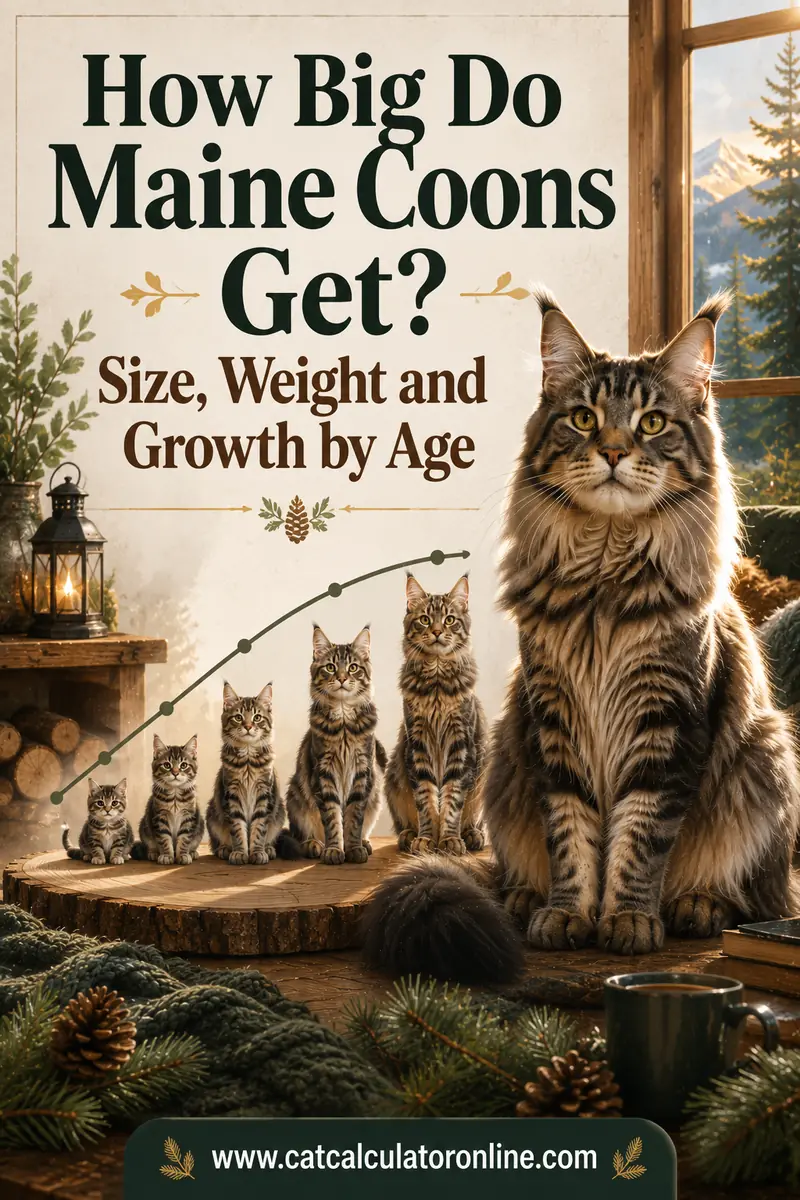
How Big Do Maine Coons Get? Size, Weight and Growth by Age
Male Maine Coons typically weigh 13–18 pounds, and plenty of healthy males pass 20. Females run smaller at 8–12 pounds. Length is where the breed really shows off: from nose to tail tip, a full-grown Maine Coon can approach 40 inches, and the record holder, a cat named Stewie, measured 48.5 inches. The other number that surprises new owners is time — Maine Coons don't reach full size until they're 3–4 years old, long after most cats have finished growing.
If you've got a Maine Coon kitten and you're wondering whether she's on track, our free kitten weight calculator gives you a typical weight range for her age so you can see where she falls.
🐾 Maine Coon size by age
Tap an age to see a typical Maine Coon weight range:
Tap an age above to see the typical weight range.
How Big Do Maine Coons Get, Exactly?
Maine Coons are the largest widely-kept domestic cat breed, and the size difference from an ordinary house cat is obvious the moment one walks into a room. Here's how the numbers break down.
| Measurement | Male Maine Coon | Female Maine Coon | Average domestic cat |
|---|---|---|---|
| Weight | 13–18 lb (many exceed 20) | 8–12 lb | 8–10 lb |
| Body length (nose to tail) | Up to ~40 in | Up to ~35 in | ~28–30 in |
| Shoulder height | 10–16 in | 8–14 in | 9–10 in |
| Age at full size | 3–4 years | 3–4 years | ~1 year |
A few things worth pulling out of that table. First, a big male Maine Coon can weigh double what an average cat weighs — that's the difference between carrying a bag of sugar and carrying a toddler. Second, females are dramatically smaller than males in this breed. If you meet an 18-pound Maine Coon, it's almost certainly a male. A 10-pound female is completely normal and not "small for the breed."
And then there's the length. The longest domestic cat ever verified was Stewie, a Maine Coon who measured 48.5 inches from nose to tail tip — a hair over four feet of cat. Stewie was exceptional, but stretching to 40 inches isn't unusual for a large male, and the long, flowing tail accounts for a lot of the drama.
They look even bigger than they are
Part of the Maine Coon's giant reputation is presentation. The shaggy semi-longhair coat, the ruff around the neck, the tufted ears, the huge snowshoe paws with fur sprouting between the toes — all of it adds visual bulk on top of an already large frame. A soaking-wet Maine Coon (and this breed famously doesn't mind water) looks noticeably less enormous than a dry, fluffed-up one.
When Do Maine Coons Stop Growing?
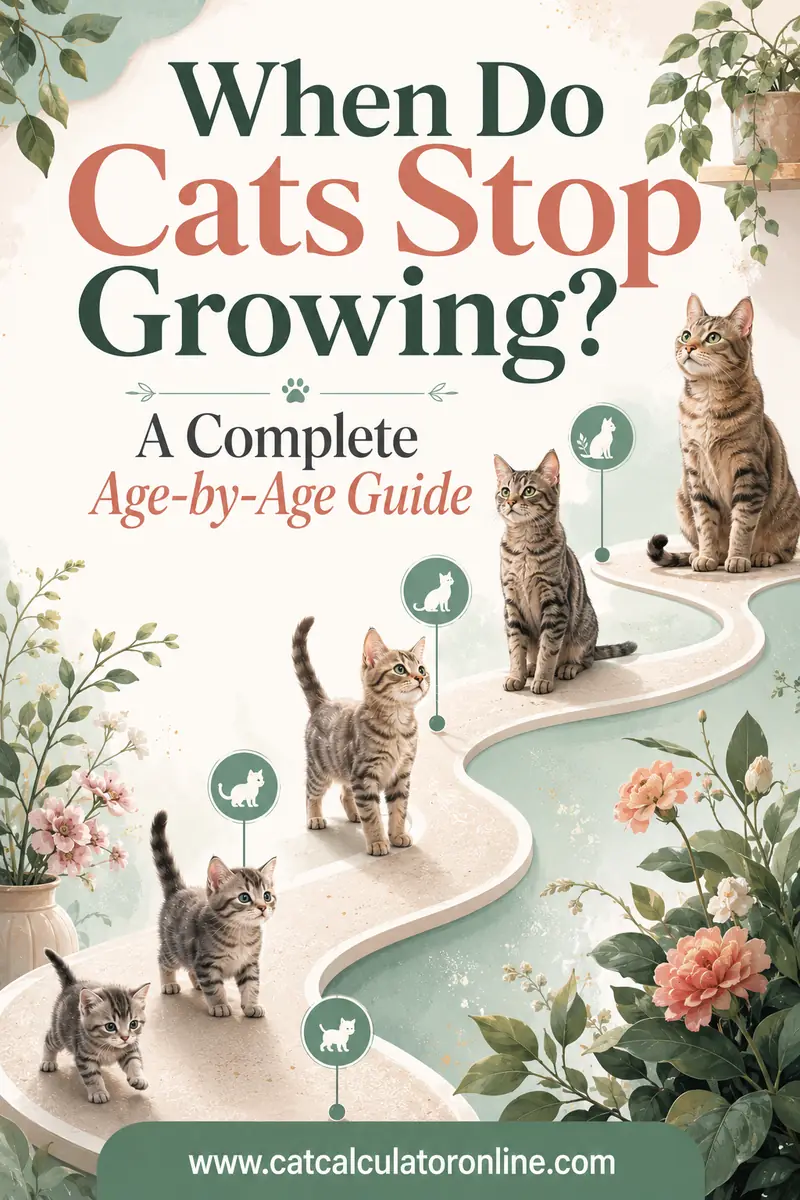
This is the number that catches almost every new owner off guard: Maine Coons keep growing until they're 3–4 years old.
Most cats hit their adult size around their first birthday. A Maine Coon at one year old is maybe two-thirds of the way there. Growth slows way down after the first year, but the chest keeps broadening, the muscle keeps building, and the weight keeps creeping up for another two to three years.
That slow maturity has practical consequences:
- Don't judge adult size at one year. A lanky 11-pound yearling male can still end up an 18-pound adult.
- Don't panic about "stunted" growth. Owners sometimes worry their two-year-old Maine Coon is small for the breed. She may simply have two more years of filling out to do.
- Nutrition matters for longer. The growth window that lasts twelve months in a normal cat stretches to several years here, which changes how you think about feeding (more on that below).
If you want the full picture of how feline growth works across breeds, when do cats stop growing walks through the whole timeline.
What Does a Maine Coon Growth Chart Look Like?
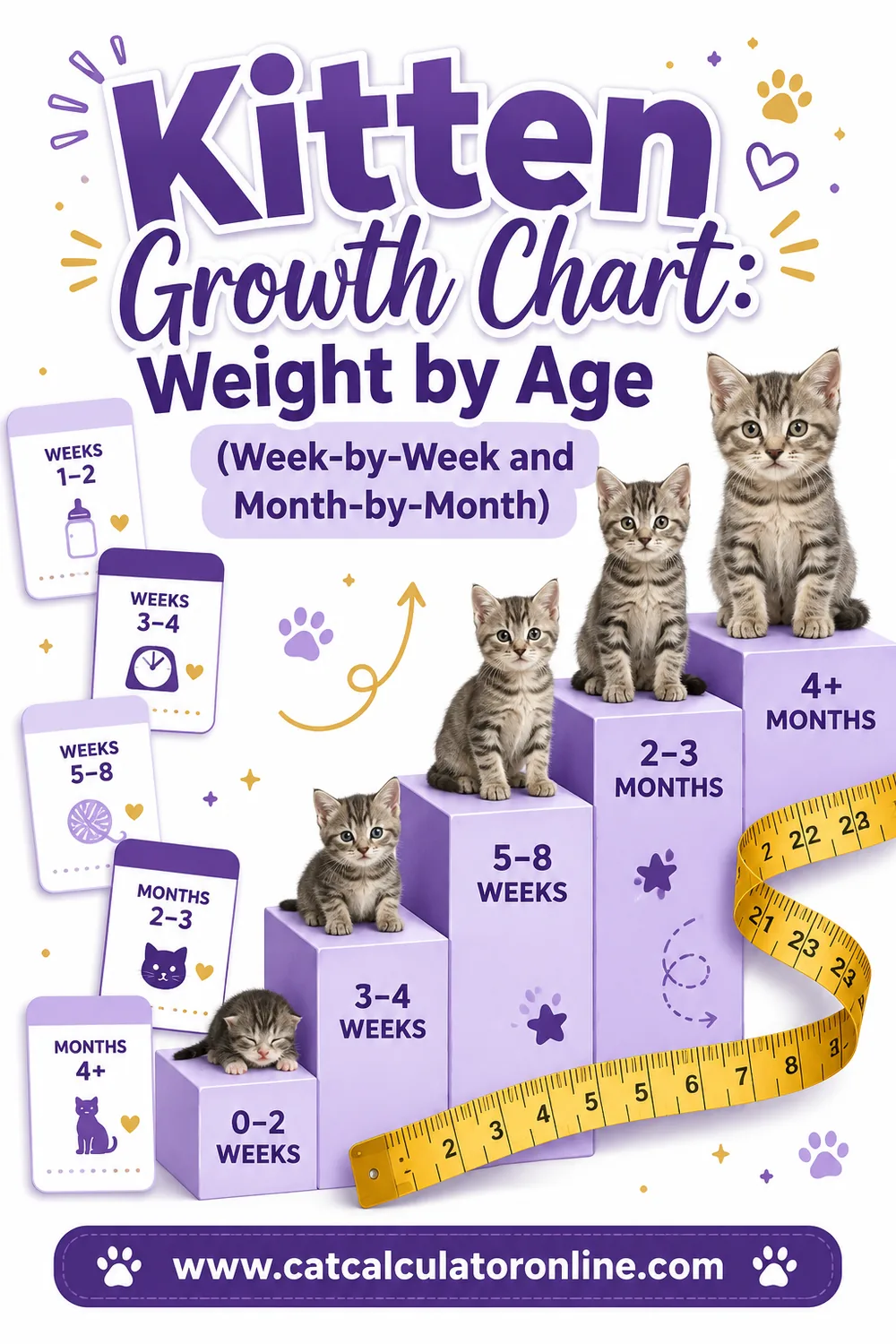
Here's a rough guide to typical Maine Coon weights by age. Treat these as broad, healthy ranges rather than targets — individual cats vary a lot, males sit toward the top of each range, and females toward the bottom.
| Age | Typical weight range | What's happening |
|---|---|---|
| 3 months | 3–6 lb | Already outpacing ordinary kittens; big paws are a giveaway |
| 6 months | 6–10 lb | Roughly the size of many adult cats |
| 9 months | 8–12 lb | Long and lanky; frame is stretching out |
| 12 months | 9–14 lb | Where average cats stop — Maine Coons keep going |
| 18 months | 10–16 lb | Chest and shoulders start to broaden |
| 2 years | 11–17 lb | Noticeably more muscle and substance |
| 3–4 years | Males 13–18+ lb, females 8–12 lb | Full adult size, finally |
Two honest caveats about any chart like this. There's no single official registry of Maine Coon growth data, so published ranges are drawn from breeder records and owner reports, and they smear together big males and small females. And a kitten's own curve matters more than the chart — a kitten who's steadily gaining along her own line is doing better than one who matches the chart one month and stalls the next.
That's exactly what our kitten growth chart and kitten weight calculator are for: enter your kitten's age, see the typical range, and track whether her line keeps climbing.
Why Are Maine Coons So Big?
Nobody bred Maine Coons to be giants on purpose — they got there the old-fashioned way. The breed developed naturally in the harsh climate of the northeastern United States, and just about everything distinctive about a Maine Coon reads like cold-weather equipment:
- Large, big-boned frame — bigger bodies hold heat better in brutal winters.
- Dense, water-resistant semi-longhair coat with a heavy ruff at the chest.
- Tufted ears — built-in earmuffs.
- Enormous tufted paws that work like snowshoes on soft snow.
- A long, bushy tail they can wrap around themselves like a scarf.
Farm cats that survived Maine winters passed on their genes, and size was part of the winning package. The result is a big, capable, weatherproof cat — and one with an unusually easygoing personality to match. Maine Coons are often described as "dog-like": they follow their people around, greet visitors, learn to fetch, tolerate leashes better than most cats, and are famously relaxed about water. Big cat, big presence, soft temperament.
Is My Maine Coon Overweight or Just Big-Boned?
Here's the myth that needs busting: the internet is full of claims about 25- and 30-pound Maine Coons as if that were normal for the breed. It isn't. A 30-pound Maine Coon is almost always an overweight Maine Coon, not a naturally huge one. Healthy males top out in the high teens to low twenties, and "he's just big-boned" has put a lot of cats on a path to diabetes and joint pain.
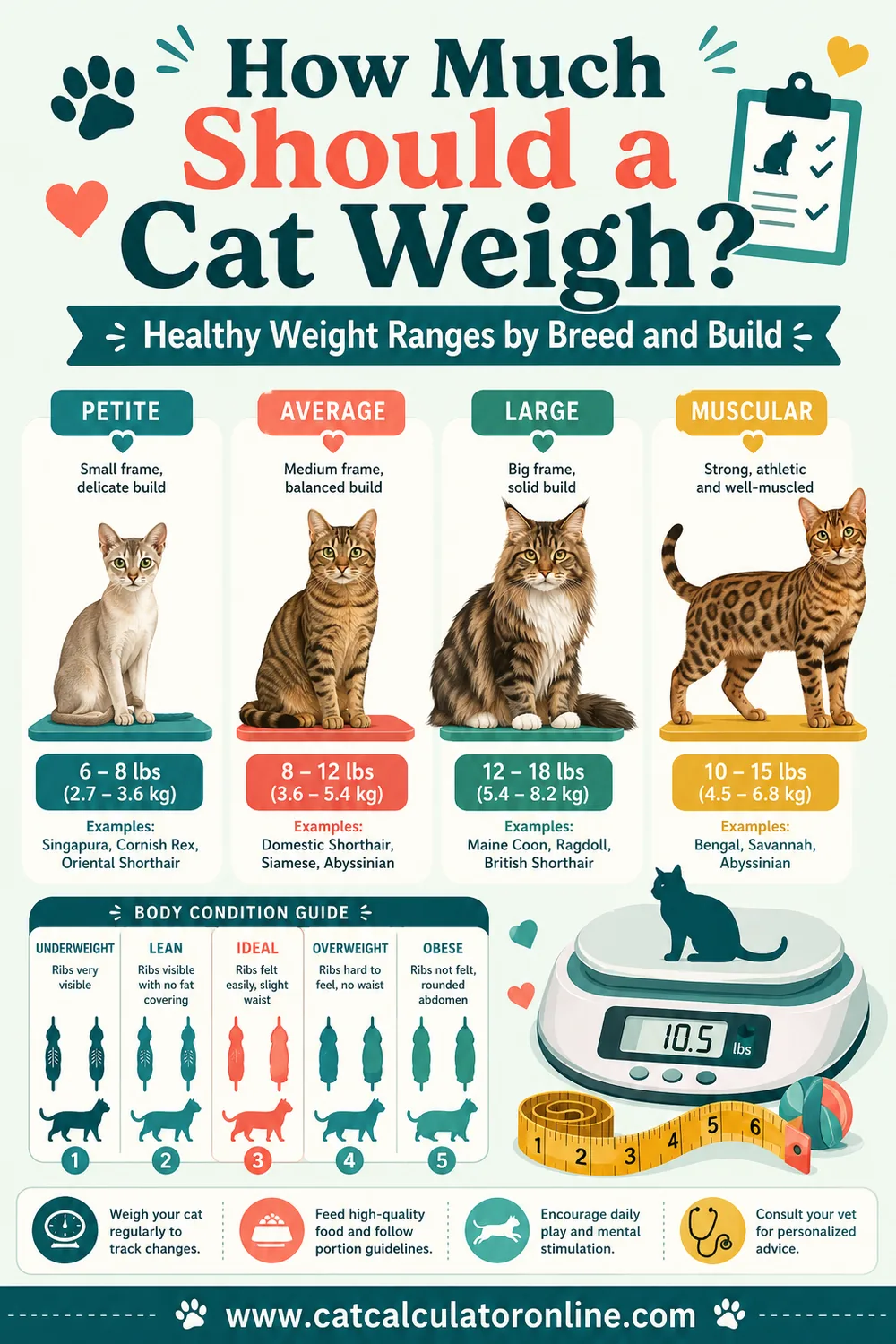
The tricky part is that a genuinely large breed gives extra weight more places to hide. A few pounds of excess fat that would be obvious on an 8-pound tabby can disappear into a Maine Coon's bulk and fur. So don't judge by the number on the scale or by eyeballing — use your hands:
- Rib check. Feel along her sides. You should be able to feel ribs under a light layer of padding without pressing hard. Ribs you can't find are a warning sign.
- Waist check. Looking from above (mentally flatten the fur), there should be a visible waist behind the ribs, even on this breed.
- Belly check. A small primordial pouch — that swinging flap of skin low on the belly — is normal and breed-typical. A round, taut belly is not.
If the hands-on check has you unsure, our guide to how much should a cat weigh walks through body condition scoring step by step. And when in doubt, ask your vet to score her — it takes them about ten seconds.
How Should You Feed a Growing Maine Coon?
The single best feeding rule for a giant breed: feed the cat in front of you, not the bag.
Feeding guidelines printed on cat food are calibrated for average cats and stated in wide ranges. A Maine Coon spends three to four years growing, needs more total food than a small cat, and yet can still get fat on the wrong portions — because "big breed" is not a license for free-feeding. A few practical rules:
- Kittens need kitten food, for longer than you'd think. Because the growth window is extended, many breeders and vets keep Maine Coons on growth-formula food past the first birthday. Ask your vet what's right for your cat's line and build.
- Measure meals. Scheduled, measured portions beat an always-full bowl. It's the only way you'll notice appetite changes, and it's the main defense against slow weight creep in adulthood.
- Recheck portions as growth slows. The amount that fuels a growing two-year-old becomes too much for a finished four-year-old. This is the moment most Maine Coons start gaining quietly.
- Weigh her monthly. A luggage scale and a carrier, or you-holding-cat minus you on the bathroom scale. Trends matter more than any single reading.
For portion math and feeding schedules, see how much should I feed my cat.
What Health Issues Should Maine Coon Owners Know About?
Maine Coons are a generally sturdy breed, but big cats carry a few breed-associated risks worth knowing about — not to worry over, but to screen for.
- Hypertrophic cardiomyopathy (HCM). The breed has a recognized association with this heart condition, in which the heart muscle thickens. A genetic test exists for a known variant in Maine Coons, and reputable breeders test their breeding cats. If you're buying a kitten, ask the breeder directly what heart screening they do; if you already have a Maine Coon, mention the breed at your next vet visit and ask whether monitoring makes sense.
- Hip dysplasia. Unusual in cats generally, but reported more in large, heavy breeds — Maine Coons included. Watch for reluctance to jump, stiffness after rest, or a bunny-hopping gait, and raise anything you notice with your vet.
- Weight-related strain. Not a genetic condition, but the practical one: extra pounds on an already-heavy frame multiply stress on joints and heart. Keeping a Maine Coon lean is the cheapest health insurance you can buy her.
None of this should scare you off the breed. It's a checklist for two conversations — one with the breeder before you buy, and one with your vet once the cat is yours. Specific screening decisions belong with them, not with an article.
One more piece of context: large breeds tend to sit slightly lower on longevity tables than small, lean breeds, and Maine Coons typically average around 12–15 years. Plenty beat that with good care. You can see how the breed compares in our roundup of cat breeds that live the longest.
How Do Maine Coons Compare to Other Large Breeds?
Maine Coons get the headlines, but they're not the only big cat on the block.
| Breed | Typical male weight | Notes |
|---|---|---|
| Maine Coon | 13–18 lb, many 20+ | Longest body of any breed; slowest to mature |
| Ragdoll | 15–20 lb | Comparable weight, shorter body, famously floppy |
| Norwegian Forest Cat | 12–16 lb | The Maine Coon's Scandinavian cousin in build and coat |
| Siberian | 10–17 lb | Stocky and powerful rather than long |
| Average domestic cat | 8–10 lb | For scale |
Ragdolls actually match or exceed Maine Coons on the scale, but the Maine Coon's extra length, height and coat make it read as the bigger cat in person. If it's sheer nose-to-tail size you're after, the Maine Coon still owns the record book.
FAQ
How big do Maine Coons get compared to normal cats?
Roughly half again to twice the size. Males typically weigh 13–18 pounds against 8–10 for an average cat, and many healthy males pass 20 pounds. Nose to tail, a large Maine Coon can approach 40 inches — close to a foot longer than an ordinary house cat.
How long does it take a Maine Coon to reach full size?
Three to four years. That's three times longer than an average cat, which finishes growing around its first birthday. Most of the visible growth happens in the first year, but chest, muscle and weight keep developing well after that.
Are 30-pound Maine Coons real?
They exist, but they're almost always overweight rather than naturally enormous. Healthy males generally top out in the high teens to low twenties. If your Maine Coon weighs 25+ pounds, ask your vet for a body condition check rather than assuming it's breed size.
How big do female Maine Coons get?
Typically 8–12 pounds — dramatically smaller than males, and overlapping with the weight of an ordinary cat. Females still have the length, coat and look of the breed, just on a lighter frame.
What was the biggest Maine Coon ever?
The famous record is for length: Stewie, a Maine Coon from Nevada, measured 48.5 inches from nose to tail tip — the longest domestic cat ever verified.
How do I know if my Maine Coon kitten is growing normally?
Track her weight monthly and compare it against typical ranges for her age — steady gains along her own curve matter more than matching any chart exactly. Our kitten weight calculator shows the typical range for each age. If gains stall or she loses weight, call your vet.
The Bottom Line
Maine Coons are genuinely giant by cat standards — males of 13–18 pounds with some past 20, females of 8–12, bodies approaching 40 inches, and a growth curve that doesn't finish until age three or four. But "big breed" isn't a blank check: a healthy Maine Coon is long and solid, not round, and the hands-on rib check matters more than the number on the scale.
If you're raising one of these slow-motion giants, check her progress with the free kitten weight calculator, and keep the kitten growth chart handy for the months ahead. Four years is a long time to grow — enjoy every oversized inch of it.