Helping a Cat Settle Into a New Home
You have brought her home, opened the carrier, and she has gone straight under the bed and stayed there. That is normal, and it is not a bad sign. The two things that make the biggest difference are giving her one small room rather than the whole house, and making that room smell of her — which is why the unwashed blanket from the shelter or her old home matters more than anything you bought new. Cats do not read a home the way we do; they read it by scent, and a place that smells of nothing feels like nowhere. Expect hiding for days rather than hours, resist the urge to reach under the bed, and let her come out on her own timetable. Here is how to set it up and what should happen when. Her age shapes the pace, and the free cat age calculator will tell you which life stage you are working with.

Why One Room Beats the Whole House
It feels mean to shut a cat in one room. It is the opposite.
A cat maps territory by patrolling it. A whole house is an enormous, unmapped space full of unfamiliar noises and exits. One room is a space she can learn in a night — every corner, every smell, where the food is, where the escape route is.
A small space means she can find you. In a big house, a frightened cat picks a hiding spot and never comes out, so the two of you never meet. In a bedroom, you sitting quietly on the floor is unavoidable, and that is how the relationship starts.
It stops her bolting. The highest-risk window for a cat disappearing is the first few days in an unfamiliar home, when she has no territory and no reason to come back. A closed door removes that risk entirely — and finding a missing cat is a much harder week than this one.
It protects any resident animals. No accidental face-to-face meeting in a hallway, which is the classic way a cat introduction goes wrong on day one.
Pick the right room. Quiet, with a door that closes, not the room with the front door in it, and ideally one you use daily so your visits are natural. A spare bedroom or a home office beats a bathroom, which tends to be echoey and cold.
Setting the Room Up Before She Arrives
Do this the day before, so nothing is being carried in while she watches.
Give her somewhere to hide that you approve of. A cardboard box on its side with a towel in it, or the carrier with the door removed and a blanket over the top. A cat with a good hiding place hides less, because she is not searching for one.
Separate the food from the tray. Opposite ends of the room, as far apart as the space allows. Cats will not reliably eat next to a toilet, and a cat who is put off her food in week one is a problem you do not need.
Add height. A chair, a windowsill, the top of a chest of drawers with a towel on it. Cats feel safest looking down at a room, and a high perch is often where she goes first when she starts to relax.
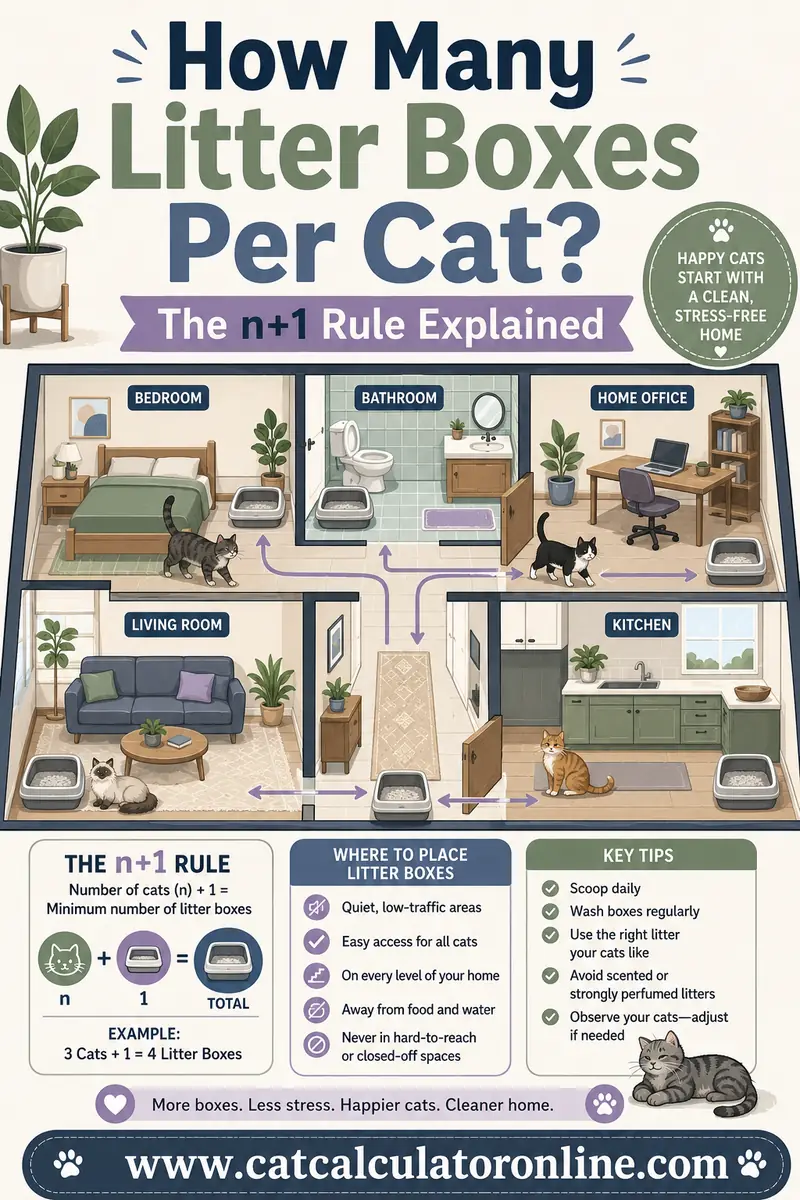
Put down a tray she cannot get wrong. Large, uncovered, low-sided if she is old or arthritic, filled with the same litter she has been using if you can find out what that was. One tray per cat plus one is the household rule — how many litter boxes per cat explains why.
Bring her smell in. Ask the shelter, breeder or previous owner for an unwashed blanket, bed or toy. Do not wash it. That single item does more for her than a whole shop of new equipment.
Keep it boring. No new toys strewn everywhere, no scented plug-ins, no music. A pheromone diffuser is a reasonable extra if you want one, though the evidence for it is modest rather than dramatic — it will not replace time.
The First Forty-Eight Hours
Your job in the first two days is almost entirely to do nothing, well.
Open the carrier and walk away. Put it down in the room, open the door, and leave. Do not tip her out. Do not lift her out. Let her come out in her own time, which may be hours after you have gone.
Expect her to vanish. Under the bed, behind the closet, inside the box. Some cats stay hidden for two or three days and only move at night. That is a normal response to a total change of world, not a sign she is unhappy with you.
Never reach under furniture for her. A hand coming into a hiding place is exactly the wrong first impression, and a scared cat will defend that space. You will undo days of progress in three seconds.
Check the evidence instead of checking on her. Has food gone? Is there anything in the tray? Both, within the first 24 hours, means she is fine even if you have not seen her.
Sit in the room and ignore her. Ten or fifteen minutes at a time, several times a day, on the floor, doing something quiet — reading out loud is genuinely useful because it gets her used to your voice at low stakes.
Slow blink and look away. A direct stare is a threat in cat. A long, slow blink with your eyes half closed is the closest thing to a friendly greeting you can offer.
What Should Happen When
This is the shape of a normal settling-in, not a schedule to hold her to.
| Stage | What she is doing | What you should do |
|---|---|---|
| Days 1–3 | Hiding, eating at night, silent, may not use the tray at first | Nothing active. Food, water, quiet, sit in the room daily |
| Days 3–7 | Coming out when you are still, eating while you are present | Play with a wand toy from a distance; start scent-swapping |
| Weeks 1–3 | Learning your routine, exploring the room, greeting you | Open the door to the rest of the house for short supervised spells |
| Weeks 3–8 | Using the whole house, sleeping in the open, tail up | Introduce visitors gradually, keep feeding times fixed |
| Months 2–3 | Playing, rubbing on you, sleeping on the bed, back-chatting | Normal life. Consider outdoor access if you plan to allow it |
| Any time | Not eating for 24 hours, hiding with no food or tray use | Call your vet — this stops being behavior and becomes health |
The common rule of thumb is three days, three weeks, three months. Three days to stop being terrified, three weeks to learn the routine, three months to feel like it is hers. It is a useful shape rather than a law — plenty of confident cats are on the sofa by the second evening, and plenty of shy ones take six months.
Letting Her Into the Rest of the House
The mistake is opening the door because you are ready.
Wait for three signals. She eats while you are in the room, she comes out to greet you rather than waiting for you to find her, and she has started using a high perch or sleeping in the open. Confidence in the small room comes before more space.
Spread her scent first. Take a soft cloth, stroke her cheeks and the base of her ears, then wipe it on door frames and furniture corners in the next room. You are pre-loading the new area with her own smell, which is the thing that makes a place feel safe.
Open the door and leave it open. Do not carry her out. Do not close the door behind her. She needs to be able to retreat to base at full speed, and she will, several times.
Start with one room at a time. Then two. A whole house at once is a lot of unmapped territory for a cat who has just got used to a bedroom.
Keep the safe room intact for weeks. Same bed, same tray, same food spot. It is her bolthole and taking it away too early undoes the work.
Watch the exits. Front door, back door, open windows, tilt-and-turn windows in particular. A newly settled cat who slips out has no territory to come back to.
Other Cats, Dogs, Children and Visitors
Everyone in the house needs a rule, including the people.
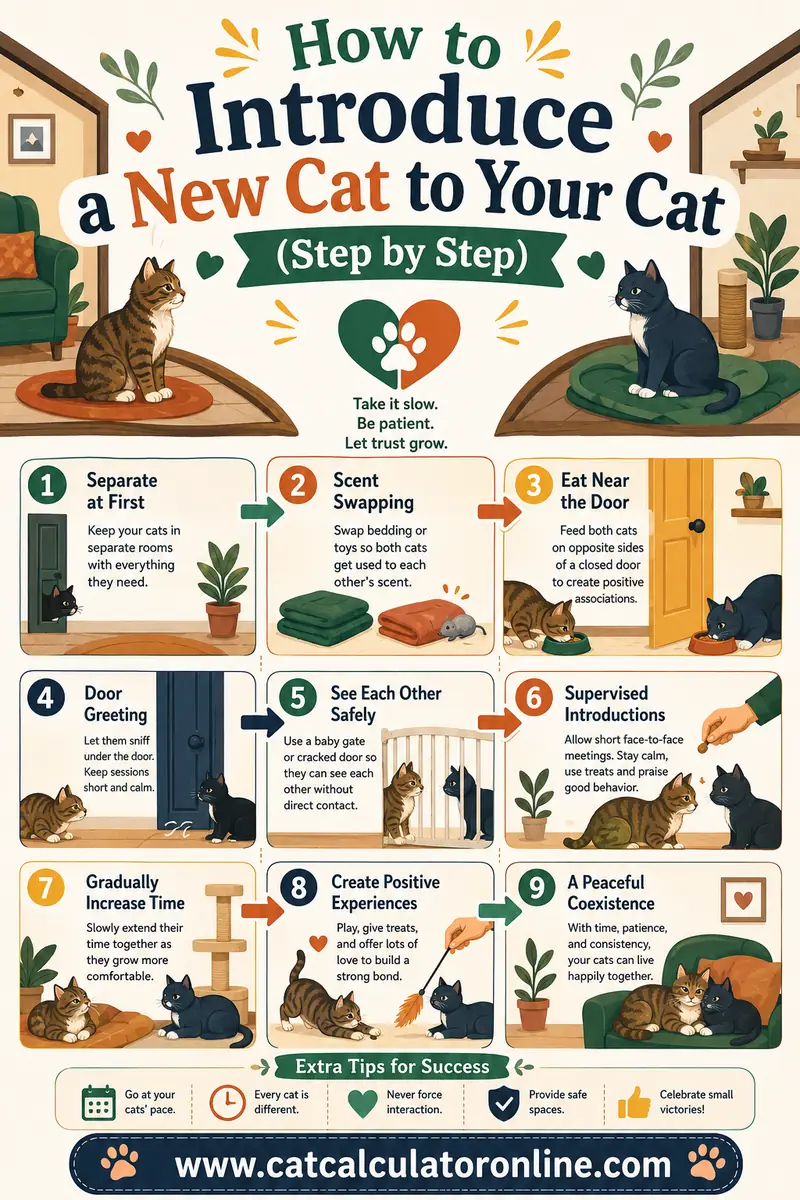
Never let a new cat and a resident cat meet on day one. Total separation first, then scent swapping, then sight without contact, then short supervised meetings. It takes days to weeks and the full method is in how to introduce a new cat. Rushing it is the single most common cause of long-term cat-to-cat tension.
Dogs meet through a closed door first. Then a baby gate, with the dog on a lead and settled, for very short sessions. The cat must always have a route up and out.
Children get three rules. No picking her up, no following her, no going into the safe room without an adult. Sitting on the floor and letting her approach turns a scared cat into a friendly one faster than any amount of stroking.
No welcome party. Visitors in the first week are noise and strange smells with no upside. Give it a two weeks.
Feed everyone separately. Resource competition is invisible to owners and enormous to cats. Separate bowls, separate rooms if needed, and no sharing of trays.
Keep the routine boringly regular. Same feeding times, same bedtime, same order of events. Predictability is what a cat reads as safety, and it is free.
Eating, Litter boxes and the Things That Go Wrong
Most first-week problems are the same handful, and most have simple fixes.
She is not eating. Very common on day one. Warm the food to body temperature, use a flat saucer rather than a deep bowl so her whiskers are free, and leave the room — many cats will not eat while watched. If she eats nothing for 24 hours, call your vet, and treat 48 hours as urgent. Cats develop fatty liver disease (hepatic lipidosis) far faster than dogs, so never wait it out or try to tempt her by removing food.
She has weed or messed outside the tray. Usually stress, an unfamiliar litter, a tray in a bad spot, or a covered tray she does not like. Go back to a big open tray, in a quiet corner, with the litter she knows. Clean accidents with an enzyme cleaner, never ammonia-based products.
She is hissing or swiping. Fear, not temperament. Reduce the pressure — less approaching, more sitting quietly. Almost all of this fades within a two weeks.
She is hiding but eating well. She is fine. Keep going.
**She is hiding and not eating, drinking or using the tray.** That is the line where settling-in becomes a health question. Call your vet, and read up on the warning signs of illness in cats, because stress can unmask problems that were already there.
She has diarrhea. Stress and a sudden food change are the usual causes. Keep her on whatever she was eating before and change food slowly over a week once she is settled. More than 48 hours, or any blood, means a vet call.
When Outdoor Access Can Start
If she is going to be an outdoor cat, the timing here matters enormously.
Give it two to four weeks minimum, and longer for a nervous cat. She needs to believe your house is home before she has the chance to leave it. Cats let out too early have been known to head off looking for their old territory.
Make sure she is chipped and the details are yours. A chip registered to the shelter or a breeder, or to an old phone number, will not get her back. Ring the database and confirm.
First trip out: hungry, supervised, door open. Just before a meal, go out with her, stay out there, and leave the door open behind her. Ten minutes is plenty. Then call her in and feed her immediately.
Repeat for a week before leaving her to it. Short trips, always ending with food indoors, so coming home has a point.
If you have moved house with an established outdoor cat, the same rules apply. Moving house with a cat covers that version, which has its own risks.
Kittens and seniors are different. A kitten under six months should not be out unsupervised at all, and a frail older cat may be better with a secure garden or a catio — what each life stage needs is worth a look before you decide.
Frequently Asked Questions
How long does it take for a cat to settle into a new home?
A useful rule of thumb is three days to stop being frightened, three weeks to learn your routine, and three months to feel genuinely at home. Confident cats can be on the sofa within a day or two; shy or previously stray cats can take six months or more.
Should I let my new cat hide?
Yes. Hiding is how a cat copes with a total change of environment, and a cat with a good hiding place actually comes out sooner. Never reach under furniture to pull her out. Check that food is going and the tray is being used instead.
Why won't my new cat eat?
Stress suppresses appetite, and many cats will not eat while being watched. Warm the food, use a shallow dish, and leave the room. If she eats nothing at all for 24 hours, call your vet — cats develop fatty liver disease quickly, so this is not something to wait out.
Should I bring bedding from my cat's previous home?
Yes, and do not wash it. Cats identify a place as safe by scent, so an unwashed blanket, bed or toy from the shelter or previous home is the single most useful thing you can put in her new room. New bedding smells of nothing to her.
How soon can a new cat meet my other cat?
Not on the first day. Keep them completely separate, swap scents by exchanging bedding and wiping cloths, then allow sight without contact, then short supervised meetings. The process usually takes one to three weeks and rushing it can cause lasting tension.
When can a newly adopted cat go outside?
Wait at least two to four weeks, and longer if she is nervous, so she is bonded to the house first. Make sure her microchip is registered to you, then let her out hungry just before a meal, with the door open and you outside with her.
Settling a cat in is mostly about restraint. Give her one small room instead of a whole house, fill it with her own smell rather than new things, and let her come out when she decides to rather than when you are ready. Sit on the floor, read out loud, blink slowly and keep your hands to yourself for the first week — every one of those does more than stroking would. Watch the evidence rather than the cat: food going, tray being used, and eventually a tail held up when she sees you. Call your vet if she eats nothing for 24 hours, because that is where settling-in stops being behavior. And keep her indoors for a few weeks before any outdoor access. Check her life stage with the free cat age calculator to know what pace to expect.