Cat Breeds That Don't Shed Much
The thing that decides how much a cat sheds is not coat length — it is whether the cat has a dense undercoat. That is why a longhaired Balinese leaves less hair on your sofa than a short, plush British Shorthair, and why the low-shedding list is full of breeds people assume would be worse. Every cat with hair sheds something; the honest question is how much, and how much of it ends up on you. This page gives the breeds that genuinely shed least, the ones with an undeserved reputation, and the part the breed lists usually skip: shedding less does not make a cat safe for an allergy. If you are pricing up a pedigree, the cat cost calculator will show what the rest of it comes to.

Do Any Cats Genuinely Not Shed?
Only one group comes close, and even that has a catch.
Every cat with hair loses hair. Hair grows in cycles, and old hairs are released when new ones push through. There is no cat with fur that does not shed at all. The realistic range runs from "barely noticeable" to "handfuls twice a year".
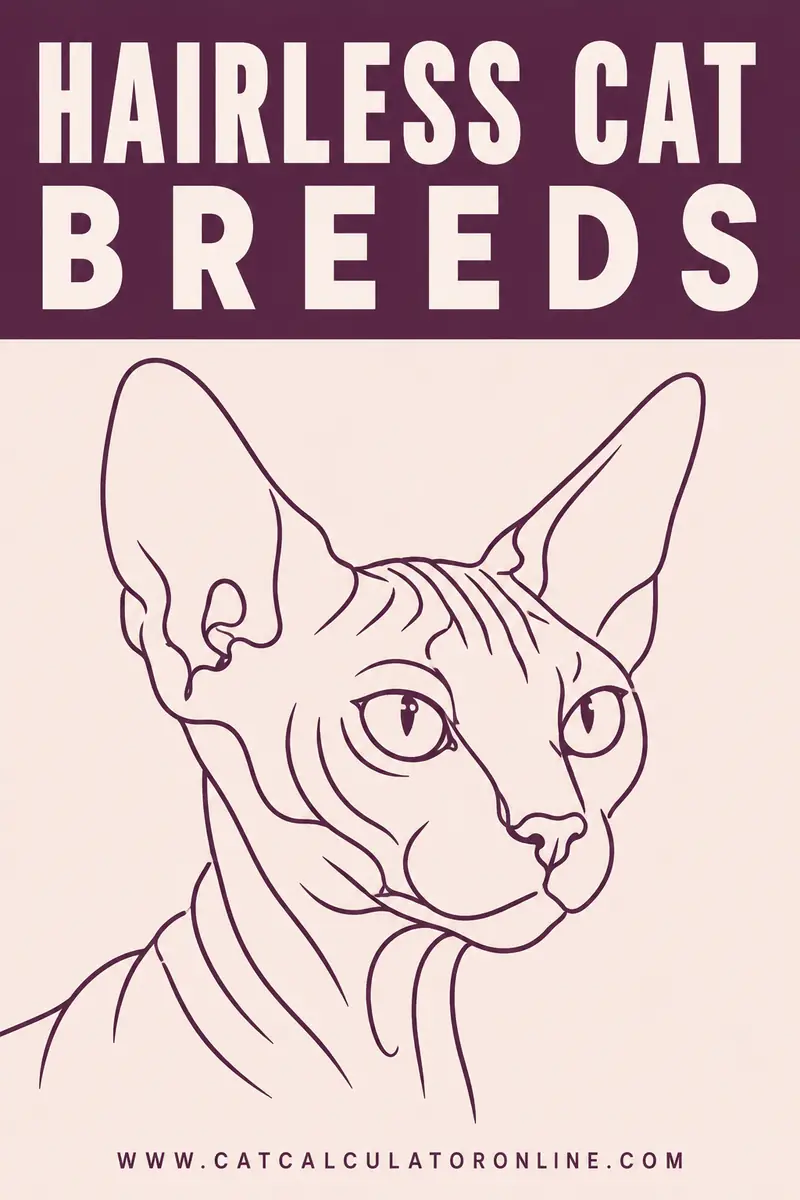
Hairless breeds are the only true non-shedders. A Sphynx, Peterbald or Donskoy leaves essentially no hair around the house because there is barely any to lose. What they do instead is produce skin oil that would normally be wicked away by a coat, which is why they need bathing weekly. Our hairless cat breeds guide covers what that actually involves day to day.
The undercoat is the variable that matters. Cats can have three hair types: coarse guard hairs, middle awn hairs, and a soft, dense down undercoat. It is the undercoat that comes out in clumps during a seasonal molt. Breeds with little or no undercoat shed steadily and lightly instead of dramatically.
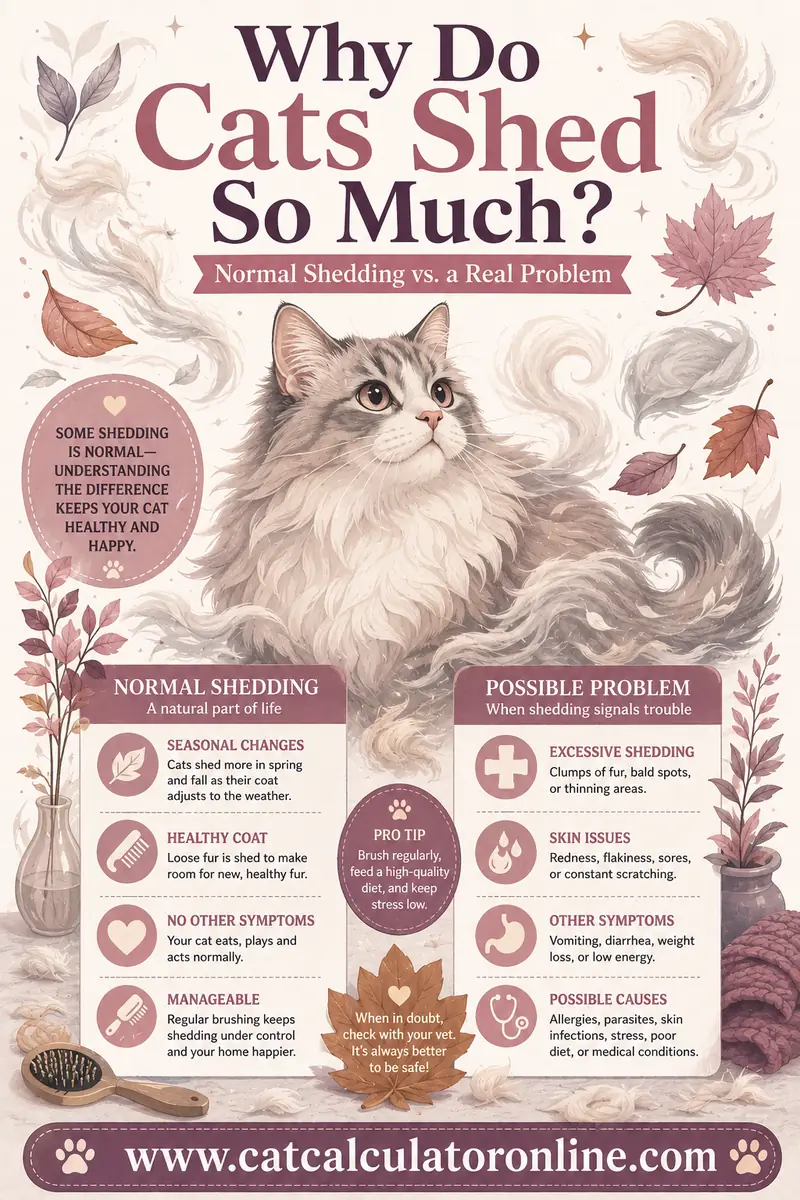
Which is why coat length is a poor predictor. A Balinese has long hair and no undercoat, so it sheds modestly. A British Shorthair has short hair and a very dense undercoat, so it sheds a lot. People routinely get this backwards. Our page on why cats shed so much explains the growth cycle behind it.
And indoor living flattens the seasons. Artificial light and steady central heating disrupt the natural molt cycle, so many indoor cats shed a moderate amount all year rather than twice heavily. That is normal, not a problem.
Which Breeds Shed the Least?
Here is the list, ordered roughly from least to most, with what you actually get.
| Breed | Coat | Shedding | Grooming needed |
|---|---|---|---|
| Sphynx | None | Almost none | Weekly bath, ear cleaning |
| Peterbald | None to fine fuzz | Almost none | Weekly bath |
| Donskoy | None to velour | Almost none | Weekly bath |
| Cornish Rex | Undercoat only, wavy | Very low | Occasional gentle stroke |
| Devon Rex | Sparse, fine, curly | Very low | Weekly, gently — coat tears easily |
| Lykoi | Partial, patchy | Very low, molts oddly | Occasional |
| Singapura | Very short, fine single | Very low | Weekly |
| Bengal | Short, dense, pelt-like | Low | Weekly rubber mitt |
| Siamese | Short, fine, single coat | Low | Weekly |
| Oriental Shorthair | Short, fine, single coat | Low | Weekly |
| Burmese | Short, satin, single coat | Low | Weekly |
| Bombay | Short, glossy, close-lying | Low | Weekly |
| Korat | Short single coat | Low | Weekly |
| Balinese | Long, silky, no undercoat | Low to moderate | Twice weekly comb |
| Javanese | Long, no undercoat | Low to moderate | Twice weekly comb |
| Turkish Angora | Long, single coat | Moderate, seasonal | Twice weekly |
The Rex breeds are the low-shedding champions among cats that still have fur. A Devon Rex has soft, sparse, curly hair and very little of it. A Cornish Rex has essentially only the down layer, arranged in tight waves. Both feel like warm suede and leave almost nothing behind.
The Siamese family is the practical mainstream choice. Siamese, Oriental Shorthair, Balinese and Javanese all share a fine single coat with no real undercoat. They are widely available, comparatively affordable, and hugely characterful. If you want low shedding without an exotic price tag, start here.
Bengal and Burmese sit just behind them. Both have short, dense, close-lying coats that hold onto hair rather than releasing it. A weekly rub with a rubber mitt is genuinely all most of them need.
The Balinese surprises people every time. It is a longhaired cat that sheds less than most shorthairs, because there is no undercoat to molt. Long does not mean heavy.
Why Doesn't Low Shedding Mean Low Allergen?
This is the most important paragraph on the page, and it is the one most breed lists leave out.
You are allergic to Fel d 1, not to hair. It is a protein produced in a cat's salivary glands and in the oil glands of its skin. The cat spreads it over its whole body every time it grooms. Hair carries the protein; it does not make it. The mechanism is set out in what actually causes cat allergies.
The airborne fraction is dander, and dander is skin. Fine flakes of shed skin carry Fel d 1 and stay suspended in room air for hours. Every cat sheds skin, including one that sheds almost no hair. That is why a Sphynx can trigger a reaction as readily as a Persian.
Low shedding does give you a partial win. Less loose hair means less allergen carried onto your clothes, your sofa and your bed. If your symptoms come largely from contact rather than from breathing, that can genuinely help.
But no breed is hypoallergenic, and none of these are. Not the Rex breeds, not the Bengal, not the Sphynx. The full version of that argument is in hypoallergenic cat breeds.
If allergy is your reason, the better levers are elsewhere. A neutered female rather than an intact male, a permanently cat-free bedroom, a HEPA purifier running continuously, and time spent with the specific individual cat before you commit.
Which Breeds Shed More Than People Expect?
Several of the most popular cats in the world are heavy shedders, and buyers are regularly caught out.
British Shorthair and Chartreux. Short coats, so people assume low maintenance. In fact both carry a very dense, plush double coat that molts substantially in spring and autumn. Expect real brushing time.
Russian Blue. Often listed as low-shedding because of its allergy reputation, but it has a thick double coat. It sheds moderately; the dense coat just holds more of it close to the body until you disturb it.
Maine Coon, Norwegian Forest Cat and Siberian. All three are big cats with long, weather-resistant triple coats and dramatic seasonal molts. Brushing several times a week is the baseline, daily during a molt.
Persian, Himalayan and Ragdoll. Long, soft coats with plenty of undercoat, prone to matting as well as shedding. A Persian is a daily grooming commitment, not a weekly one. Our guide on how to deal with cat matting is worth reading before you take one on.
American Shorthair and the ordinary domestic shorthair. Perfectly nice cats and moderate to heavy shedders. "Shorthair" is not a low-shedding label.
None of these are bad choices — they are just bad choices if minimal hair is your priority. Pick the temperament and accept the brush.
What Else Changes How Much a Cat Sheds?
Breed sets the baseline. Several other things move it, and some are worth acting on.
Diet does real work. A cat on a good-quality complete food with adequate protein and essential fatty acids holds its coat better and drops less. Poor nutrition shows up in the coat before almost anywhere else.
Stress increases shedding, sometimes dramatically. Vets see it constantly — a cat on the consulting table sheds visibly more than the same cat at home. Household upheaval, a new pet or a house move can all raise shedding for weeks.
Parasites, allergies and skin disease all raise it. Fleas are the commonest cause of a sudden increase, and a cat can be flea-allergic without you ever seeing a flea.
Hydration matters more than people think. A chronically under-drinking cat has drier skin and a poorer coat. Wet food helps here as much as a water fountain does.
Grooming does not reduce shedding — it relocates it. Brushing takes the loose hair off the cat before it lands on your furniture, which is exactly what you want. Frequency by coat type is covered in how often you should groom a cat, and the practical routine in how to reduce cat shedding.
Age shifts it in both directions. Kittens shed little until their adult coat comes in. Older cats often groom themselves less thoroughly, especially with arthritis, so their coats look worse even when shedding has not changed.
What Do Low-Shedding Coats Cost You in Care?
Less hair usually means a different job rather than no job.
Hairless cats need weekly bathing. With no coat to absorb skin oil, it builds up on the skin and in the folds, and it will mark your bedding. Ears also produce more wax and need regular cleaning. This is a real, permanent chore.
Rex coats are delicate. Devon Rex hair in particular is fine and breaks easily, so aggressive brushing damages it. A gentle hand or a soft mitt is the right tool, and a wire slicker is not.
Hairless and thin-coated breeds get cold and get sunburnt. They seek out warm spots, often need jumpers in a cool house, and should not sunbathe through glass unprotected.
Short, dense coats can still mat under the arms and behind the ears. Less often than a Persian, but it happens, particularly in an older cat that has stopped grooming properly.
Low-shedding pedigrees are expensive. Devon Rex and Cornish Rex kittens commonly run around 1,000–2,000 USD, Bengals 1,500–3,000 USD, Sphynx 1,500–3,500 USD. A Siamese from a registered breeder is often nearer 800–1,500 USD, and a rescue adult of any of these is a fraction of that.
Budget for the whole picture, not the kitten price. Food, litter, insurance, vaccination and the occasional emergency dwarf the purchase price over a cat's life. Run your own numbers through the cat cost calculator.
When Is Shedding a Health Problem Rather Than a Coat Type?
There is a line between a hairy jumper and something that needs a vet, and it is worth knowing where it is.
Bald patches are never normal. Symmetrical thinning on the flanks or belly, or a patch you can see skin through, means something is wrong — parasites, an allergy, over-grooming from stress or pain, or a hormonal problem.
Sudden heavy shedding in a cat that was fine last month deserves attention. Especially with weight change, increased thirst, or a change in appetite.
Broken hairs and a greasy or scurfy coat suggest the cat has stopped grooming properly. In an older cat, that often means arthritis or dental pain making the movement uncomfortable.
Red, scaly, crusted or itchy skin needs seeing. So do scabs along the spine and around the tail base, which is the classic pattern of flea allergy.
Book an appointment promptly for: bald patches, skin that is red or sore, a cat grooming itself raw, or shedding alongside weight loss, increased drinking or lethargy. Call the vet the same day if your cat seems unwell in itself as well as hairy, and treat any cat that is off its food for more than a day as a reason to call — cats deteriorate quietly.
Frequently Asked Questions
What cat breed sheds the least?
Hairless breeds shed least of all, since they have almost no hair to lose — Sphynx, Peterbald and Donskoy. Among cats with fur, the Cornish Rex and Devon Rex shed least, thanks to fine, sparse, curly coats. Both need weekly bathing or gentle handling instead of brushing.
Do any cats not shed at all?
Only hairless breeds come close, and even they shed skin. Every cat with fur loses hair as part of the normal growth cycle. Breeds without a dense undercoat shed steadily and lightly rather than molting in clumps, which is what people usually mean by a cat that does not shed.
Are low-shedding cats better for allergies?
Only partly. Less loose hair means less allergen carried onto clothes and furniture, which helps some people. But Fel d 1, the protein most cat-allergic people react to, is made in saliva and skin and travels on airborne skin flakes. No low-shedding breed is hypoallergenic.
Do British Shorthairs shed a lot?
Yes, more than their short coat suggests. British Shorthairs have a very dense plush double coat with a substantial undercoat, and they molt noticeably in spring and autumn. Brushing two or three times a week, and more during a molt, keeps the hair off your furniture.
Does a long-haired cat always shed more than a short-haired one?
No. Coat structure matters more than length. A Balinese has long hair but no undercoat and sheds modestly, while a short-coated British Shorthair has a dense undercoat and sheds heavily. Look for whether the breed has an undercoat rather than at hair length.
How much does a low-shedding pedigree kitten cost?
Roughly 1,000–2,000 USD for a Devon or Cornish Rex, 1,500–3,000 USD for a Bengal, 1,500–3,500 USD for a Sphynx and around 800–1,500 USD for a Siamese from a registered breeder. Adopting an adult of any of these breeds from rescue costs far less.
If low shedding is what you actually want, look for a coat with no dense undercoat rather than a short one. That points you at the Rex breeds first, then the Siamese and Oriental family, then Bengal, Burmese and Bombay — and, surprisingly, at the longhaired Balinese ahead of most shorthairs. Hairless breeds shed nothing but trade brushing for weekly bathing. What none of them offer is allergy relief, because the protein you react to is made in saliva and skin and travels on flakes of shed skin rather than on hair. Choose on temperament and on the grooming job you are willing to do, and put the real numbers into the cat cost calculator before you commit.