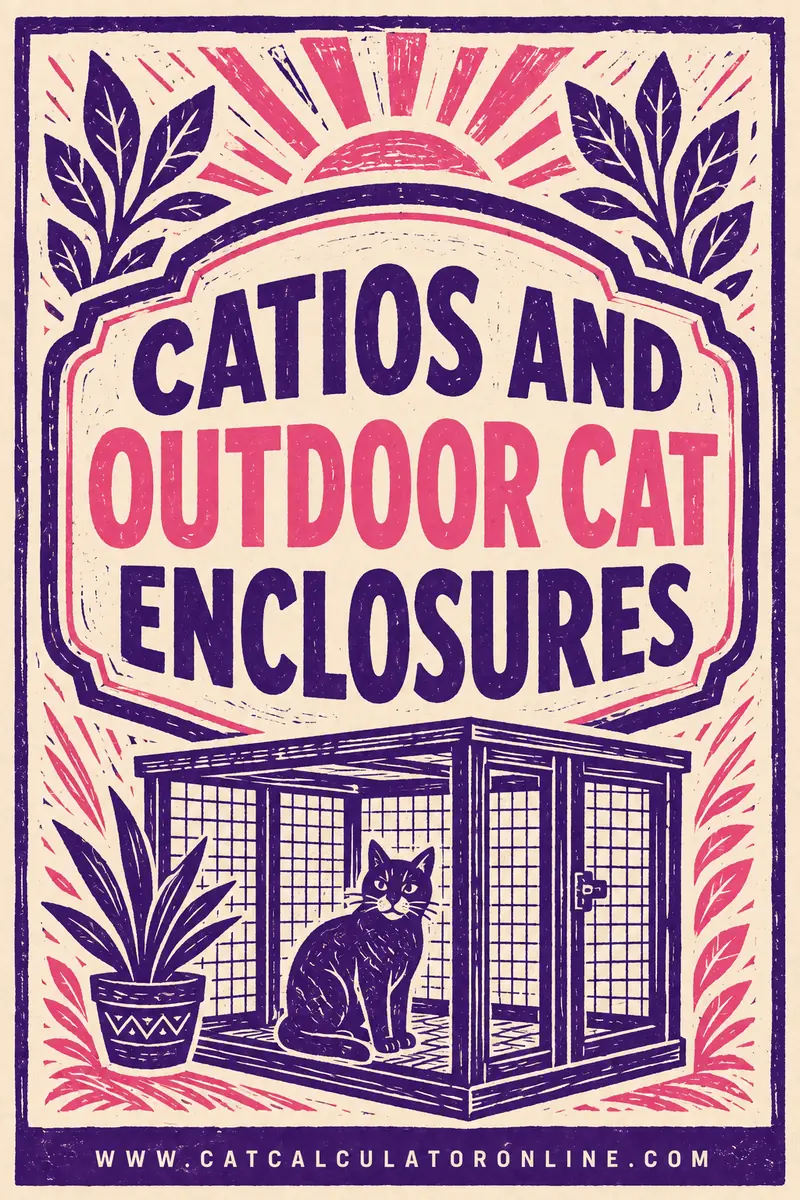
Catios and Outdoor Cat Enclosures
The indoor-versus-outdoor argument usually gets framed as a choice between a longer life and a fuller one. A catio is the answer that refuses the framing. An enclosed outdoor run gives a cat sunlight, moving air, birdsong, grass and weather — the things indoor life genuinely lacks — while removing the traffic, the fights, the poisons and the disappearances that shorten outdoor lives. It is the single biggest enrichment upgrade most indoor cats can be given. The main decisions are whether to buy a kit or build one, how to make it genuinely escape-proof, and how she gets in and out. Costs sit alongside the rest of the year in the cat cost calculator.
What Is a Catio, and What Does It Solve?
A catio is any fully enclosed outdoor space a cat can use safely without supervision. The name covers everything from a window box to a shed-sized run.
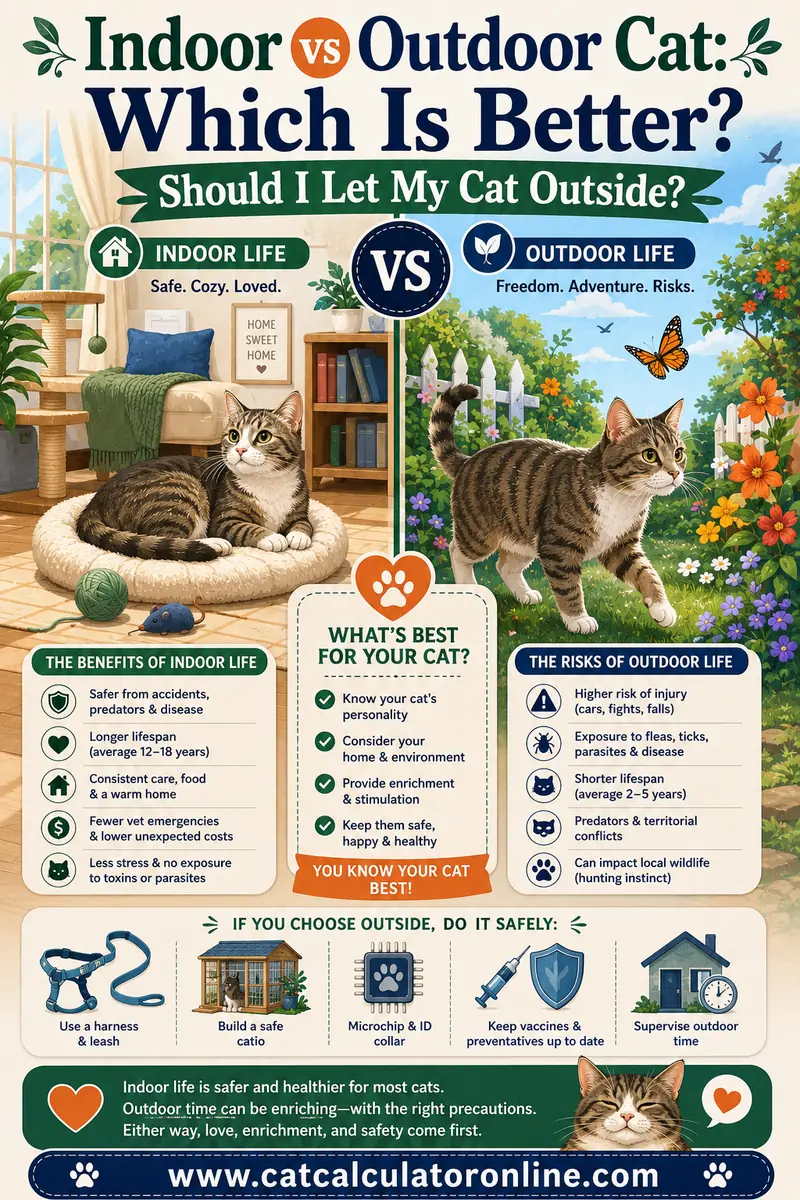
It removes the things that actually kill outdoor cats. Road traffic, dogs, fights with other cats, poisons and antifreeze, and simply not coming home. Those risks are the entire reason indoor life extends lifespan, and they are the reason the choice feels so difficult — the balance is set out in indoor vs outdoor cat.
It gives back what indoor life genuinely lacks. Sunlight on fur, temperature and airflow changing through the day, insects to watch, grass to chew, birdsong, and rain smelt from somewhere dry. These are not luxuries; they are most of what an outdoor cat's day consists of.
It stops your cat killing wildlife, which matters in places where free-roaming cats are a serious pressure on bird and small-mammal populations.
It stops other cats coming in, which quietly resolves a lot of spraying and tension.
It suits cats who cannot go out. Deaf cats, blind cats, three-legged cats, FIV-positive cats, elderly cats and cats in flats beside busy roads all get outdoor life with the risk removed.
It is not a substitute for your attention. A cat alone in a run for eight hours is still a cat alone. Play and interaction still matter — see how much playtime does a cat need.
Should You Buy a Kit or Build One?
Both are reasonable. The decision is mostly about space, budget and how handy you are.
Kits go up in an afternoon and need no design decisions. Modular mesh panels bolt together into a box, usually 6 x 3 ft (1.8 x 0.9 m) or similar, with an optional tunnel to a window or door. Good for renters, because most can be dismantled and taken with you.
Kits cost more per square foot and rarely fit an awkward space well. Check three things before buying: the mesh gauge, whether the panels lock with bolts rather than clips, and whether the base is enclosed or open to the ground.
Building gives you far more space for the money. A timber frame and welded wire mesh is basic carpentry: posts, rails, mesh stapled and battened, a door, a roof. Most people who build one spend a weekend on it.
Building lets you use dead space — a side return, a strip beside a fence, the area under a deck. These are exactly the spaces kits do not fit.
Convert what you already have. A carport, a lean-to, a covered porch, or an existing dog run can often be meshed in for a fraction of a new build.
Renting changes the calculation. Freestanding is the safe answer, or a window box that fixes without permanent fixings. Check your tenancy agreement before you drill anything into a wall.
Check whether you need permission. Rules vary widely by country, state and city. Small freestanding structures are usually fine, but height limits, boundary distances and homeowners' association rules catch people out. A structure attached to the house is more likely to need approval than one that stands alone.
How Big Does It Need to Be?
Bigger than you think, and taller than most kits.
Height matters more than floor area. Cats use vertical space, so a tall narrow run with three levels of shelves is worth more to a cat than a wide flat one with the same footprint. Aim for at least 6 ft (1.8 m) so you can walk in to clean it.
A rough minimum for one cat is around 12–16 sq ft (1.1–1.5 m²) of floor with two or three levels of shelving above it. Less than that works only for short supervised sessions.
Add roughly 50% for each additional cat, and add escape routes: multiple levels, at least two ways up and down, and somewhere a cat can be out of sight of another.
| Type | Typical footprint | Rough US cost | Best for |
|---|---|---|---|
| Window box enclosure | 2 x 3 ft | $120–$350 | Flats, rentals, one cat |
| Kit panel run | 6 x 3 ft | $250–$600 | Fast install, small yards |
| Tunnel plus small run | Varies | $350–$800 | Linking a flap to a run |
| DIY timber and mesh run | 8 x 4 ft | $250–$600 in materials | Best value per square foot |
| Walk-in catio | 8 x 8 ft | $800–$2,500 | Multi-cat homes, a shared space |
| Whole-deck enclosure | 100+ sq ft | $2,000–$6,000 | Permanent, adds to the house |
| Fence-top barrier system | Whole garden | $600–$2,000 | Keeping a cat in an existing yard |
Fence-top systems are a different product. Angled brackets or free-spinning rollers along the top of an existing fence keep a cat in the garden without a roof. They work well for many cats and fail for determined climbers, and they do not keep other cats out.
Build once, properly. The most common regret is building too small and rebuilding within two years.
What Makes an Enclosure Genuinely Escape-Proof?
Cats climb, squeeze and jump, and they have all day to study the problem.
Roof it. This is not optional. An adult cat clears 5–6 ft (1.5–1.8 m) from standing and can climb almost any vertical surface with grip. An unroofed run is a fenced garden.
Use welded wire mesh, not chicken wire. Chicken wire is soft, tears and rusts through, and the hexagonal weave stretches. Welded mesh at around 16 gauge with 1 x 1 in or 1 x 2 in (25 mm) squares is the standard, and small enough to keep kittens in and most wildlife out.
Fix the mesh with battens, not staples alone. Staples pull out. A timber batten screwed over the mesh edge means it cannot be worked loose.
Close the gap at the ground. Cats dig less than dogs but they do push under. Either lay paving slabs around the perimeter, bury the mesh 12 in (30 cm) down, or run a mesh skirt outwards under the soil.
Overlap every seam. Panel joints and corners are where escapes happen. Nothing wider than about 1 in (2.5 cm) should be open anywhere.
Two doors are better than one. A small vestibule or double-door airlock means a cat cannot dash past you as you come in. On a large run this is worth the extra materials.
Check for launch pads. A trash can, a garden chair or a low branch beside the run turns a 6 ft wall into a 3 ft one. Look at it from outside as well as in.
Inspect it twice a year. Timber moves, mesh sags, and screws back out. A five-minute walk round in spring and autumn catches most of it, and pairs naturally with the indoor checks in how to cat proof your home.
Does It Need Shade and Shelter?
Yes, and this is the part most builds get wrong.
At least half the roof should be solid. Clear corrugated polycarbonate or a shingled section keeps rain off and gives shade that does not depend on the weather.
Shade has to move with the sun. A west-facing run with a single shaded corner is unusable on a summer afternoon. Cats will lie in the sun until they overheat, particularly white-eared and thin-coated cats, who also sunburn.
Provide a raised, dry, enclosed bed. A covered box on a shelf, out of the wind, is where most cats will actually spend their time.
Water, always. A bowl in the shade, checked daily, and moved if it becomes a wasp magnet.
Think about winter. Frozen water, icy shelves and cold metal mesh all matter. Many owners simply close the run below a certain temperature, which is a perfectly reasonable answer.
Do not leave food out there. Food attracts rats, racoons, foxes and wasps to the exact spot your cat sleeps.
Provide a covered litter box if she uses the run for long periods, and clean it as often as an indoor one.
How Does She Get In and Out?
The access method decides how much use the catio actually gets.
Free access through a cat flap is by far the best. A flap in a door, wall or window unit, opening into the run, means she uses it twenty times a day on her own terms. Free access is what turns a catio from an outing into part of her territory. Flap types and fitting are covered in cat flaps and microchip cat doors, compared.
A window insert is the usual solution for flats. A panel replaces part of a sash or casement window, with a flap or opening leading straight into a box outside.
Tunnels extend the reach. Mesh tunnels let you put the run at the bottom of the garden and still give free access. Keep them wide enough that two cats can pass, or they become a pinch point.
A supervised door is the fallback. It works, but a run she has to be let into gets a fraction of the use, and the effort falls entirely on you.
Do not lock her out there. Access should be two-way at all times, so she can retreat indoors if she is cold, frightened or wants company.
Introduce it slowly. Prop the flap open, sit out there with her, and let her explore in short sessions. Some cats walk straight in; nervous cats need a week or two.
What Should Go Inside It?
An empty mesh box is not enrichment. What you put in it does the work.
Shelves at several heights, with a route up and a route down that does not require jumping the whole way.
A sunny platform and a shaded one, so she can choose.
Cat-safe planting. Cat grass, catnip, valerian, silvervine and cat mint are all popular. Check anything else carefully — lilies are lethal to cats, and several common garden plants are toxic.
Logs, branches and a scratching surface. A rough log fixed upright is the best scratching post most cats will ever meet.
A hiding place at ground level, so a nervous cat has somewhere to go when a dog barks two gardens away.
A view of something. A run facing a blank wall is much less interesting than one facing a bird feeder — placed outside the mesh, and far enough out that she cannot reach it.
Rotate a couple of toys through it, exactly as you would indoors. The wider principle is in how to keep an indoor cat entertained.
Give her more than the run alone. A catio pairs well with harness walks for confident cats, covered in leash training a cat: gear and method, though most cats are perfectly content with the enclosure by itself.
Frequently Asked Questions
What is a catio?
A catio is a fully enclosed outdoor space a cat can use safely and unsupervised — anything from a mesh box on a window sill to a walk-in run the size of a shed. It gives sunlight, fresh air and outdoor stimulation while removing traffic, fights and poisoning risk.
How big should a catio be for one cat?
Around 12–16 sq ft (1.1–1.5 m²) of floor as a minimum, with two or three levels of shelving above it and at least 6 ft (1.8 m) of height so you can walk in to clean. Add roughly 50% more floor area for each additional cat.
Is it cheaper to build or buy a catio?
Building is cheaper per square foot: an 8 x 4 ft timber and mesh run costs around $250–$600 in US materials, while a similar kit runs $250–$600 for less space. Kits win on speed and are easier to dismantle if you rent.
What mesh should a catio use?
Welded wire mesh, around 16 gauge, with 1 x 1 in or 1 x 2 in (25 mm) squares. Avoid chicken wire — it stretches, tears and rusts. Fix the mesh with timber battens screwed over the edges rather than relying on staples alone.
Does a catio need a roof?
Yes. An adult cat can jump 5–6 ft (1.5–1.8 m) from standing and climb most vertical surfaces, so an open-topped run is not an enclosure. At least half the roof should be solid to provide reliable shade and a dry area.
Will my cat actually use a catio?
Most cats use one heavily if they have free access through a cat flap. Runs that need a human to open a door get far less use. Introduce it gradually with the flap propped open, and always allow two-way access so she can come back inside.
A word on cost, because the numbers above cover a wide range: the cheapest useful catio is a window box for a couple of hundred dollars, and it delivers a surprising share of the benefit. Fresh air, direct sun and a view she can smell as well as see is most of the point. You do not need a walk-in structure to change an indoor cat's day.
Whatever the scale, the same four rules apply. Roof it. Use welded mesh fixed with battens. Give her real shade and a dry raised bed. And connect it to the house with a flap so she can come and go herself. Get those right and it becomes the part of your home she uses most. To weigh the build cost against everything else a cat costs in a year, run it through the cat cost calculator.