Signs Your Cat Is Pregnant
The earliest reliable sign is "pinking up" — the nipples becoming noticeably pinker and slightly enlarged, usually around 15 to 18 days after mating. After that, expect a rising appetite, steady weight gain of 1 to 2 kg across the whole pregnancy, a rounding belly from about week five, and nesting behavior in the final week or two. Cat pregnancy lasts roughly 63 to 67 days, so the signs unfold quickly. Only a vet can confirm it properly, and the cat pregnancy calculator gives you an estimated due date once you have a mating date.
What Are the Earliest Signs?
Cat pregnancy is short — around nine weeks — so signs appear faster than many owners expect.
Heat cycles stop. This is often the first thing noticed, though it's easy to miss. A queen that had been calling loudly, rolling and demanding attention every two to three weeks simply goes quiet. Because the absence of something is less obvious than its arrival, plenty of owners only recognize it in hindsight.
"Pinking up", days 15–18. The most reliable early visual sign. The nipples become distinctly pinker and slightly enlarged as the mammary tissue prepares. It's easiest to see on a cat with a pale or thin coat, and harder on a dark or long-haired one — you may need to part the fur gently.
Appetite changes. Some queens eat more from around week three. A minority go briefly off food in the early weeks, a rough equivalent of morning sickness, which usually resolves within a few days.
Behavior shifts. Many queens become noticeably more affectionate and sleep more. Others become slightly withdrawn. Both are normal, and neither is diagnostic on its own.
The honest caveat with all of these: none is conclusive. Weight gain, appetite change and increased sleeping have plenty of other explanations, some of which need investigating. A vet visit is what turns suspicion into a plan.
How Does a Cat's Body Change Week by Week?
| Stage | What you'll see |
|---|---|
| Days 1–14 | Nothing visible. Heat cycles stop |
| Days 15–18 | Pinking up — nipples pinker and slightly enlarged |
| Days 18–25 | Possible brief appetite dip; some queens more affectionate |
| Week 4 | Appetite rising; slight weight gain begins |
| Weeks 5–6 | Belly visibly rounding; weight gain becomes obvious |
| Week 7 | Kittens may be felt moving; queen slows down |
| Week 8 | Marked abdominal swelling; nesting behavior begins |
| Week 9 | Restlessness, seeking a nest site, possible appetite drop before labor |
Total weight gain across the whole pregnancy is usually 1 to 2 kg (2–4 lb), depending on litter size. That's substantial on a cat weighing 4 kg to begin with — roughly a quarter to a half of her body weight.
Two things worth noting about the timeline. The first two weeks show nothing at all, which is why an unplanned pregnancy is often well established before anyone suspects it. And the visible changes are compressed into the second half, so a cat that looked normal two weeks ago can look obviously pregnant now. Full detail is in cat pregnancy week by week.
How Do Vets Confirm Pregnancy?
Three methods, each with its own window.
Ultrasound, from around day 15–21. The earliest reliable confirmation. It detects heartbeats and confirms viable kittens, though it's poor at counting them accurately — kittens hide behind each other.
Abdominal palpation, around day 17–25. An experienced vet can feel the developing kittens as distinct swellings. Cheap and quick, but there's a narrow window: too early and there's nothing to feel, too late and the kittens merge into a general mass. This should only ever be done by a vet — pressing on a pregnant cat's abdomen at home risks real harm.
X-ray, from day 40–45. Once the kittens' skeletons have mineralised they show up clearly, and this is the only way to get a reliable count. Knowing how many to expect is genuinely useful at birth, so you know when the queen has finished.
There's no reliable home pregnancy test for cats. Human tests don't work — they detect a hormone cats don't produce in the same way. A blood test for relaxin exists and is used by some practices from around day 20–25, but it confirms pregnancy rather than counting or dating it.
If you want a due date, the practical route is a mating date plus the cat pregnancy calculator, confirmed by your vet.
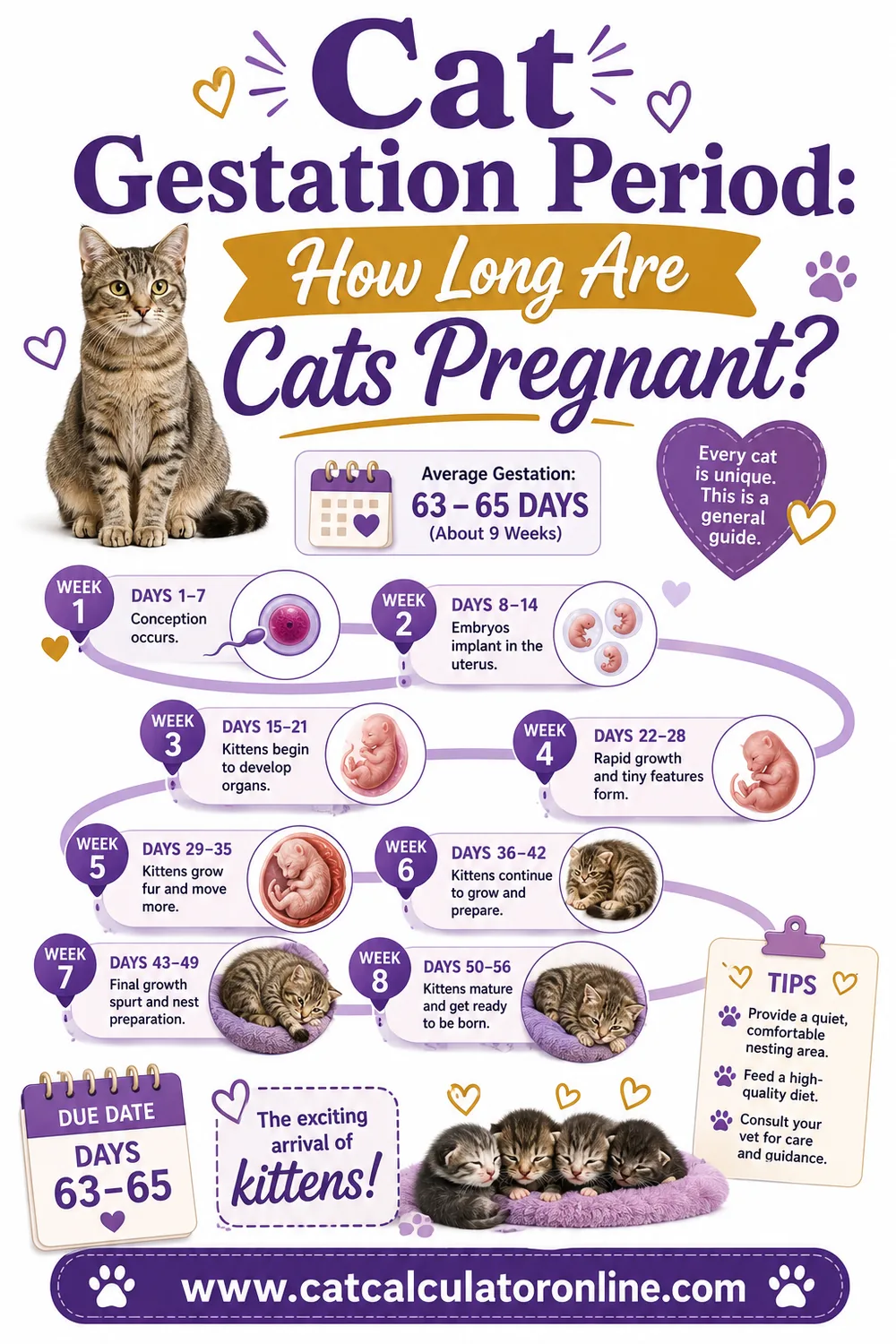
How Long Are Cats Pregnant?
Roughly 63 to 67 days, with about 64 to 65 being typical. Anything from 61 to 70 days can be normal.
That's short — about nine weeks against nine months in humans — which explains why everything happens so quickly once signs appear.
Two complications when dating a pregnancy:
The mating date is often unknown. For an outdoor cat, or a queen who slipped out during a heat, there may be no date at all. In that case a vet's estimate from ultrasound or X-ray is more useful than any calculation.
Cats can mate more than once. Cats are induced ovulators — ovulation is triggered by mating rather than happening on a schedule — and a queen in heat may mate several times, sometimes with different males. A single litter can genuinely have more than one father, and the mating dates may span several days.
So a due date is a window rather than a fixed day. Expect to be roughly right within a few days, and prepare a week early rather than on the estimated date. Detail on the gestation period itself is in the cat gestation period.
Could It Be Something Else?
Yes, and this is why confirmation matters rather than assuming.
A false pregnancy (pseudopregnancy). A queen can ovulate without conceiving and then show genuine pregnancy signs — pinking up, weight gain, nesting, even mammary development — for several weeks before they resolve. It's less common in cats than dogs but it does happen, and it's indistinguishable from real pregnancy without a scan.
Weight gain from overfeeding. An expanding belly is easy to attribute to pregnancy when it's ordinary weight gain, particularly in a cat that has recently been neutered or become less active.
Abdominal swelling from illness. Fluid accumulation, an enlarged organ or a mass can all cause a distended abdomen. This is the possibility that makes a vet visit important rather than optional — a cat that seems pregnant but is losing condition elsewhere needs investigating properly.
Pyometra, an infection of the uterus, is the one to know about. It occurs in unspayed females, often some weeks after a heat, and can cause abdominal swelling alongside lethargy, increased thirst and sometimes discharge. It's a genuine emergency requiring immediate veterinary care. If an apparently pregnant cat becomes unwell — off her food, lethargic, feverish — that is not something to watch and wait on.
What Should You Do If Your Cat Is Pregnant?
Five practical steps.
1. See a vet to confirm and date it. This establishes whether she's pregnant, roughly how far along, and whether anything needs attention. It's also the moment to discuss any medication she's on, since some drugs and flea treatments aren't suitable during pregnancy.
2. Move to kitten food from around week four. A pregnant queen needs more energy and protein than an adult maintenance diet provides, and kitten food is the standard recommendation. Feed to appetite through the second half rather than restricting — a queen in late pregnancy may need 1.5 times her normal intake, and more while nursing.
3. Feed smaller, more frequent meals late on. A uterus full of kittens leaves little room for a full stomach, and many queens do better with four or five small meals than two large ones.
4. Prepare a nesting box by around week seven. A cardboard box lined with soft, washable bedding, in a quiet, warm, dimly lit spot away from household traffic. Show it to her, but expect her to choose somewhere else entirely — wardrobes and airing cupboards are perennial favorites.
5. Keep her indoors from around week eight. This prevents her giving birth somewhere inaccessible and reduces the risk of injury while she's slow and heavy.
What to avoid: routine vaccinations and most parasite treatments unless your vet specifically approves them, unnecessary handling of the abdomen, and any strenuous disruption in the final two weeks.
It's also worth thinking ahead about the practical side while you have time. A litter of four kittens means four homes to find, and responsible rehoming takes longer than most people expect — kittens shouldn't leave before eight weeks, so you're looking at three months of care after the birth before any of them go. Vaccinations, worming and microchipping for a whole litter add up, and the queen herself needs more food throughout. None of this is a reason for alarm; it's simply easier to arrange in week five than in week nine.
When Should You Call the Vet Urgently?
Most cat pregnancies proceed without difficulty. These are the situations that don't wait.
Call immediately if you see:
- Vaginal discharge that is green, dark, foul-smelling or bloody before labor
- Straining for more than 20–30 minutes without producing a kitten
- More than two hours between kittens while she's still clearly straining
- The queen becoming lethargic, feverish, or refusing food for more than a day
- Signs of pain, crying, or obvious distress
- Pregnancy running past day 70 with no sign of labor
- Muscle tremors, twitching or collapse, particularly while nursing
That last one is worth knowing about specifically. Eclampsia — dangerously low blood calcium — can occur in late pregnancy or, more often, during nursing. It presents as restlessness, tremors, stiffness or collapse, and it is a genuine emergency.
The general principle for pregnancy and birth: cats usually manage on their own, and interference is rarely needed. But when something does go wrong it tends to go wrong quickly, so knowing which signs warrant a call rather than observation is the useful preparation.
How Do You Know Labor Is Starting?
The final signs are distinct from the pregnancy signs, and they arrive in a recognizable order over roughly 24 hours.
Nesting intensifies. She'll settle on a spot and start rearranging bedding, often becoming reluctant to leave it.
Appetite drops. Many queens go off food in the last 24 hours or so. On its own this isn't alarming at this stage — it's one of the more reliable indicators that labor is close.
Body temperature falls. A queen's normal temperature sits around 38–39°C (100.5–102.5°F), and it typically drops by about a degree in the 12–24 hours before labor. Taking a cat's temperature isn't something to attempt without your vet showing you how, but breeders use it routinely.
Restlessness and vocalising. Pacing, repeated trips to the nest, crying, and often more grooming of the rear end.
Visible contractions. Once straining begins, the first kitten should normally arrive within an hour or so.
Labor itself typically runs two to six hours for the whole litter, with kittens arriving roughly every 10 to 60 minutes. The queen usually manages entirely on her own — she'll clean each kitten, break the sac and sever the cord herself. The best thing you can do is stay quiet, keep the room warm, and watch from a distance.
What's worth having ready in advance: your vet's out-of-hours number, clean towels, and a small box with a heat source in case a kitten needs warming. Most queens need none of it, but the ones that do need it quickly.
What About an Unplanned Pregnancy?
Common, and worth discussing openly with your vet rather than deciding alone.
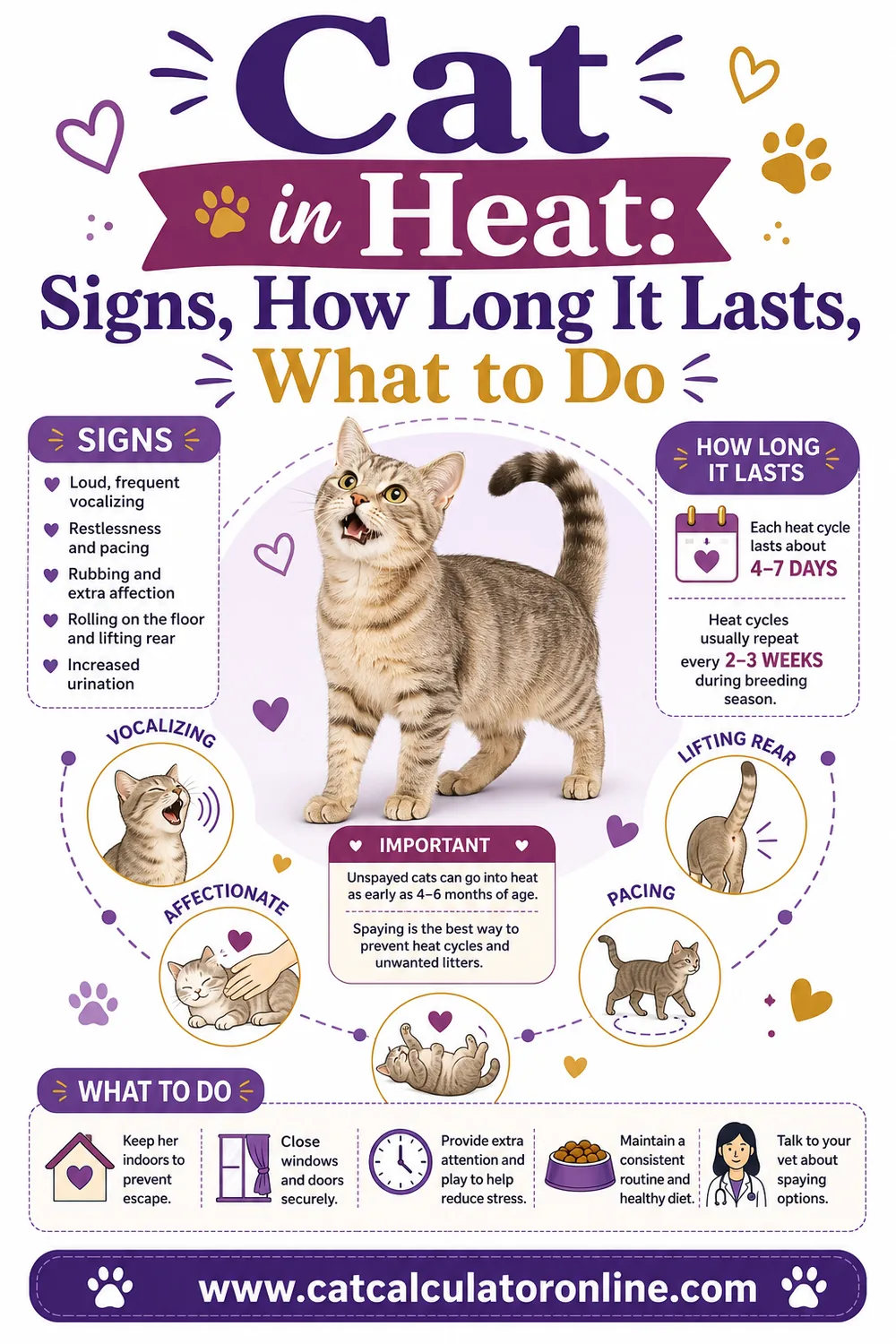
Cats reach sexual maturity remarkably early — often four to six months, sometimes younger — so a kitten that still seems like a kitten can become pregnant. They're also seasonally polyestrous, cycling repeatedly through the breeding season, which means a queen who isn't spayed will keep coming into heat every two to three weeks until she mates.
If the pregnancy is unplanned, your vet can talk through the options, including whether spaying is appropriate and at what stage. That's a decision that depends on how far along she is, her health, and your circumstances — and it's genuinely a conversation for a professional rather than an article.
Two things worth planning for regardless:
Litter sizes are typically around four kittens, ranging from one to eight or more. Larger litters mean more homes to find, more vet costs and more feeding. The range is covered in how many kittens are in a litter.
Kittens shouldn't leave their mother before eight weeks, and ten to twelve is better. So the commitment runs at least two to three months past the birth, not just to the delivery.
For the future, spaying prevents unplanned litters entirely and removes the risk of pyometra. Timing is worth discussing with your vet, and the heat cycle that leads to all of this is explained in cat in heat.
Frequently Asked Questions
What is the earliest sign a cat is pregnant?
"Pinking up" — the nipples becoming noticeably pinker and slightly enlarged — usually appears around days 15 to 18. Before that, the clearest sign is that heat cycles simply stop, which owners often only recognize in hindsight.
How can I tell if my cat is pregnant at home?
You can look for pinking up, a stop to heat cycles, rising appetite, a rounding belly from about week five, and nesting behavior late on. None is conclusive — only a vet can confirm it, using ultrasound from around day 15–21 or X-ray from day 40–45.
How long is a cat pregnant?
Roughly 63 to 67 days, with 64 to 65 typical and anything from 61 to 70 considered normal. That's about nine weeks, which is why visible changes appear and progress so quickly once they begin.
Can I feel my cat's kittens moving?
Often from around week seven, movement can be felt or even seen as the abdomen ripples. Don't press on her abdomen to check — palpation should only be done by a vet, since firm pressure risks harming the kittens.
Is my cat pregnant or just fat?
Weight gain from overfeeding is spread across the whole body, while pregnancy produces a distinctly rounded lower abdomen alongside pinking up and behavioral changes. Abdominal swelling can also indicate illness, so a vet check is worthwhile either way.
How many kittens will my cat have?
Typically around four, though litters range from one to eight or more. First litters are often smaller. An X-ray from day 40–45 is the only reliable way to count them, and knowing the number helps you tell when she has finished giving birth.
Cat pregnancy moves fast, and the signs follow a fairly predictable order: heats stop, nipples pink up around day 15–18, appetite climbs, the belly rounds from week five, and nesting begins in the final two weeks. What none of that gives you is certainty — for that you need a vet, ideally early enough to plan the nutrition and the nesting box properly. Once you have a mating date, put it into the cat pregnancy calculator for an estimated due date, and read what to expect at each stage in cat pregnancy week by week.