How Much Does a Kitten Cost the First Year?
Expect to spend roughly $900 to $2,200 in a kitten's first year in the US, with most owners landing near $1,300. That first year is the most expensive your cat will ever have, because it stacks one-off setup costs — neutering, the vaccine course, a carrier, a litter tray — on top of the ordinary running costs of food and litter. After year one, the figure typically drops to somewhere between $700 and $1,300 annually. Knowing which parts are unavoidable and which are genuinely optional is what makes the number manageable, and the cat cost calculator lets you build the estimate around your own choices.
What Does the First Year Actually Cost?
Here's the full picture with honest ranges:
| Category | Low | Typical | High |
|---|---|---|---|
| Adoption or purchase | $0 | $150 | $2,500+ |
| Neutering / spaying | $50 | $200 | $500 |
| Vaccine course + boosters | $80 | $150 | $250 |
| Deworming and parasite treatment | $40 | $90 | $180 |
| Microchipping | $25 | $50 | $80 |
| Health checks | $60 | $150 | $300 |
| Carrier, trays, post, bedding | $120 | $250 | $500 |
| Food (kitten, 12 months) | $200 | $350 | $600 |
| Litter | $120 | $200 | $350 |
| Toys and enrichment | $30 | $80 | $200 |
| Insurance (optional) | $0 | $220 | $400 |
| First-year total | ~$900 | ~$1,300 | $2,200+ |
The spread is wide because two lines dominate it: where the kitten comes from, and whether you insure.
A shelter kitten at $120 that arrives already neutered, vaccinated and microchipped eliminates three of the most expensive rows at once. A pedigree kitten at $1,500 that needs everything doing separately can double the year before you've bought a single toy.
Is Adopting Cheaper Than Buying?
Considerably, and not just on the sticker price.
Shelter and rescue adoption fees typically run $50–$200, and that fee almost always bundles services you'd otherwise pay for separately: neutering, the first vaccine course, deworming, microchipping, and often a flea treatment and a vet check. Bought individually those add up to $300–$700.
So an adoption fee of $150 that includes all of it can leave you better off than a "free" kitten from a neighbor's litter, which arrives entire, unvaccinated and unchipped.
Breeder kittens run $600–$2,500+ depending on breed, and popular pedigrees like Bengals, Maine Coons and Sphynx sit at the top. Reputable breeders usually include first vaccines, worming, a microchip and sometimes a few weeks of starter insurance — but rarely neutering, since kittens typically go home before the usual age.
A word on the genuinely free kitten. There's nothing wrong with taking one, but budget honestly: you'll need the full vet workup, and an unvaccinated kitten of unknown history occasionally arrives with fleas, worms or a respiratory infection that adds $100–$300 in the first month.
Whatever the source, ask what's already been done and get it in writing. Paying twice for a vaccine because nobody was sure is a common and avoidable waste.
What Are the Unavoidable Vet Costs?
Four things every kitten needs, regardless of where it came from.
The vaccine course. Kittens need a primary course, usually two or three visits a few weeks apart starting around eight or nine weeks, then a booster at about a year. Core vaccines protect against feline panleukopenia, herpesvirus and calicivirus, with rabies required by law in many US states. Budget $80–$250 for the year.
Deworming and parasite control. Kittens are commonly born with roundworms, so repeated worming through the early months is routine rather than a sign anything's wrong. Add flea prevention and you're at $40–$180 across the year.
Neutering or spaying. Usually done around five to six months, though many shelters neuter earlier. Costs vary enormously by region and provider: a low-cost clinic may charge $50–$100, a private practice $200–$500, and spaying a female is typically more than neutering a male because it's abdominal surgery.
Health checks. At least one full examination, plus the checks bundled into vaccine visits. $60–$300 depending on how many times you go.
That's $300–$700 of essentially non-negotiable veterinary spending. It's the largest unavoidable block in the year, and the one most often underestimated by people budgeting from the adoption fee alone.
Low-cost options are worth knowing about. Many areas have subsidised neutering schemes, shelter-run vaccination clinics and charity veterinary services with income-based eligibility. Using them for routine work is sensible, not second-rate.
What Supplies Does a Kitten Actually Need?
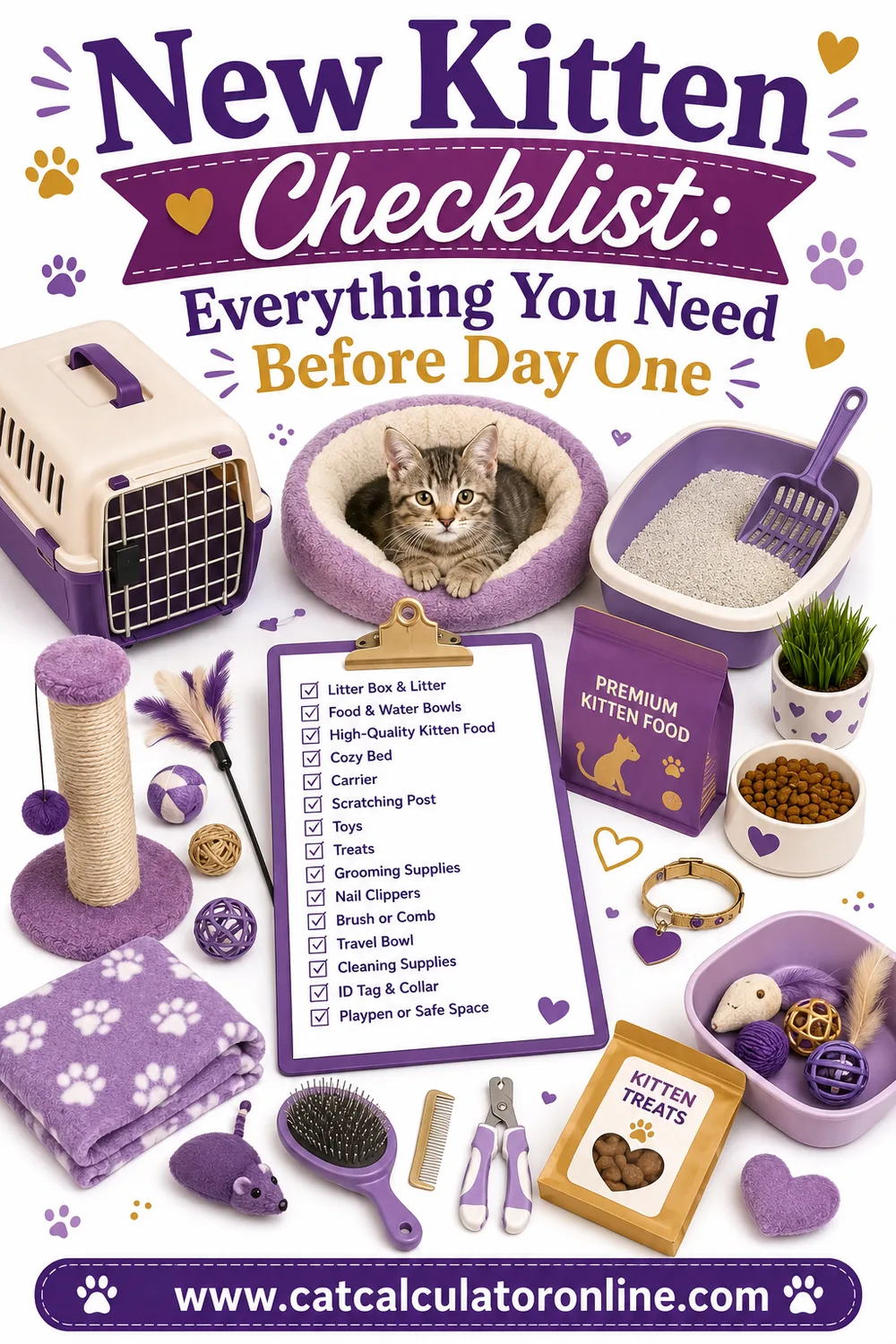
Less than the pet shop suggests. The genuine essentials:
- Carrier ($25–$60) — needed on day one for the journey home, and for every vet visit after.
- Litter tray, plus a spare ($20–$60) — the rule of thumb is one tray per cat plus one.
- Litter scoop and mat ($10–$25)
- Food and water bowls ($10–$40) — shallow and wide suits most cats better than deep bowls.
- Scratching post ($25–$70) — not optional. A cat will scratch something, and a post is far cheaper than a sofa.
- Bed ($15–$50) — though many kittens ignore it in favor of a cardboard box.
- Toys ($20–$60) — wand toys and small throwable items do more for a cat than expensive gadgets.
- Grooming brush ($10–$25) — essential for longhairs, useful for everyone.
That's roughly $150–$400, and most of it lasts years. A carrier bought now will still be in use at fifteen.
What you can skip initially: automatic feeders, water fountains, cat trees over $100, cat flaps before your kitten goes outside, and most subscription toy boxes. Buy the basics, see what your kitten actually likes, and add from there. Our new kitten checklist covers the full setup in order of priority.
How Much Does Feeding a Kitten Cost?
Kittens eat more per pound of body weight than adult cats, because they're building a body. They also need kitten-specific food — higher in protein, fat and calories — until around twelve months, and it usually costs more than adult formulas.
Expect $200–$600 for the year, driven mostly by what you feed:
- Dry food only is cheapest, roughly $15–$30 a month.
- Wet food only is most expensive, often $40–$60 a month, and more for premium brands.
- A mix is what most owners settle on, landing around $25–$40 a month.
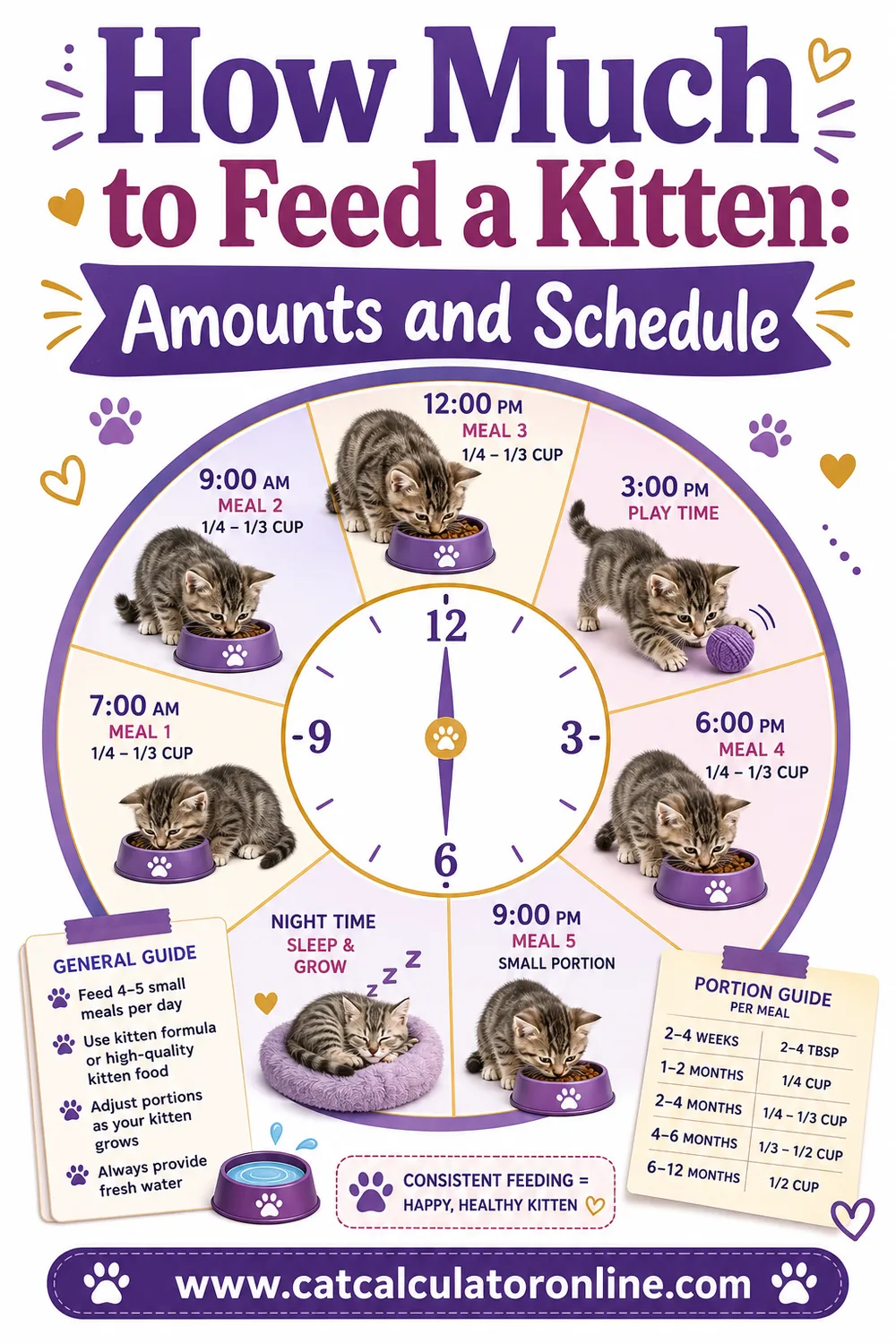
Portion sizes rise through the first six months as your kitten grows, then start easing back toward adult amounts. Feeding guidance by age and weight is in how much to feed a kitten.
Litter is the other recurring cost, at $120–$350 a year. Clay clumping litter is cheapest; crystal, wood and paper litters cost more. A single kitten gets through less than you'd expect, but a multi-cat household scales fast.
Treats are worth a line of their own, mostly as a caution. They're cheap individually and creep up quietly, and treats should stay under about 10% of daily calories regardless of budget.
Should You Insure a Kitten?
If you're going to insure your cat at any point in its life, year one is the moment that buys the most.
Two reasons, and the second matters more.
First, premiums are at their lifetime low — typically $15–$25 a month for accident-and-illness cover on a kitten, against $55–$110 for the same cat at twelve.
Second, and more importantly, a kitten's medical record is empty. Anything your cat has already shown signs of is excluded permanently, so insuring before anything appears keeps every future condition coverable. Enrolling early doesn't freeze the price — premiums reprice upward every year regardless — but it does lock in coverage, which turns out to be the more valuable thing.
Against that: it's a real cost, roughly $180–$300 in year one, on top of an already expensive twelve months. Some owners reasonably prefer to build a dedicated savings buffer instead. The honest weakness of that plan is the early gap — a $3,000 emergency in month three arrives long before a fund could cover it.
Current premium bands are in how much cat insurance costs per month.
How Does the Cost Spread Across the Year?
The total matters less than the timing, because first-year spending is heavily concentrated at the front. Knowing the shape helps you plan cash flow rather than being surprised in month two.
Weeks 1–2: the big hit. Adoption or purchase, carrier, litter trays, scratching post, bowls, bedding and the first food. For most owners this is $300–$700 in two weeks, and it's the moment the year feels expensive.
Months 1–4: the veterinary block. The vaccine course spread over two or three visits, repeated worming, microchipping if not already done, and a health check or two. Roughly $150–$400, arriving in instalments.
Months 5–6: neutering. A single lump of $50–$500 depending on where you go. This is the last big one-off.
Months 7–12: it settles. From here you're mostly paying for food and litter, plus the twelve-month booster. Around $50–$80 a month, which is close to what an adult cat costs.
So roughly 60–70% of the year's spending lands in the first six months. If money is tight, that's the part to plan for — and it's a strong argument for having the essentials bought before the kitten arrives rather than shopping in a hurry at full price.
One timing note worth acting on: if you intend to insure, doing it before the first vet visit is meaningfully better than after. Anything recorded at that first appointment — even a minor note — can become a permanent exclusion. Insuring on day one costs the same and covers more.
What Costs Do Owners Forget?
Six lines that rarely make it into first-year budgets:
- Damage. Scratched furniture, a shredded blind, a knocked-over lamp. Not universal, but common enough that a small contingency is realistic.
- Emergency vet visits. Kittens swallow things — string, hair ties, tinsel. A foreign body needing surgery runs $2,000–$4,000, and it's the single most likely large bill in year one.
- Cat-proofing. Window screens, secure balcony netting, cord tidies. $50–$200 in many homes, and worth it.
- Boarding or a sitter if you travel. $20–$40 a day, and it arrives whether you budgeted for it or not.
- Replacing things your kitten destroys. The first scratching post rarely survives to adulthood intact.
- A second litter tray, which people almost always buy after discovering one isn't enough.
None are enormous alone. Together they're often the difference between the $900 estimate and the $1,300 reality.
The emergency line deserves a moment's thought rather than a shrug. Kittens are the age group most likely to eat something they shouldn't, and a linear foreign body — string, ribbon, tinsel, dental floss — is a genuine surgical emergency rather than a wait-and-see. That's the scenario that turns a $1,300 year into a $4,000 one, and it's the single strongest practical argument for either insuring in year one or holding a real emergency buffer. Most kittens never need it. The ones that do need it without warning.
How Can You Reduce First-Year Costs Without Cutting Corners?
Five things that save real money without affecting your kitten's welfare:
- Adopt rather than buy. The single largest saving available, and the fee usually bundles $300–$700 of veterinary work.
- Use low-cost neutering and vaccination clinics. Widely available, run by qualified vets, and often half the price of a private practice.
- Buy litter and dry food in bulk, once you know what your kitten will actually eat. Don't bulk-buy before then.
- Skip the gadgets in month one. Cardboard boxes, paper bags and a wand toy entertain a kitten better than most things costing $40.
- Keep up preventive care. Vaccines, worming and dental checks are cheap relative to what they prevent, and several insurers require evidence of routine care before paying certain claims.
What not to economise on: neutering, the vaccine course, and a decent carrier. Each one prevents costs or risks far larger than the saving. A cheap carrier that fails on the way to the vet is the kind of false economy that turns a routine appointment into a lost cat, and an unneutered cat brings behavioral problems, spraying and — with a female — the possibility of a litter that multiplies every other cost on this page.
What Happens to the Cost After Year One?
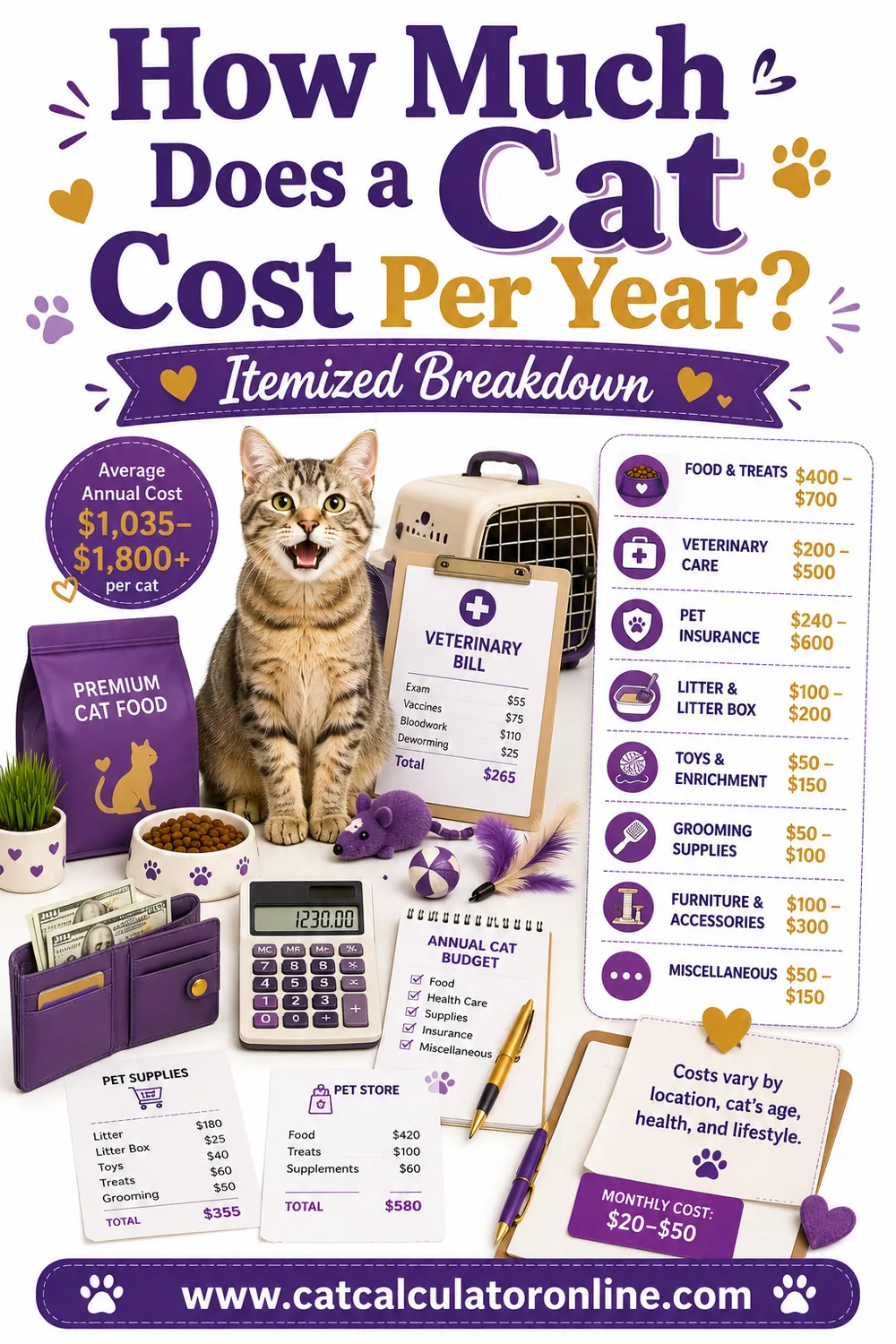
It drops, and noticeably. Once the setup and one-off veterinary work is behind you, ongoing costs settle to roughly $700–$1,300 a year for a healthy adult cat — mostly food, litter, an annual checkup, parasite treatment and insurance if you have it.
The curve then rises again slowly from around age eight, as senior screening, dental work and the first chronic conditions appear. Insurance premiums climb through the same years, so the total cost of a cat is roughly U-shaped across its life: expensive at the start, cheap through the middle, expensive again at the end.
Full year-by-year figures are in how much a cat costs per year, and the recurring monthly picture is broken down in the monthly cost of owning a cat.
Frequently Asked Questions
How much does a kitten cost in the first year?
Most US owners spend $900–$2,200, with a typical figure around $1,300. That covers adoption or purchase, neutering, the vaccine course, microchipping, setup supplies, food and litter. Where the kitten comes from and whether you insure account for most of the variation.
Is it cheaper to adopt a kitten from a shelter?
Usually yes, by a wide margin. Adoption fees of $50–$200 typically include neutering, first vaccines, deworming and microchipping — services worth $300–$700 if bought separately. A free kitten from a private litter often costs more overall, since nothing has been done.
How much should I budget monthly for a kitten?
Around $60–$110 a month for food, litter, parasite treatment and insurance, on top of the one-off setup and veterinary costs concentrated in the first few months. Kittens cost more per month than adult cats because they eat more relative to size and need more vet visits.
How much does it cost to neuter a kitten?
Between $50 and $500 depending on where you go and whether it's a male or female. Low-cost and charity clinics often charge $50–$150; private practices commonly charge $200–$500. Spaying a female usually costs more than neutering a male because it's abdominal surgery.
Do I need pet insurance for a kitten?
It's optional, but year one is when insurance buys the most — premiums are at their lifetime low and an empty medical record keeps every future condition coverable. The main alternative, a dedicated savings fund, has a real weakness early on, since it takes time to build.
What is the most expensive part of a kitten's first year?
Usually the combination of getting the kitten and the initial veterinary work — neutering, vaccines, worming and microchipping — which together often exceed everything else combined. If you buy from a breeder, the purchase price alone can dominate the whole year.
The first year is expensive because it's front-loaded, not because cats are costly to keep. Once the carrier, the post, the neuter and the vaccine course are behind you, the running cost settles into something much more predictable. Adopting rather than buying and using low-cost clinics for routine work are the two changes that move the total most. Build your own estimate in the cat cost calculator with your actual food, litter and insurance choices.