Why Do Cats Hide?
Most people worry about the wrong half of this. Hiding is not a problem behavior — it is a cat's main coping strategy, and it works. Research on cats in shelters has consistently found that cats given a box or a covered bed to hide in settle faster and show lower stress than cats housed without one. A hiding place is a welfare item, not a symptom. The question that matters is not whether your cat hides, but whether the hiding is new. A newly adopted cat under the bed for three days is behaving exactly as she should. A confident cat who has lived with you for six years and has suddenly taken up residence behind the boiler is telling you something, and it is often medical. Curious how old that cat is in human terms? The free cat age calculator tells you in a tap.

Hiding Is Coping, Not Sulking
The behavior makes complete sense once you remember what a cat actually is.
Cats are predator and prey at once. A domestic cat hunts things smaller than herself and is hunted by things larger. Concealment is the strategy that handles both jobs.
Cats do not have a fight-or-flight temperament by default. Faced with something frightening, the first choice of most cats is to disappear and wait. Aggression comes only when hiding is unavailable.
It is a genuinely effective strategy. Removing herself from the situation lowers her arousal, which is exactly what a stressed animal needs.
Taking the option away backfires. Cats housed without anywhere to hide show more stress behavior, and cats blocked from their hiding place often escalate to hissing or swiping instead.
She is not sulking. Cats do not hold grudges in the human sense. She is managing her own nervous system.
Which is why the right response is usually to do nothing. Give her the space and let the arousal drop on its own. The other signals to watch alongside it are in cat body language.
The New Cat Timeline
If you have just brought a cat home, this is the part you actually need.
| Stage | Typical timing | What is normal |
|---|---|---|
| Total hiding | Day 1 to 3 | Under the bed or behind furniture, eating and using the tray at night |
| Cautious emergence | Day 3 to 7 | Coming out when the house is quiet, retreating if approached |
| Exploring | Week 1 to 3 | Wider range, still returning to base, may accept short contact |
| Settling | Week 3 to 6 | Sleeping in the open, greeting you, using the whole house |
| Fully settled | 6 weeks to 3 months | Normal personality visible, confident routine |
Some cats compress this into two days. Others, particularly ex-strays and cats from rescue, take months. Neither is a problem.
Start her in one room, not the whole house. A single quiet room with food, water, a tray, a bed and a covered hiding place is far less overwhelming than a full house, and it speeds everything up.
Put the tray and food near her hiding spot at first. Too far away and she may hold on rather than cross open ground.
Sit in the room and ignore her. Read aloud, do something quiet, do not look at her. Being boring and predictable is what earns you the first approach.
Check that she is eating and using the tray, even if you never see it happen. That is the line between shy and unwell.
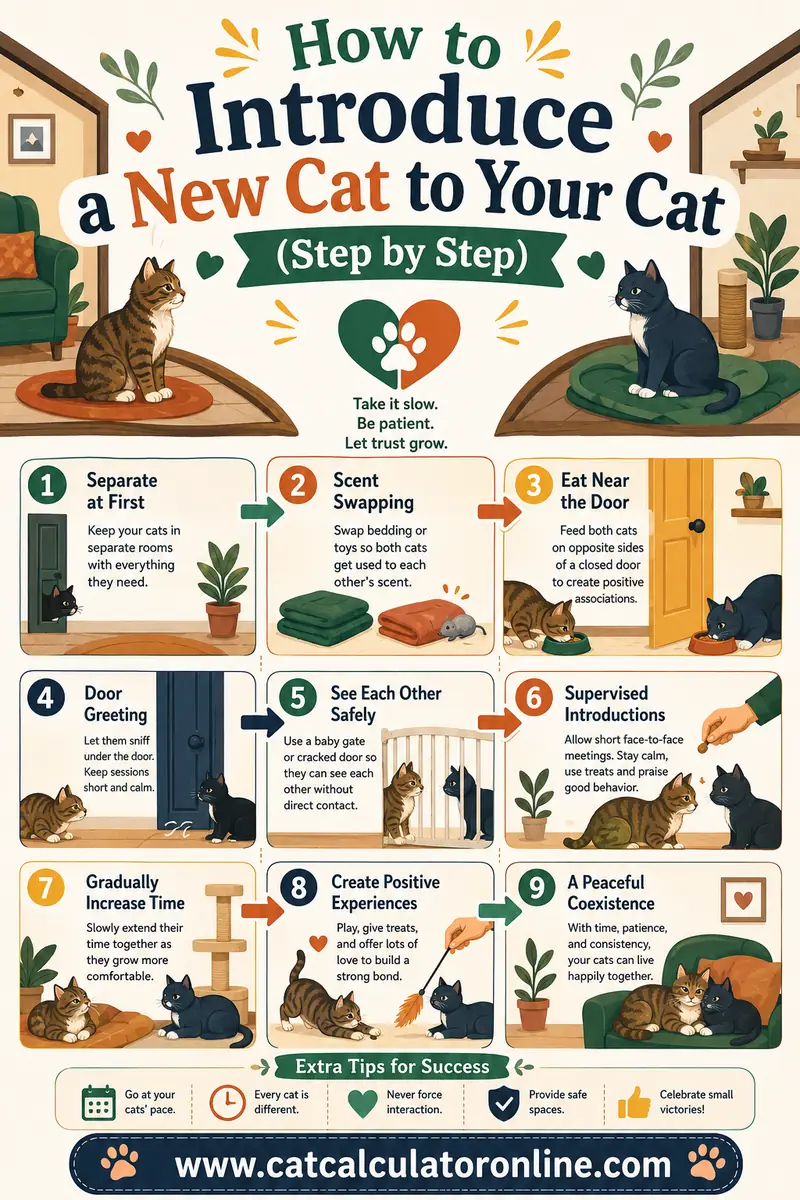
A cat introduced to an existing cat needs more time again, and the staged method is in how to introduce a new cat.
Where Cats Hide, and What the Choice Tells You
The location is informative, and it is a quick read.
Low and enclosed means frightened. Under beds, behind the sofa, inside cabinets, in the airing cabinet, behind the boiler.
High and open means confident. The top of a closet or a shelf is a lookout, not a bolt hole, even though it looks like hiding.
Warm and dark is the pain default. A cat who feels unwell often chooses somewhere warm, dark and hard to reach, and stays there.
Tight spaces are calming. Pressure on the sides of the body appears to be reassuring, which is part of why boxes work — see why cats like boxes.
Watch for dangerous choices. Tumble dryers, washing machines, open drawers, the underside of a reclining chair and car engine bays are all real hazards. Check before you close or start anything.
A cat who moves from high spots to low ones has changed. That shift is worth taking as seriously as the hiding itself.
The Question That Decides Everything: Is This New?
Everything else on this page hangs on this distinction.
A cat who has always been shy is a personality. Some cats vanish whenever the doorbell rings and always have. That is a temperament, not a decline.
A cat who has changed is giving you information. Sociable to reclusive over days or weeks is a behavioral change, and behavioral change in cats is very often physical.
Cats conceal illness by instinct. A sick animal in the wild that shows weakness is a target, and domestication has not removed that. Hiding is frequently the very first sign an owner notices.
Assume medical first, behavioral second. It is the safer order, and it is the one vets use.
Count the days. A settled cat hiding for more than 24 hours, or hiding and refusing food, has crossed into vet territory.
Note what else changed. New pet, new baby, building work, a house move, a change in your working hours, a new cat in the garden. Any of these can explain it, and none of them rules out illness at the same time.
Household Causes of Sudden Hiding
When the trigger is environmental, it is usually one of a short list.
Another cat, indoors or out. A new housemate or a strange cat visible through the window can push a cat into hiding for weeks. Covering the lower half of the glass often helps quickly.
Noise. Fireworks, thunder, alarms, drilling, a new washing machine. Cats hear far above our range, so things that seem mild to us are not.
Visitors and children. Especially unpredictable, fast-moving small people.
Building work and redecoration. Both the noise and the loss of her scent from surfaces.
A house move. Expect a two weeks of hiding as standard, and set up one safe room from the start.
Changes in routine. Returning to an office, a new baby, a household member leaving. Cats are considerably more sensitive to routine than they are given credit for.
Give her more places to hide, not fewer. The instinct to block off the spot under the bed is understandable and usually makes things worse.
When Hiding Is a Health Sign
This is the escalation section, and it is worth reading before you need it.
Book a vet appointment if a normally sociable cat hides for more than 24 hours, or if the hiding has increased steadily over a week or two with no obvious trigger.
Ring the same day if hiding comes with any of: not eating, not drinking, vomiting, diarrhea, obvious weight loss, hunching, or reluctance to be touched.
Treat as an emergency a cat who is hiding and straining in the litter box with little or nothing produced — in male cats this can be a blocked bladder, which is fatal within about 24 to 48 hours. Also emergencies: open-mouthed or labored breathing, collapse, a dragged back leg, or a cat who cries out when touched.
Never wait to see whether she starts eating again. Cats that go without food for even a couple of days risk a serious liver condition (hepatic lipidosis), and it is far harder to treat than the original problem. If she will not eat, that is the vet call — food should never be withheld or rationed to encourage her.
Pain is the commonest hidden cause. Dental disease, arthritis, an abscess from a fight, urinary problems. The subtle signs are in how to tell if a cat is in pain.
Take a note of what changed and when. Dates, appetite, tray use, weight if you have it. It shortens the consultation considerably. Other early warning signs are listed in signs your cat is sick, and appetite specifically in why your cat will not eat.
Never Pull a Cat Out of a Hiding Place
There is one exception, and otherwise this rule is firm.
Dragging her out teaches her the hiding place is not safe. She will simply find a better one, usually somewhere you cannot reach at all.
It also risks a serious bite or scratch. A cornered, frightened cat defends herself, and cat bites to the hand infect quickly and often need antibiotics.
It undoes trust that took weeks to build. With a rescue cat in particular, one forced extraction can set you back a month.
Coax instead. Strong-smelling food, a wand toy dragged slowly past the entrance, or simply sitting nearby and ignoring her.
The exception is a medical emergency. If she needs a vet now, get her out — a towel wrapped firmly around her and a top-loading carrier is the least frightening way to do it.
Otherwise, wait. Cats emerge when their own arousal drops, and that timetable is not negotiable.
Giving Her Better Places to Hide
Rather than removing hiding spots, upgrade them — it is the single most effective change you can make.
Provide at least one covered bed per cat. An igloo bed, a covered basket or a cardboard box on its side all work, and the box is often preferred.
Add height as well as cover. A shelf, a closet top or the upper platform of a cat tree gives the confident kind of retreat.
Put hiding places in quiet parts of the house, away from the front door, the washing machine and the busiest walkway.
One per cat plus a spare, in separate rooms. Competition for a single good spot is its own source of stress.
Cardboard boxes are genuinely excellent. Cheap, replaceable, and the shelter research that found hiding places reduce stress used exactly that.
Keep her carrier out and open, with a blanket in it. A carrier that doubles as a favorite bed turns vet trips from an ambush into a normal event.
A cat with good hiding options generally hides less, which sounds contradictory and is well supported — as are the other contentment signals in how to tell if your cat is happy.
Frequently Asked Questions
Why is my cat suddenly hiding all the time?
A sudden change in a previously sociable cat should be treated as medical until a vet says otherwise, because cats conceal illness by instinct and hiding is often the first sign. Environmental triggers — a new pet, building work, a strange cat outside — are also common, but rule out illness first.
How long will a new cat hide for?
Anything from a few hours to several weeks is normal. Most cats hide almost completely for the first one to three days, emerge cautiously within a week, and settle over three to six weeks. Ex-strays and nervous rescue cats can take two or three months and still turn out fine.
Should I pull my cat out from under the bed?
No, unless she needs urgent veterinary attention. Forcing a cat out teaches her the spot is unsafe, so she finds a less accessible one, and it risks a bite that infects quickly. Coax her with strong-smelling food or a wand toy, or simply sit nearby and ignore her.
Is it normal for a cat to hide when guests come over?
Yes, and it is sensible cat behavior rather than a problem. Cats retreat from unpredictable noise and movement and reappear once the house is quiet. Make sure she has an accessible hiding place in a quiet room, and ask visitors not to seek her out or coax her from under the bed.
When should I take a hiding cat to the vet?
Book an appointment if a normally sociable cat hides for more than 24 hours or increasingly over a week. Ring the same day if she is also not eating, vomiting, hunched or reluctant to be touched, and treat straining in the litter box or labored breathing as an emergency.
Do cats hide when they are dying?
Cats often withdraw and seek somewhere quiet, warm and enclosed when they are seriously unwell, which is where the folklore about cats going away to die comes from. It is not a peaceful choice, though — it usually means she feels very poorly, and it warrants a vet visit rather than being left alone.
A cat who hides is using the tool she has for managing a world that is occasionally too loud, too new or too crowded — and shelter research is clear that cats given somewhere to hide cope better than cats who are not. So resist the urge to block the gap under the bed, and add better options instead: a covered bed per cat, somewhere high, and a cardboard box in a quiet room. Then keep your attention on the one thing that actually matters, which is whether this is new. A shy cat who has always been shy is fine. A settled, confident cat who has started hiding, and especially one who is hiding and not eating, needs a vet rather than patience. Check where your cat sits on the life-stage map with the free cat age calculator.