How to Choose a Scratching Post Your Cat Will Use
Most ignored scratching posts fail on one of two specs, and both are measurable before you buy. The post must be tall enough for a full-body stretch — around 30 in (75 cm) of uninterrupted scratching surface for an adult cat — and heavy enough that it does not shift when she throws her weight into it. A cat scratching properly leans back, hooks in near the top and drags down with real force. A short post means she cannot stretch; a light one tips or rocks, which is startling enough that most cats simply never try again. Everything else — color, shape, the toy dangling off it — is decoration. Where a purchase like this sits in the annual budget is in the cat cost calculator.
How Tall Should a Scratching Post Be?
Tall enough that she can stretch out fully with her front paws above her head and still have post left over.
Aim for at least 30 in (75 cm) of continuous scratching surface for an average adult cat. That is the surface, not the box height — a 36 in product with a platform halfway up offers 18 in of usable post, which is not enough.
A 10 lb (4.5 kg) adult reaches roughly 24–28 in (60–70 cm) when she stretches up a vertical surface. The extra few inches above her reach are what make the post feel unlimited rather than just adequate.
Large breeds need more. A Maine Coon, Norwegian Forest or big Ragdoll wants 36 in (90 cm) or more. Measure your own cat against a door frame while she stretches; it takes ten seconds and settles the argument.
The stretch is half the point of scratching. Cats scratch to shed the outer sheath of the claw, to leave scent from glands in the paw pads, to leave a visual mark, and to stretch the whole back and shoulder chain. A short post satisfies exactly none of the last one.
Kittens can use a full-height post from the start. There is no reason to buy a small one — she will grow into it within months, and a kitten who learns on a tall sisal post keeps that habit.
If you already own a short post, add height rather than replacing it. A length of sisal rope and a broom handle bolted to a paving slab is genuinely a better post than most things sold in pet shops, and costs about $15.
Why Does Stability Matter More Than Anything Else?
Because a post that moves once has usually lost the cat for good.
Cats commit their full weight to a proper scratch. She rears up, digs the claws in, and pulls down hard. If the post tips, wobbles or slides across the floor, that is a small fright, and cats do not repeat things that startled them.
The base should be at least as wide as the post is tall, or close to it. Narrow-based posts with a tall column are the classic wobbly design, and they are everywhere.
Weight is the honest test. Pick it up in the shop. A 30 in post weighing 6–8 lb (3 kg) will rock; one at 15–20 lb (7–9 kg) will not. If you are buying online, look for the shipping weight, which is the most useful number on the listing.
Wall-mounted posts sidestep the problem entirely. A sisal panel screwed to a wall or the side of a doorway cannot move, uses no floor space, and can be fixed at exactly the right height. These are underrated.
Check the top for flex. Some posts have a solid base but a hollow cardboard core that bends under load. Push the top sideways with one hand — if it flexes more than an inch, the cat will feel it too.
Bolted construction beats glued. Posts loosen with use. Ones you can tighten with a wrench last years; ones glued together develop a wobble and are then finished.
Recheck it every few months. A post that has developed a wobble after two years of use gets abandoned surprisingly quickly, and the fix is usually one bolt.
Sisal or Carpet: Which Material Do Cats Prefer?
Sisal, and the difference is not marginal.
Sisal rope is the best surface for most cats. It has the right resistance — enough grip to pull against, coarse enough to shred, and it wears down slowly and evenly. Look specifically for sisal rope wound tightly around the column, with no gaps.
Sisal fabric is second. It is flatter, wears faster, and some cats find it less satisfying, but it is still far better than carpet.
Carpet-covered posts are actively counterproductive. They teach a cat that carpet is a scratching surface, which is a poor lesson in a carpeted home, and the loops catch claws in a way many cats dislike. Carpet posts are common because they are cheap to make, not because cats prefer them.
Corrugated cardboard is excellent, and often ignored in favor of posts. Many cats prefer it to everything else. It is cheap, it is disposable, and the shredded mess it makes is a sign it is working.
Bare or bark-covered wood works for a subset of cats, particularly ones with outdoor experience who have learned on trees. A log fixed upright is a legitimate post.
Avoid anything that sheds fibers a cat could swallow in quantity, and avoid posts where the rope is only glued at the ends — it unwinds within weeks.
Do not re-cover a post the cat likes. A shredded post smells of her and marks the territory. Owners often replace a post at exactly the point it has become perfect.
Do You Need Vertical and Horizontal Options?
Yes, because scratching preference is individual and you cannot predict it.
Some cats are strictly vertical scratchers. They want to rear up against something and drag down — sofa arms, door frames, the post.
Others only ever scratch horizontally, flat on the floor, and will walk past a tall post to shred a rug. Buying such a cat three vertical posts solves nothing.
A good number of cats use both, often at different times: horizontal after waking, vertical when greeting you at the door.
The cheapest way to find out is to watch her. What is she already damaging? Sofa arm means vertical. Rug or stair carpet means horizontal. Doorframe corner means vertical, and probably a scent-marking spot she has chosen deliberately.
Angled cardboard ramps split the difference, and suit cats who cannot commit either way. They are also the cheapest option on the shelf.
Offer both for a new cat or kitten while you learn her preference. One tall sisal post and one flat cardboard pad covers almost every cat for under $40 total.
Preference can change with age. Arthritic cats often stop using vertical posts because rearing up hurts, and switch to flat pads. A senior cat who has suddenly started scratching the rug may be telling you her shoulders and hips are sore, not being naughty.
Where Should You Put It?
Placement decides whether a well-chosen post gets used, and the tidy corner is the wrong answer.
Put it directly beside the thing she already scratches. If the sofa arm is shredded, the post goes against the sofa arm — touching it, not across the room. She chose that location for a reason, usually visibility and scent.
Move it later, a few inches at a time. Once she is reliably using it, shift it 2–3 in (5–8 cm) a day toward where you would prefer it. Move it in one go and she will often go back to the sofa.
Sleeping spots are prime sites. Cats stretch and scratch immediately after waking, so a post beside her favorite bed gets heavy use.
Doorways and room entrances matter, because scratching is partly territorial signalling and cats mark thresholds. A post at the entrance to the main room is well placed.
Beside the window or her lookout perch picks up the post-nap stretch and the arrival-home greeting.
Not tucked behind furniture. A scratching mark is meant to be seen. A post hidden in an alcove fails the whole purpose from the cat's point of view.
Watch her for a day before you decide where the second one goes. Cats scratch at predictable moments — waking, greeting, before a big stretch, and after a disagreement with another cat. Note where those moments happen and put a post there. It is more reliable than any general rule about rooms.
In multi-cat homes, spread them out. Posts near each other become contested, and a lower-ranking cat that has to pass a housemate will not use one — the same logic that governs how to stop cats fighting.
How Many Posts Does a Home Need?
| Household | Minimum | Sensible target |
|---|---|---|
| One cat, small flat | 1 vertical + 1 flat pad | 2 vertical, 1 flat |
| One cat, house over two floors | 2 | 3–4, one per main room |
| Two cats | 3 | 4–5, spread widely |
| Three or more cats | One per cat plus one | Multiple heights and angles |
| Home with an existing damage problem | 1 per damaged spot | Post at each spot, then move slowly |
| Kitten | 1 tall + 1 flat | Same, but bought at adult size |
One post in a hallway is the most common under-provision. Cats scratch where they live, sleep and greet people. A single post two rooms away from all of that is not a real option for her.
A cat tree can count as one of them, provided its posts are 24 in (60 cm) or more of uninterrupted sisal — many are not. Multi-level furniture is covered separately in the cat tree buying guide.
Cardboard pads are cheap enough to over-provide. At $6–$12 each you can put one in every room and find out where she votes.
Expect to spend $25–$60 on a good standalone sisal post in the US, and to replace the rope rather than the post every couple of years.
What Else Helps, and What Does Not?
Catnip helps, sparingly. Rub dried catnip into the sisal to draw her over. Roughly one in three cats does not respond to catnip at all; many of those respond to silvervine, which is worth trying instead.
Play at the post. Dragging a wand toy up and around it gets claws into the surface within minutes, which is usually all the introduction a cat needs. Daily play is worth its own place in the routine — see how much playtime does a cat need.
Never take her paws and rake them down the post. Cats hate having their feet handled that way, and it creates the opposite association.
Never punish scratching. It is not a behavior problem to be suppressed; it is a physical need, and punishment simply teaches her to scratch when you are out.
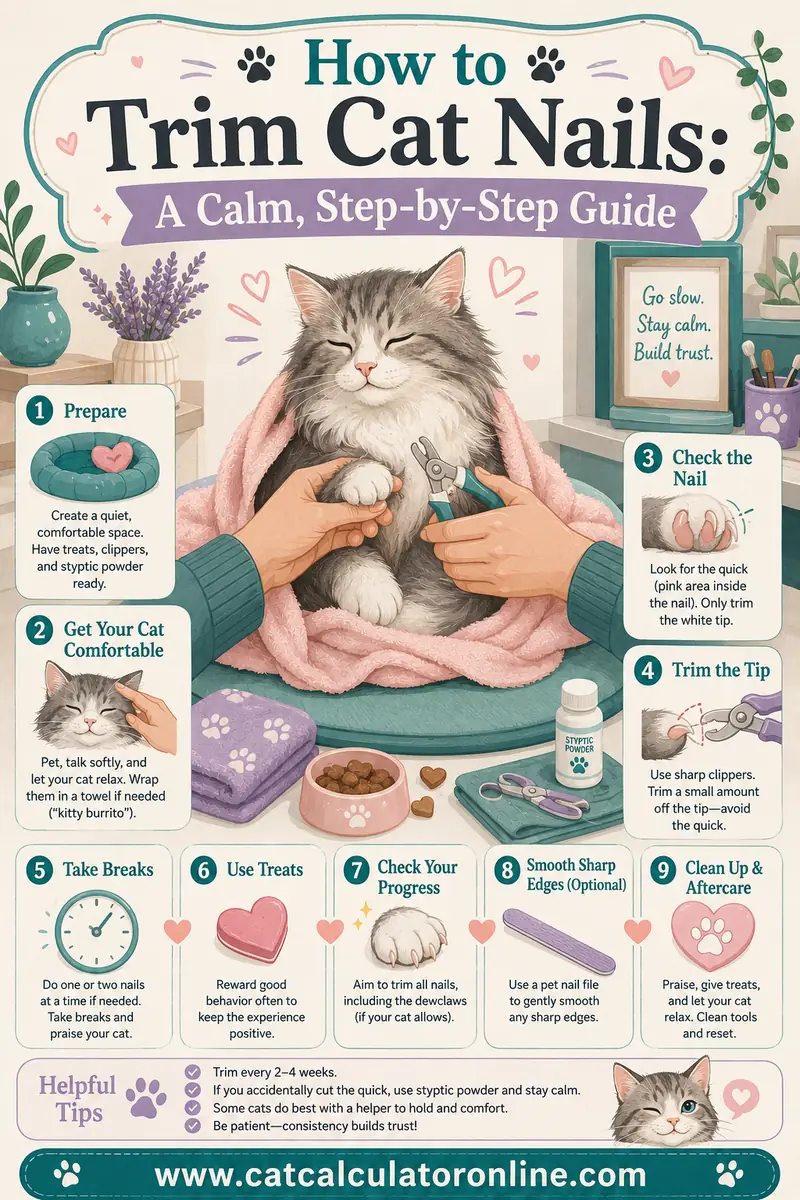
Keep claws trimmed. Trimming does not remove the urge to scratch, but it reduces the damage while she learns — the method is in how to trim cat nails.
Protect the target temporarily. Double-sided tape or a covering on the sofa arm makes the old spot unattractive while the post is being learned. Take it off once the habit has moved.
Do a quick safety pass on anything freestanding. A tall post that can topple onto a kitten is worth anchoring, alongside the rest of the checks in how to cat proof your home.
Indoor cats need more of everything. More posts, more play, more vertical space — the whole enrichment picture is in how to keep an indoor cat entertained.
Frequently Asked Questions
How tall should a cat scratching post be?
At least 30 in (75 cm) of uninterrupted scratching surface for an average adult cat, and 36 in (90 cm) or more for a large breed. Measure the usable surface rather than the total product height — platforms partway up cut the real figure sharply.
Is sisal or carpet better on a scratching post?
Sisal rope, clearly. It gives the resistance cats want, shreds satisfyingly and wears evenly. Carpet-covered posts are cheaper to manufacture but teach a cat that carpet is an acceptable scratching surface, which is unhelpful in a carpeted home.
Why won't my cat use her scratching post?
Usually height, stability or location. If it is under 30 in, wobbles when pushed, or sits in a tidy corner away from where she actually scratches, she will ignore it. Move it beside the spot she already uses and check it does not rock.
Do cats prefer vertical or horizontal scratching?
It varies by individual, and many cats use both. Watch what she already damages: sofa arms and door frames mean vertical, rugs and stair carpet mean horizontal. Offering one tall sisal post and one flat cardboard pad covers nearly every cat.
How many scratching posts does one cat need?
At least two for a one-cat home — one vertical, one horizontal — and one per main room in a house. Multi-cat homes want one per cat plus one, spread widely, because posts placed close together become contested territory.
Should I replace a scratching post when it looks shredded?
Not usually. A shredded post is a working post, and it carries your cat's scent, which is part of why she returns to it. Replace it only when the rope has unwound, the core is exposed, or it has developed a wobble.
There is one more thing worth saying, because it saves a lot of frustration: scratching is not something a cat can be trained out of. It maintains her claws, marks her territory with scent and sight, and stretches her whole body. The realistic goal is redirection — giving her something better than your sofa in the place she has already chosen.
Get the four specs right and most cats redirect within days. Thirty inches of sisal, a base heavy enough that nothing moves, a flat cardboard pad as well as a post, and the whole lot placed where she already scratches rather than where it looks best. For the cost side of kitting out a home, the cat cost calculator puts one-off buys like this next to the running costs.