Questions to Ask a Breeder or Shelter Before You Take a Cat Home
Ask everything on this page and you will still learn most of what you need from something else entirely: whether the person asks you questions back. A breeder or shelter who wants to know about your home, your other pets, your work hours and what happens when you go away is one who cares where the cat ends up. A seller who only wants the money asks nothing. Beyond that, the two questions that carry the most weight are "can I see the mother with the kittens?" for a breeder and "what do you actually know about this cat's history?" for a shelter. Everything else follows from those. Cost out the cat you are considering in the cat cost calculator.

What Should You Ask a Breeder About Health Testing?
Start here, because it is the question that separates a breeder from someone whose cat had kittens.
"Which health tests have both parents had, and can I see the certificates?" You want documents in the parents' registered names, with dates, not a verbal assurance. Which tests are relevant depends entirely on the breed:
| Breed group | Tests you should expect |
|---|---|
| Maine Coon | HCM DNA test plus recent heart scan, hip X-rays, SMA, PK deficiency |
| Ragdoll | HCM DNA test plus heart scan, blood typing |
| Persian, Exotic Shorthair | PKD DNA test, PRA, assessment of nostril and eye conformation |
| British Shorthair | HCM heart scan, PKD DNA test, blood typing |
| Bengal | PRA-b, PK deficiency, HCM heart scan |
| Sphynx, Devon Rex | HCM heart scan, blood typing, HMS in Devons |
| Abyssinian, Somali | PK deficiency, PRA |
| Any breed | FeLV and FIV testing on the breeding cats |
"When was the most recent heart scan?" This one catches people out. Hypertrophic cardiomyopathy can appear later in life, so a DNA test taken once is not the same as a scan, and a scan from four years ago tells you very little. Breeding cats should be rescanned annually or every other year.
"How many litters has the mother had, and how old is she?" Reasonable answers: a first litter no earlier than about a year old, litters spaced with real recovery between them, and retirement around five or six.
"Have any kittens from previous litters had health problems?" The answer you want is a straight one. A breeder who says "yes, one had a heart murmur at eight weeks and here is what we did" is far more trustworthy than one who says nothing has ever gone wrong.
If the answers are vague, check the asking price against the going rate in kitten prices by breed — vague plus cheap is the standard profile, and how to avoid a kitten scam covers the rest of the pattern.
Can You Meet the Mother, and Why Does It Matter?
Ask to see the mother with the kittens, in the room they live in. In person if you can, live on video if distance makes that impossible.
It matters for three separate reasons, and they are worth knowing rather than just accepting.
Temperament is partly inherited and heavily learned. A relaxed, confident queen produces kittens that watch her be relaxed around people. A fearful mother teaches fear. This is one of the better predictors you have of what your kitten will be like at two years old.
It proves the litter exists and is where they say it is. A kitten in the same frame as its mother, in a home you can see, cannot be a stolen photograph.
It tells you how they are being reared. Kittens raised underfoot in a kitchen — hearing the washing machine, the doorbell, the television, being handled daily — are dramatically better socialized than kittens raised in an outbuilding. The window that matters most is roughly two to seven weeks of age, and it does not reopen. Handling during that period is the single biggest influence on how friendly the adult cat is.
A note on the father: he is often not on the premises, because many breeders use an outside stud. That is normal. Ask for his registered name and his health test results instead.
If someone refuses to show you the mother and offers to meet you somewhere neutral, that is the end of the conversation. There is no good version of that arrangement.
What Is the Earliest Age a Kitten Should Come Home?
Two answers, and the second surprises people buying their first pedigree.
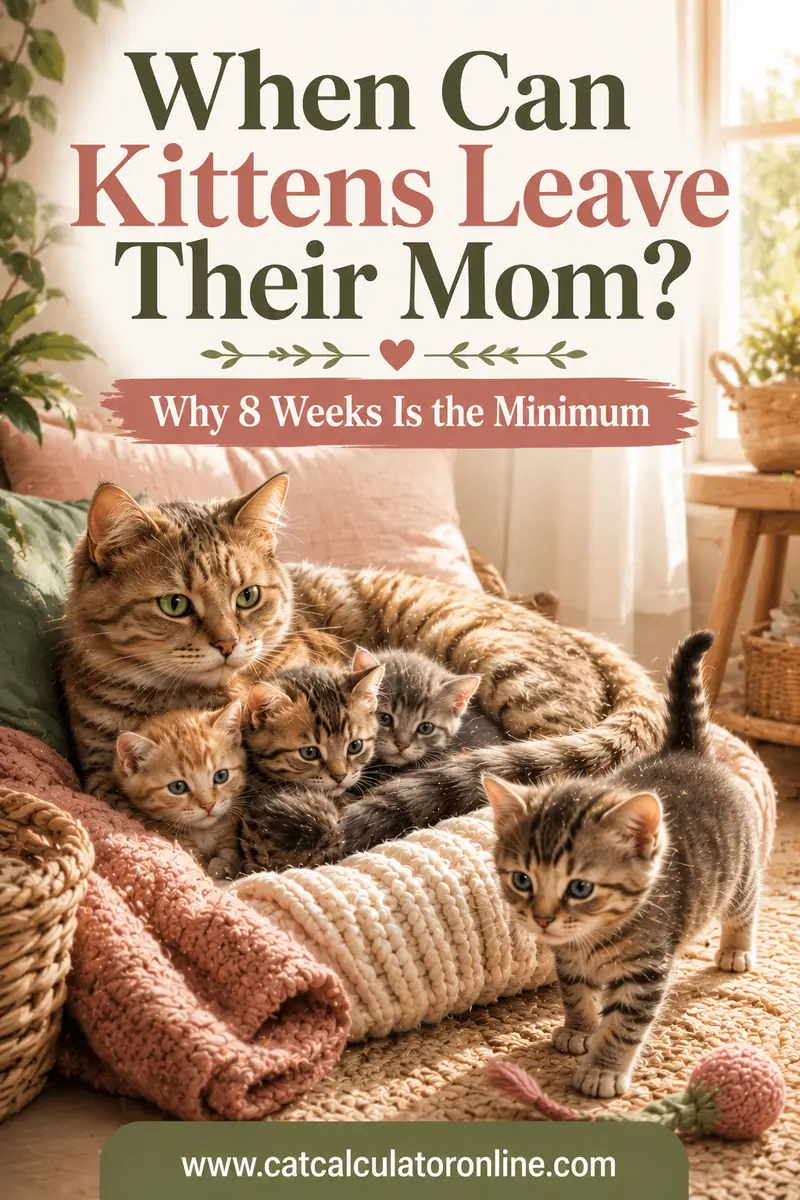
Never before 8 weeks, for any kitten. Before that, the kitten is still learning bite inhibition, litter box habits and how to be a cat, from its mother and littermates. Kittens removed at five or six weeks are more likely to grow into adults with biting problems, food anxiety and poor social skills, and they are more prone to illness because weaning was rushed.
12 to 14 weeks for a pedigree kitten from a registered breeder. This is the norm rather than a nicety. The extra weeks allow the second vaccination to be given and take effect, more socialization with littermates, and confident weaning. Most registries' codes of ethics specify something in this range.
So if a breeder offers you a pedigree kitten at eight weeks, that is a real warning sign, not a bonus. It usually means the kittens are being turned around quickly, and it often means the second vaccination has not been given.
Ask specifically: "How old will the kitten be on collection day, and how many vaccinations will it have had by then?" Then check the vaccination card against the answer. The reasoning behind these ages is in when kittens can leave their mother.
What Should You Ask a Shelter About the Cat's History?
Shelters cannot answer everything, and a good one will say so plainly. What you are testing for is honesty, not omniscience.
"What do you know about where this cat came from?" There are three broad categories, and they matter. An owner surrender usually comes with real history — age, habits, medical background, why it was given up. A stray comes with none. A cat from a hoarding or neglect case may need considerable patience.
"How long has the cat been here, and has it been in a foster home?" A cat that has spent six weeks in a foster living room has a personality assessment worth trusting. A cat that has been in a noisy pen for three days does not; it is showing you a stress response, not a character.
"How does it behave with the staff who know it?" Ask the person who feeds it, not just the person on the desk. That is where the useful detail lives.
"Has it shown any of the things that make cats hard to live with?" Litter box problems, spraying, aggression when handled, hiding for weeks. A shelter that flags these openly is protecting the cat from being returned, and that is the shelter you want.
"What is it eating, and what litter is it using?" Small question, big effect. Keeping both the same for the first two weeks removes two unnecessary changes from an already stressful week.
What Medical Checks Should Already Be Done?
Ask about the same list wherever you are getting the cat from, then get the answers written on the paperwork.
Vaccinations. Which vaccines, which dates, and when the next is due. Kittens usually start the core FVRCP course at around 8–9 weeks with a second dose 3–4 weeks later. Rabies vaccination is required by law in many US states.
Worming and flea treatment. Product names and dates, not just "yes".
FeLV and FIV testing. Ask for the date and the result. One subtlety worth knowing: a kitten under about six months can test positive for FIV because of antibodies from its mother rather than its own infection, so a positive result at that age should be retested at six months rather than treated as final. FIV-positive cats can live long, normal lives indoors, but you deserve to know before, not after.
Neutering. Done, or not yet? If not, when, and is a voucher or deposit involved?
Microchip. Is it fitted, is it registered, and will the registration transfer into your name? Transferring it is the most-forgotten step in the entire process, and an unregistered chip is a useless chip.
For an adult or senior cat: ask about teeth, kidney values, thyroid, and any current medication. Dental disease is extremely common in adult cats and is the most likely near-term cost.
Ask for a copy of the veterinary record. Then book your own check within the first week. What all of this costs is in what a kitten costs in the first year and the cost of adopting a cat.
How Will This Cat Fit Your Household?
The mismatch between cat and household causes more returns than health problems do, so these questions earn their place.
"How is it with other cats?" Not a yes or no. Ask whether it has lived with cats, how it behaves with the cats in the next pen, and whether it was found as part of a bonded pair. A cat that has always lived alone can learn, but the introduction takes weeks — the method is in how to introduce a new cat.
"How is it with dogs?" Some shelters test this. Most can at least say whether the cat has lived with one before.
"How is it with children?" Ask about ages specifically. A cat that is fine with a calm ten-year-old may be badly suited to a grabby toddler, and it is far kinder to know now.
"How much does it hide, and for how long?" Every cat hides in a new home. The useful question is how long this one took to settle in foster care.
"Is it used to being handled — picked up, brushed, claws trimmed?" Longhaired cats especially. A cat that hates brushing turns into a sedated de-matting appointment.
"Indoor only, or does it want outside?" A cat that has lived outdoors for years rarely converts happily to a small flat, and this is one of the honest limits of adoption matching.
What Paperwork and Guarantees Should You Get?
Get all of this in your hand before you leave, not promised afterwards.
- Vaccination record with dates, products and batch numbers.
- Microchip number and the transfer paperwork or code.
- Worming and parasite record.
- Veterinary history, at least a summary.
- From a breeder: registration papers and a pedigree of at least three generations, copies of the parents' health test certificates, and a written contract covering the neutering agreement, any health guarantee and its time limit.
- From a shelter: the adoption contract, and clarity on any conditions such as indoor-only.
- The return policy, in writing. Ask both types of source: will you take this cat back at any point in its life? The answer you want is yes, without hesitation.
Two questions about guarantees are worth asking directly. "What does the health guarantee actually cover, and for how long?" Many cover congenital conditions for a defined period. And "what happens if my vet finds a problem in the first week?" A good breeder wants that call. Anyone who becomes evasive about it has told you what you needed to know.
What Should They Be Asking You?
This is the reverse test, and it is the most reliable signal in the whole process.
A good breeder or rescue will want to know: who lives in your home and their ages, whether you rent and whether pets are allowed, what other animals you have, how many hours the cat will be alone, whether it will go outside, whether you have a plan for holidays, whether you intend to declaw (a dealbreaker for most reputable sources, and illegal in some US jurisdictions), and what you would do if the cat developed an expensive illness.
Some of it feels intrusive. It is not personal. It comes from having taken back cats that were rehomed carelessly.
The corollary is blunt: a seller who asks you nothing is not vetting the home, and someone who does not care where the cat goes generally did not care where it came from either. In the pedigree market, no questions plus a low price plus immediate availability is close to a definition of a scam.
Once you have chosen, spend the wait getting the house ready rather than shopping in a panic on collection day. The new kitten checklist covers the setup in priority order, and it works just as well for an adult cat.
Frequently Asked Questions
What should I ask a cat breeder before buying a kitten?
Ask which health tests both parents have had and to see the certificates in their registered names, when the most recent heart scan was, whether you can meet the mother with the kittens, the collection age, what vaccinations are done, and whether they take cats back for life.
What should I ask a shelter before adopting a cat?
Ask what is known about the cat's history, whether it has been in foster care and for how long, how it is with other cats, dogs and children, whether it has been tested for FeLV and FIV, what it eats, whether it is neutered and chipped, and the return policy.
At what age should a kitten leave its mother?
Never before 8 weeks for any kitten, and 12 to 14 weeks for a pedigree kitten from a registered breeder. Earlier separation is linked to biting, food anxiety and poor social skills, and pedigree kittens need the extra weeks for their second vaccination.
Should I be worried if a kitten tests positive for FIV?
Not immediately, especially in a kitten under six months, because a positive result at that age often reflects antibodies from the mother rather than infection. It should be retested at six months. Many FIV-positive cats live long, normal lives as indoor-only cats.
Is it a bad sign if a breeder asks me lots of questions?
The opposite. Detailed questions about your home, other pets, working hours and holiday plans are the strongest single indicator of a responsible breeder or rescue. A seller who asks nothing at all is not screening homes and often has more serious problems.
What paperwork should come with a cat or kitten?
A vaccination record with dates and batch numbers, the microchip number and transfer details, a worming record, and the veterinary history. From a breeder, add registration papers, a three-generation pedigree, copies of the parents' health test certificates and a written contract.
Most of what you need to know comes out in one honest conversation. Ask a breeder about health tests, the mother and the collection age, and ask a shelter what it genuinely knows about the cat and what it does not. Get the vaccination record, the microchip transfer and the return policy in your hand rather than in a promise. Then listen to what you are asked in return, because a source that interrogates you about your home is one that will still take the cat back in six years if life goes wrong. Once you have chosen, run your own numbers through the cat cost calculator so the first year holds no financial surprises.