How Many Calories Does My Cat Need?
A healthy adult cat needs roughly 20 calories per pound of ideal body weight per day — so a 10 lb cat needs about 200 calories. Neutered indoor cats often need less, closer to 18 per pound, while kittens, pregnant cats and very active outdoor cats need considerably more. The number that matters is based on your cat's ideal weight, not its current one, which is what makes it useful for a cat that needs to lose a little. Turning that figure into actual grams of food takes one extra step, and the cat food calculator handles both.

What's the Basic Calculation?
The working rule most owners can use: about 20 calories per pound of ideal body weight per day for a healthy adult cat.
| Ideal weight | Typical daily calories |
|---|---|
| 6 lb | ~120 kcal |
| 8 lb | ~160 kcal |
| 10 lb | ~200 kcal |
| 12 lb | ~240 kcal |
| 15 lb | ~300 kcal |
| 18 lb | ~360 kcal |
Vets use a more precise method based on resting energy requirement (RER), calculated as 70 × (body weight in kg)^0.75, then multiplied by a factor for life stage and activity. For a typical neutered adult that factor is around 1.2; for an active intact cat it's higher; for weight loss it's lower.
The two approaches land close together for average cats, which is why the simpler rule is fine for everyday use. Where the RER method earns its keep is at the extremes — very small cats, very large cats, and cats on a supervised weight-loss plan — because the relationship between body weight and energy need isn't perfectly linear.
Use ideal weight, not current weight. This matters most for an overweight cat: calculating from a 14 lb current weight when the target is 10 lb simply feeds the excess. Finding that target is covered in the healthy weight range for cats.
What Changes the Number?
Six factors, and most cats have several applying at once.
Neutering is the biggest single adjustment and the most overlooked. A neutered cat's energy requirement drops by roughly 20–30%, but portions usually stay exactly the same after the operation. This is why the year after neutering is when so many cats start gaining.
Indoor versus outdoor. A cat with genuine outdoor range covers considerably more ground than an indoor cat that sleeps sixteen hours a day. The gap can be 20% or more.
Age. Kittens need two to three times the adult figure per pound while growing. Senior cats' needs often increase again past twelve, because ageing cats digest protein and fat less efficiently — which surprises people expecting a steady decline.
Body condition. A cat that needs to lose weight is fed to its target rather than its current size, under veterinary supervision.
Pregnancy and nursing raise requirements dramatically — a nursing queen may need two to four times normal intake.
Individual metabolism. Two identical-looking cats in the same house can differ by 20% in what they actually need. This is real, and it's why any calculated figure is a starting point to adjust from rather than a prescription.
Two further factors matter less often but are worth knowing. Illness changes requirements in both directions — hyperthyroidism dramatically increases energy use, which is why an affected cat can eat voraciously while losing weight, whereas a cat recovering from surgery may need more calories in a smaller, more digestible form. And ambient temperature has a modest effect: a cat living in a cold environment with outdoor access burns more simply maintaining body heat, which is why some outdoor cats' needs rise slightly in winter.
The point of listing all six is not to make the calculation complicated. It's to explain why two owners can both follow the same guidance and get different results — and why the monthly weight check matters more than the precision of the initial sum.
How Do You Turn Calories Into Actual Food?
This is the step most guidance skips, and it's where the number becomes useful.
Every complete cat food declares its energy content, usually as kcal per kilogram for dry food or kcal per can/pouch for wet. It's often in small print on the back rather than the front, and sometimes only on the manufacturer's website.
The math:
Dry food. Daily calories ÷ (kcal per kg ÷ 1000) = grams per day.
Worked example: a cat needing 200 kcal, on a food containing 3,800 kcal/kg. That's 3.8 kcal per gram, so 200 ÷ 3.8 = 53 g a day.
Wet food. Daily calories ÷ kcal per pouch = pouches per day.
Worked example: 200 kcal needed, pouches containing 85 kcal each → about 2.4 pouches daily.
Mixed feeding. Split the total. If you feed one 85 kcal pouch, that leaves 115 kcal from dry — about 30 g on the food above.
Then weigh it. A kitchen scale costs around $12 and is the single most useful piece of equipment for feeding a cat correctly. Scoops vary enormously between brands and people fill them generously; the difference between a level and a heaped scoop can be 30% of a cat's daily intake.
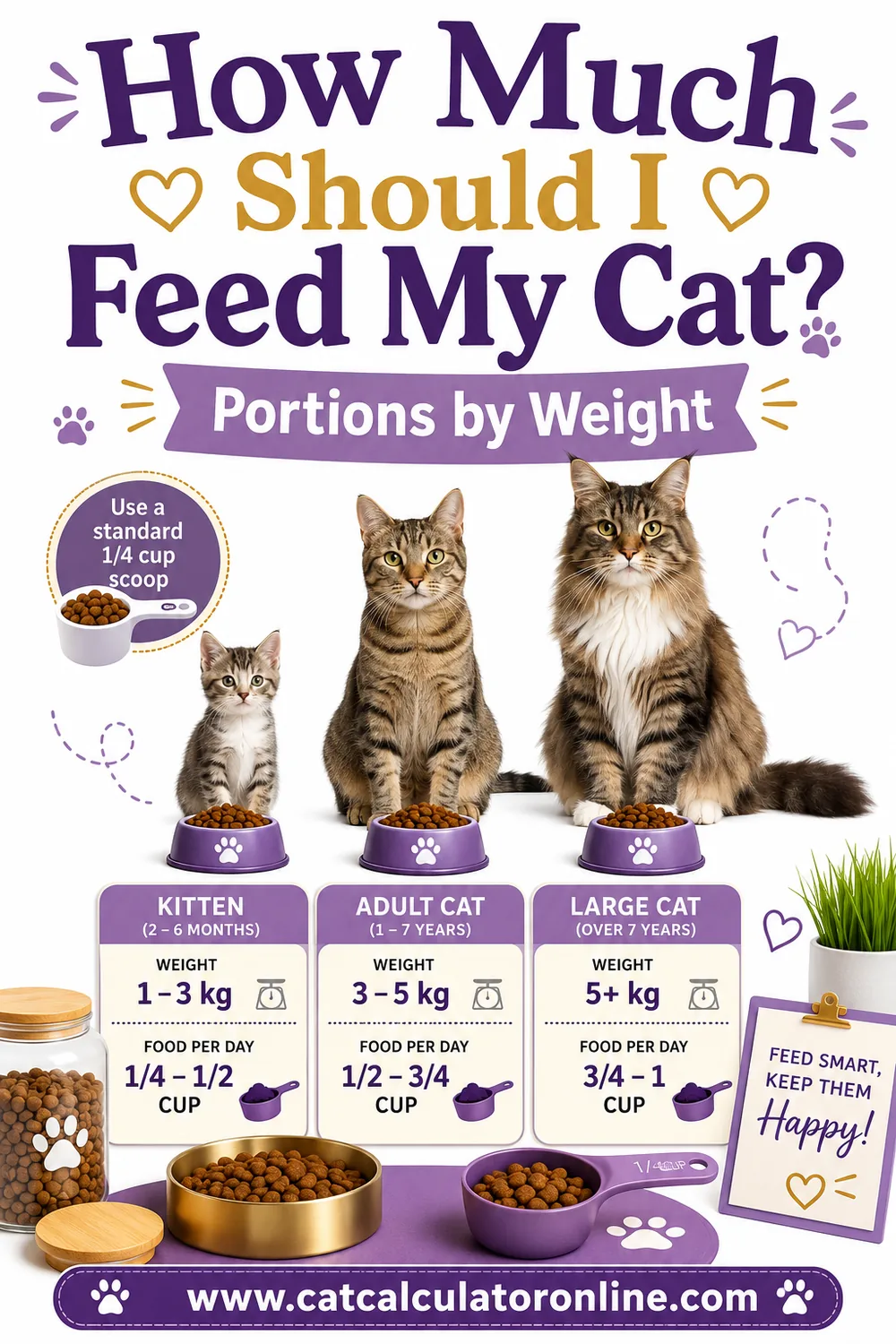
Portion guidance by weight is also in how much should I feed my cat.
Why Is the Bag's Guidance Usually Too High?
Because it's written for an average cat, and most pet cats aren't average in the direction the packaging assumes.
Feeding guides are typically calculated for a cat with moderate activity and intact metabolism. The majority of pet cats today are neutered, indoor, and fairly sedentary — a combination needing noticeably less than the guide suggests.
Manufacturers also have little incentive to err low. A cat that seems hungry on the recommended amount reflects poorly on the food; a cat that gradually gains weight over two years doesn't get connected to it.
There's also a structural quirk worth knowing. Many feeding guides are presented as a range against body weight — "45–70 g for a 4–5 kg cat", say. That single row spans a 55% difference in food, which is an enormous span to leave to the owner's judgement, and most people read toward the middle or the top rather than the bottom. A cat at the lighter end of a weight band being fed the middle of a portion band can easily be receiving 25% more than it needs.
The practical approach: treat packaging guidance as an upper bound, start around 10–20% below it for a neutered indoor cat, and adjust based on what actually happens to your cat's weight and body condition over the following month or two.
That last part is what matters. No formula, calculator or bag can account for your individual cat's metabolism. The calculated figure gets you close; monthly weighing and condition scoring tell you whether it's right.
Do Treats Count?
Yes — and this is the most common reason a carefully calculated portion still produces a fat cat.
Treats should stay under about 10% of daily calories, and crucially they come out of the daily total rather than being added on top. For a cat needing 200 calories, that's a ceiling of 20 calories from treats — which is less than it sounds.
Some rough figures worth knowing:
- A typical commercial cat treat: 2–5 kcal each
- A dental chew: 5–15 kcal
- A teaspoon of tuna: around 10 kcal
- A lickable treat tube: 10–15 kcal
- A tablespoon of milk: around 9 kcal, and many adult cats don't digest it well anyway
Five small treats a day is 10–25 calories — potentially over the entire allowance before you've counted the "just a little bit" of chicken from dinner.
In multi-person households this compounds invisibly. If three people each give the cat "just one" treat, that's fifteen calories nobody logged. A note on the fridge, or a single daily portion of treats measured into a dish in the morning, solves it entirely.
It's worth keeping the proportions in perspective. Twenty calories on a 200-calorie daily allowance is 10% — the equivalent, on a 2,000-calorie human diet, of 200 calories a day from snacks. That's not trivial for a person, and on an animal a fifteenth of your size the same proportional excess accumulates far faster than instinct suggests. Cats are small enough that human intuitions about "a little bit won't hurt" consistently overshoot.
None of which means treats should be abolished. They're genuinely useful for training, for medication, and for the ordinary business of enjoying your cat's company. The fix is counting them rather than cutting them — and swapping some of the food allowance for the treat allowance rather than stacking one on top of the other.
How Do Calorie Needs Change for Weight Loss?
They go down, but carefully — and this is one place where guessing is genuinely risky.
The standard approach is to feed to ideal body weight rather than current weight, sometimes with a further modest reduction. For a 14 lb cat whose target is 11 lb, that means feeding for 11 lb — around 220 calories rather than the 280 its current size suggests.
Two hard rules:
Never cut sharply. Cats are unusually vulnerable to hepatic lipidosis, a serious liver condition triggered when fat is mobilised faster than the liver can process it. A sudden drop in intake — or a cat refusing a new diet food for a few days — can set it off. This is genuinely dangerous and it's the reason feline weight loss must be gradual.
Never do it unsupervised. Your vet should set the target and the rate. Safe loss is roughly 0.5–2% of body weight per week, meaning a substantially overweight cat may take six months to a year.
Practical points that make it work: switch foods gradually over a week or more; consider a therapeutic weight-management diet, which is formulated to keep a cat feeling full on fewer calories; split the daily allowance into more, smaller meals; and weigh monthly rather than daily. The full plan is in how to help your cat lose weight.
How Many Calories Does a Kitten Need?
Considerably more per pound than an adult, because a growing body is building tissue as well as running itself.
A rough guide by stage:
| Age | Approximate daily calories |
|---|---|
| 2–3 months | 200–250 kcal |
| 4–5 months | 250–320 kcal |
| 6–8 months | 300–350 kcal |
| 9–12 months | 250–300 kcal, easing toward adult |
What surprises owners is that a four-month-old kitten weighing perhaps 4 lb may need more total calories than a 10 lb adult cat. Per pound of body weight, kitten requirements run two to three times adult levels.
Three practical consequences:
- Feed kitten-specific food until around twelve months. It's formulated with higher protein, fat and calorie density precisely because of this. Large breeds such as Maine Coons often stay on it longer, sometimes to eighteen months.
- Feed more frequently. Small stomachs can't hold a day's calories in two meals — three or four meals a day suits most kittens until about six months.
- Don't restrict a growing kitten. Kittens are meant to look lean and leggy rather than rounded, but a growing cat shouldn't be calorie-restricted to control weight without veterinary advice.
Requirements peak somewhere around four to six months, then ease down as growth slows. The transition to adult food and adult portions around twelve months is a common point for gain to begin, because the food changes but the quantity doesn't.
How Do You Know If You've Got It Right?
Not from the calculation — from your cat, over time.
Any figure you calculate is an estimate based on population averages. The real test is what happens to your cat's weight and body condition across the following weeks.
Check monthly. Weigh your cat, run the three condition checks — ribs easy to feel, waist visible from above, slight belly tuck from the side — and write both down. The method is in cat body condition score explained.
Then adjust:
- Weight stable and body condition ideal → the amount is right.
- Gaining slowly → reduce by about 10% and recheck in a month.
- Losing unintentionally → see a vet before increasing food. Unexplained loss in a cat over eight is more often a symptom than a feeding error.
- Constantly begging but at a healthy weight → the amount is probably fine. Consider more frequent smaller meals, food puzzles, or a higher-moisture diet that fills more volume.
Adjust in small steps and give each change a month before judging it. Cat weight moves slowly, and reacting week to week produces a lot of churn and very little information. The checks are covered in is my cat overweight.
One reassurance for anyone finding this fiddly: you only need to do the arithmetic once. Work out the daily grams for your cat and your current food, write it on a sticky note on the food container, and the daily decision becomes weighing to a known number rather than judging by eye. The calculation only needs revisiting when something changes — a different food, neutering, a significant weight change, or a new life stage.
Frequently Asked Questions
How many calories should a 10 lb cat eat per day?
Roughly 200 calories for an average adult, based on about 20 calories per pound of ideal body weight. A neutered indoor cat often needs less — closer to 160–180 — while an active outdoor cat may need 240 or more. Adjust based on monthly weight and body condition.
How do I convert calories into how much food to give?
Find the food's energy content (kcal per kg for dry, kcal per pouch for wet) and divide your cat's daily calories by it. A cat needing 200 kcal on a 3,800 kcal/kg dry food needs about 53 g a day. Weigh the portion rather than using a scoop.
Does neutering change how much my cat should eat?
Yes, significantly. Neutering lowers energy requirements by roughly 20–30%, but portions usually stay the same afterward. Reducing the amount after the operation is one of the single most effective things you can do to prevent weight gain.
Why does the bag say more than the calculator?
Packaging guidance is written for an average cat with moderate activity, while most pet cats are neutered, indoor and fairly sedentary — needing noticeably less. Treat the bag as an upper bound and start 10–20% below it, then adjust based on your cat's weight.
Do senior cats need fewer calories?
Not necessarily. Needs often dip in middle age but frequently rise again past twelve, because older cats digest protein and fat less efficiently. Unexplained weight loss in a senior cat should be investigated by a vet rather than simply met with more food.
How many treats can my cat have a day?
Keep treats under about 10% of daily calories, and count them within the daily total rather than adding them on top. For a cat needing 200 calories that's roughly 20 calories — about four to five small commercial treats, or one dental chew.
The calculation is straightforward: around 20 calories per pound of ideal body weight, adjusted down for a neutered indoor cat and up for a growing or highly active one. What turns it into a result is the follow-through — converting calories into grams, weighing rather than scooping, counting the treats, and checking weight and condition monthly. Start with the cat food calculator for your cat's daily figure, then confirm you're on target using the condition checks.