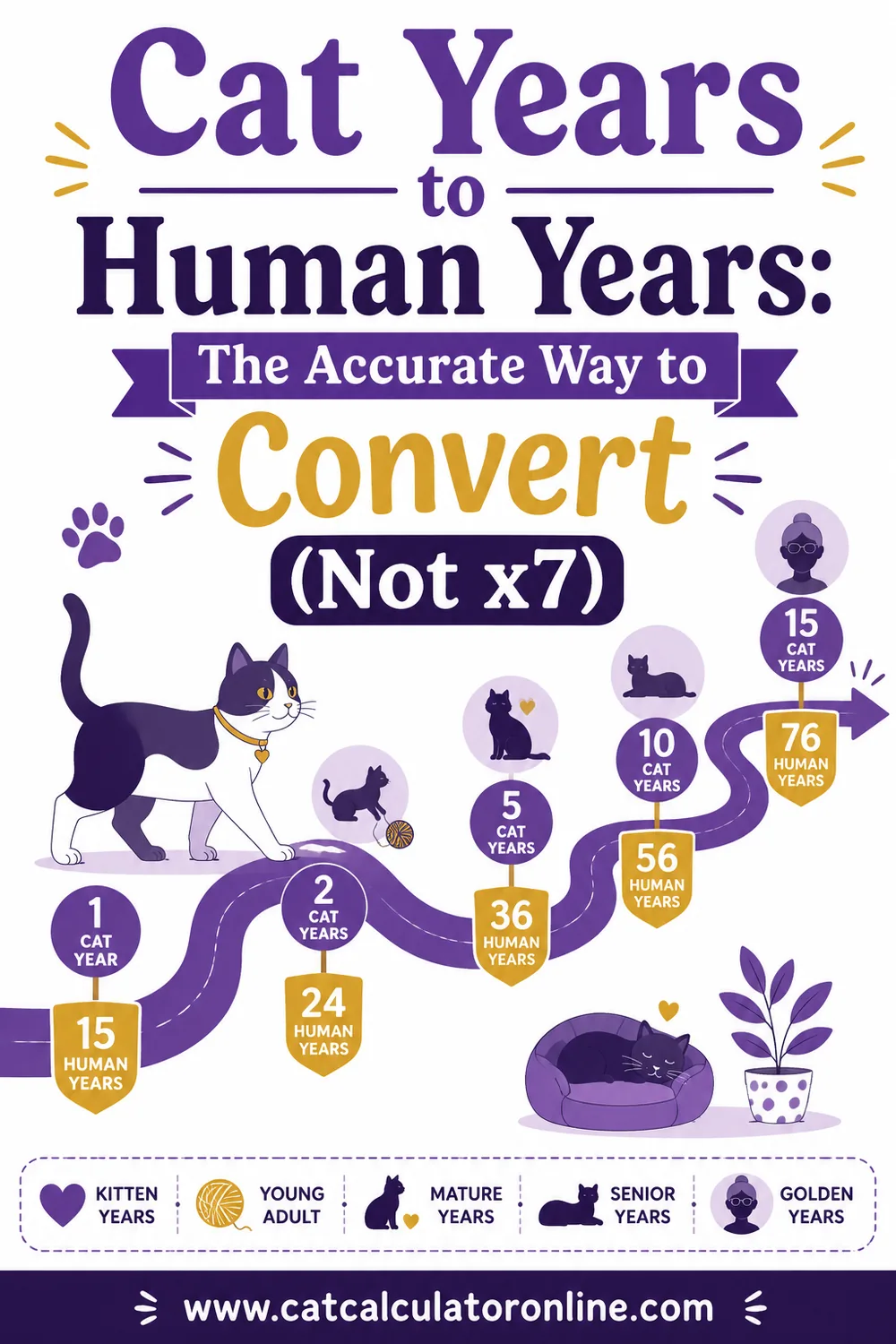
16 Cat Years in Human Years
A sixteen-year-old cat is about 80 in human years. Sixteen is past the average lifespan quoted for indoor cats, which means two things at once: your cat has done well, and the margin for anything going unnoticed has narrowed. At eighty-equivalent, small changes carry more weight than they did — a few days off food, a slight increase in drinking, a new hiding spot. This page covers the arithmetic, what sixteen realistically looks like, and how to keep a very old cat comfortable and well-monitored. Any age converts with the cat age calculator.
How Do You Get 80?
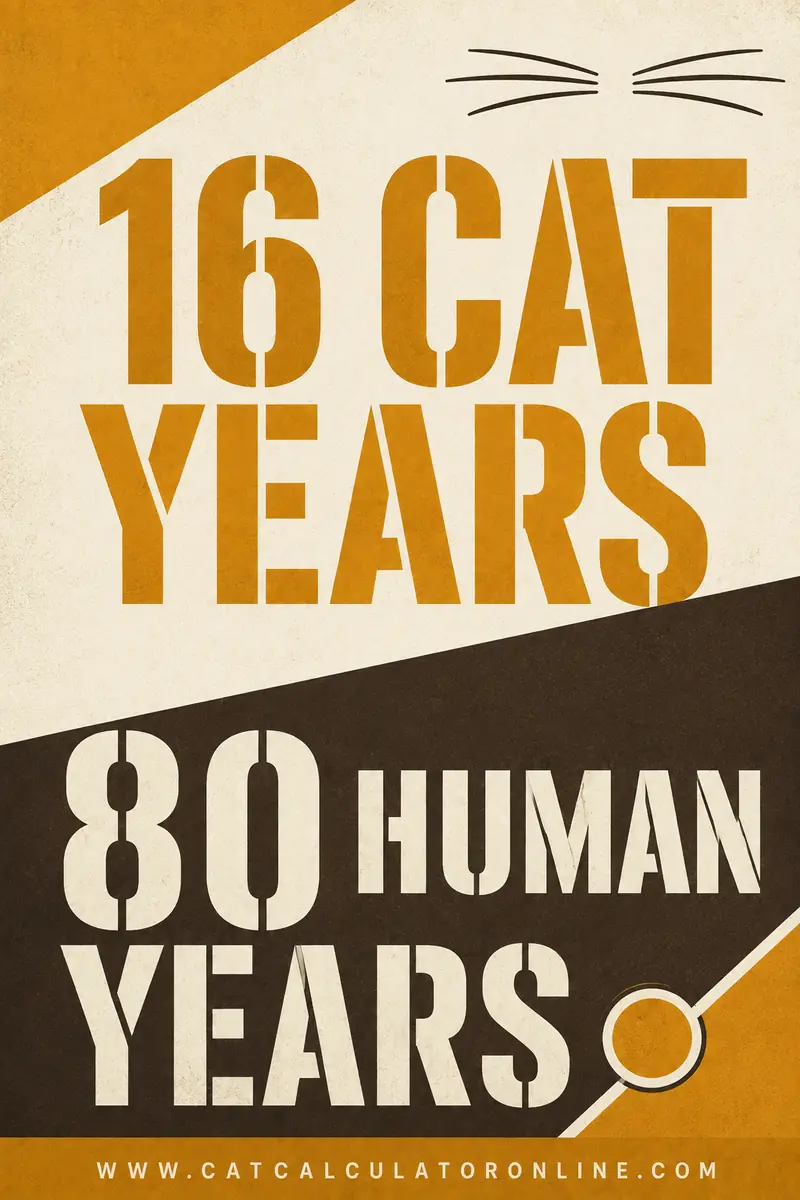
The same method, all the way from the second birthday.
15 for year one, 9 for year two, 4 for every year after. By sixteen: 24 + (14 × 4) = 80.
| Cat's age | Human years | Life stage |
|---|---|---|
| 14 | 72 | Senior |
| 15 | 76 | Senior |
| 16 | 80 | Senior |
| 17 | 84 | Senior |
| 18 | 88 | Senior |
| 19 | 92 | Senior |
| 20 | 96 | Senior |
| 22 | 104 | Senior |
A sixteen-year-old cat at 80 compares to a person of eighty — many are still getting about and enjoying themselves, most are managing something, and everyone involved pays closer attention than they did a decade earlier.
The years either side are covered in 15 cat years in human years and 17 cat years in human years, the whole table in cat years to human years, and the method in how a cat age calculator works.
How Unusual Is a Sixteen-Year-Old Cat?
Less unusual than the averages suggest, and a genuinely good outcome.
The figures in context. Indoor cats are commonly quoted at 13 to 17 years, so sixteen is at the top of the ordinary range. That average includes cats lost early to accidents, infection and undiagnosed illness, so a cat reaching sixteen has already avoided most of what shortens feline lives.
How much further cats go. Seventeen and eighteen are seen routinely in practice. Nineteen and twenty are uncommon but far from unheard of. Cats in their early twenties exist in most vets' caseloads, and the oldest verified cat reached 38 — an outlier, but a real one.
What has got your cat here: almost certainly living indoors, being kept at a sensible weight, having reasonable dental care, and having problems found rather than missed. The same four things determine what happens next. More on the range in how long do cats live.
The mindset that helps. Sixteen is not a reason to stop investigating. Cats at this age are still diagnosed with hyperthyroidism, hypertension and dental disease, and all of those are still treatable — and treating them still buys comfortable time. Age is a context, not a diagnosis.
What Does Sixteen Actually Look Like?
Small, light, warm, slow, and often deeply attached to you.
Sleeping almost all day — 18 to 20 hours or more, in short stretches, usually somewhere warm and low.
Very little climbing or jumping. Most cats at sixteen have stopped using anything above seat height. Steps to favorite spots keep them involved rather than confined.
Noticeably lighter, with prominent shoulder blades, spine and hips. Some of that is normal age-related muscle loss; genuine weight loss is a separate thing and still worth pursuing.
A coat that needs your help entirely. Reduced flexibility means the back half goes ungroomed, and long-haired cats mat over the hips and tail base.
Long claws needing a monthly check, because a cat that barely scratches doesn't wear them down and overgrown claws curl into the pad.
Cloudy-looking eyes, usually benign nuclear sclerosis, and often reduced hearing.
More talkative and more affectionate, which many owners describe as one of the best parts of a cat's final years.
Fussier about routine, disliking noise, visitors and change more than before.
What still isn't just age: weight loss, increased drinking, vomiting, going outside the box, difficulty or reluctance eating, night yowling, continuous hiding, or labored breathing. The last of those is an emergency at any age.
When Should You Pick Up the Phone?
Sooner than you would have at eight, because an old cat has less reserve to spend on waiting.
Same day, without hesitation: not eating at all, labored or open-mouthed breathing, straining in the litter box with nothing produced (especially in a male cat), collapse, sudden inability to use the back legs, sudden blindness or disorientation, or repeated vomiting.
Within a day or two: eating noticeably less, drinking noticeably more, weight down on the monthly weigh-in, vomiting more than very occasionally, going beside the box, a new smell from the mouth, or a cat that has taken to hiding.
At the next check, but mentioned specifically: stiffness, reduced grooming, new lumps, changes in vocalisation, or confusion.
Why the threshold shifts. A cat that eats nothing for a couple of days is at real risk of hepatic lipidosis, a liver problem that develops because cats tolerate fasting badly. That risk is higher in a thin old cat. Similarly, dehydration in a cat with reduced kidney function moves faster than in a young one. Waiting a week to see how things go is a reasonable strategy at five and a poor one at sixteen.
And describe specifics when you call. "She's eaten half of what she normally does for three days and is drinking more" gets a better response than "she seems a bit off".
How Should the House Be Set Up?
Everything the cat needs, on one floor, within a few steps.
A warm bed, or several. Soft, deep, sided, draught-free, near but not against a heat source. Older cats lose heat quickly and warmth eases stiff joints — this is the single most appreciated change at this age.
A low-entry litter box in the same room, plus one on any other floor the cat uses. A plastic storage tub with a U cut into one side gives generous floor area and a two-inch step, which almost nothing shop-bought matches.
Food and water within easy reach, on the floor or slightly raised if your cat stands stiffly, in wide shallow bowls, away from the litter box.
Steps or a stool to the one or two places your cat still wants to get to.
Non-slip footing on hard floors along the routes the cat walks and where it lands.
A night light, which helps a cat with dimming sight navigate a familiar house.
Quiet, and a retreat. A room with the bed, water and a box, where the household doesn't intrude.
Hands-on care as routine: brushing several times a week over the back and hips, a monthly nail check, and a weekly run of your hands over the cat — spine, hips, mouth, lumps. The wider routine is in senior cat health checklist.
How Do You Keep a Sixteen-Year-Old Eating?
At this age, eating is close to the whole game — appetite is both a health indicator and the thing that keeps a thin old cat going.
Warm the food. Wet food heated to just below body temperature smells far stronger, and smell drives feline appetite much more than taste does. A few seconds in the microwave, stirred thoroughly and tested with a finger, is usually enough. Never serve it hot.
Use wide shallow dishes so whiskers aren't pressed against the sides, and raise the bowl an inch or two if your cat crouches awkwardly or stands stiffly to eat.
Feed small amounts often. Four small meals suit an old cat better than two large ones, and food left out for hours loses its smell and its appeal.
Keep the spot quiet, consistent and away from the litter box, and away from other pets if there is any tension between them.
Prioritize wet food for the water in it. A cat eating mostly wet food takes in substantially more fluid than one eating dry, without being asked to drink at all — which supports ageing kidneys directly. Put several water bowls around the house too, away from food.
Don't switch foods without a reason. At sixteen, a food the cat reliably eats is worth more than a food with better marketing. Prescription diets exist for specific diagnoses and should be introduced gradually, mixed in over one to two weeks — and a renal diet the cat refuses does nothing at all.
Ask about help if appetite won't hold. Appetite stimulants and anti-nausea medication exist for cats and work well. Many owners don't know to ask, and it is one of the more transformative interventions at this age.
Is Screening Still Worth It at Sixteen?
Yes, and the question behind it is usually "is treatment worth it", which is the more useful thing to discuss.
What the six-monthly panel still finds: kidney values and SDMA trending, urine specific gravity, thyroid levels, blood pressure, blood glucose, blood count and liver enzymes, plus a dental assessment and a proper physical examination.
Why it still matters. Hyperthyroidism at sixteen is as treatable as it is at twelve. Hypertension found before it damages the retinas prevents sudden blindness. Dental disease treated keeps a cat eating, which at this age is close to everything. Kidney disease staged properly gets the right diet and the right monitoring interval.
What changes at sixteen is the balance of investigation against stress. A long anaesthetic for a marginal benefit is a fair thing to question; a blood test, a urine sample and a blood pressure reading are not. Discuss the specific procedure rather than declining everything on principle.
Ask two questions of any recommendation: what would we do differently with the result, and how much will this cost the cat in stress. Good vets welcome both, and the answers usually make the decision obvious.
Where the money goes furthest at this age: dental treatment that keeps a cat eating, pain relief for joints, the screening that catches things early, and hydration support for ageing kidneys.
Frequently Asked Questions
How many human years is 16 cat years?
About 80. The method is 15 human years for the first year, 9 for the second and 4 for each year after — giving 24 at age two, plus fourteen further years at four each.
Is 16 old for a cat?
Very. It's at the top of the usual 13-to-17-year range for indoor cats. Seventeen and eighteen are still common, though, and cats in their early twenties are unusual rather than unheard of.
Why has my 16-year-old cat become so vocal?
Common causes include reduced hearing, hyperthyroidism, high blood pressure, pain, and cognitive change. The first four are found by standard senior bloodwork and a blood pressure check, so it's worth investigating before treating it as a habit.
Should I still take a 16-year-old cat for check-ups?
Yes, every six months. Hyperthyroidism, hypertension and dental disease are all still treatable at this age, and treating them buys comfortable time.
My 16-year-old cat has stopped eating — how urgent is that?
Urgent. A cat that eats nothing for a couple of days risks hepatic lipidosis, a liver problem caused by fasting, and the risk is higher in a thin old cat. Call the same day.
What is the single most useful thing I can do for a 16-year-old cat?
Put everything it needs — a warm sided bed, water, food, and a low-entry litter box — within a few steps of each other on one floor, and weigh it monthly.
Sixteen cat years is about 80 human years — past the usual range, and a good outcome. Keep the six-monthly checks, put everything on one floor, keep the bed warm and the box low, weigh monthly, and call sooner than you would have a decade ago. Convert any age with the cat age calculator.