Cat Treats: How Many Are Too Many?
There is a real number, and almost nobody applies it. Treats should make up no more than about 10% of a cat's daily calories, with the other 90% coming from complete, balanced food. For a typical 9 lb (4 kg) adult cat needing roughly 200–250 kcal a day, that is a treat budget of about 20–25 kcal — which a single dental stick or a small handful of commercial treats can consume entirely. The arithmetic surprises people because treats look tiny and the packet often does not print a calorie figure at all. Work out the meal side of the equation with the free cat food calculator.
The 10% Rule, and What It Actually Allows
The rule is simple. The consequences of it are not obvious until you do the sums.
Treats should be no more than a tenth of daily calorie intake. This is the standard veterinary nutrition guideline, and it applies to everything that is not the cat's complete food: commercial treats, dental chews, lickable tubes, scraps from your plate, the milk in the bottom of a cereal bowl, and the food used for training.
A typical adult cat needs around 200–250 kcal a day. That is the ballpark for a neutered 9 lb (4 kg) indoor adult at a healthy weight. Active, young, entire or outdoor cats need more; older and less active ones frequently need less.
So the treat budget is about 20–25 kcal. Not 20–25 treats. Twenty to twenty-five kilocalories, total, across the whole day and everyone in the household who feeds her.
That is a genuinely small amount of food. Around a level tablespoon of most wet foods. Roughly a third of an ounce of cooked chicken. Sometimes a single dental stick and nothing else.
Smaller cats have smaller budgets. A 7 lb cat needing about 180 kcal has a treat allowance closer to 18 kcal, and a slim cat on a weight-management plan may have less again.
The exact daily calorie figure for your cat depends on weight, age, neuter status and activity — how many calories does my cat need works through the calculation properly.
Working Out the Budget in Real Numbers
Rough calorie values, because seeing them side by side is what makes the point land.
| Treat | Typical calories | Share of a 20–25 kcal budget |
|---|---|---|
| One small crunchy commercial treat | 1–3 kcal | About 10% each — so 8–10 is the whole day |
| One freeze-dried chicken or fish piece | 1–2 kcal | Among the most budget-friendly options |
| One lickable purée tube (whole) | 6–15 kcal | Between a quarter and most of the budget |
| One dental stick or chew | 10–25 kcal | Frequently the entire daily allowance |
| One teaspoon of tuna in spring water | 5–8 kcal | About a quarter to a third |
| One teaspoon of cooked plain chicken | 8–10 kcal | Roughly a third to a half |
| One 10 g (about 1/3 oz) cube of hard cheese | 35–40 kcal | Over the entire budget, in one mouthful |
| A saucer of full-fat milk (50 ml, under 2 oz) | 30–35 kcal | Over budget, and many adult cats cannot digest it |
| One pouch of wet food given as a "snack" | 30–90 kcal | Not a treat. That is a meal |
The cheese line is the one worth remembering. A single small cube can exceed a whole day's treat allowance, which is why the "just a little bit of cheese" habit shows up on the scales within months.
Dental sticks are the other surprise. They are marketed as a health product and priced as a treat, but calorically several behave like a small meal.
Lickable tubes vary enormously. Some are 6 kcal, some are 15. The brand matters, and so does whether you give the whole tube or half.
Divide the tube. Half now and half later is a legitimate way to double the number of good moments without doubling the calories.
Reading the Calories Off the Packet
This is harder than it should be, and the difficulty is itself informative.
Many treat packets print no calorie figure at all. Complete cat foods are far more likely to carry a calorie content statement than treats are, and treats frequently show only a protein, fat, fiber and moisture analysis, which does not tell you kcal directly.
Where a figure exists, it is often per 100 g. To get per-treat calories, you need the weight of one treat — sometimes on the packet, otherwise worked out by dividing the pack weight by the number of pieces.
The math, once. Calories per 100 g, divided by 100, multiplied by the weight of one treat in grams. A treat at 400 kcal per 100 g weighing 0.5 g is 2 kcal.
Count the pieces in the packet if the weight is missing. Pack weight divided by piece count gives you a usable average.
Email or ring the manufacturer if you cannot find it. Most will supply a figure for a specific product, and a brand that cannot tell you how many calories are in its treat is telling you something.
Reading the rest of the label matters too — ingredient order, the protein source and what "with chicken" legally allows are covered in how to read a cat food label.
Subtract the Treats, Don't Add Them
The single most common mistake, and the reason careful owners still end up with a heavy cat.
Treat calories must come out of the meal. If she is on 220 kcal a day and gets 20 kcal of treats, the food should provide 200 kcal, not 220. Added on top, that is roughly 9% more calories every day, indefinitely.
Small excesses compound. An extra 20 kcal a day is around 7,300 kcal a year. On a cat whose entire daily requirement is a couple of hundred calories, that is a meaningful amount of surplus.
Weight gain in cats is quiet. A cat gaining 1 lb over a year has put on roughly 11% of its body mass — the human equivalent of a stone and a half — while looking, week to week, exactly the same.
Measure the food, do not eyeball it. Use kitchen scales or a proper measuring cup rather than a mug or a scoop that came with something else. Reducing a portion you have never actually measured is guesswork.
Account for everyone. In most households the reason the sums do not work is that two people are both giving treats and each assumes the other is not.
Write it on the fridge. A note saying the daily allowance and who has already given it removes the argument entirely.
Why the Other 90% Has to Be Complete Food
The percentage exists for a nutritional reason, not just a calorie one.
Complete food is formulated as a whole diet. Protein, fat, vitamins, minerals and — critically for cats — taurine, arachidonic acid and preformed vitamin A are balanced against each other to meet the requirements of an obligate carnivore.
Most treats are not complete. They are made to be palatable, not balanced. They are usually higher in fat and salt and lower in the micronutrients that matter, and they are not designed to be a meaningful proportion of intake.
So treats displace nutrition, they do not add it. Every calorie taken as treats is a calorie not taken as balanced food. At 10% that dilution is negligible. At 30–40%, which is easy to reach without noticing, it stops being negligible.
The risk is worst in cats that eat less overall. Small cats, seniors, and cats on restricted portions have the least room for dilution, because their total intake is already low.
Prescription diets are the strict case. For a cat on a urinary, renal or hypoallergenic diet, treats can undo the point of the food entirely. Ask which treats are compatible — most manufacturers make a matching one.
Kittens are the other strict case. Growth has high, specific nutritional demands, and a kitten filling up on treats is short-changing itself at the worst possible time.
Treats as Payment, Not Affection
A reframe that makes the budget easier to live within.
Cats do not read food as love the way people do. The affection is in the interaction — the attention, the routine, the fact that you came over. The treat is a marker for that moment, not the substance of it.
Which means treats work best when they buy something. Coming when called. Getting into the carrier. Tolerating a nail trim. Going onto the scales. Sitting still for ear drops.
Use them for training and it changes the whole relationship. Cats train readily with food rewards, and a cat that has learned to hop onto a chair on cue is far easier to live with and to medicate.
Make them work for it. Puzzle feeders, treat balls and scatter-feeding turn the same calories into fifteen minutes of activity rather than fifteen seconds. For an indoor cat that is genuine enrichment.
Break them up. Most treats can be broken into halves or quarters. Ten small pieces is ten rewards; one whole treat is one, at the same calorie cost.
Non-food rewards count too. A wand toy session, a brush, or two minutes of undivided attention are things most cats value highly and none of them cost a calorie.
Human Food: Tiny Amounts Versus Never
Two separate questions that often get muddled.
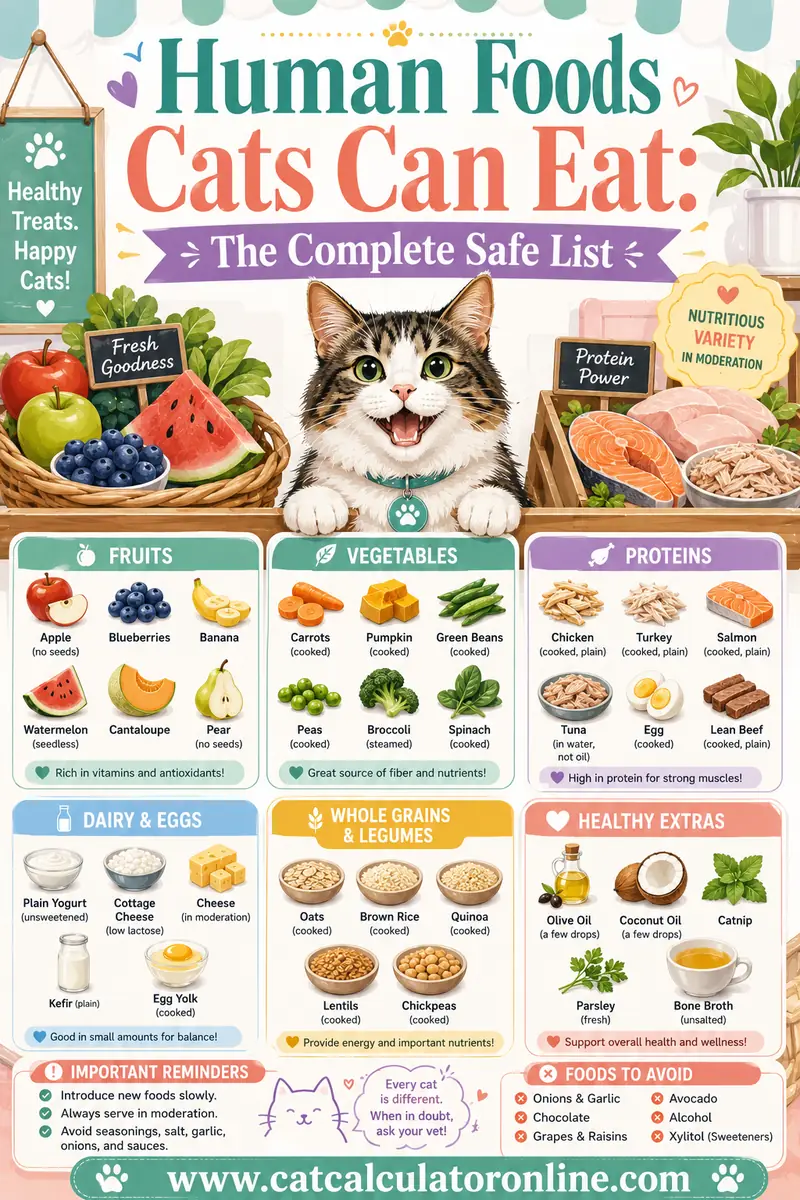
Some human foods are safe in small amounts. Plain cooked chicken, turkey or white fish with no seasoning, bones or skin. A little plain cooked egg. Small pieces of plain cooked meat generally. These still count against the 10%.
Portion is the whole game. A piece of chicken the size of your thumbnail is a treat. A piece the size of your palm is a meal, and an unbalanced one.
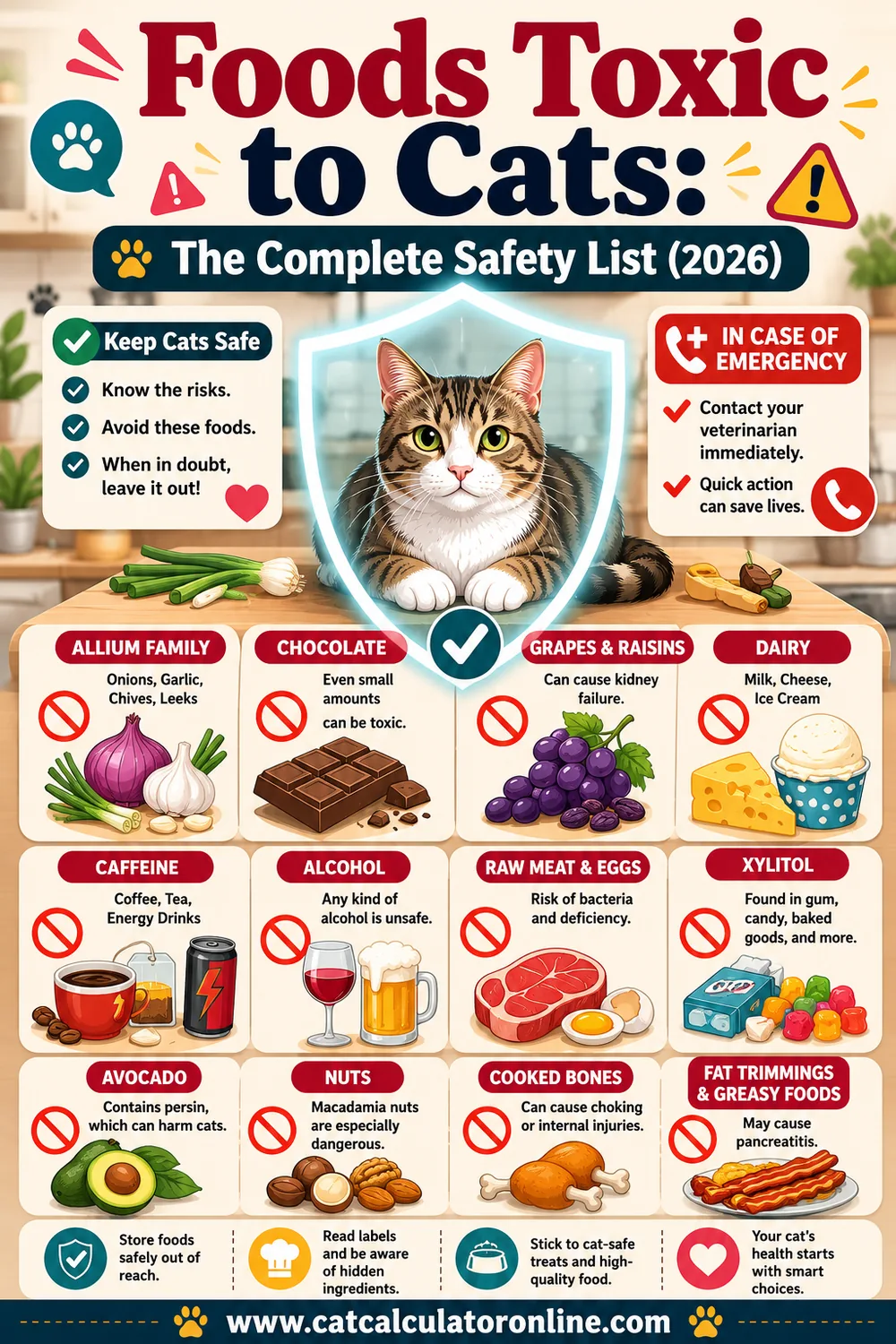
Some are never safe, at any amount. Onion, garlic, chives and leeks in any form including powders and gravies. Grapes and raisins. Chocolate. Alcohol. Xylitol. Raw dough. These are covered properly in foods toxic to cats.
Milk is not the treat it looks like. Most adult cats are lactose intolerant, and a saucer of milk delivers both digestive upset and a large share of the calorie budget.
Tuna deserves a specific warning. Cats love it, which is exactly the problem. Tuna intended for humans is not nutritionally balanced, it is easy to over-give, and cats can become genuinely fixated on it and start refusing balanced food.
The full safe list, with sensible portions, is in human foods cats can eat.
Dental Treats: What the Evidence Actually Supports
Worth being honest about, because the marketing runs ahead of the data.
Some dental products do have evidence behind them. A number of chews and diets have been shown to reduce plaque or tartar accumulation, and independently accepted products exist — the Veterinary Oral Health Council maintains a list of those that have met its standards.
Most treats marketed as "dental" have not been through that. A crunchy texture on its own does very little; many cats swallow treats nearly whole, and a treat that never contacts the tooth surface cannot clean it.
The effect size is modest even for the good ones. Reduced accumulation is not the same as removal, and no chew reverses existing dental disease.
Brushing remains the standard. Daily toothbrushing with cat toothpaste outperforms every chew, and dental treats are best understood as a supplement to it rather than a replacement.
And they still count. A 20 kcal dental stick given daily on top of meals is roughly a tenth of the cat's requirement added, every day, for a modest benefit.
If dental disease is already present, treats are not the answer. That needs examination and, usually, a scale and polish under anaesthetic.
Multi-Cat Households and Who Is Really Eating Them
The scenario where the sums quietly fail.
Treats are rarely distributed evenly. The bold cat gets there first, eats its share and then the shy cat's, and over a year one cat is overweight while the other is not.
Watch an actual treat session. Most owners are surprised by the ratio when they pay attention to it for once.
Feed treats separately, in different rooms. The same approach that works for meals works here, and it is the only reliable way to know who got what.
Scatter or hide them. Placing treats in several spots forces both cats to search rather than letting one monopolise a hand.
Beware the cat on a special diet. In a household where one cat is on a prescription or weight-loss food, uncontrolled treats are the usual reason the plan fails.
Treats are also useful currency for medication, especially in a multi-cat house where dosing has to be individual — how to give a cat a pill covers using high-value food to make that easier without blowing the budget.
Frequently Asked Questions
How many treats can I give my cat a day?
Enough to stay within about 10% of daily calories, which for a typical 9 lb adult on 200–250 kcal means roughly 20–25 kcal of treats. That is usually eight to ten small commercial treats, or a single dental stick, or about a tablespoon of wet food.
What is the 10% rule for cat treats?
That treats and any non-complete food should provide no more than a tenth of daily calorie intake, with the remaining 90% coming from complete, balanced food. It protects both the calorie total and the nutritional balance, since most treats are palatable rather than complete.
Should I reduce my cat's food if I give treats?
Yes. Treat calories should be subtracted from the meal rather than added on top. Around 20 extra kcal a day on a cat needing 220 kcal is roughly 9% surplus every day, which is one of the most common quiet causes of weight gain.
Are dental treats good for cats?
Some have real evidence for reducing plaque and tartar accumulation, and independently accepted products exist. Many marketed as dental do not, since a cat that swallows a treat whole gets no cleaning effect. None replace brushing, and they still count against the treat budget.
Can cat treats make a cat fat?
Easily. They are calorie-dense, easy to over-give, and frequently added on top of full meals rather than subtracted from them. In multi-cat homes the effect concentrates on whichever cat gets there first, which is why one cat can gain while the other does not.
What human foods make safe cat treats?
Small pieces of plain cooked chicken, turkey, white fish or egg, with no seasoning, skin or bones. Keep the portion thumbnail-sized and count it against the 10%. Onion, garlic, chives, grapes, raisins, chocolate and xylitol are never safe in any amount.
Treats are not the problem; unmeasured treats are. Hold them to about a tenth of daily calories — roughly 20–25 kcal for a typical 9 lb adult — take that amount out of the meal rather than adding it on, and check the packet for a kcal figure, converting from per-100 g where you have to. Keep the other 90% as complete food so the balance is not diluted, use treats to pay for training, carriers and medication rather than as a substitute for attention, and feed them separately if you have more than one cat. Then check the result honestly: is my cat overweight and cat body condition score explained tell you whether the budget is working, and the free cat food calculator sets the meal side.