How to Tell If Your Cat Is Happy
Here is the thing almost every article gets wrong: purring is not proof. Cats purr when they are content, and they also purr when they are frightened, injured, giving birth and dying — it appears to be a self-soothing behavior as much as a happy one, so a purring cat at the vet tells you very little. The genuinely reliable signals are quieter and more boring. Where she chooses to sleep, whether she eats and grooms normally, whether her body is loose rather than tucked, whether she uses the tray without fuss. A cat who sleeps stretched out in the middle of an open room, in daylight, with her belly showing, is telling you more about her state of mind than an hour of purring ever will. Curious how old that cat is in human terms? The free cat age calculator does it in one tap.

The Fastest Read: Where She Chooses to Sleep
If you only learn one thing from this page, make it this one.
Open, central, exposed means safe. A cat sleeping stretched out on the living room rug in the middle of the afternoon has judged her environment to be free of threats. That is a welfare assessment she has made herself.
Height means comfortable, not necessarily happy. Cats like elevation because it gives a view. It is a good sign, but a cat who only ever rests high up may be avoiding something at floor level.
Enclosed and hidden is neutral. All cats like boxes and covered beds. A cat who uses one sometimes is fine.
Hidden and unwilling to come out is not. Sustained hiding, particularly in a cat who used to be sociable, is the clearest behavioral red flag there is — covered fully in why cats hide.
Sleeping near you rates highly. Cats are vulnerable when asleep, and choosing to do it beside a large animal is a considerable statement.
Track the change, not the position. What matters is whether her chosen spots have moved lower, darker and more enclosed than they used to be.
The Signals That Really Mean Content
Not all happy signs carry the same weight, so here is how much to trust each one.
| Signal | What it means | How reliable |
|---|---|---|
| Sleeping in the open, belly exposed | Feels safe in her environment | Very high |
| Slow blinking at you | Relaxed, non-threatened, social | High |
| Tail held up with a hooked tip | Confident, friendly greeting | High |
| Loose, sprawled posture | No tension held anywhere | High |
| Playing, hunting toys, chasing | Good physical and mental health | High |
| Normal eating and grooming | Baseline welfare intact | Very high |
| Kneading, bunting, cheek rubbing | Social contentment | Moderate to high |
| Purring | Content, or self-soothing | Low on its own |
| Chirping and trilling | Sociable, usually positive | Moderate |
| Rolling on the floor near you | Comfortable, often a greeting | Moderate |
Combine at least three before drawing a conclusion. A single behavior rarely means much in isolation.
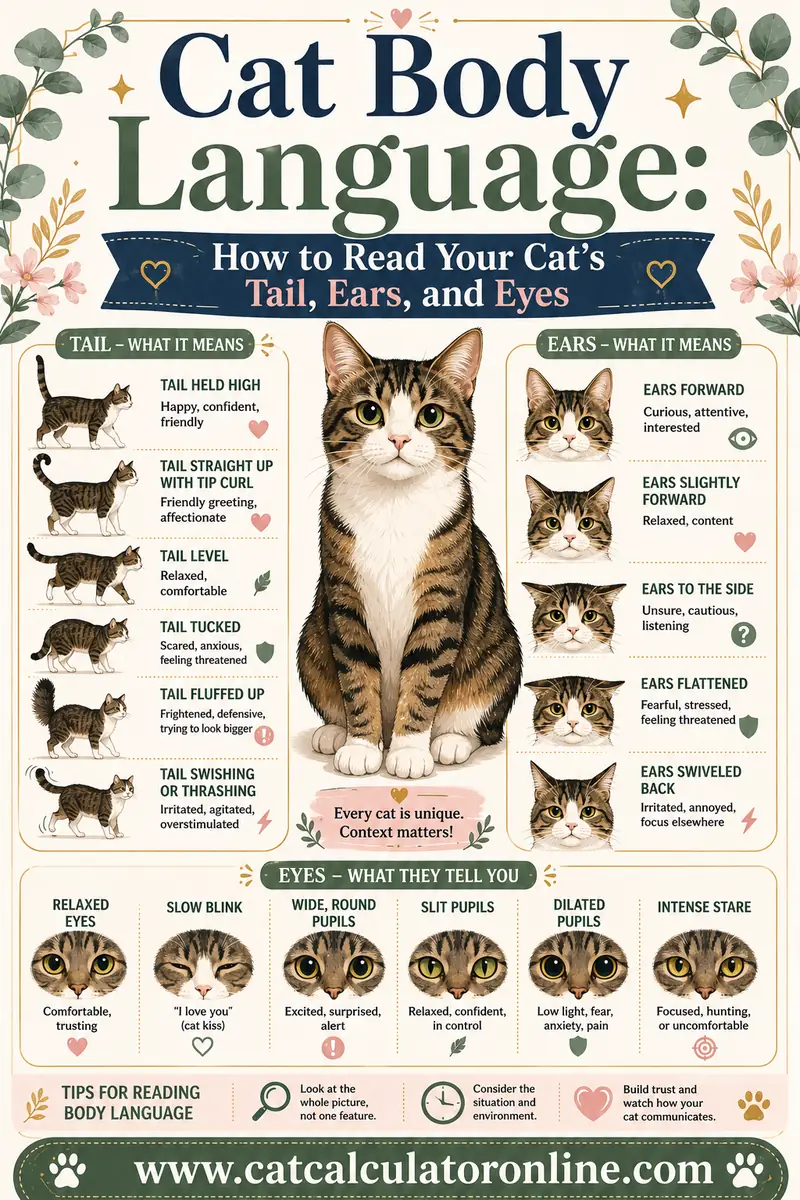
The whole-cat rule applies. Read the tail, the ears, the eyes and the posture together — the same principle set out in cat body language.
Absence is as informative as presence. A cat who has stopped doing the things on this list is worth a closer look.
Individual baselines differ enormously. A quiet, reserved cat can be perfectly happy. What matters is her normal, not somebody else's.
Why Purring Is Not the Answer
Worth being honest about, because it is repeated everywhere as the definitive sign.
Purring starts very early. Kittens purr while nursing, and mothers purr back. It begins as a communication signal between mother and kitten.
Adult cats purr in bad situations too. In pain, at the vet, when frightened, during labor and when seriously ill. Vets see this constantly.
The leading interpretation is self-soothing. The behavior appears to be a request for care or a way of calming, which covers both the contented and the distressed versions.
There is a solicitation purr. Some cats embed a higher, more urgent note into the purr when they want food — humans find it hard to ignore, which is rather the point.
Read it with the body. A purring cat who is loose, sprawled and blinking is content. A purring cat who is crouched, tense and still is not.
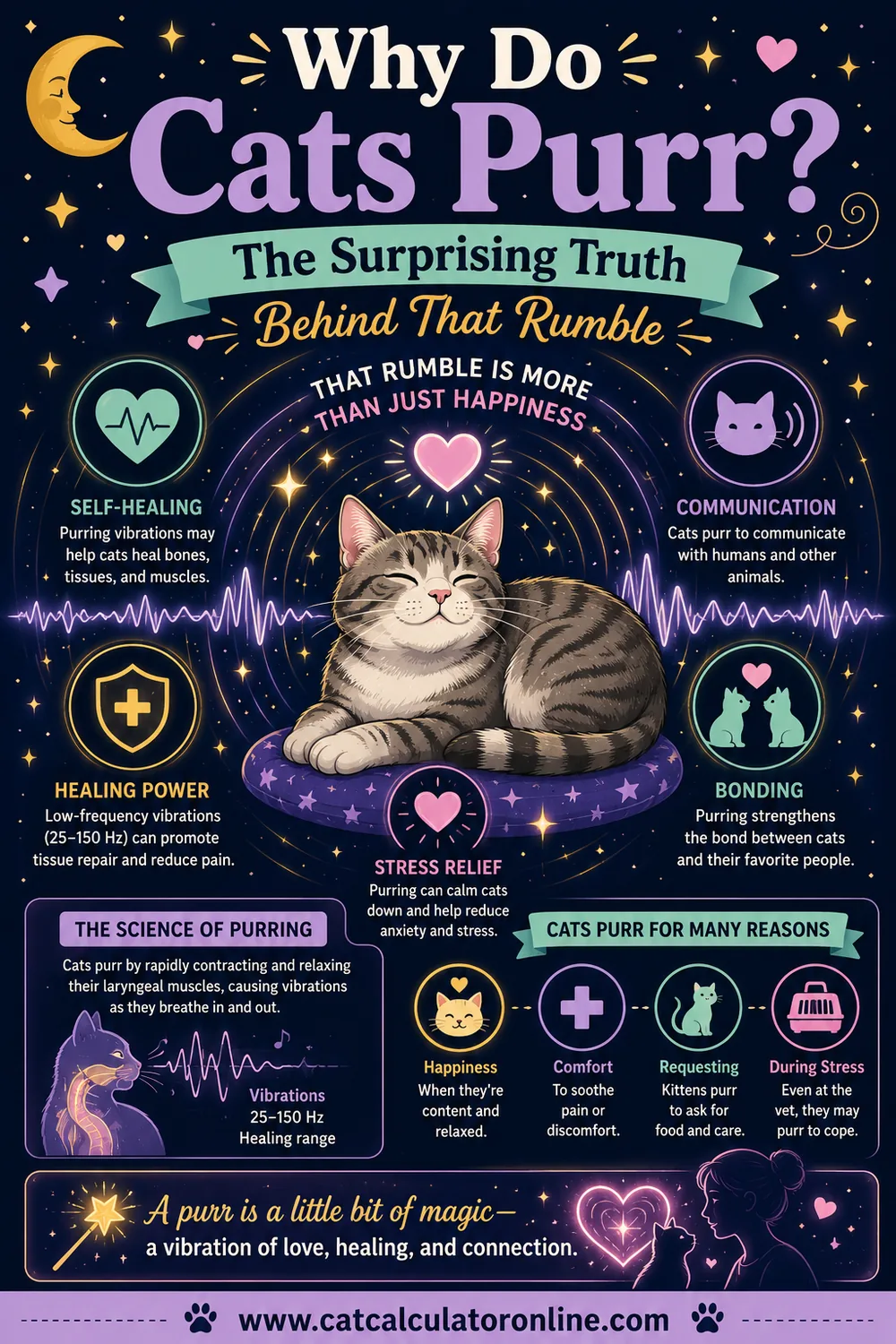
None of which makes purring meaningless. The mechanism and the full range of reasons are in why cats purr.
The Slow Blink, and How to Test It
This is the one signal you can actively check rather than passively observe.
A slow blink is a deliberate half-closing of the eyes while looking toward you, held for a moment, sometimes repeated.
It signals absence of threat. A hard, unblinking stare is confrontational between cats. Closing the eyes is the opposite statement.
You can send it back. Look at her, relax your face, and close your eyes slowly for a second or two, then open them. Do not stare between blinks.
Many cats answer. Small studies have found cats are more likely to blink back at a person who blinks first, and more likely to approach that person afterwards.
It works with strange cats too, which makes it a genuinely useful tool with a nervous rescue.
Do not force it. If she looks away entirely, that is also a polite signal, and it should be respected.
Body Shape: Loose Versus Tucked
Posture is harder to fake than any individual gesture, and it is easy to learn.
Happy cats are long. Stretched, sprawled, legs extended, sometimes on their side or back.
Tense cats are compact. Feet tucked under, tail wrapped tightly around the body, muscles held.
The loaf position is neutral. Sitting with paws tucked in is often just comfortable, though a tight loaf with wide eyes is a cat who is ready to move.
Watch the whiskers. Relaxed whiskers sit out to the sides. Pulled back against the cheeks or pushed hard forward both mean arousal.
Watch the ears. Forward or gently to the sides is fine. Rotated back or flattened is not.
And watch the tail base. A tail clamped down against the body is a stress sign even when everything else looks calm.
Exposed Belly: Trust, Not an Invitation
This one causes more scratched hands than any other misreading.
Rolling over and showing the belly means she feels safe. The belly is the least defended part of a cat, and exposing it in your presence is a real compliment.
It is usually not a request for a belly rub. Many cats will grab your hand with all four feet the moment you try — an instinctive defensive response rather than a betrayal.
Some cats genuinely love it. A minority do. You will know, and if you are guessing then the answer is probably no.
Stroke the head end instead. Cheeks, chin, base of the ears and along the jaw are where most cats want contact.
Rolling near you is also a greeting. Cats often roll in front of a person they are pleased to see, sometimes with a chirp.
Take the message and skip the belly. She said she trusts you. She did not offer a service.
The Boring Indicators That Matter Most
If the glamorous signals disagree with these, believe these.
Eating normally. A steady appetite is the single strongest welfare indicator in a cat. Never restrict food to change behavior — cats develop a serious liver problem (hepatic lipidosis) within days of not eating.
Grooming normally. A well cat keeps herself immaculate. A greasy, clumped coat suggests she has stopped, and bald patches suggest she has overdone it.
Using the litter box without fuss. Straining, avoiding the tray or going elsewhere are all meaningful changes.
Playing at least a little every day. Play is one of the first things to disappear when a cat feels unwell or stressed.
Greeting you. A cat who used to come to the door and no longer does has changed something.
Sleeping her normal hours. Big shifts in either direction are worth noticing more than the absolute number.
Keep a mental baseline. Most owners spot problems late because they never consciously noted what normal looked like.
What an Unhappy Cat Looks Like, and What Usually Helps
Unhappiness in cats rarely looks like sadness. It looks like withdrawal or friction.
Hiding more than usual is the commonest sign, and often the earliest.
Over-grooming to bald patches, typically on the belly or inner legs, frequently relates to stress or to pain underneath.
Litter box problems are near the top of the list, and are as often medical as behavioral.
Aggression and irritability are unhappiness expressed outwards. So is hissing at a housemate she used to tolerate.
Loss of appetite or comfort eating both count as changes.
Look at territory first. Most feline unhappiness traces back to too little space, too few resources, or an unwelcome cat — indoors or visible outside. One litter box, bed, bowl and hiding place per cat plus a spare, in separate locations, resolves a surprising amount.
Then look at boredom. Under-stimulated indoor cats need daily hunting-style play, height and a window view — practical ideas are in keeping an indoor cat entertained.
When "Unhappy" Is Actually Unwell
This is the escalation point, and it is the reason not to spend a two weeks rearranging furniture first.
Cats hide pain by instinct. Behavior change is often the only symptom you get, which is why a sudden personality shift deserves a vet visit rather than a behavior plan.
Book an appointment for any lasting change in appetite, grooming, sleeping spot, litter box habits, sociability or willingness to jump.
Ring the same day if she is hiding and will not eat, is hunched and still, is breathing with effort, or is crying while using the tray.
Treat as an emergency a cat straining in the tray with little or nothing produced, especially a male — a blocked bladder is fatal within a day or so. Sudden collapse, a dragged back leg, or open-mouthed breathing are also emergencies.
Do not withhold food to see whether she perks up. Ever.
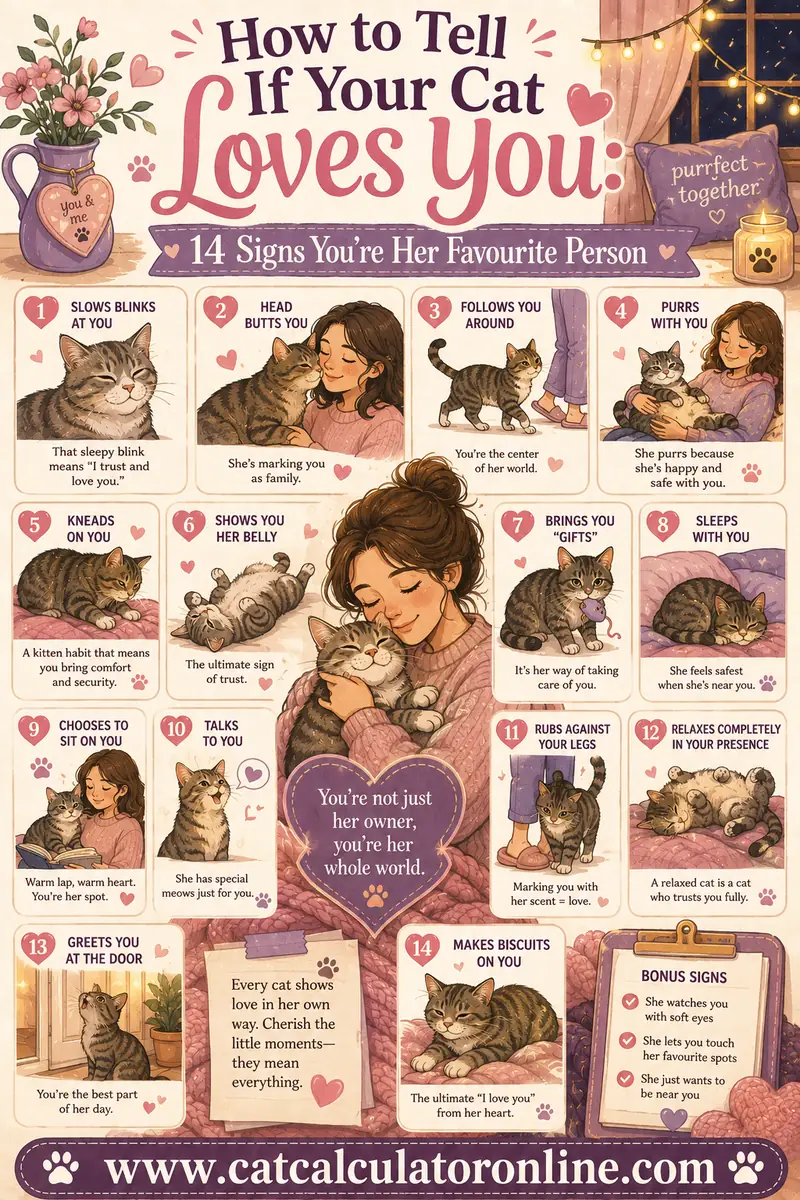
Subtle pain signs are worth learning, because they precede the obvious ones — see how to tell if a cat is in pain and signs your cat is sick. For the affection-specific signals rather than welfare ones, there is how to tell if your cat loves you.
Frequently Asked Questions
What are the signs of a happy cat?
The most reliable are sleeping stretched out in open, exposed places, a loose relaxed posture, a tail held up with a small hook, slow blinking at you, daily play, and completely normal eating, grooming and litter box use. Look for three or more together rather than any single sign.
Does purring always mean a cat is happy?
No. Cats also purr when frightened, in pain, giving birth and when seriously ill, which is why vets often hear purring from very unwell cats. It appears to be self-soothing as well as contented. Read purring alongside her posture and the situation, never as proof on its own.
Is my cat happy as an indoor cat?
She can be, provided the environment does the work her territory would. That means daily hunting-style play, climbing height, a window view, scratching posts, and one litter box, bed and feeding station per cat plus a spare. Indoor cats become unhappy through under-stimulation, not through being indoors as such.
What does it mean when my cat shows her belly?
It means she feels safe, because the belly is a cat's least defended area. It is usually not a request for a belly rub, and many cats will grab a hand that tries. Accept it as a compliment and stroke her cheeks, chin or the base of her ears instead.
How can I tell if my cat is unhappy or just quiet?
Compare her with her own baseline rather than with other cats. A naturally reserved cat who still eats, grooms, plays a little and sleeps in open spots is fine. Concern is warranted when a cat changes: more hiding, less grooming, less play, or a new reluctance to be near you.
Can a cat be depressed?
Cats show something that looks much like low mood — withdrawal, reduced grooming, less play, appetite change — often after a bereavement, a house move or a new pet. Because those signs overlap almost exactly with illness and pain, the right first step is a vet check rather than assuming it is emotional.
The honest test for a happy cat is not the one you have been told. Ignore the purr for a moment and look at where she sleeps, how long her body is when she is lying down, whether she is eating and grooming exactly as she always did, and whether she still comes to say hello. Those quiet, unglamorous things track welfare far better than any single charming gesture, and they are also the first to change when something is wrong. Learn her baseline while she is well, so a shift is obvious rather than a hunch — and remember that a change in personality is a reason to call your vet, not to rearrange the furniture. Start by placing her on the life-stage map with the free cat age calculator.