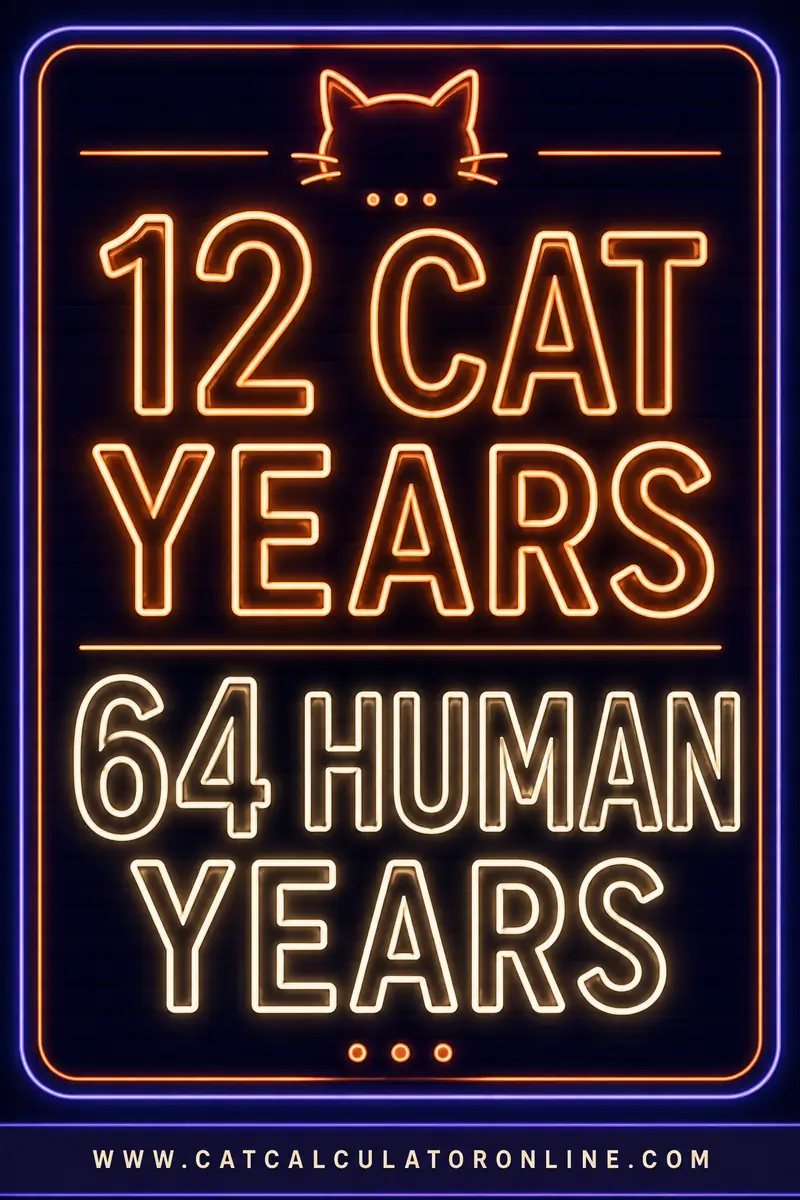
12 Cat Years in Human Years
A twelve-year-old cat is about 64 in human years. Twelve is around the point where the average indoor cat starts approaching the middle of the 13-to-17-year range, and where screening stops being purely precautionary — by this age a meaningful proportion of cats have something worth managing, most often kidney disease, hyperthyroidism or arthritis. The good news is that all three are manageable, often for years, and cats diagnosed at twelve frequently live well into their late teens. This page covers the arithmetic, what the screening should be looking for, and what daily care looks like now. Any age converts with the cat age calculator.
How Do You Get 64?
The arithmetic hasn't changed and won't.
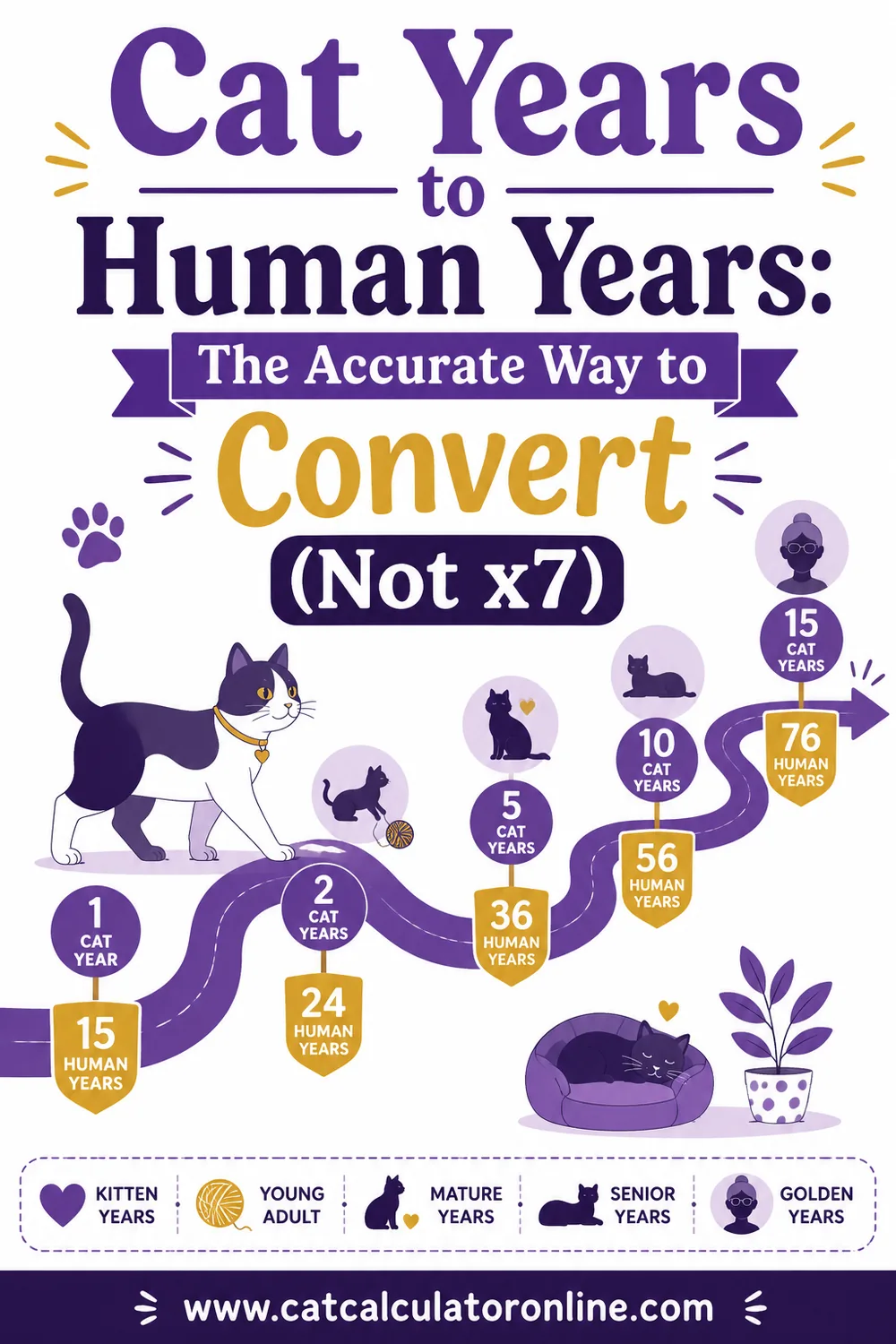
15 for year one, 9 for year two, 4 for every year after. By twelve: 24 + (10 × 4) = 64.
| Cat's age | Human years | Life stage |
|---|---|---|
| 10 | 56 | Senior |
| 11 | 60 | Senior |
| 12 | 64 | Senior |
| 13 | 68 | Senior |
| 14 | 72 | Senior |
| 15 | 76 | Senior |
| 17 | 84 | Senior |
| 20 | 96 | Senior |
A twelve-year-old cat at 64 is comparable to someone approaching retirement — often entirely well, generally slower than they were, and at an age where regular medical review finds things worth acting on.
The neighbouring ages are covered in 11 cat years in human years and 13 cat years in human years, the full table in cat years to human years, and the method in how a cat age calculator works.
Why Is Weight Loss the Signal That Matters Most?
Because it is the earliest, most reliable and most consistently ignored indicator of illness in an older cat.
The problem with noticing it by eye. A cat's coat conceals a great deal. By the time an owner can see that a cat has become thin, it has typically lost a substantial proportion of its body mass — often 15% or more — and whatever caused it has been running for months.
The scale that matters. A 4.5 kg cat losing 50 grams a month looks identical week to week and is down 600 grams — over 13% — within a year. That degree of loss in an older cat is significant regardless of cause.
What causes it at this age: hyperthyroidism, chronic kidney disease, diabetes, dental pain making eating uncomfortable, intestinal disease, and less commonly cancer. Several of these are highly treatable, and all are more treatable early.
The specific combination to act on: eating more while losing weight. That points strongly at hyperthyroidism, which is common at this age and responds very well to treatment — detail in hyperthyroidism in cats.
What to do:
- Weigh monthly, on the same scales, and write it down. Kitchen scales work: weigh yourself, then yourself holding the cat, subtract
- Look at the twelve-month trend, not the month-to-month variation
- Take a photo from above every few months as a cross-check
- Report any sustained loss, even a small one, even if the cat seems well
And take the opposite seriously too. Sudden weight gain, or a swollen abdomen, warrants a call rather than relief that the cat is eating well.
What Should the Twelve-Year Screening Cover?
The senior panel, and at this age it's realistically going to find something in a fair proportion of cats.
Kidney values — creatinine, urea and SDMA. Early chronic kidney disease is the most common finding, and catching it at an early stage is what allows years of stable management with diet and monitoring.
Urine specific gravity, which frequently changes before blood values do. Insist on this one; it's often omitted.
Total T4 for thyroid. Twelve is squarely in the peak age range for hyperthyroidism. A borderline result should be rechecked in weeks rather than filed for next year.
Blood pressure. Hypertension is common in older cats and silent until it damages the retinas or kidneys. Some cats present having gone abruptly blind.
Blood glucose and fructosamine where diabetes is a question, since stress alone raises feline blood glucose and a single high reading can mislead.
Complete blood count and liver enzymes.
A proper dental assessment. Painful teeth are a common and correctable cause of weight loss at this age, and one that gets missed because cats keep eating regardless.
Physical examination, with specific attention to thyroid gland palpation, kidney size, heart murmur, and joint range of movement.
What a diagnosis means at twelve. Usually less than owners fear. Early kidney disease is managed with diet, hydration and monitoring, and cats often remain well for years. Hyperthyroidism has several effective treatments. Hypertension responds to medication. Arthritis responds to weight management, environment and pain relief. Twelve is not an age at which a diagnosis implies a short remainder — the checklist in senior cat health checklist covers the management side.
How Do You Keep a Twelve-Year-Old Cat Well?
Five things, and muscle is the one people miss.
1. Keep the cat moving. Muscle loss accelerates from this age, and lost muscle is difficult to rebuild. Short, gentle, daily play — a wand toy at floor level, food scattered so the cat has to walk for it — genuinely slows the decline. A cat that stops moving at twelve is markedly less able at fifteen than one that kept going.
2. Protect protein intake. Older cats need adequate good-quality protein to maintain muscle, and under-feeding protein is a common error when owners switch to a "light" or "senior" food. Unless a specific condition dictates otherwise, don't restrict protein. If kidney disease is diagnosed, follow veterinary guidance rather than general advice.
3. Push hydration. Wet food as the main diet if possible, multiple water points, a fountain if your cat likes moving water. This matters more with every year.
4. Keep the mouth comfortable. Dental pain reduces eating, and reduced eating in an older cat causes weight loss that then gets attributed to age. Continue brushing if your cat accepts it, and act on veterinary advice about treatment.
5. Make everything easy to reach. Steps, low-entry boxes on every floor, warm soft beds, food and water at floor level, non-slip surfaces at landing spots. A cat that can reach what it needs uses what it needs.
And keep the routine steady. Older cats cope less well with change — new furniture arrangements, house moves, new pets, disrupted feeding times. Predictability is genuinely worth something at this age.
What Changes Are Worth a Call?
At twelve the threshold for phoning should be lower than it was at six.
Same day: not eating for 24 hours, straining in the litter box with no output, labored breathing, collapse or sudden weakness, repeated vomiting with lethargy, or sudden apparent blindness.
Within a few days: measurable weight loss, increased drinking or urination, eating more without gaining, vomiting more than about once a month, a new lump, a coat that has become unkempt, difficulty getting to the litter box, or noticeable night-time yowling.
Mention at the next check: slightly more sleeping, gradual reduction in play, mild reluctance to jump, occasional constipation.
The reason for the lower threshold: cats decompensate faster than they appear to. A senior cat that is off its food for a week has lost meaningful condition and may have tipped into hepatic lipidosis, which is a serious complication in itself. Two weeks of watching and waiting costs more at twelve than at six.
And trust your own observation. Owners frequently apologize for bringing a cat in over something vague. Vague observations from someone who sees the cat daily are exactly how senior conditions get caught early, and no reasonable vet minds.
What About Behavior Changes at Twelve?
Frequently dismissed as "she's just getting old", and frequently treatable.
Night yowling is the one owners ask about most. A cat that walks the house at three in the morning calling out is usually not being difficult. The common causes are hyperthyroidism, high blood pressure, declining hearing, failing vision, pain, and cognitive change — and the first four are all found by the senior screening panel. It is worth investigating properly before accepting it as a habit.
Increased clinginess or increased withdrawal, either direction, is worth noting. A cat that suddenly wants constant contact, or one that has started sleeping somewhere it never used to and stays there, has changed for a reason.
Litter box lapses. Going beside the box rather than in it is very often a physical problem — sore joints making the step painful, or a urinary issue making the association unpleasant. The fix is frequently a low-entry box and a vet visit, not a behavioral program.
Confusion at doorways, staring at walls, or forgetting a route through the house can indicate cognitive dysfunction, which is genuinely recognized in older cats. There's no cure, but routine, night lighting, keeping furniture where it is, and enrichment all help, and some cats respond to dietary support.
Reduced grooming or over-grooming one area. The first suggests stiffness or nausea; the second often marks a painful spot underneath.
The principle: at twelve, a new behavior is a symptom until proven otherwise. Describe it specifically to your vet rather than summarising it as old age.
How Should You Think About Cost at This Age?
Worth addressing plainly, because senior cat care has a real price and pretending otherwise helps nobody.
Twice-yearly checks with annual bloods are the recurring baseline, and they cost meaningfully more than the single annual visit of the middle years.
A diagnosis adds ongoing cost — a prescription diet, monthly medication, or repeat monitoring bloods every three to six months. None of it is individually large; together it's a standing commitment for the rest of the cat's life.
Insurance rarely helps by now. If a policy wasn't taken out years ago, anything already diagnosed is excluded and premiums for a twelve-year-old are high. This is why the decision at five or six mattered.
Where the money is best spent, in rough order of value: the screening that catches things early, dental treatment that keeps a cat eating, weight and diet management, and pain relief for joints. Those four buy more comfortable years than anything else available.
Where it's often wasted: supplements without a diagnosis, premium foods chosen on marketing rather than on a specific need, and repeated investigation of findings that were already explained.
And the honest framing: early diagnosis is usually cheaper than late diagnosis, not just better. A kidney case managed from stage two costs less over five years than a crisis presentation at stage four, and the cat lives longer. The screening is the economical choice as well as the kind one.
Frequently Asked Questions
How many human years is 12 cat years?
About 64. The method is 15 for the first year, 9 for the second and 4 for each year after — giving 24 at age two plus ten further years at four each.
Is a 12-year-old cat elderly?
Senior rather than elderly. Indoor cats average 13 to 17 years and many reach 20, so a healthy twelve-year-old commonly has several years ahead — often more with a well-managed condition.
Why is my 12-year-old cat losing weight?
Common causes are hyperthyroidism, chronic kidney disease, diabetes, dental pain and intestinal disease. Eating more while losing weight points particularly at hyperthyroidism. Any sustained loss in a senior cat warrants investigation, even if the cat seems well.
How often should a 12-year-old cat have blood tests?
At least annually, and many vets recommend at each six-monthly visit for senior cats. What matters as much as the values is the trend across previous results, so ask for the history rather than just the latest figures.
Should a 12-year-old cat eat senior food?
Not automatically. A healthy senior cat needs adequate good-quality protein to maintain muscle, and restricting it can accelerate muscle loss. Therapeutic diets are appropriate in response to a specific diagnosis rather than to an age.
Does a diagnosis at twelve mean my cat hasn't long left?
Usually not. Cats diagnosed with early kidney disease or hyperthyroidism at twelve frequently live well into their late teens with appropriate management. Early diagnosis is precisely what makes that outcome likely.
Twelve cat years is about 64 human years, and it's the age where screening starts genuinely earning its place. Weigh monthly and treat any steady loss as a reason to call, keep protein and hydration up, keep the cat moving to protect muscle, and remember that a diagnosis at twelve is usually the beginning of management rather than the end of anything. Convert any age with the cat age calculator.