How to Care for Orphaned Kittens
The order matters more than anything else you will read here. Warm first, then hydrate, then feed — feeding a cold kitten can kill it, because a chilled gut stops moving and the milk sits there undigested. And the fact that kills more orphaned kittens than any other: kittens under about three to four weeks cannot urinate or defecate without being stimulated, so if nobody wipes the genital area with a warm damp cloth after every feed, they stop passing anything at all. Hand-rearing is a genuine two-hourly commitment, round the clock, but it is very doable if you follow the sequence. Weigh daily and check the numbers with the kitten weight calculator.

First: Are They Actually Orphaned?
Worth thirty minutes before you commit to six weeks of night feeds.
Most "abandoned" kittens are not. A queen moving a litter carries them one at a time, and she leaves the others while she does it. She also hunts, and can be away for a couple of hours.
Watch from a distance for two to four hours if the kittens are warm, plump and quiet. Stay well back and out of sight — a queen will not return while you are standing there.
Do not wait if the kittens are cold, wet, thin, crying continuously, in danger, or visibly ill. Those are the cases where waiting costs lives.
Warm, quiet, round-bellied kittens have been fed recently. Cold, limp, wrinkled, constantly crying kittens have not.
Kittens raised by their mother do far better on every measure, so reuniting them is the best outcome available and worth the wait where the wait is safe.
If you take them, take the whole litter. Littermates keep each other warm and teach each other social behavior that you cannot.
Step One: Warm Them
Not negotiable, and it comes before everything else.
A cold kitten cannot digest. Below normal body temperature the gut slows and stops, and milk given to a chilled kitten ferments in the stomach rather than being absorbed.
Check the ears and paw pads. Cool ears and cold pads mean a chilled kitten. A limp, floppy, silent kitten is usually cold.
Warm slowly over 30 to 60 minutes, inside your jumper against your skin, or on a covered heat pad or wrapped hot water bottle. Rapid warming is dangerous.
Never place a kitten directly on a heat source and never use an uncovered pad. Heat one end of the nest only, so a kitten can crawl away.
Then hold the nest at about 86 to 90°F (30 to 32°C) in week one, dropping roughly 5°F (3°C) a week to room temperature by week four. The full temperature schedule is in newborn kitten care week by week.
Do not feed until the kitten feels warm and is moving. A little sugar solution rubbed on the gums is acceptable during warming if the kitten is very flat, but milk is not.
Step Two: Hydration
The step that is most often skipped, and the reason some kittens fail despite being fed.
Dehydration is common in found kittens and it undermines everything else. A dehydrated kitten absorbs milk poorly.
Check by skin tent and gums. Gently lift the skin over the shoulders — it should snap back instantly. Gums should be moist and pink, not tacky or pale. The wider signs are in signs of dehydration in cats.
Mild cases: offer a warmed electrolyte or rehydration solution for one or two feeds before starting milk replacer.
Anything beyond mild is a vet job. Subcutaneous fluids under the skin take a couple of minutes and transform a flat kitten, and most practices will do it cheaply or free for a found litter.
Never give fluids by mouth to a kitten that is not swallowing. It goes into the lungs. An unresponsive kitten needs a vet, not a syringe.
Once warm and hydrated, feed. That is the sequence, and it is the whole reason this page starts where it does.
Step Three: Feeding
The routine, in detail.
Kitten milk replacer only. Powdered or liquid, from a vet, pet shop or supermarket. Nothing else is a complete substitute.
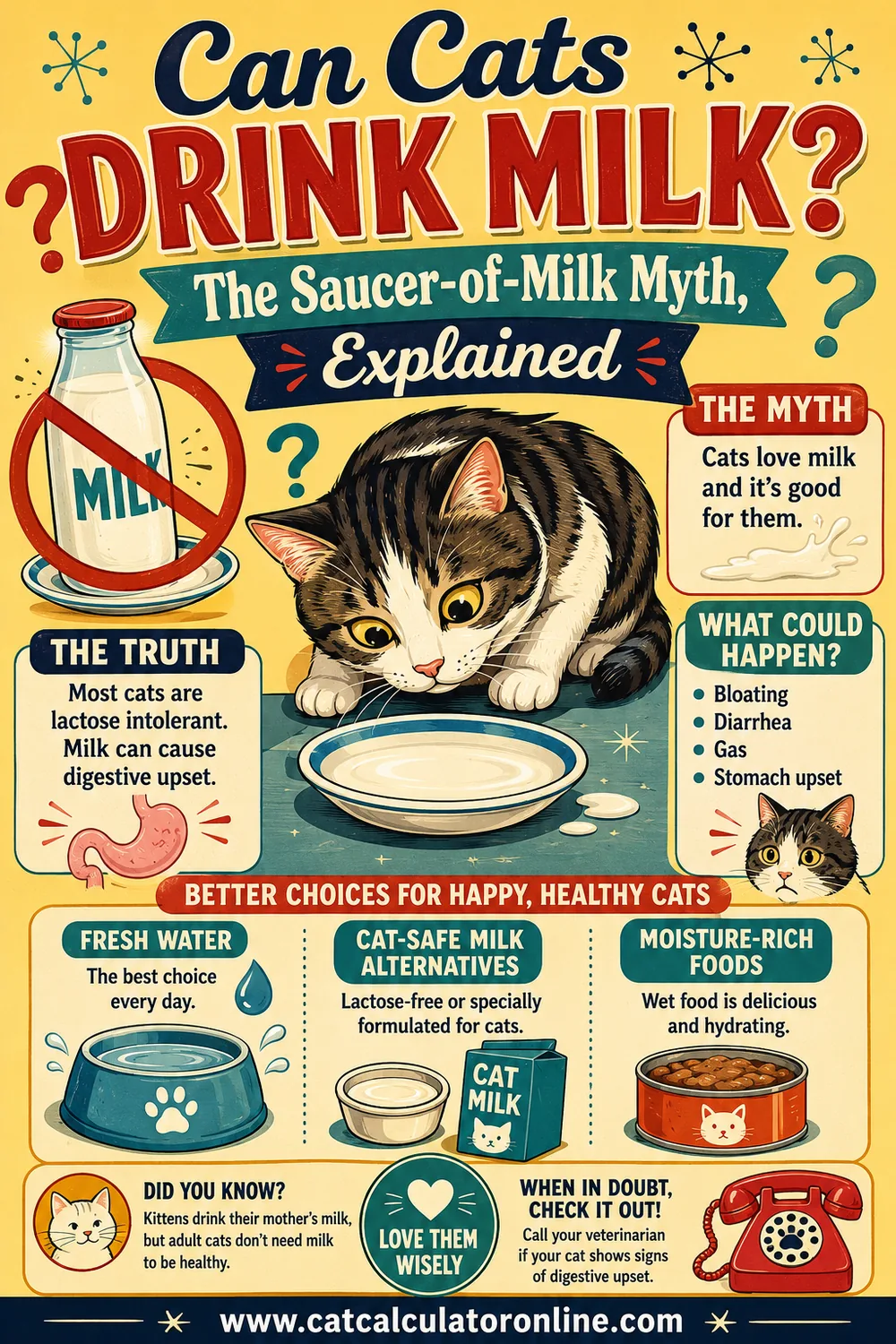
Never cow's milk, goat's milk, lactose-free milk, condensed milk, cream or human infant formula. Cow's milk causes diarrhea and lacks what a kitten needs — the reasoning is in can cats drink milk.
In a genuine emergency overnight, a vet may advise a temporary rehydration solution until you can get replacer in the morning. That is a stopgap, not a formula.
Feed belly-down, at a slight head-up angle, exactly as a kitten nurses from the queen. Never on its back like a human baby — that is the fastest route to milk in the lungs.
Use a proper kitten bottle with the teat opening cut so milk drips slowly when inverted. A hole that is too big drowns kittens. A syringe works if you go drop by drop.
Warm the milk to about 100°F (38°C) and test on your wrist. Mix fresh for each feed and discard leftovers.
Let the kitten set the pace. It should suck actively. Milk bubbling from the nose means stop immediately, tip the head down and let it clear.
Burp gently afterwards by holding the kitten upright against your shoulder and patting its back.
Feeding Schedule by Age
Frequency matters more than exact volume, and it stretches out as they grow.
| Age | Feeds per day | Interval | Rough volume per feed | Night feeds |
|---|---|---|---|---|
| 0–1 week | 10–12 | Every 2 h | 2–6 ml | Yes |
| 1–2 weeks | 8–10 | Every 2–3 h | 6–10 ml | Yes |
| 2–3 weeks | 6–8 | Every 3–4 h | 10–14 ml | Yes, fewer |
| 3–4 weeks | 5–6 | Every 4–5 h | 14–18 ml | One |
| 4–5 weeks | 4–5 plus gruel | Every 5 h | Reducing | None |
| 5–8 weeks | Mostly solid food | 4 meals | — | None |
Millilitres are the working unit here because feeding syringes and bottle barrels are marked in them, and nothing else is fine enough at this size. If it helps to picture: 5 ml is about a teaspoon, so the earliest feeds are well under half a teaspoon each, and a three- to four-week-old is taking roughly three teaspoons.
Follow the volumes on your replacer tin, which are calculated per 100 g of kitten and are more accurate than any generic table.
A rough guide is about 8 ml of replacer per 100 g of body weight per day — call it a heaped teaspoon and a half per 3.5 oz of kitten — split across the feeds.
Do not overfeed to save a night feed. Overfeeding causes diarrhea and bloat, and both are dangerous at this size.
Never skip feeds to make the schedule easier. Kittens this small have hours of reserve, not days, and low blood sugar develops quickly.
Step Four: Toileting — The One Most People Miss
This is the single fact that separates kittens who survive from kittens who do not.
Kittens under about three to four weeks cannot urinate or defecate on their own. The queen licks the genital and anal area after every feed to trigger it. Without that, nothing happens.
Do it after every single feed. Take a piece of cotton wool, a soft cloth or a tissue, dampen it with warm water, and wipe gently over the genital area in small circular strokes.
Keep going for 10 to 20 seconds, or until urine passes. Hold the kitten belly-down or upright over a paper towel.
Urine should come at every feed. Feces once or twice a day is normal, and often less frequent on replacer than on queen's milk.
No urine for more than about 12 hours is a vet call. So is diarrhea, at any point, in a kitten this size.
Dry the area afterwards and check for redness. Damp skin gets sore very fast, and a little barrier cream on a vet's advice helps if it does.
Stop at three to four weeks as they start using a tray. Put a shallow, low-sided tray with plain non-clumping litter down at about three weeks — clumping litter is a hazard for kittens that taste it.
Weighing, Hygiene and Housing
The background tasks that keep the whole thing on track.
Weigh once a day, at the same time, on digital kitchen scales in grams. Write it down for each kitten.
Expect roughly 10 to 15 g a day — a third to half an ounce — or around 100 g (3.5 oz) a week, and a doubling of birth weight by one to two weeks.
Two consecutive flat days, or any loss, means call the vet. The scales spot trouble two days before the kitten looks unwell.
Use a nesting box with high sides and a low entrance, soft washable bedding changed daily, in a quiet, draught-free, dim room away from other pets.
Keep littermates together. They regulate each other's temperature and learn social boundaries from one another.
Wash your hands before and after handling, and keep orphans strictly away from other cats until a vet has seen them. Orphans have often missed the antibodies in the queen's first milk and are genuinely vulnerable.
Estimate the age carefully, because everything above depends on it. The signs are in how to tell how old a kitten is, and when in doubt assume younger.
Weaning, Worming and Vaccines
The orphan's path back to a normal kitten timetable.
Weaning starts at three and a half to four weeks, same as any kitten. Offer replacer in a shallow dish first so they learn to lap, then blend kitten food into it a little at a time.
Drop one bottle feed at a time over about two weeks, keeping the night feed until last, and finish by seven to eight weeks. The method is in how to wean kittens.
Water goes down as soon as solids start.
Worming usually begins at two to three weeks and repeats fortnightly to around twelve weeks. Orphaned and stray kittens almost always carry worms and often fleas, and adult flea products are dangerous for kittens this small — never use a dog product on a cat. Your vet's schedule is the one to follow, and the general pattern is in cat worming schedule.
First vaccination at around eight to nine weeks, with a booster three to four weeks later. Orphans matter more here, because without the queen's colostrum they have less maternal protection — the schedule is in kitten vaccination schedule.
Get them seen by a vet early regardless. A found kitten needs a check for worms, fleas, ear mites, eye infections and umbilical problems, and none of that waits for the vaccine date.
Getting Help, and When to Ring
Hand-rearing is hard, and you do not have to do it alone.
Ring a local cat rescue first. Many have a lactating queen who will accept extra kittens, and a queen beats any bottle by a wide margin. Rescues also run experienced fosterers and often supply replacer and bottles.
Ring a vet on day one, whatever else you do, for a check, an age estimate, worming advice and fluids if needed. Many practices see found kittens at reduced cost.
Same-day veterinary call for: a cold, limp or unresponsive kitten; no urine passed in 12 hours; diarrhea; labored or noisy breathing; milk coming from the nose; constant crying; weight loss; or a kitten that will not feed at two consecutive feeds.
Be realistic about the commitment. Two-hourly feeds through the night for the first two weeks is a genuine sleep cost, and it is better to hand a litter to a fosterer on day one than to fail at day five.
Not every orphan survives, particularly very young ones found cold, and that is not a reflection on the person who tried. Fading kitten syndrome has causes that no amount of care can reverse.
And once they are weaned and vaccinated, book the neuter and start finding homes — keeping them together to at least eight weeks, and preferably twelve, gives them the best temperament.
Frequently Asked Questions
What is the first thing to do with an orphaned kitten?
Warm it. Warm slowly over 30 to 60 minutes against your body or on a covered heat pad, and do not feed until it feels warm and is moving, because a chilled kitten cannot digest milk. Hydration comes next, then feeding.
What can I feed an orphaned kitten?
Kitten milk replacer only, warmed to about body temperature and given belly-down at a slight angle. Cow's milk, goat's milk and human formula are all unsuitable and cause diarrhea. In an overnight emergency, ask a vet about a rehydration solution as a stopgap.
How often do orphaned kittens need feeding?
Every two hours for the first week, every two to three hours in weeks one to two, and every three to four hours in weeks two to three, including through the night. Feeds stretch out from three weeks and stop by seven to eight.
Do orphaned kittens need help to go to the toilet?
Yes, and this is critical. Kittens under three to four weeks cannot urinate or defecate without stimulation. Wipe the genital area with a warm damp cloth for 10 to 20 seconds after every feed. No urine in 12 hours needs a vet.
How much weight should an orphaned kitten gain?
Roughly 10 to 15 g a day, or about 100 g (3.5 oz) a week, with birth weight doubling by one to two weeks. Weigh at the same time daily and ring a vet after two flat days or any weight loss.
Can a rescue find a mother cat for orphaned kittens?
Often, yes. Many rescues have a lactating queen who will accept additional kittens, and a nursing mother gives far better outcomes than hand-rearing. Ring local rescues before committing to weeks of two-hourly bottle feeds.
The sequence is what saves orphaned kittens: warm them before anything else, correct dehydration next, and only then feed kitten milk replacer, belly-down and never on the back, every two to three hours around the clock. After every feed, stimulate them to toilet with a warm damp cloth until they are three or four weeks old, because they genuinely cannot do it alone. Weigh daily and treat two flat days as a reason to ring. Then wean from about four weeks, worm on schedule and vaccinate from eight or nine. Before you start, ring a rescue — a nursing queen beats a bottle every time. Track every gram with the free kitten weight calculator.