Are Self-Cleaning Litter Boxes Worth It?
For some households, yes — genuinely. For others they are the wrong purchase at any price. The honest answer depends on your cat's size, her temperament, and one thing almost no review mentions: scooping a tray by hand is the most reliable early-warning system you have for feline illness, and an automatic box takes it away. Changes in how much a cat urinates, how often, and what her stools look like are among the very first signs of kidney disease, diabetes, urinary blockage and inflammatory bowel problems. A machine that rakes it all away before you see it removes that check. Running costs sit in the cat cost calculator.

What Do Self-Cleaning Litter Boxes Actually Do?
They separate clumps from clean litter, on a timer or after the cat leaves, and drop the waste into a sealed drawer.
Raking boxes drag a comb through a flat bed of clumping litter and push the clumps into a covered compartment at one end. They are the older design, cheaper, and generally quieter.
Rotating globe boxes tumble the whole chamber so clean litter falls through a sieve and clumps roll into a drawer underneath. These are the large, expensive, app-connected units. They hold more litter and empty more completely, but they are also the ones that make a cat feel like she is standing inside a machine.
Most are triggered by a weight sensor or an infrared beam, with a delay of anywhere from 3 to 20 minutes after the cat steps out. The delay exists to give clumping litter time to harden — cycle too early and you smear rather than lift.
Almost all of them require clumping clay litter. Crystal, pine, paper and corn litters either do not clump firmly enough or jam the mechanism. That locks you into one litter type, which matters if your cat has a strong preference — types of cat litter compared covers what those preferences usually are.
None of them are truly self-cleaning. You still empty the waste drawer, top up litter, wipe the sensors, and strip and wash the whole unit every few weeks. What you are buying is the removal of the twice-daily scoop, not the removal of the chore.
What Do You Lose by Not Scooping?
This is the argument that should decide the purchase, and it is the one review sites skip.
Litter box changes are among the earliest signs of illness in cats. Cats hide being unwell extremely well — it is a survival instinct, not stoicism — and the tray is often the first place the truth shows up. Scooping twice a day gives you an unglamorous but very effective daily screen.
Bigger, more frequent urine clumps are a classic early flag for chronic kidney disease, diabetes and hyperthyroidism. The cat looks fine. The clumps get noticeably larger over a few weeks. That is the sign, and it is easy to miss if a machine buries it.
Tiny clumps, or many visits producing almost nothing, point toward cystitis or a urinary blockage. In a male cat, a full blockage is a genuine emergency measured in hours, not days — urinary blockage in cats sets out what to watch for. An automatic box hides exactly the pattern that gives it away.
Blood, mucus, straining or diarrhea all show in a scooped tray and vanish in a waste drawer.
No output at all for 24 hours is significant in either direction. With three cats and one machine, you may not notice for days.
You can have both. Plenty of owners run an automatic box and still tip the waste drawer into the bin over a sheet of newspaper once a day, glancing at what comes out. That takes fifteen seconds and preserves most of the benefit. If you buy one, build that habit deliberately — otherwise you will genuinely lose the check.
Is It Big Enough for Your Cat?
Size is where automatic boxes most often fail, and it is a hard limit rather than a preference.
The standard rule is that a litter box should be at least 1.5 times the length of your cat, nose to base of tail. For a 10 lb (4.5 kg) adult that means roughly 22–24 in (56–60 cm) of internal length. Many automatic boxes have less usable floor than that once the rake track and sensors are accounted for.
Globe designs feel smaller than their dimensions suggest. The usable litter bed is a shallow dish at the bottom of a sphere, and the walls curve inwards. A big cat can physically fit and still refuse to use it, because she cannot turn or dig comfortably.
Large breeds are frequently a straight no. A 16 lb (7 kg) Maine Coon or a big Ragdoll needs a tray most automatic units simply do not offer. A large plain storage box, scooped by hand, is a better home for that cat. The sizing logic is set out in best litter box size for cats.
Entry height matters for seniors. Arthritic cats struggle with high steps and enclosed entries. If she has started perching on the rim or missing the tray, entry height is a likely cause.
Watch the digging. Cats that dig energetically before and after fling litter out of shallow automatic beds, and some units cannot cope with a deep litter fill because the rake stalls.
Will Your Cat Actually Use One?
Most cats adapt. A meaningful minority never do, and there is no reliable way to know which yours is before you buy.
Confident, food-motivated, unbothered-by-the-vacuum cats usually accept one within one to two weeks.
Nervous cats often will not. The moment the motor starts while she is anywhere near it, some cats decide the box is dangerous. Once a cat associates the tray with something frightening, she looks for somewhere else to go — and toileting outside the box is far harder to fix than it is to prevent. Why is my cat not using the litter box covers how stubborn that problem becomes.
Introduce it properly. Run it unplugged, in the same spot, filled with her usual litter, for at least a week. Only then switch it on. Never remove the old tray at the same time; keep both available for a month.
Never take the last conventional tray away. If your cat has one box and you replace it with a machine she distrusts, she has no legal option left.
Watch for the quiet refusals. Cats do not announce a problem. Perching on the rim, not covering, eliminating right beside the box, or holding on for hours all mean she is unhappy with it.
Kittens under about six months should not use one. They may be too light to trigger the sensor, and moving parts plus a curious kitten is a combination worth avoiding entirely.
Does It Change the Number of Boxes You Need?
No. This is the most common and most expensive misunderstanding.
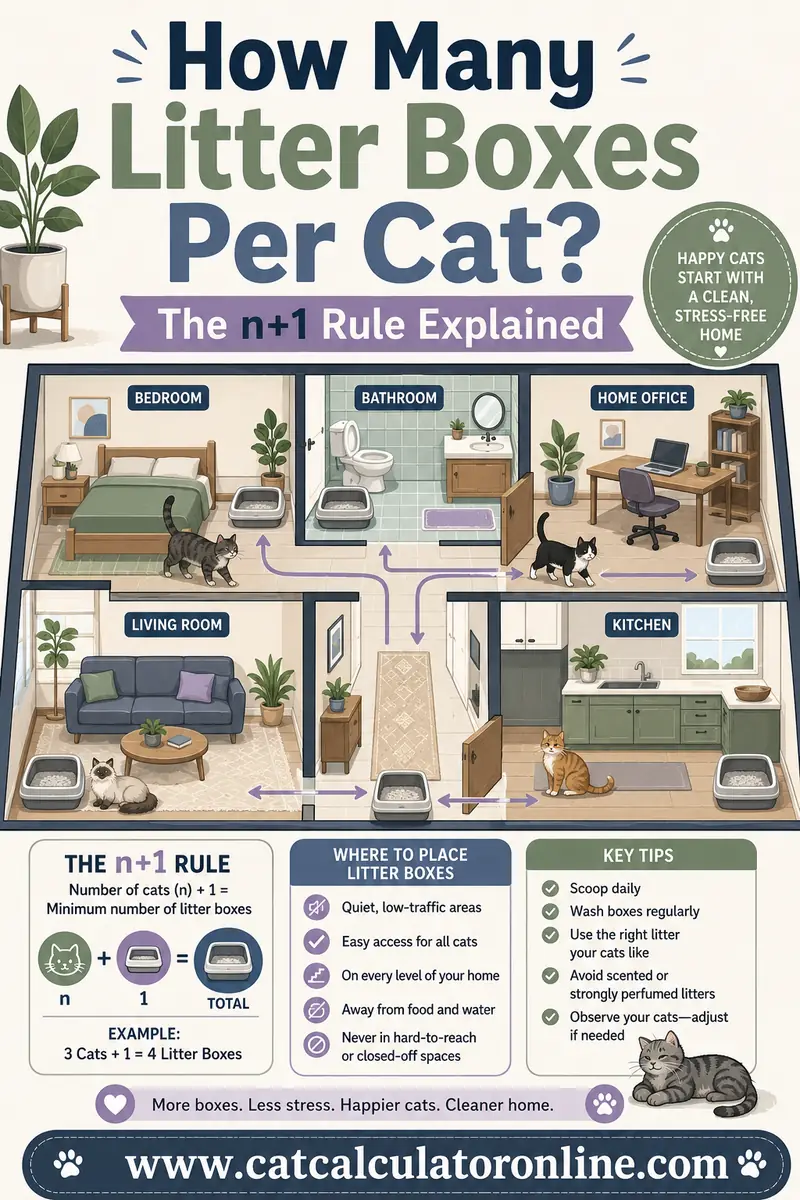
The rule stays one box per cat, plus one. Three cats need four boxes, whether they clean themselves or not. The rule exists because of territory and queuing, not hygiene — a cat that has to walk past a housemate to reach the only tray will eventually stop trying.
One machine for a multi-cat home creates a bottleneck. Many units also lock out for several minutes while cycling, so a second cat arriving during that window finds the box unavailable.
Buying four automatic boxes is rarely sensible at $150–$700 each, which is why most multi-cat homes end up with one machine and several ordinary trays. That works well.
Spread them across the house, on different floors and away from noisy appliances. Two trays side by side count as one box in a cat's eyes. The reasoning is set out in how many litter boxes per cat.
Individual monitoring is a real advantage of the better units. Some track visits per cat by weight and will flag a cat whose visit frequency changes. In a multi-cat house that is genuinely useful information you would otherwise never have.
What Do They Cost to Run?
| Cost | Typical US figure | Notes |
|---|---|---|
| Purchase, basic rake unit | $80–$200 | Simpler, quieter, less to break |
| Purchase, globe or app-connected | $350–$700 | Larger capacity, app tracking |
| Clumping clay litter | $15–$30 a month | Usually more litter used than a plain tray |
| Waste drawer liners | $5–$15 a month | Some models need proprietary liners |
| Carbon filters | $3–$8 a month | Optional on most units |
| Electricity | Under $5 a year | Genuinely negligible |
| Replacement rake or sensor | $20–$60 | Every few years on older units |
| Expected lifespan | 3–7 years | Motors and sensors fail before the shell does |
The proprietary consumables are where the real money is. A unit that only takes its own branded trays or liners can cost more over three years than the machine did. Check what the refills cost before you check what the box costs.
A plain tray plus litter runs roughly $15–$25 a month all in, so an automatic box is not cheaper. It buys time and reduces smell in the room, and those are the honest reasons to want one.
Litter usage often goes up, not down, because most units need a minimum fill depth to work and you top up rather than fully change. That said, full changes become less frequent — the trade-offs are covered in how often to change cat litter.
What Actually Goes Wrong With Them?
Sensor faults. Dust and litter granules coat the infrared sensors, the unit stops detecting the cat, and it either cycles while she is inside or stops cycling altogether. Wiping the sensors weekly prevents most of this.
Jams. Wet litter, a large stool, or a clump that has fused to the floor stalls the rake. Some units then sit in an error state until you notice, which may be days.
Smearing. Cycling too soon after a soft stool spreads it across the bed rather than lifting it. Almost every owner has scrubbed a whole unit out because of this.
Noise creep. Motors get louder as they age, and a cat who tolerated it at eighteen months may not at four years.
Deep cleaning is a bigger job than a tray. A plain tray is emptied, washed and dried in five minutes. A globe unit means dismantling, avoiding the electronics, and letting it dry fully before refilling.
Warranty length tells you a lot. A one-year warranty on a $500 machine is a statement about expected life.
So Who Should Buy One?
Buy one if: you have one or two confident adult cats of normal size, the tray is somewhere you cannot easily scoop twice a day, you work long hours, you have limited mobility or a pregnancy that makes handling litter risky, or the smell in a small flat is the actual problem you are solving.
Skip it if: your cat is nervous or noise-sensitive, she is a large breed, she is a kitten, she is elderly or has a diagnosed condition you are monitoring, you have four cats and one budget, or your cat has any history of toileting outside the box.
Be honest about the health trade-off either way. If you buy one, look inside the waste drawer daily and weigh your cat monthly. Weight loss plus bigger urine clumps is a pattern worth a vet appointment — it is one of the classic openings of chronic kidney disease in cats, and catching it early changes the outlook substantially.
Call your vet the same day if your cat is straining in the tray, producing nothing, crying while urinating, or has stopped eating. In a male cat that combination is an emergency. Do not wait for an appointment slot.
Frequently Asked Questions
Are self-cleaning litter boxes worth the money?
For a confident, average-sized adult cat in a one or two cat home, often yes — they reduce smell and save daily scooping for $80–$700 upfront. They are a poor choice for nervous cats, large breeds, kittens, and any cat whose health you are actively monitoring.
Do self-cleaning litter boxes hide health problems?
They can. Scooping a tray shows you urine clump size, stool consistency and frequency, which are among the earliest signs of kidney disease, diabetes and urinary blockage. If you use an automatic box, empty and glance at the waste drawer every single day.
Do I still need one box per cat with an automatic box?
Yes. The one-box-per-cat-plus-one rule is about territory and queuing, not cleanliness, so three cats still need four boxes. Most multi-cat homes run one automatic unit plus ordinary trays spread around the house.
Will my cat be scared of a self-cleaning litter box?
Some are. Run it unplugged for a week in the final position, keep the old tray available for at least a month, and switch the power on only once she is using it. Nervous or noise-sensitive cats often never accept one.
What litter do automatic litter boxes need?
Almost all require firm clumping clay litter, usually fine-grained. Crystal, pine, paper and corn litters either fail to clump hard enough or jam the mechanism. Check the manual before buying, because changing litter type can upset a cat.
Can kittens use a self-cleaning litter box?
Not under about six months. Young kittens are often too light to trigger the weight sensor, and moving parts are a genuine hazard for a curious kitten. Use a low-sided open tray until she is fully grown and reliably trained.
One practical middle path is worth mentioning: a very large plain tray, filled deep with good clumping litter and scooped once a day, gets you most of the smell control an automatic box promises for about a tenth of the money. Most litter smell comes from waste sitting too long or a tray that is too small, not from the absence of a machine.
If you do buy one, buy the largest you can fit, introduce it slowly, never remove the last conventional tray, and open that waste drawer every day. Used that way, an automatic box is a reasonable convenience purchase rather than a health blind spot. To see how the upfront price and the monthly consumables sit against everything else a cat costs across a year, put the figures into the cat cost calculator.