Is My Cat Overweight?
You can check in about thirty seconds without scales: run your hands along your cat's ribs, then look down at them from above and from the side. You should feel the ribs easily under a thin layer of fat, see a visible waist behind the ribs when viewed from above, and see the belly tuck up slightly rather than hang down when viewed from the side. If the ribs are hard to find and there's no waist, your cat is probably carrying excess weight. That matters because feline obesity is genuinely common and drives diabetes, arthritis and urinary problems — and the cat ideal weight calculator gives you a target to work toward.
How Do You Check at Home?
Three checks, done together. Any one alone can mislead you; all three together are reliable.
The rib check. Place both hands flat on either side of your cat's ribcage and run them gently backward. You're feeling for the ribs with light pressure, not digging for them.
- Easy to feel with a thin fat covering — about like feeling the bones on the back of your hand. That's ideal.
- Have to press to find them — overweight.
- Can't find them at all — obese.
- Sharply visible and prominent — underweight, which needs a vet visit rather than more food.
The overhead view. Stand over your cat while it's standing. Look for a waist: a slight inward curve behind the ribcage, before the hips. An hourglass suggestion is what you want. If your cat's outline is an oval or a rectangle with no narrowing, that's excess weight.
The side view. Crouch to your cat's level. The abdomen should slope gently upward from the bottom of the ribcage toward the hind legs — an "abdominal tuck". If the belly runs level with the ribcage, or hangs below it, that suggests excess fat.
Do all three. A long-haired cat can hide its outline completely, which is why the hands-on rib check matters most for Persians, Maine Coons and Ragdolls. Wet a long-haired cat and the shape underneath is often a surprise in both directions.
Do the checks when your cat is standing rather than lying down, and ideally when it's relaxed rather than tense — a cat braced to escape holds its abdomen differently. A few seconds during a normal stroking session works better than a formal examination your cat is trying to end.
Isn't That Belly Flap Just Fat?
Usually not — and this is the single most common misunderstanding about cat body shape.
That loose flap of skin swinging low on the belly, between the hind legs, is the primordial pouch. It's normal feline anatomy present in almost all cats, including lean ones and wild felids. It's a fold of skin and a little fat that allows the body to stretch during running and gives some protection to the abdomen in a fight.
How to tell it apart from genuine excess weight:
- The pouch swings when your cat walks and feels loose and empty between your fingers.
- Fat is firmer, spread more evenly across the belly and flanks, and doesn't swing independently.
- The pouch sits low and toward the back; excess fat covers the whole abdomen and the ribs.
A cat can have a prominent pouch and be perfectly lean. Judge weight by the ribs and waist, not by the flap. Plenty of owners put a healthy cat on a diet because of a normal pouch, which is worth avoiding.
What Should a Cat Weigh?
For most domestic shorthairs and longhairs, a healthy adult weight sits between 8 and 12 lb (3.6–5.4 kg). But breed changes that considerably, and "average" is a poor guide for an individual cat.
| Breed type | Typical healthy adult weight |
|---|---|
| Domestic shorthair / longhair | 8–12 lb |
| Siamese, Abyssinian, Devon Rex | 6–10 lb |
| British Shorthair | 9–15 lb |
| Ragdoll | 10–18 lb |
| Maine Coon | 12–20 lb |
| Sphynx | 6–12 lb |
A Maine Coon at 16 lb may be perfectly lean; a Siamese at 16 lb is seriously overweight. This is exactly why body condition matters more than the number on the scale.
The most useful figure isn't a breed average at all — it's your cat's own healthy adult weight, usually measured around twelve months when a cat has finished growing but hasn't started gaining. If you know your cat weighed 10 lb at eighteen months and it's 13 lb now, that's a 30% increase, and it tells you far more than any chart. Detailed ranges are in the healthy weight range for cats.
How Do Vets Measure It?
With the body condition score, a 9-point scale where 5 out of 9 is ideal. It formalises exactly the checks described above into a consistent scoring system.
Roughly:
- 1–3: underweight, ribs and spine prominent, no fat cover
- 4–5: ideal — ribs easily felt, visible waist, slight abdominal tuck
- 6–7: overweight — ribs hard to feel, waist barely visible or absent
- 8–9: obese — ribs not palpable, no waist, distended abdomen, fat deposits on the back
Each point above 5 corresponds to roughly 10% over ideal body weight. So a cat scoring 7 is carrying about 20% excess — for a cat whose ideal is 10 lb, that means 12 lb.
That translation is what makes BCS more useful than weight alone: it gives you a target rather than a verdict. The full scoring method, with what to feel for at each point, is in cat body condition score explained.
Vets will also weigh your cat at every visit, and the trend across visits matters more than any single reading. A cat that has gained a pound a year for three years is on a trajectory worth interrupting, even if it isn't obese yet.
Why Does It Matter?
Because excess weight in cats causes specific, expensive and often painful conditions — and it's one of the few health risks owners can genuinely control.
Diabetes. Overweight cats are substantially more likely to develop type 2 diabetes. Management costs $1,000–$2,500 a year and involves daily insulin injections and regular monitoring. Some cats achieve remission with weight loss, which is a genuinely hopeful part of the picture.
Arthritis and joint disease. Extra weight loads joints that weren't designed for it. Cats hide pain well, so this often shows up as reduced jumping, less grooming of the back half, or sleeping more — easily mistaken for "just getting older".
Urinary tract disease. Overweight and less active cats are more prone to urinary problems, including the blockages that are a common feline emergency.
Reduced grooming and skin problems. A heavy cat physically cannot reach parts of its body, leading to matting, dandruff and skin irritation along the back and base of the tail.
Anaesthetic risk. Obesity complicates anaesthesia, which matters because dental work — very common in cats — requires it.
Shortened lifespan. Carrying significant excess weight is associated with living less long, and with more of those years spent managing conditions.
None of this is said to alarm. It's said because the trade-off is unusually favourable: modest, gradual weight loss meaningfully reduces every risk on that list.
Why Do Indoor Cats Gain Weight?
Three reasons that compound, and none of them are your cat being greedy.
Free-feeding. A permanently full bowl lets a cat eat well beyond its needs. Cats evolved to hunt ten to twenty small meals a day, and an always-available bowl of calorie-dense kibble bears no resemblance to that.
Neutering lowers energy requirements. A neutered cat needs meaningfully fewer calories — often around 20–30% less — but portions frequently stay the same after the operation.
Indoor life is low-activity. An indoor cat may walk a fraction of what an outdoor cat covers, and many spend most of the day asleep with nothing to hunt or explore.
Add packaging guidance that's generous for an average cat, plus treats that nobody counts, and steady weight gain is close to the default outcome rather than an unlucky one.
The scale of it is easy to underestimate. A cat needing 200 calories a day that receives 240 is only 40 calories over — roughly one small treat, or a slightly heaped scoop. That's about a pound of weight gain over a year, which is invisible month to month and substantial across three years. Most overweight cats didn't overeat dramatically; they were quietly over-served by a small margin for a long time.
Multi-cat households add a further complication: cats eat each other's food. A confident cat finishing both bowls while a shyer one goes short is common, and it produces one overweight cat and one underweight cat from the same amount of food. Separate feeding stations, or timed and microchip-activated bowls, are the practical fix.
Age matters too. Cats tend to gain through middle age, then often lose weight past eleven or twelve. Weight loss in an older cat is not a success — it's a common early sign of hyperthyroidism, kidney disease or diabetes, and warrants a vet visit rather than relief.
What Should You Do If Your Cat Is Overweight?
Start with your vet, and be patient. This is one area where doing it slowly genuinely matters medically.
Never crash-diet a cat. Rapid weight loss or sudden food restriction can trigger hepatic lipidosis, a serious and potentially fatal liver condition where fat floods the liver faster than it can process. Cats are unusually vulnerable to this — far more so than dogs or people. A cat that stops eating for even a few days is at risk. This is the reason weight loss should always be vet-supervised.
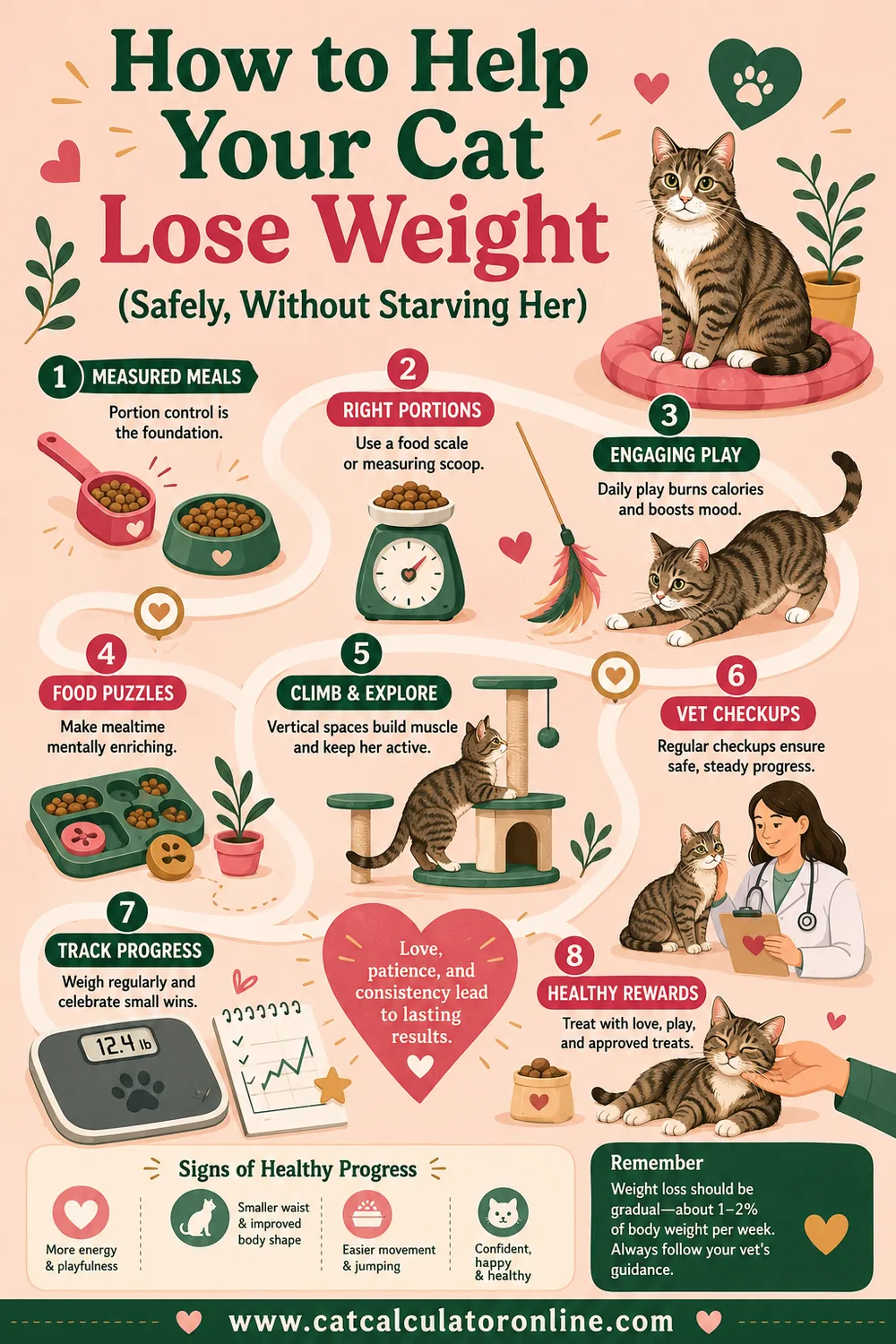
Safe weight loss is slow: typically around 0.5–2% of body weight per week, meaning a genuinely overweight cat may take six months to a year to reach target. That's normal and correct.
The practical steps:
- Get a vet check first. Confirm the excess weight and rule out anything underlying. Your vet sets a realistic target weight.
- Work out actual calorie needs rather than following the bag. Guidance is in how many calories does my cat need.
- Measure every meal with scales, not a scoop.
- Count the treats toward the daily total — under about 10% of calories.
- Stop free-feeding and move to measured meals.
- Add activity gradually — wand toys, food puzzles, moving the bowl upstairs.
- Weigh monthly and adjust with your vet rather than guessing.
A full step-by-step plan is in how to help your cat lose weight, and portion guidance is in how much should I feed my cat.
How Do You Weigh a Cat at Home?
Scales are worth using alongside the hands-on checks, because the trend is what you're really tracking and small changes are invisible by eye.
The easiest method needs no special equipment: weigh yourself, then weigh yourself holding the cat, and subtract. Bathroom scales are usually accurate enough to spot a change of half a pound or so, which is the resolution you need for monthly tracking.
For better precision, a digital baby or kitchen scale with a flat top works well, especially for kittens and small cats. Some cats will sit in an open carrier or a box on the scale — tare the empty container first.
Three things that make home weighing genuinely useful:
- Same scales, same time of day, same conditions. Comparing a morning reading to an evening one adds noise you don't need.
- Monthly, not daily. Cat weight fluctuates slightly with hydration and meal timing. Monthly readings show the trend; daily readings mostly show noise and cause unnecessary worry.
- Write it down. A short note on your phone with date and weight is far more valuable than a remembered impression. Vets find this genuinely useful, and it's how you catch a slow gain — or a slow loss — before it becomes obvious.
Half a pound sounds trivial, but on a 10 lb cat it's 5% of body weight. The human equivalent would be roughly 8 lb on a 160 lb person. Cats are small enough that modest changes matter proportionally more than instinct suggests, which is exactly why the scale catches things the eye misses.
When Should You See a Vet Urgently?
Most weight concerns are a conversation for your next routine appointment. Some aren't.
Book promptly if you notice:
- Rapid weight loss, or any unexplained loss in a cat over eight
- Increased drinking or urinating, which can signal diabetes or kidney disease
- A cat that stops eating for more than a day — genuinely urgent given the hepatic lipidosis risk
- A swollen or distended abdomen that isn't generalised fat
- Difficulty breathing, reduced mobility, or reluctance to jump
- Straining in the litter tray, especially in a male cat — this is an emergency
Weight change is one of the most useful signals a cat gives you, in both directions. Gain is a slow problem worth correcting; unexplained loss in an older cat is often the first sign of something that responds much better to early treatment.
Frequently Asked Questions
How can I tell if my cat is overweight without scales?
Use three checks together: feel for the ribs with flat hands (they should be easy to find under thin fat), look from above for a visible waist behind the ribcage, and look from the side for a slight upward tuck of the belly. Missing waist plus hard-to-find ribs means excess weight.
Is my cat's hanging belly fat or normal?
Usually normal. The loose flap swinging low between the hind legs is the primordial pouch, present in nearly all cats including lean ones. It swings freely and feels empty. Genuine fat is firmer, spread across the whole belly and flanks, and comes with hard-to-feel ribs.
What is a healthy weight for a cat?
Most domestic shorthairs sit healthily between 8 and 12 lb, but breed matters enormously — a Siamese may be ideal at 7 lb and a Maine Coon at 16 lb. Body condition is a better guide than the scale, and your cat's own weight at around twelve months is the most useful reference.
How much overweight is my cat?
Each point above 5 on the 9-point body condition scale represents roughly 10% over ideal weight. A cat scoring 7 is carrying about 20% excess, so a cat whose ideal is 10 lb would be around 12 lb. Your vet can score this in seconds at a routine visit.
How quickly should an overweight cat lose weight?
Slowly — typically 0.5–2% of body weight per week under veterinary supervision. Rapid weight loss or sudden food restriction can trigger hepatic lipidosis, a serious liver condition cats are particularly prone to. Reaching a healthy weight often takes six months to a year.
Why is my indoor cat gaining weight?
Usually a combination of free-feeding, reduced calorie needs after neutering, and low activity levels. Packaging guidance is generous for most indoor cats, and uncounted treats add up. Measured meals, counted treats and daily play address nearly all of it.
The at-home checks take half a minute and tell you most of what you need to know: ribs easy to feel, a waist visible from above, a slight tuck from the side. If those aren't there, it's worth a conversation with your vet rather than an immediate diet — cats need weight loss managed slowly and carefully. Get a target weight from the cat ideal weight calculator, then work out the portions to match.