How Old Is My Cat in Human Years?
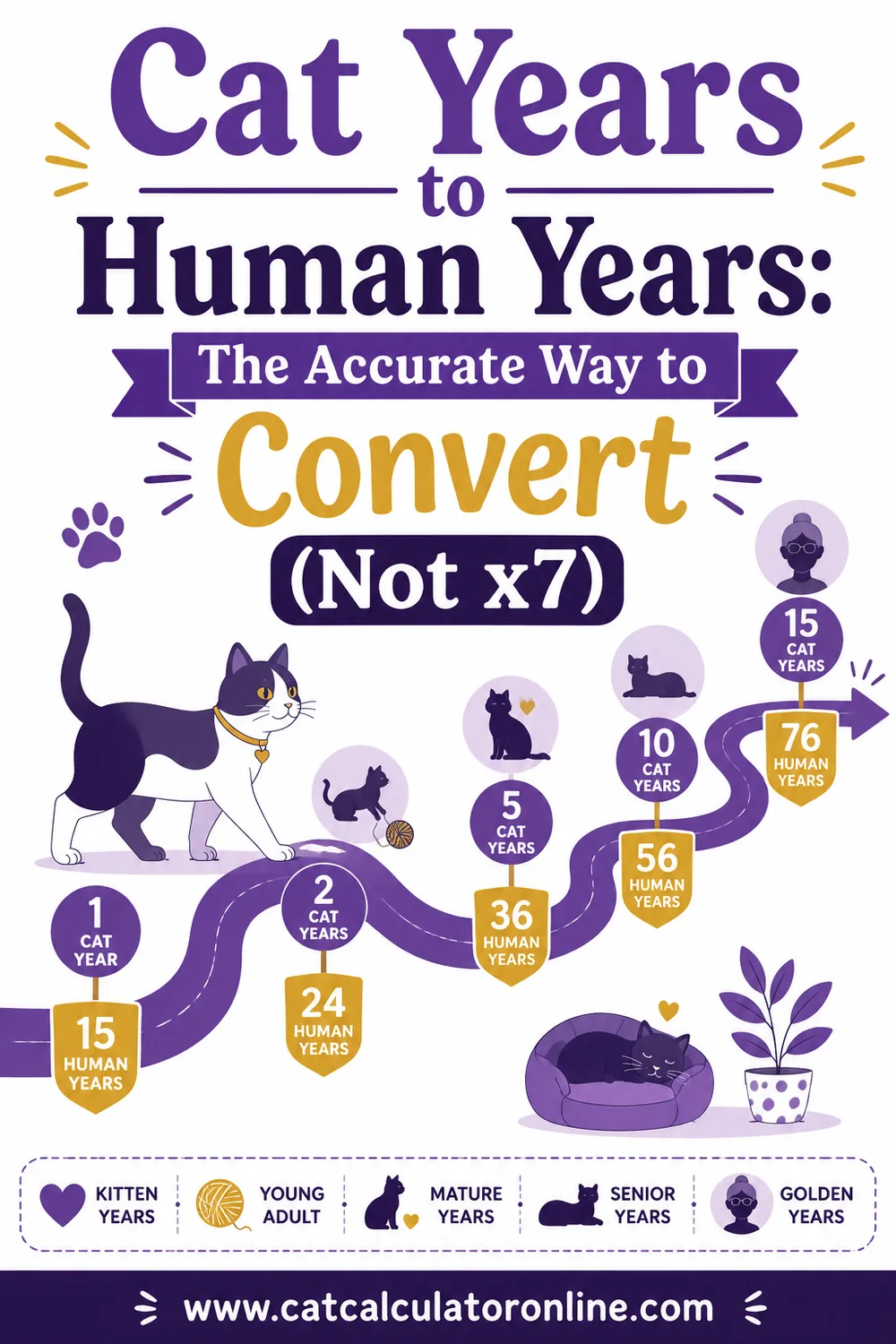
To find your cat's age in human years, count the first year as about 15, add 9 for the second year, then add 4 for every year after that. So a 3-year-old cat is about 28 in human years, a 7-year-old is about 44, and a 12-year-old is about 64. Cats age at nearly the same rate whatever their size, so this one formula works for almost every cat.
If you'd rather skip the arithmetic, our free cat age calculator gives you the answer instantly — just enter your cat's age. Below, we'll walk through how to work it out yourself, and what to do if you don't actually know your cat's birthday.
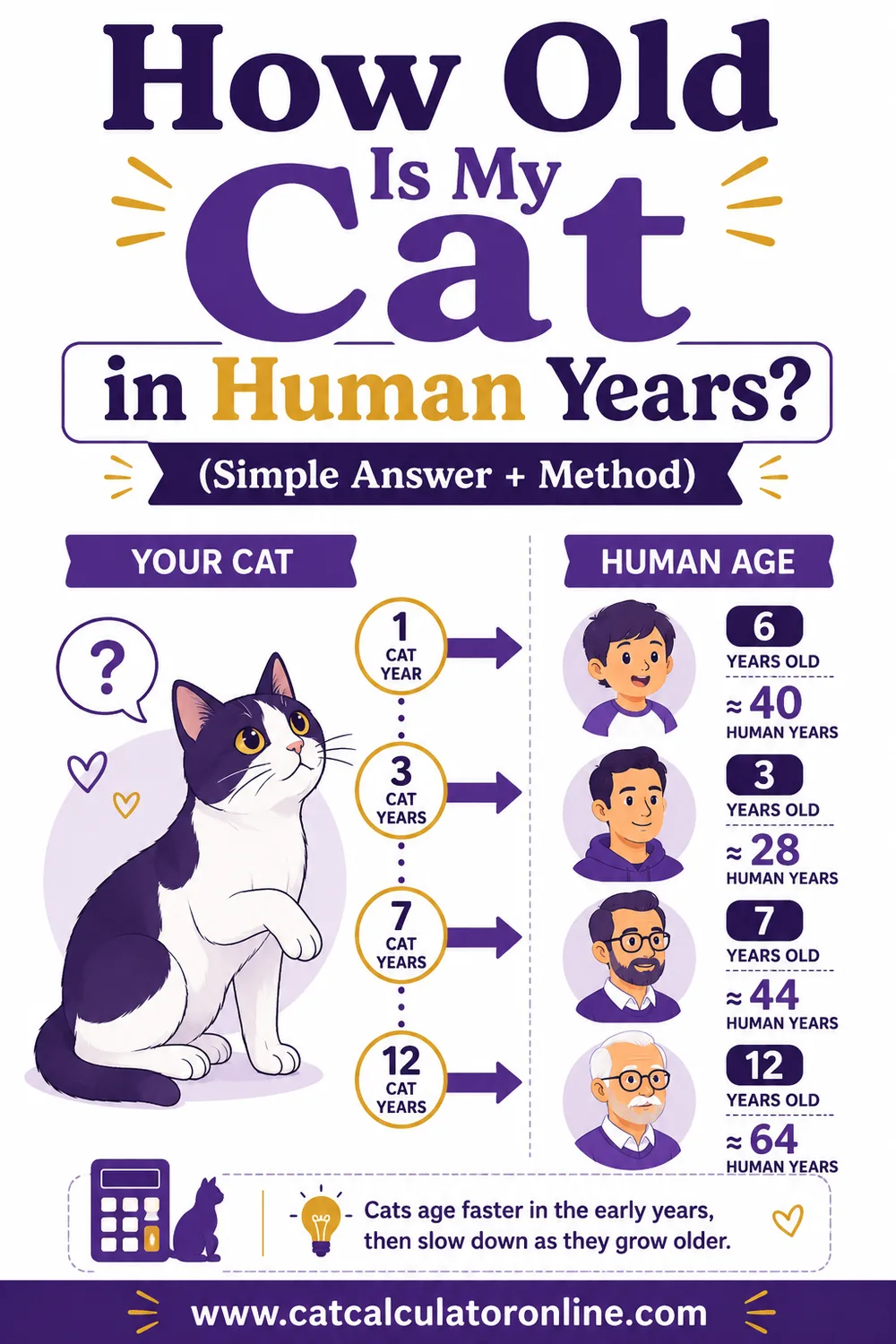
The Simple Answer
Here's the shortcut most people are looking for:
- 1 year old → about 15 human years
- 2 years old → about 24 human years
- Each year after 2 → add about 4 more
That's really it. A cat sprints through the human equivalent of childhood and the teen years in her first twelve months, has a big jump in year two, and then settles into a steady four-years-per-year pace for the rest of her life.
For a quick reference, here are the common ages:
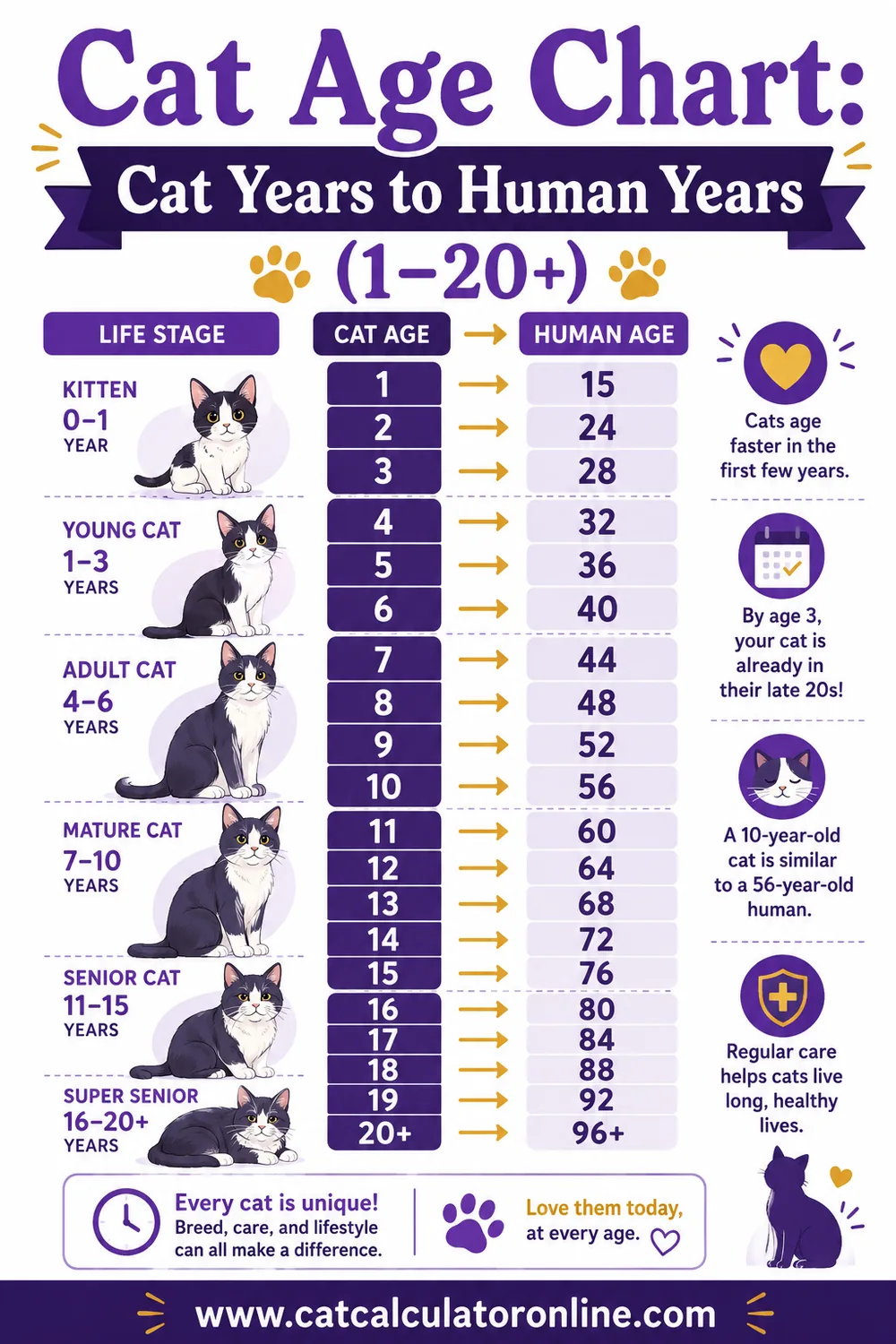
| Your cat's age | About this old in human years |
|---|---|
| 1 | 15 |
| 2 | 24 |
| 3 | 28 |
| 4 | 32 |
| 5 | 36 |
| 6 | 40 |
| 8 | 48 |
| 10 | 56 |
| 12 | 64 |
| 15 | 76 |
| 18 | 88 |
| 20 | 96 |
Want the whole thing, year by year, with life stages? Our cat age chart lays out all 20 years in one place.
How to Work It Out Yourself
If you like doing the math, here's the full method step by step.
- Start with 15 for the first year of life.
- Add 9 for the second year. That brings a 2-year-old to 24.
- Add 4 for every year after that. Multiply the years over 2 by 4, then add it on.
So the formula is: human age = 24 + (cat's age − 2) × 4, for any cat older than two.
Let's try a few
- A 5-year-old cat: 24 + (5 − 2) × 4 = 24 + 12 = 36
- A 9-year-old cat: 24 + (9 − 2) × 4 = 24 + 28 = 52
- A 14-year-old cat: 24 + (14 − 2) × 4 = 24 + 48 = 72
For a cat under two, just use 15 for year one and count up toward 24 for year two.
A worked example: your 6-year-old cat
Say you've got a 6-year-old cat and you want the human number. Start at 24 for the first two years, then look at the four extra years on top: 6 − 2 = 4 years, and 4 × 4 = 16. Add that to 24 and you land on 40. So a 6-year-old cat is right around 40 in human years — a healthy adult in her prime, not old, but past the giddy kitten-brain phase. If she were 7 instead, you'd add one more block of 4 and get 44, which is the point vets start calling a cat a "mature adult." That single year between 6 and 7 is a good moment to book a checkup and get a baseline set of numbers while everything's still normal.
Does My Cat's Breed or Size Change the Answer?
Barely. This is the big difference between cats and dogs. With dogs, a small breed and a giant breed age at very different rates, so you have to factor in weight. With cats, one formula covers almost everyone.
A few small notes:
- Large breeds grow for longer. A Maine Coon can keep gaining size until three or four years old. That affects when she looks fully grown, not how her age converts.
- Some breeds tend to live longer, which raises the odds of reaching 18 to 20 — but it doesn't change the year-by-year conversion.
So when someone asks "how old is my cat in human years," you can confidently give the same answer whether they have a petite Siamese or a hefty Maine Coon.
Why the Times-Seven Rule Doesn't Work for Cats
You've probably heard that one pet year equals seven human years. It's a tidy rule, it's easy to remember, and it's wrong — for cats especially.
The problem is that cats don't age at a steady pace. They race through the equivalent of human childhood and the teenage years in a single calendar year, then slow way down. If you used ×7 on a 1-year-old cat, you'd get 7 human years — a young child. But a 1-year-old cat is fully grown, independent, and able to have kittens of her own. She's far closer to a 15-year-old human than a 7-year-old one. The ×7 rule undershoots badly at the start.
Then it overshoots later. Take a 15-year-old cat. Times seven gives you 105 — practically the oldest human alive. In reality a 15-year-old cat is about 76: old, yes, and a senior, but plenty of them are still jumping on the couch and demanding breakfast. The ×7 shortcut turns a lively senior into a supercentenarian on paper.
The 15 / 24 / +4 method exists precisely because it tracks that fast-then-steady curve. It front-loads the growth where cats actually do their growing, then eases off. That's why it matches what vets see in the exam room and the ×7 rule doesn't.
Indoor vs Outdoor: Same Number, Different Lifespan
One quick point that trips people up: whether your cat lives indoors or roams outside doesn't change the conversion. A 10-year-old indoor cat and a 10-year-old outdoor cat are both about 56 in human years. Age is age.
What lifestyle changes is how many of those years a cat is likely to get. Indoor cats commonly live 13 to 17 years and often reach 20, while cats living outdoors full-time average just 2 to 5. So the formula is identical for both — an outdoor cat simply has far lower odds of ever reaching the older rows. If you want the full picture on that gap, our how long do indoor cats live guide breaks it down.
What If You Don't Know Your Cat's Birthday?
Plenty of cats — especially rescues and strays — arrive with no paperwork and no known age. You can still get a solid estimate.
Clues you can read at home
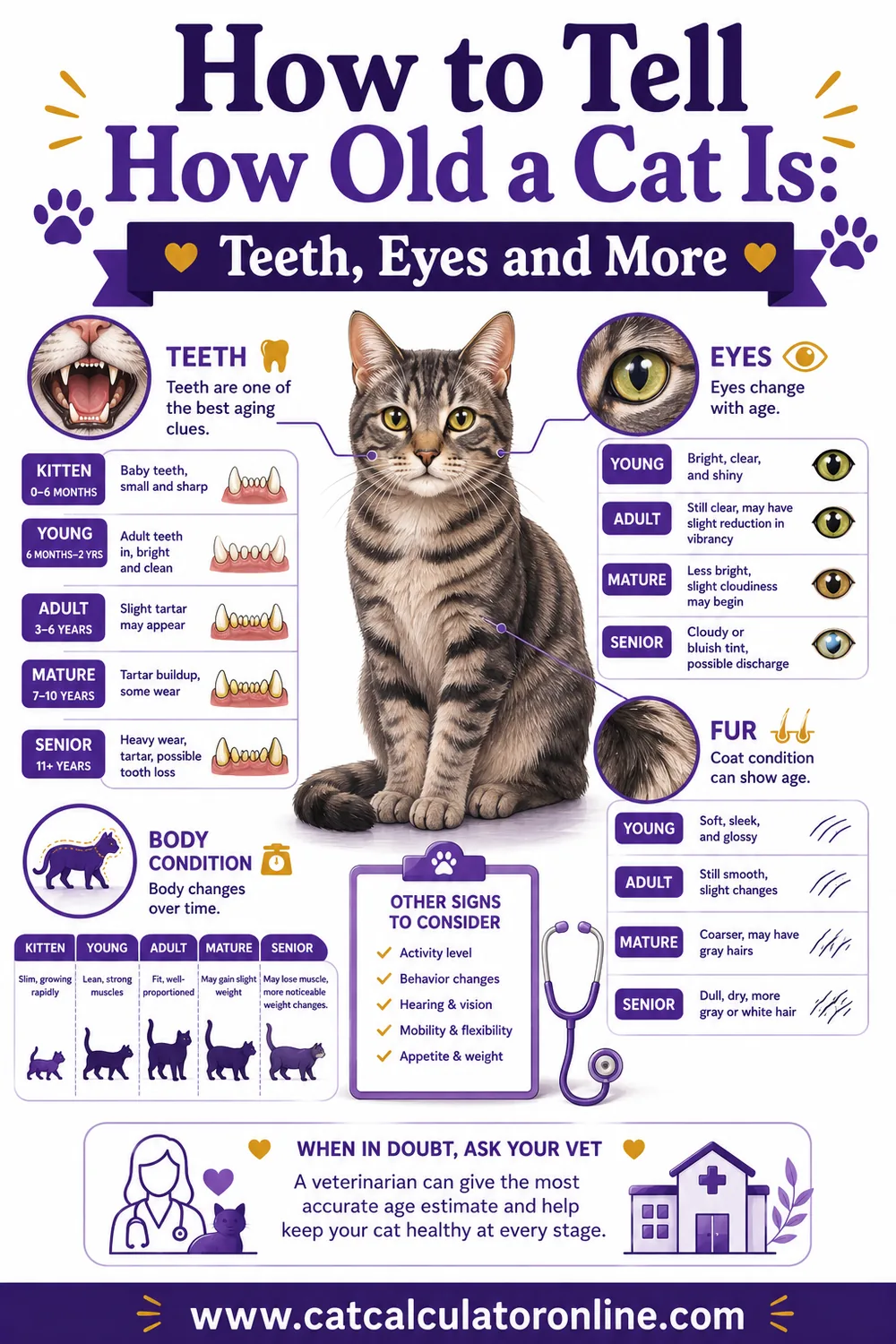
- Teeth. Kittens get their baby teeth by 8 weeks and adult teeth by around 6 months. Tartar buildup and yellowing suggest an older cat; heavy wear or missing teeth point to a senior.
- Eyes. Young cats have bright, clear eyes. A cloudy or slightly hazy look to the lens often shows up in older cats.
- Coat. Kittens and young cats have soft, fine fur. Older cats often develop a coarser coat, and some get patches of gray or white hairs.
- Muscle and movement. Young cats are lean and springy. Seniors may lose muscle over the spine and hips and move more stiffly.
For a full walk-through of reading these signs, see our guide on how to tell a cat's age.
Let your vet make the call
A veterinarian can estimate age far more precisely than any home check, using teeth, eyes, coat, and a physical exam together. If you've adopted a cat of unknown age, ask for an age estimate at the first visit — it helps set the right diet and care plan from day one.
Turning the Number Into Better Care
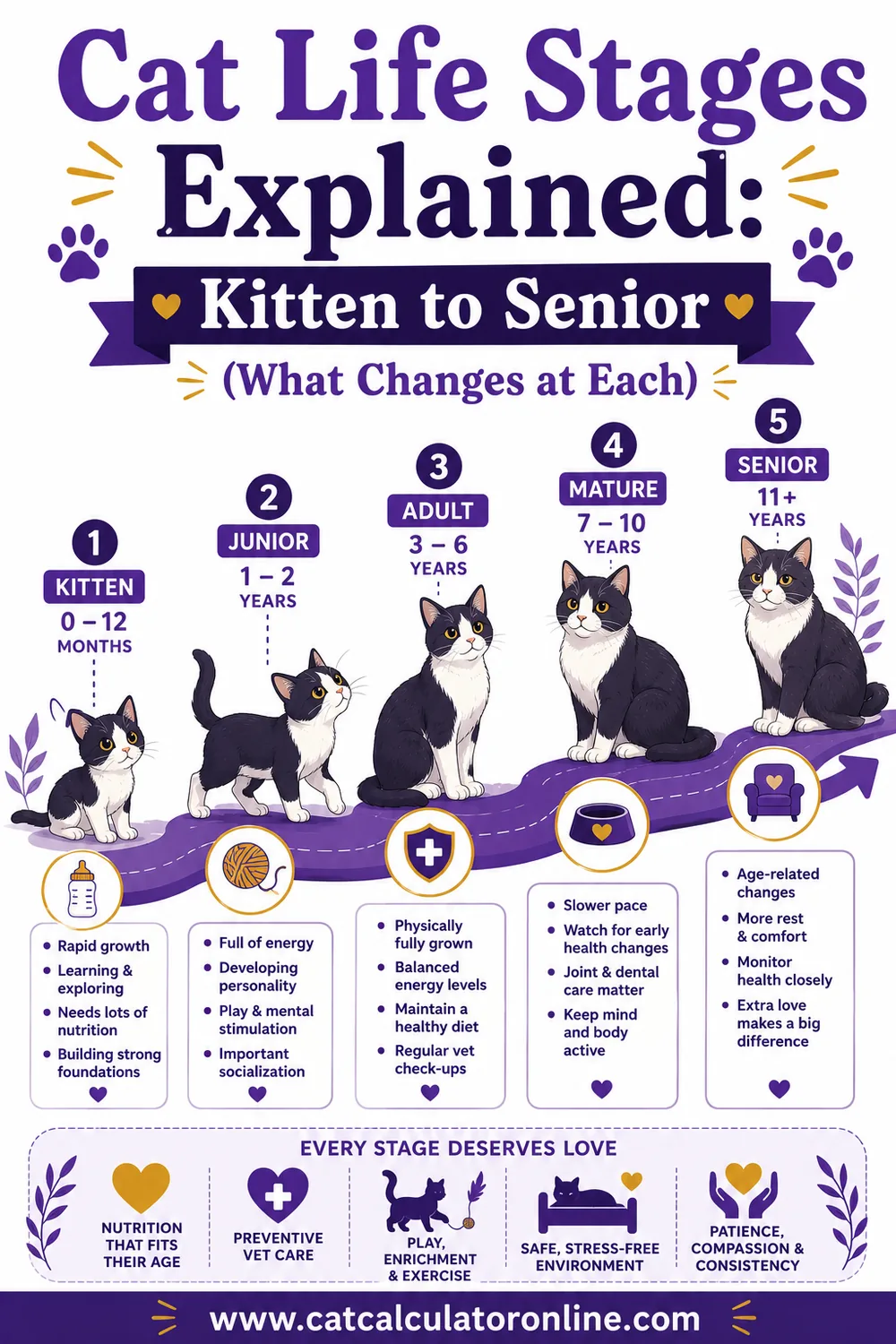
Knowing your cat's human age is genuinely useful because it tells you which life stage she's in — and that shapes her care.
| Human-year range | Life stage | What it means for care |
|---|---|---|
| Up to ~15 | Kitten | Kitten food, vaccinations, spay/neuter |
| ~24–40 | Young adult | Annual checkups, steady weight, dental care |
| ~44–52 | Mature adult | Watch weight, start closer monitoring |
| ~56 and up | Senior | Twice-yearly vet visits, bloodwork |
Once your cat crosses roughly 56 human years — that's age 10 — it's worth shifting to senior care. Our cat life stages explained guide covers what changes at each phase, and when is a cat considered senior digs into that transition.
FAQ
How old is my cat in human years if she's 1?
About 15. Cats mature very quickly in their first year — a 1-year-old cat is more like a human teenager than a small child, and can already have kittens of her own.
Is there a simple formula for cat years?
Yes: 15 for the first year, 24 by the second year, then add 4 for every year after that. So human age = 24 + (cat's age − 2) × 4 for any cat over two.
Does size change how old my cat is in human years?
No. Cats age at almost the same rate regardless of size or breed, so the same formula works for a small cat and a large one. This is different from dogs, where size matters a lot.
How can I tell my cat's age if I adopted her?
Look at her teeth, eyes, coat, and muscle tone for rough clues, then ask your vet for an estimate at the first checkup. See our how to tell a cat's age guide for the details.
At what human age is my cat a senior?
Around 56 human years, which is 10 cat years. That's when vets typically recommend more frequent checkups and bloodwork.
The Bottom Line
Your cat's age in human years is easy to work out: 15 for year one, 24 by year two, then add 4 each year after. Size and breed barely change it, so you can trust one formula for almost any cat. And if you don't know her exact age, teeth, eyes, and coat give you a good estimate — with your vet as the final word.
Want the answer in one tap? Try our free cat age calculator, then explore the full cat years to human years breakdown to see exactly how the numbers work.