How Much Does a Cat Dental Cleaning Cost?
A cat dental in the US usually starts somewhere between $400 and $900 for a clean and polish under anaesthesia with X-rays, and lands between $800 and $2,000 once extractions are involved — but the single most useful thing to understand is that the number you are quoted is an estimate, not a price. Nobody, including your vet, knows how many teeth need to come out until the cat is anaesthetised and X-rayed. That is not evasiveness. It is the honest limit of what you can see in a conscious cat's mouth. Here is how to read a dental quote, what changes it, and what a cheap dental usually leaves out. The cat cost calculator will put it against your yearly budget.
What Does a Cat Dental Cost in Practice?
These are US bands for a general practice. Referral dental specialists sit above them.
| Procedure | Typical total | What it usually includes |
|---|---|---|
| Scale and polish, no extractions | $400–$900 | Anaesthesia, monitoring, full-mouth X-rays, cleaning |
| One to three extractions | $800–$1,400 | The above plus surgical extractions and take-home pain relief |
| Multiple extractions | $1,200–$2,000 | Longer anaesthesia, nerve blocks, sutures, antibiotics |
| Full-mouth extractions (stomatitis) | $1,500–$3,000+ | Often two to three hours of surgery, sometimes referred |
| Dental X-rays alone, if quoted separately | $100–$250 | Full-mouth series, usually 8–12 views |
| Pre-anaesthetic bloodwork | $40–$120 | Kidney, liver and red cell values before anaesthesia |
Where you live moves these more than anything else. A dental at a rural general practice and the same dental in a major city can differ by 50% or more, for the same reasons rent and wages differ.
The word "cleaning" undersells it. This is a general anaesthetic, a full-mouth radiographic series, a probe of every tooth, ultrasonic scaling above and below the gumline, polishing, and often oral surgery. Comparing it to a hygienist appointment is what makes the price feel wrong.
A first dental usually costs more than you expect and later ones less, because the first one is where the accumulated backlog gets dealt with.
Why Is the Quote Only an Estimate?
This is the part worth understanding properly, because it explains almost every unpleasant surprise on a dental invoice.
You cannot see most feline dental disease in a conscious cat. A cat will let you lift a lip for about two seconds. Even a fully cooperative cat cannot be probed tooth by tooth while awake, and the back of the mouth is barely visible.
Most of the disease is below the gumline anyway. Tooth resorption — where the tooth structure breaks down from within — often starts at or under the gum margin. The crown can look normal while the root is destroyed. The details of the disease itself are in dental disease in cats.
So the plan is written after the cat is asleep. The vet cleans, probes every tooth, takes the X-rays, and only then knows how many teeth are unsalvageable. That is why quotes are given as a range with a decision point in the middle.
Ask how they handle the mid-procedure call. Good practices agree a ceiling with you beforehand and ring you if the findings push past it. Ask directly: "What happens if you find more than expected — do you ring me, and what number do you need my agreement on?"
A low estimate is not a promise. If a quote is dramatically below everyone else's, the usual reason is that it assumes no extractions and no X-rays.
What Is Actually Included in a Dental?
Reading the line items makes the total make sense, and makes two quotes genuinely comparable.
Pre-anaesthetic assessment and bloodwork. An examination plus blood values to check the cat is safe to anaesthetise. Increasingly standard past about seven years — the individual test costs are broken down in what cat blood tests and scans cost.
Intravenous catheter and fluids. Blood pressure support through the anaesthetic and instant vein access if anything needs treating quickly.
General anaesthesia and monitoring. The drugs plus a trained person watching heart rate, blood pressure, oxygen, carbon dioxide and temperature for the whole procedure. This is the largest single cost driver, and it scales with time.
Full-mouth dental radiographs. Eight to twelve small films of the roots. This is the line that separates a real dental from a cosmetic clean.
Scaling and polishing. Ultrasonic removal of tartar above and below the gumline, then polishing so the enamel is not left microscopically rough.
Extractions, nerve blocks, sutures and medication. Charged per tooth or by difficulty, plus local anaesthetic blocks and the pain relief that goes home with you.
Why Do Dental X-Rays Matter So Much?
Because in cats specifically, the expensive, painful disease usually hides where you cannot look.
Tooth resorption is extremely common in adult cats and is the main reason feline dentistry differs from canine dentistry. The body begins reabsorbing the tooth. It is genuinely painful, and affected cats often show almost nothing — they carry on eating, because a cat that stops eating in the wild dies.
A resorbing tooth can look fine from above. Sometimes there is a small pink spot at the gumline. Often there is nothing. The X-ray shows a root that has been eaten away.
X-rays also change the surgery. They show root shape, whether roots are fused, and whether fragments were left behind by an earlier extraction. Extracting a tooth without knowing the root anatomy is how fragments get retained, and retained roots hurt.
A dental without X-rays can leave the painful teeth in the mouth. That is the real cost of a cheap dental: not that the cleaning is worse, but that the diagnosis never happened. You pay for an anaesthetic and the disease stays.
If a practice does not offer full-mouth radiographs, ask where they refer for them. Plenty of good general practices have the kit now. If one does not, it is a fair reason to price a second opinion.
Is Anaesthesia-Free Dental Cleaning a Cheaper Option?
It is cheaper, usually $100–$300, and it does not do the same job. That is worth saying plainly.
It only addresses visible tartar. Scraping the outer surface of the crowns makes teeth look whiter. The disease that causes tooth loss and pain sits under the gum, and that area cannot be cleaned or examined in a conscious cat.
No X-rays are possible. A cat will not hold a sensor plate in its mouth and stay still. So resorption, root abscesses and bone loss all go undetected.
It can be actively misleading. A mouth that looks clean reassures the owner, and the underlying disease progresses quietly for another year or two, ending in more extractions than it would have needed.
It is also stressful for many cats, who have to be restrained for a procedure they do not understand and cannot consent to.
The honest comparison is not "cheap dental versus expensive dental". It is "cosmetic tartar removal versus a diagnostic and treatment procedure". If money is the constraint, saving toward a proper dental usually serves the cat better than paying repeatedly for the other thing. Practical ways to fund it are in how to lower your cat's vet bills.
How Do You Get a Real Quote for Your Cat?
Prices drift, so a method beats a number. This takes about twenty minutes.
Ring three practices with the same question. "My cat needs a dental. What is your estimate range for a scale and polish with full-mouth X-rays, and what do extractions add?"
Then ask the five that matter. Are full-mouth X-rays included or extra? Is pre-anaesthetic bloodwork included? Are IV fluids included? Is take-home pain relief included? Is extraction charged per tooth or by time?
Ask for the estimate in writing with a low and high figure. Any practice will do this and none will find it rude.
Ask about the ceiling agreement. What is the number above which they will stop and ring you?
Ask about the recheck. Many practices include a post-operative check at ten to fourteen days; some charge for it.
Book the consultation first if you have not had one. A vet needs to look in the mouth before quoting anything meaningful, and that consultation is typically $60–$90. The wider picture of what feline vet care costs is in cat vet costs explained.
What Reduces How Often Your Cat Needs a Dental?
You cannot prevent tooth resorption — the cause is not fully understood, which is worth saying honestly — but you can slow periodontal disease considerably, and that is most of the tartar.
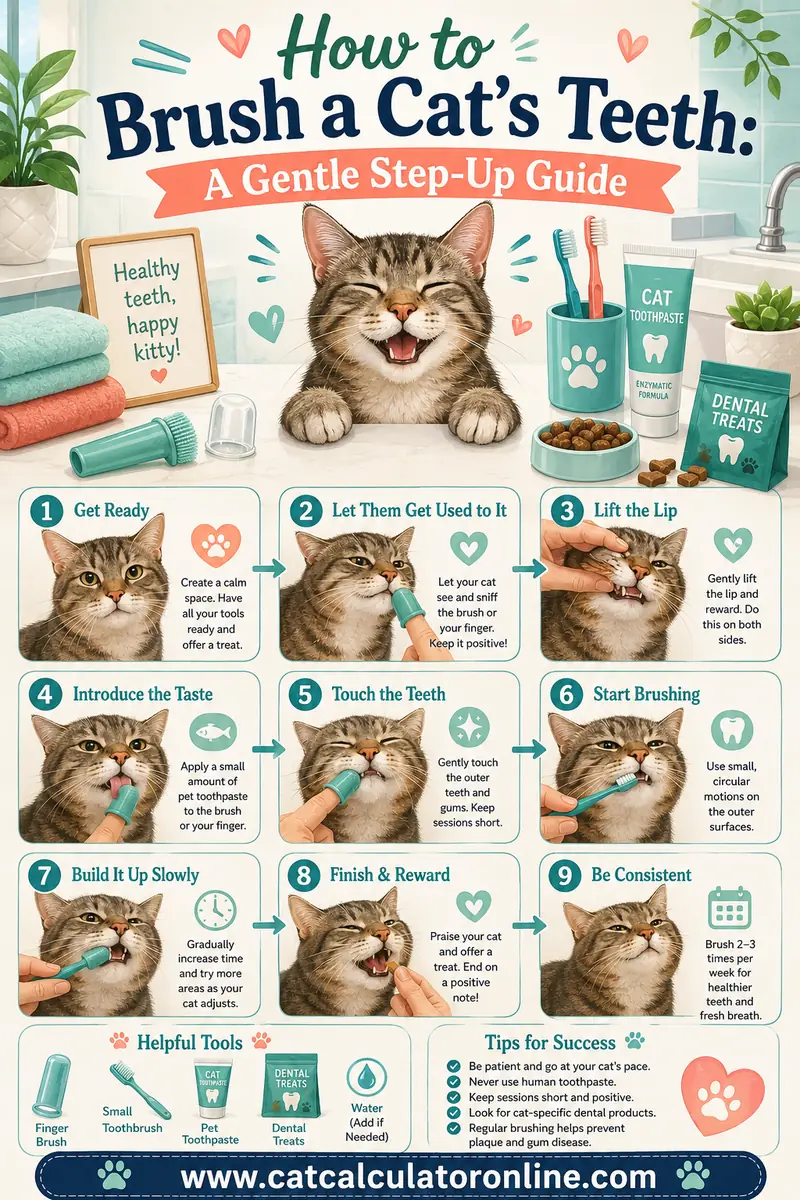
Brushing is the only thing with a large effect. Daily is the target; three times a week still helps materially. It has to be a cat toothpaste, never human toothpaste, and the method matters more than the effort — the gentle build-up approach is in how to brush a cat's teeth.
Start young if you can. A kitten who learns that a finger in the mouth means chicken-flavored paste becomes an adult who tolerates brushing. An eight-year-old who has never had it done is a much harder project.
Dental diets and approved chews help modestly. Look for products carrying a veterinary oral health seal rather than marketing language. They reduce tartar; they do not replace brushing.
Water additives and dental treats are the weakest of the options. Not useless, but do not let them substitute for a check.
Have the mouth looked at every year, twice a year past ten. Catching gingivitis early is what keeps a dental at the $500 end rather than the $1,800 end. Senior monitoring generally is covered in how to care for a senior cat.
When Should You Stop Waiting and Call the vet?
Dental pain in cats is easy to miss and worth acting on rather than watching for another month.
Call your vet within a few days if you notice bad breath that has changed, drooling, blood in the water bowl, dropping food, chewing only on one side, pawing at the mouth, or a sudden preference for wet food over dry.
Ring the same day if your cat has stopped eating altogether. A cat that does not eat for more than about 24 hours is at real risk of hepatic lipidosis, a serious liver problem. Never withhold food to "see if it settles" — the aim is always to get calories in and get advice.
Do not wait for weight loss. By the time a cat has lost noticeable weight from a painful mouth, the disease is usually well advanced and the bill is larger.
A cat can be in pain and still eat. That is the single hardest thing for owners to accept. Eating is a survival reflex, not a comfort report.
Owners very often say the same thing afterwards — that the cat became playful and vocal again within a two weeks of a dental, and that they had quietly attributed the change to age.
Frequently Asked Questions
Why is a cat dental cleaning so expensive?
Because it is surgery under general anaesthesia, not a hygienist appointment. The cost covers anaesthetic drugs, a trained person monitoring vital signs throughout, full-mouth X-rays, ultrasonic scaling above and below the gumline, any extractions, nerve blocks, sutures and take-home pain relief. Anaesthesia time is the biggest single driver.
Why can't my vet tell me the exact price beforehand?
Because most feline dental disease sits below the gumline and cannot be assessed in a conscious cat. The number of extractions is only known once the cat is anaesthetised, probed and X-rayed. Reputable practices quote a range, agree a ceiling with you, and ring if findings exceed it.
Are dental X-rays really necessary for a cat?
For a meaningful dental, yes. Tooth resorption, the most common painful feline dental problem, frequently starts at or below the gumline and can look normal from above. Without full-mouth radiographs a dental can leave the painful teeth in place, so you pay for an anaesthetic without the diagnosis.
Is anaesthesia-free dental cleaning a cheaper alternative?
It costs less, usually $100–$300, but it is not the same procedure. It removes visible tartar from the crowns only. No probing under the gum, no X-rays and no treatment of disease is possible in a conscious cat, so underlying problems progress while the mouth looks clean.
How much do cat tooth extractions cost each?
Extractions are usually charged per tooth or by surgical difficulty, and typically add $50–$200 per tooth to the base dental. One to three extractions commonly bring the total to $800–$1,400. Full-mouth extractions for severe stomatitis often reach $1,500–$3,000 because the surgery can take hours.
Is my senior cat too old for a dental?
Age alone is not a reason to skip one. Anaesthetic risk relates to organ function and overall health rather than years, which is why pre-anaesthetic bloodwork and intravenous fluids are recommended in older cats. Untreated dental pain in a senior cat is generally the greater harm.
The number to hold on to is a range, not a price: roughly $400–$900 for a clean and polish with X-rays, and $800–$2,000 once teeth come out. Everything else follows from one fact — the plan is written after your cat is asleep, because that is the first moment anyone can actually see the disease. So ask what the estimate includes, insist on full-mouth X-rays, agree a ceiling and a phone call, and get the mouth checked every year so the backlog never builds. Put your quote into the cat cost calculator to see how it sits alongside the rest of the year.