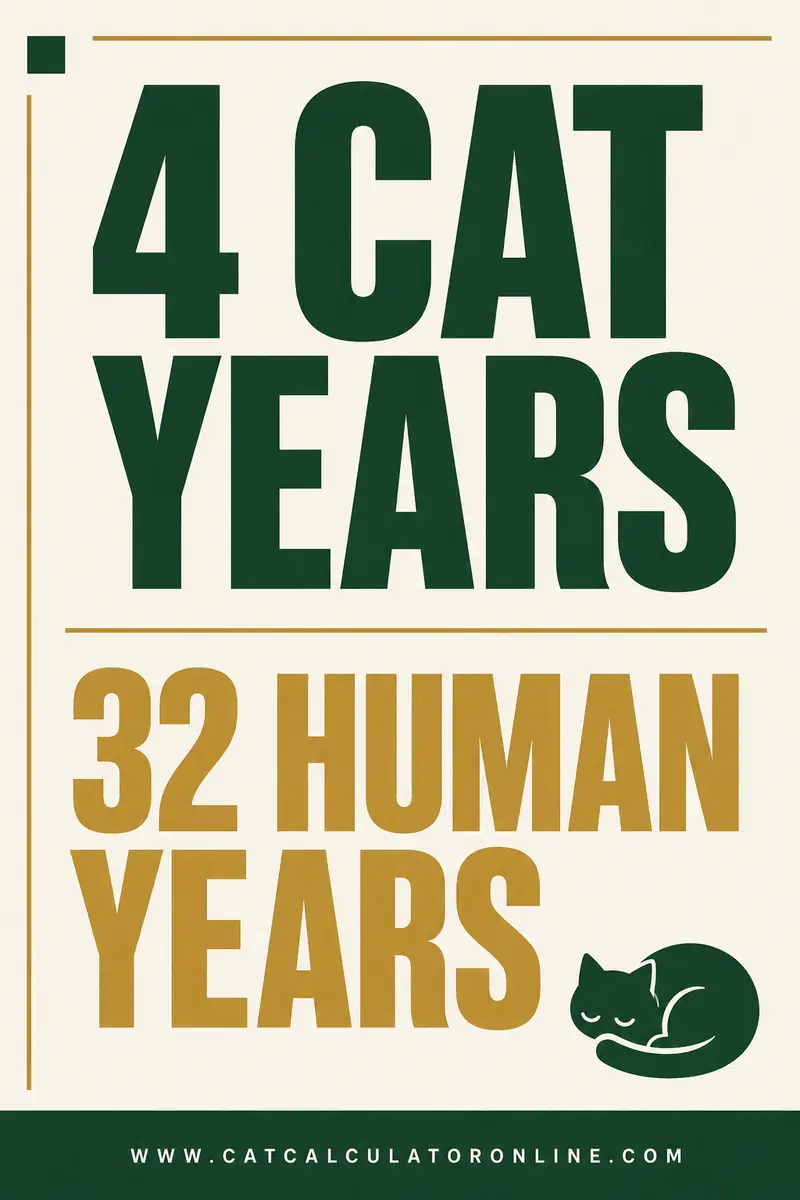
4 Cat Years in Human Years
A four-year-old cat is about 32 in human years — 24 at the second birthday, plus four for each year since. Four is an unremarkable age in the best possible sense: nothing changes, nothing needs adjusting, and a healthy cat at four is simply in the middle of its strongest years. That makes it the ideal age to record a proper baseline, because everything you'll be comparing against for the next decade is happening right now. This page covers the math, what "in its prime" actually looks like, and the one number worth writing down. For any age, the cat age calculator does the arithmetic.
How Do You Work Out 32?
The same three-step method that covers every age.
15 for year one. 9 for year two. 4 for every year after.
- Year 1 → 15
- Year 2 → 24
- Year 3 → 28
- Year 4 → 32
Or the shortcut: 24 plus four times the number of years past two. For a four-year-old that's 24 + (2 × 4) = 32.
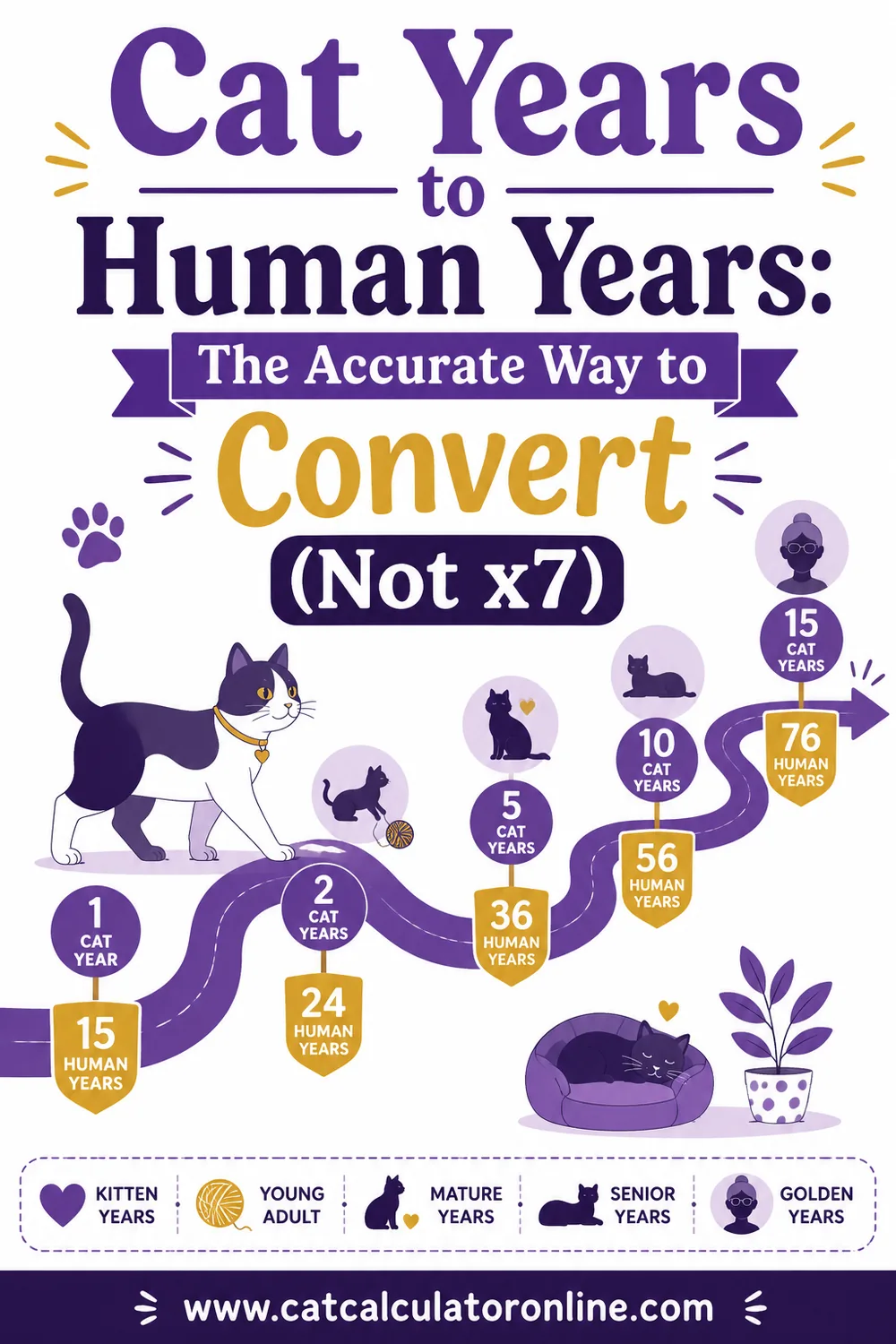
| Cat's age | Human years | Stage |
|---|---|---|
| 2 | 24 | Young adult |
| 3 | 28 | Young adult |
| 4 | 32 | Young adult |
| 5 | 36 | Young adult |
| 6 | 40 | Young adult |
| 7 | 44 | Mature adult |
| 10 | 56 | Senior |
| 15 | 76 | Senior |
Why it's worth knowing the human figure at all. Four sounds young — and in cat terms it is — but 32 places it correctly: an adult in good condition, past the last of the growing-up, and with the majority of life still ahead. That framing tends to produce better decisions than "only four", which sometimes leads owners to postpone habits like dental care on the grounds that the cat is still young.
The neighbouring ages are covered in 3 cat years in human years and 5 cat years in human years, the complete table in cat years to human years, and the method itself in how a cat age calculator works.
What Does a Cat in Its Prime Look Like?
Specific and worth knowing, because this is the standard you'll measure later years against.
Body: ribs findable easily under a thin layer, a visible waist behind the ribcage when viewed from above, and a slight abdominal tuck from the side. No sagging belly pouch beyond the normal primordial pouch most cats have.
Coat: glossy, evenly distributed, no mats, no dandruff, no bald patches. A cat that grooms itself properly has a coat that looks maintained without your involvement.
Movement: jumps up to counter height without hesitating or measuring the distance twice. Lands quietly. Runs, stretches fully, and uses vertical space freely.
Eyes and nose: clear, no discharge, no squinting.
Teeth: white to off-white, gum line pale pink with a clean margin, no smell.
Appetite and thirst: consistent day to day. A cat that eats the same amount at the same times is telling you nothing is wrong.
Litter box: predictable volume and frequency, no straining, no accidents.
Behavior: a settled routine, regular play, normal social interaction with the household. A cat in good condition initiates things — comes to greet you, starts a play session, chooses a lap. A cat that has become entirely passive is worth a second look even when nothing else seems wrong.
Write this down. Genuinely — weight in grams, a photo from above and from the side, what a normal day's food is, roughly how often the box needs scooping. In eight years, when you're wondering whether something has changed, this record will answer a question your memory can't.
Why Is Weight the Thing That Matters Most Now?
Because it's the single largest modifiable factor in how long and how comfortably a cat lives, and four is squarely in the window where the damage is done quietly.
The mechanism. Cats gain slowly — a hundred grams here, two hundred there — and the gain is invisible under fur and easily rationalised. By the time a cat looks obviously overweight it's typically been carrying excess for years, and the associated conditions have had that long to develop.
What excess weight leads to: diabetes mellitus, which is strongly associated with obesity in cats; osteoarthritis, which affects far more cats than owners realize; urinary tract disease; hepatic lipidosis if a heavy cat ever stops eating suddenly; and reduced grooming ability, which causes matting over the back and hindquarters.
How to catch it:
- Weigh monthly on kitchen scales or a pet scale, and log the number. A 4 kg cat that reaches 5 kg has gained 25% of its body weight — the human equivalent of going from 70 kg to 87 kg
- Do the rib check weekly. Findable with light pressure, not pressed for
- Look from above. A waist should be visible
- Count treats. They routinely account for a surprising share of daily calories
- Measure food rather than estimating, and reassess the amount when activity changes
What to do if the number is climbing. Reduce gradually rather than sharply — rapid weight loss in cats is genuinely dangerous and can trigger hepatic lipidosis. This is a conversation to have with your vet rather than a crash diet to impose. The assessment method is in is my cat overweight.
Why Does Water Intake Matter at This Age?
Because cats are poor drinkers by evolutionary design, and the consequences show up years later.
Domestic cats descend from desert-dwelling ancestors that obtained most of their water from prey. Their thirst drive is correspondingly weak — a cat that is mildly dehydrated often won't drink enough to correct it. On a dry-food-only diet, many cats run at chronically low hydration for years without any visible sign.
Why it matters: low water intake is associated with urinary tract disease and contributes to the workload on kidneys that are already the most vulnerable organ in an ageing cat. Chronic kidney disease is the single most common serious diagnosis in older cats, and hydration across the middle years is one of the few things an owner can actually influence.
What helps:
- Wet food, which is roughly 70–80% water against about 10% for dry. This is the largest single lever available
- A water fountain — many cats drink noticeably more from moving water
- Multiple bowls, away from the food and away from the litter box
- Wide, shallow bowls, since some cats dislike their whiskers touching the sides
- Fresh water daily, changed rather than topped up
What to watch for: a sudden increase in drinking is as significant as a decrease, and often more so — it's an early sign of kidney disease, diabetes and hyperthyroidism. Knowing what normal looks like now is what makes an increase noticeable later. The detail is in how much water should a cat drink.
What Should the Vet Check at Four?
A routine annual appointment, and there's value in it precisely because nothing is expected to be wrong.
Physical examination — weight and body condition score, teeth and gums, heart and lungs, abdominal palpation, coat and skin, eyes and ears.
Weight trend, compared against previous visits. A practice that's been recording weight since kittenhood has a data series more useful than any single measurement.
Dental assessment, with a specific ask about whether a professional clean is warranted. Most cats have some periodontal disease by this age.
Vaccination and parasite review, adjusted for whether the cat goes outdoors.
Optional baseline bloodwork. Not medically necessary for a healthy four-year-old, and genuinely useful to have — kidney values, thyroid and liver enzymes recorded while everything is normal give you a personal reference range. When a result at eleven is "within normal limits but higher than his usual", that comparison only exists if the baseline was taken.
Ask about pain, specifically. Cats mask discomfort almost completely, and early arthritis is far more common in middle-aged cats than most owners expect. Subtle signs — jumping less, choosing lower perches, a slightly reluctant landing — are easy to attribute to personality when they're actually early joint change.
What to raise: anything you've noticed even if it seems minor. Small changes in drinking, appetite, grooming, litter box use or sociability are the things that matter, and a healthy four-year-old is exactly when you establish what normal means.
What Doesn't Need Doing at Four?
Worth stating, because a healthy young adult cat attracts a surprising amount of unnecessary intervention.
Supplements. A cat on a complete commercial food is getting what it needs. Joint supplements, coat supplements and multivitamins have little to offer a healthy four-year-old, and some are actively unhelpful in excess. Save the money for the dental you'll need at nine.
Senior or prescription diets. Four is not senior, and prescription diets exist to manage diagnosed conditions rather than to prevent hypothetical ones. Feeding a kidney diet to a cat with healthy kidneys does nothing useful.
Routine dental cleaning without an indication. Anaesthesia carries a small but real risk, and a clean is warranted when there's disease to address, not on a calendar.
Frequent bathing. Cats groom themselves effectively. Bathing strips coat oils and stresses most cats considerably, and a healthy four-year-old should never need one.
Changing food that's working. If your cat is a good weight, has a glossy coat, produces normal stools and eats consistently, the food is doing its job. Switching for marketing reasons risks digestive upset for no gain.
What does need doing is unglamorous and short: right portion, monthly weigh-in, daily play, teeth checked and brushed, water available in several places, and one annual vet visit. That list is the whole job at this age, and doing it consistently outperforms anything you could buy.
Frequently Asked Questions
How many human years is 4 cat years?
About 32. The calculation is 15 for the first year, 9 for the second, and 4 for each year after — so 15 + 9 + 4 + 4 = 32 by the fourth birthday.
Is a 4-year-old cat still young?
Yes. Under AAHA feline life-stage guidelines a cat is a young adult from one to six years old, so four sits comfortably in the middle of that stage. The mature adult stage doesn't begin until seven.
Are large cat breeds fully grown at four?
Generally yes. Maine Coons, Ragdolls, Norwegian Forest Cats and similar large breeds typically finish filling out between three and four years old, so four is usually final adult size for them.
How much should a 4-year-old cat weigh?
It depends on frame and breed rather than a single figure — a Siamese and a Maine Coon have very different healthy weights. The reliable test is condition: ribs easily felt under a thin covering, a visible waist from above, and a slight tuck from the side.
Why is water intake important for cats?
Cats descend from desert animals and have a weak thirst drive, so many run chronically under-hydrated on dry food alone. Low intake is linked to urinary tract disease and adds to the burden on ageing kidneys. Wet food is the biggest single improvement.
Should a healthy 4-year-old cat have blood tests?
Not necessarily, but a baseline panel is genuinely useful. Kidney, thyroid and liver values recorded while your cat is healthy give a personal reference range that makes future results far easier to interpret.
Four cat years is about 32 human years — the quiet middle of a cat's strongest stretch, where the right answer is mostly to keep doing what you're doing. Use the calm to record a baseline: weight, condition, routine, and a photo from above. It's the most useful thing you can do at an age when nothing is wrong. Convert any age with the cat age calculator.