11 Cat Years in Human Years
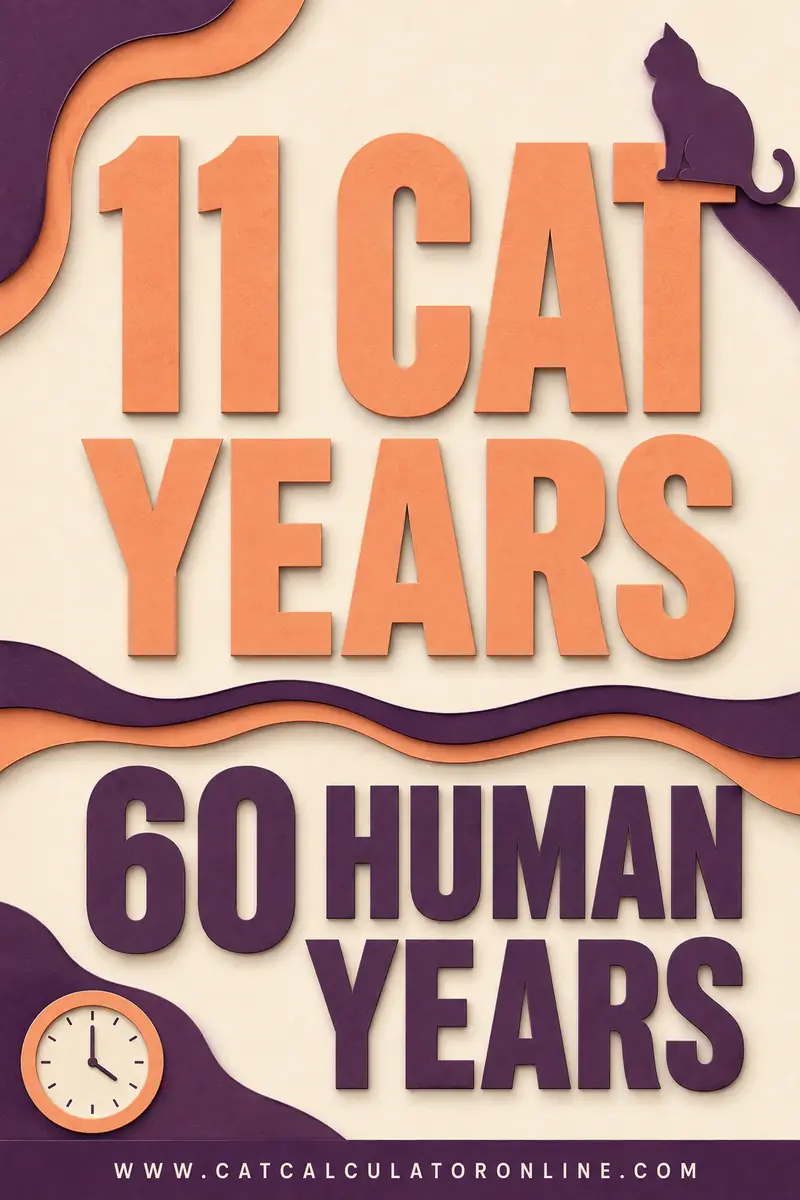
An eleven-year-old cat is about 60 in human years — a year into the senior stage, and typically the age at which the small adaptations of old age start being genuinely useful rather than merely sensible. Most cats at eleven are still well: eating, playing, jumping, doing everything they did at eight. What's changed is that the margin has narrowed, and the things you set up now — steps, low-sided boxes, warm beds, twice-yearly bloods — are what keep the next five years comfortable. This page covers the arithmetic, what eleven actually looks like, and where to put the effort. Any age converts with the cat age calculator.
How Do You Get 60?
The same three-step method, unchanged since the second birthday.
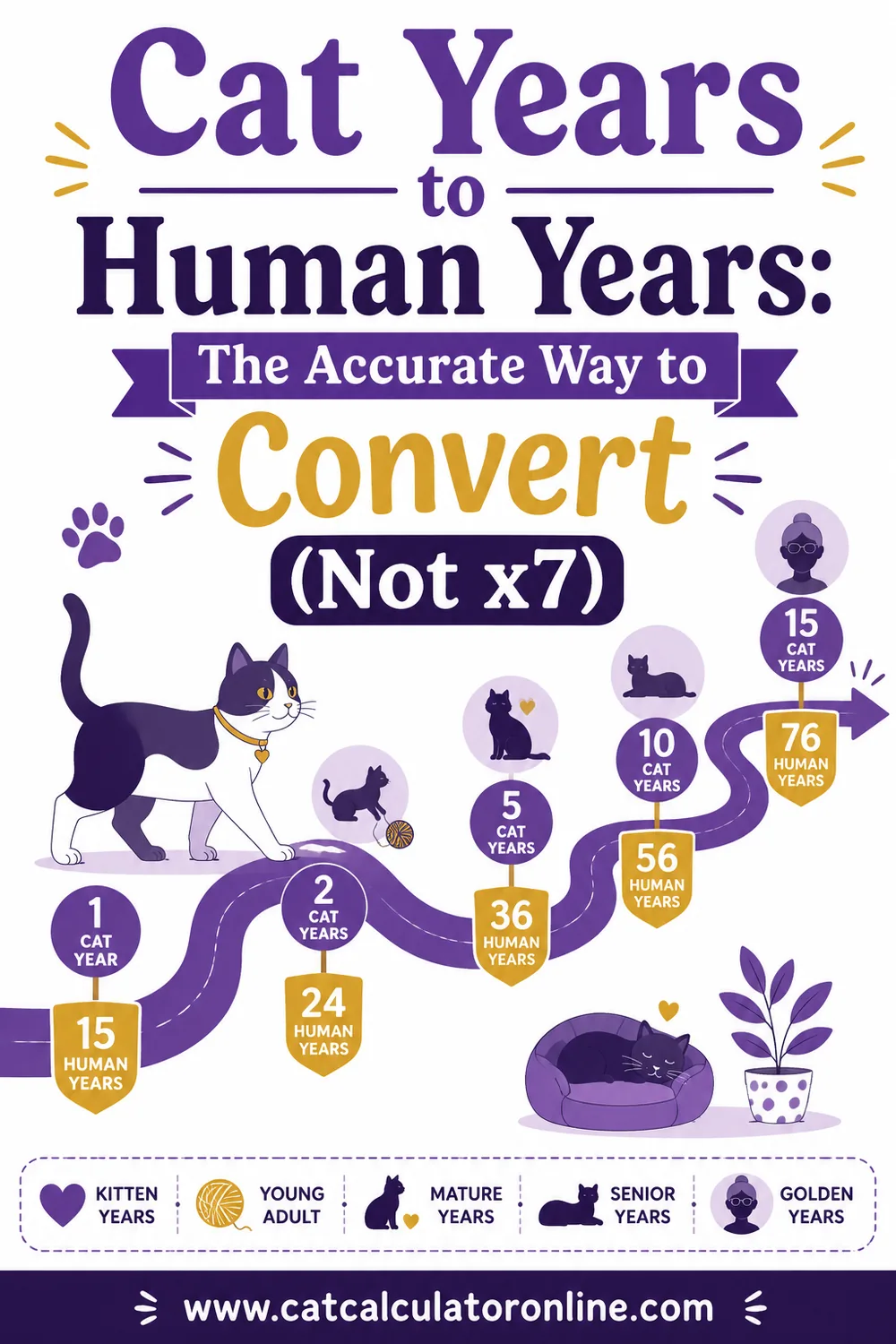
15 for year one, 9 for year two, 4 for every year after. By eleven: 24 + (9 × 4) = 60.
| Cat's age | Human years | Life stage |
|---|---|---|
| 9 | 52 | Mature adult |
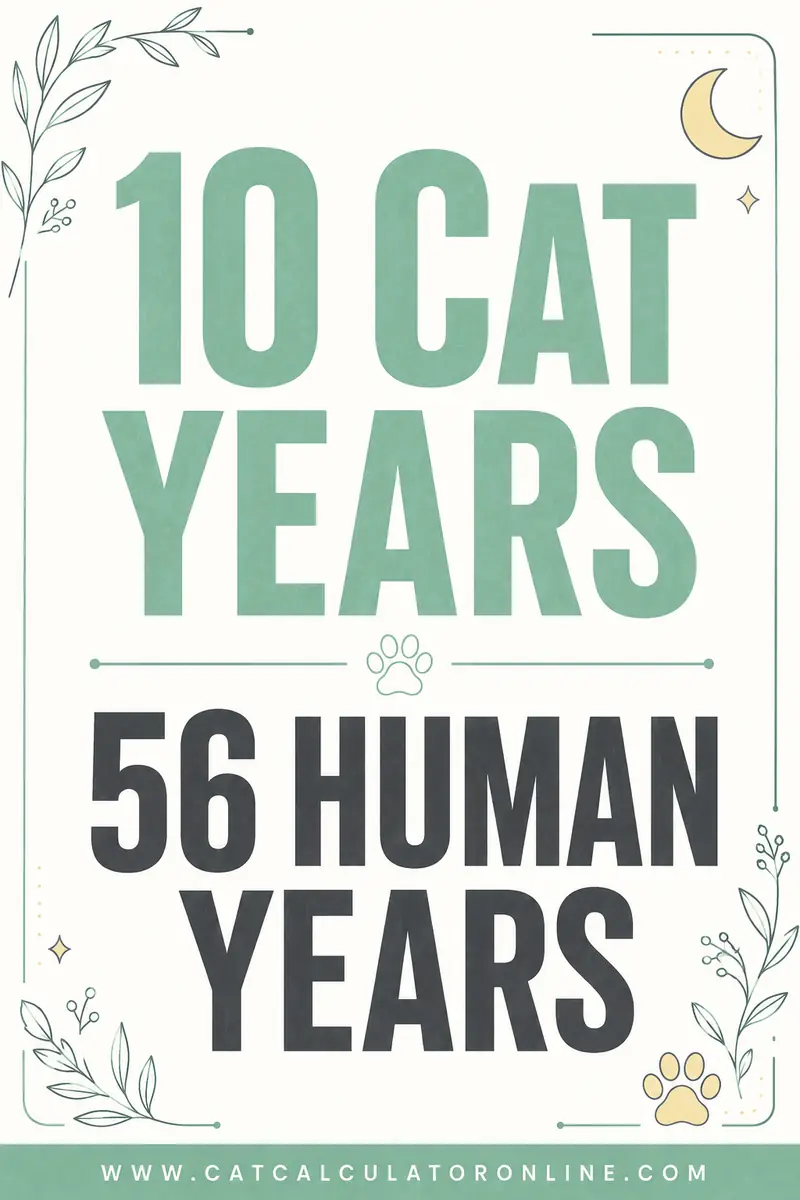
| 10 | 56 | Senior |
| 11 | 60 | Senior |
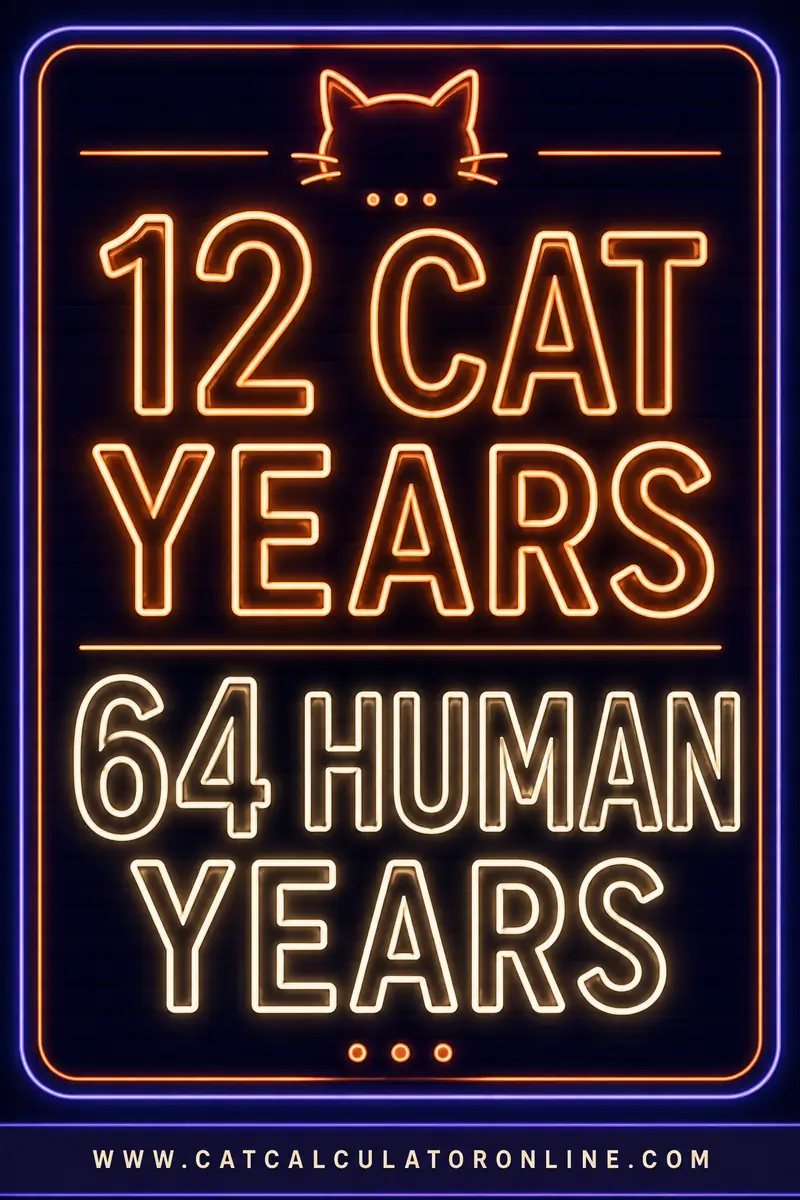
| 12 | 64 | Senior |
| 13 | 68 | Senior |
| 14 | 72 | Senior |
| 16 | 80 | Senior |
| 18 | 88 | Senior |
Eleven lands neatly on sixty, which is a useful anchor. A person of sixty is generally healthy, active and independent, and also at the age where routine screening is simply expected rather than optional. That's a fair description of an eleven-year-old cat.
The years either side are covered in 10 cat years in human years and 12 cat years in human years, the whole table in cat years to human years, and the method in how a cat age calculator works.
What Does an Eleven-Year-Old Cat Look Like?
Mostly well, with changes that are easy to attribute to age rather than to anything addressable.
Sleeping more — often 16 to 20 hours a day, in many short naps. Normal, provided the waking hours still involve normal behavior.
Playing less, but not never. A cat that has entirely stopped responding to a wand toy is worth investigating. Shorter, gentler sessions are the expectation; total disinterest is a signal.
Choosing lower places. Almost universal at this age, and almost universally read as preference. It is usually joint discomfort.
Coat needing help. Grooming declines, and long-haired cats in particular start developing mats over the hips, lower back and tail base — precisely the places a stiff cat can't reach.
Weight ideally steady. Some cats begin a slow decline around this age even when well, so the trend matters more than any single reading.
Nails growing longer, because a cat that scratches less doesn't wear them down. Check monthly; overgrown claws can curl into the pad.
Muzzle greying in dark-coated cats, and often a bluish haze in the lens that is usually benign nuclear sclerosis rather than cataract — worth having a vet confirm rather than assuming either way.
What isn't just age: weight loss, increased drinking, vomiting more than occasionally, going beside the box, a genuinely unkempt coat, night yowling, or a cat that has stopped going upstairs. Each of those has a cause worth finding.
Why Do Joints Matter Most at This Age?
Because degenerative joint disease is present in the majority of cats by their teens, it's badly under-treated, and the treatment works.
The recognition problem. Cats compensate rather than limp. Every sign looks like a lifestyle choice: sleeping on the sofa instead of the wardrobe, taking the chair as a step to the windowsill, grooming the front half properly and the back half not at all, sitting beside the litter box rather than climbing in.
The consequence of missing it. A cat that quietly stops moving loses muscle. Less muscle means less support for the joints, which means more discomfort, which means less movement. Two years of that and you have a cat that genuinely can't do what it used to — and much of that loss isn't recoverable.
What actually helps:
- Weight reduction, if there's any excess. The single biggest lever, and the one most within your control
- Environmental adaptation — steps, ramps, low-entry boxes, food and water at floor level. Immediate effect, costs almost nothing
- Warm, soft, supportive bedding away from draughts
- Veterinary pain management. Options for cats have improved considerably in recent years. This is a conversation worth having explicitly, because it won't be offered unless joint disease is raised
- Gentle continued activity, which preserves the muscle that supports the joints
What to avoid: human painkillers, absolutely and without exception. Paracetamol is fatal to cats, and ibuprofen and aspirin are toxic. Never give a cat anything from a human medicine cabinet. The full picture is in arthritis in cats.
How to raise it usefully: don't ask "is my cat arthritic". Describe the specifics — "she used to jump straight to the windowsill and now she goes via the chair", "he's stopped grooming his back end". Those observations are what lead to a diagnosis.
How Should You Adapt the House?
Cheap, quick, and it makes a visible difference within days.
Steps or a stool to every place your cat likes to be. Bed, windowsill, sofa back, the spot on top of the bookcase. A carpeted stool or a stack of sturdy boxes works as well as anything sold for the purpose.
A litter box on every floor, and at least one with a low entry. Cut a U-shape into a plastic storage tub — it gives full floor area with a two-inch step, which nothing shop-bought offers. Most "he's started going next to the box" is solved by this alone.
More boxes generally. A senior cat shouldn't have to cross the house or climb stairs when it needs to go.
Food and water at floor level, in more than one place, and away from the litter box. If your cat has always eaten on a counter, move it down.
Warmth. Older cats seek heat. A soft bed in a warm, draught-free spot — near a radiator but not against it — is genuinely appreciated and eases stiff joints.
Non-slip surfaces where the cat lands. Laminate and tile are hard work for an unsteady cat, and a rug or runner at a landing spot restores confidence quickly.
Night lighting. A dim night light helps cats whose vision has started to decline navigate a route they've walked for years.
Grooming help. A few minutes of brushing several times a week, with particular attention to the hips and tail base. More on the whole routine in how to care for a senior cat.
What Should the Screening Show Now?
The interpretation matters more than the numbers themselves at this stage.
Ask for the trend, not the reading. A creatinine that has climbed steadily across three years while staying inside the reference range is meaningful information — arguably more meaningful than a single result that has just crossed a threshold. Practices will print the history if you ask.
Kidney values including SDMA, which rises earlier than creatinine and is the more sensitive early marker.
Urine specific gravity, which often falls before blood values move. This is the test most frequently skipped and among the most informative in a senior cat.
Total T4 for thyroid, and a recheck of anything borderline rather than a decision to wait a year.
Blood pressure at every senior visit if the practice offers it.
Blood glucose, interpreted alongside fructosamine if the cat was stressed at the appointment.
Weight compared against your home log, which is usually more reliable than clinic weights taken on different scales.
What a normal set of results means at eleven: genuinely good news, and a baseline for the next one in six months. What it doesn't mean is that the next screening can be skipped — the entire value of the senior schedule is in the series, and a single normal result at eleven tells you nothing about twelve.
What Changes About Food and Water at Eleven?
Less than most people expect, and more than most people do.
There is no single "senior diet" a cat needs at eleven. Cats without a diagnosis do best on good quality complete food they will actually eat, at a portion that holds their weight steady. Switching to a food labeled senior for no reason other than the number achieves nothing.
What does change is water. Older cats drink more and concentrate their urine less, and kidney function benefits from anything that raises total fluid intake. Wet food is the easiest lever — a cat eating mostly wet food takes in far more water than one eating dry, without being asked to drink at all. Multiple bowls in different rooms, away from food and litter, help too, and many cats prefer a wide shallow bowl to a deep narrow one.
Watch for the opposite signal. A cat that suddenly starts drinking noticeably more — emptying the bowl, seeking taps, standing at the shower — is telling you something. Increased thirst is the classic early sign of kidney disease, hyperthyroidism and diabetes, and it warrants a visit rather than a bigger bowl.
Portion honestly. Free-feeding works until it doesn't, and an eleven-year-old carrying extra weight is carrying it on joints that already hurt. Measure meals rather than topping up a bowl, and adjust by what the scales say monthly.
And make eating easy. Raise the bowl slightly if your cat crouches awkwardly, warm wet food a little to lift the smell, and keep the eating spot quiet. Appetite in an older cat is a health indicator worth protecting.
What Does a Good Day Look Like at Eleven?
Worth picturing, because it sets a realistic standard against which to notice change.
A well eleven-year-old cat wakes, stretches properly rather than gingerly, eats its breakfast with interest, uses the box without hesitation, finds a warm spot and sleeps. It surfaces a few times through the day, grooms, watches something out of a window, has a short burst of play if you initiate it, eats again, and sleeps somewhere warm overnight. It greets you, or at least acknowledges you. It gets to where it wants to go, even if it now takes a route via a chair.
None of that is demanding. Which is exactly why deviations are informative — when the baseline is this simple, a change stands out.
The specific things to notice going wrong: a cat that stops stretching fully, eats with less enthusiasm, hesitates at the box, sleeps somewhere new and lower, stops greeting you, or no longer bothers going upstairs. Each is small on its own; together they describe a cat that has quietly become less comfortable.
Two habits worth building at eleven. First, actively invite play once a day, even briefly — it tells you what your cat can still do, and it preserves muscle. Second, put hands on the cat properly once a week: feel along the spine and hips, check the mouth, look at the nails, feel for lumps. It takes two minutes and it's the difference between finding something at eleven and finding it at thirteen.
Frequently Asked Questions
How many human years is 11 cat years?
About 60. The method is 15 for the first year, 9 for the second and 4 for each year after — giving 24 at age two plus nine further years at four each.
Is 11 old for a cat?
It's early senior. Indoor cats average 13 to 17 years and many reach 20, so an eleven-year-old often has several good years ahead. The stage label is about monitoring rather than decline.
Why has my 11-year-old cat stopped jumping onto things?
Most commonly joint discomfort. Cats rarely limp — they simply avoid what hurts, which looks like a change of preference. It's worth raising with a vet specifically, because feline arthritis is treatable and badly under-diagnosed.
How often should an 11-year-old cat see a vet?
Twice a year, with bloodwork, urinalysis and a blood pressure reading at least annually. Six months of a senior cat's life is roughly two human years, which is why the interval halves at ten.
What home changes help an 11-year-old cat?
Steps to favorite high spots, a litter box with a low entry on every floor, food and water at floor level, warm soft bedding away from draughts, and non-slip surfaces where the cat lands. All are cheap and take effect immediately.
Can I give my cat painkillers for stiff joints?
Never give human painkillers — paracetamol is fatal to cats and ibuprofen and aspirin are toxic. There are effective feline-specific pain management options, and they need to come from your vet.
Eleven cat years is about 60 human years — early senior, usually still well, and the year the small adaptations start earning their keep. Put steps and a low-sided box in, keep the twice-yearly checks, ask for trends rather than single readings, and raise anything that looks like reduced jumping. Convert any age with the cat age calculator.