Do Mixed-Breed Cats Live Longer?
Yes — and this is the honest answer most people do not expect. Mixed-breed cats outlive pedigree cats on average in essentially every large veterinary dataset that has looked, usually by something in the region of one to two years. The effect is called hybrid vigor, and in cats it is real rather than folklore. The reason is genetic: pedigree breeds are closed populations descended from a small number of founders, so rare disease-causing genes concentrate in them. The mixed-breed cat asleep on your sofa has a much more scattered genetic deck. That said, lifestyle still beats genetics by a wide margin. Curious how old your own cat is in human terms? Our cat age calculator will tell you.

The Short Answer, And How Big The Gap Is
Mixed-breed cats win, but not by as much as the internet sometimes claims.
A typical mixed-breed cat lives around 13 to 17 years, with plenty of indoor mixed-breed cats reaching 18 to 20. Pedigree averages sit a little below that overall, though the spread between individual breeds is far wider than the gap between pedigree and non-pedigree as categories.
The direction of the finding is consistent; the exact figure is not. Studies using veterinary practice records and insurance data agree that crossbreds do better, and disagree about by how much — anywhere from under a year to around two. Anyone quoting a single decimal-place number is over-reading the data.
The breed spread matters more than the label. A Siamese and a Persian are both pedigrees, and their typical lifespans differ by several years. Comparing "pedigree" to "mixed" hides that. Our cat breed lifespan chart sets the breeds out side by side.
And all of it is dwarfed by whether the cat goes outside. Indoor cats commonly live 12 to 18 years while cats with free outdoor access average dramatically less — a difference measured in years, not months.
Why Hybrid Vigor Is Real In Cats
This is where the mechanism is genuinely interesting, and worth understanding rather than taking on trust.
Most inherited diseases are recessive, meaning a cat needs two faulty copies of a gene to be affected. One copy does nothing. In a large, freely mixing population, the chance of two cats who both carry the same rare fault meeting and breeding is tiny, so those diseases stay rare.
A pedigree breed is a closed population. Registries generally do not allow outcrossing to unregistered cats, so every modern member of a breed descends from a limited founder group — sometimes only a handful of cats. Rare faults carried by those founders are now spread through the whole breed.
That is why breed-specific conditions exist at all. Polycystic kidney disease in Persians, the two different heart-disease mutations in Maine Coons and Ragdolls, progressive retinal atrophy in Bengals — each traces back to a small number of ancestors and then multiplies within the closed pool.
Mixed-breed cats reproduce the opposite way. A mixed-breed cat's parents are usually unrelated in any meaningful sense, so faulty copies rarely pair up. That is hybrid vigor: not superior genes, just a much lower chance of doubling up on a bad one.
The Popular Sire Problem
One breeding practice does more damage than any other, and it is not deliberate.
When a male wins shows, everybody wants his kittens. A single popular stud can father hundreds of offspring across a breed in a few years. Whatever he happens to carry — a heart mutation, a kidney gene, a structural weakness — spreads through the breed at speed.
This is how a rare fault becomes a breed-defining problem in one generation. No individual breeder does anything wrong; the collective effect is severe. It is the single clearest reason pedigree populations lose genetic diversity faster than you would expect from inbreeding alone.
DNA testing has genuinely helped where it exists. The Persian polycystic kidney disease test, available since the mid-2000s, has cut the frequency of that gene dramatically in tested lines. Responsible breeders now screen, and buyers can ask to see results, as our guide to Persian cat lifespan explains.
But tests only exist for known mutations. A breed's next inherited problem is, by definition, untested. That is the residual advantage a mixed-breed cat keeps no matter how well breeders behave.
Mixed Breed Versus Pedigree, Side By Side
| Factor | Mixed-breed cat | Pedigree cat |
|---|---|---|
| Typical lifespan | 13 to 17 years, many to 20 | Varies widely by breed, often a little lower |
| Inherited disease risk | Lower overall, unpredictable | Known and breed-specific, sometimes testable |
| Health history available | Usually none | Good breeders provide test results and pedigrees |
| Purchase cost | Low, often an adoption fee | High, commonly several hundred to a few thousand USD |
| Insurance premiums | Generally cheaper | Often higher, sometimes with breed exclusions |
| Predictable adult size | No | Yes, roughly |
| Predictable temperament | Broad range | More consistent within breed |
| Effect of indoor living | Very large | Very large |
The last row is the one to read twice. It is identical for both columns, and it outweighs everything above it.
Where Pedigree Cats Have The Advantage
Being fair about this matters, because "just get a mixed-breed cat" is not always the better advice.
You know what you are walking into. A responsible breeder screens for the conditions that run in their breed and hands you the paperwork. With a rescue mixed-breed cat you get a healthier average and no information whatsoever about the individual.
Predictability has practical value. If you need a cat who will tolerate a busy household, or who will stay under 12 lb (5.4 kg), or whose coat you can actually manage, breed narrows the odds. Temperament in a mixed-breed kitten is a genuine unknown until she grows up.
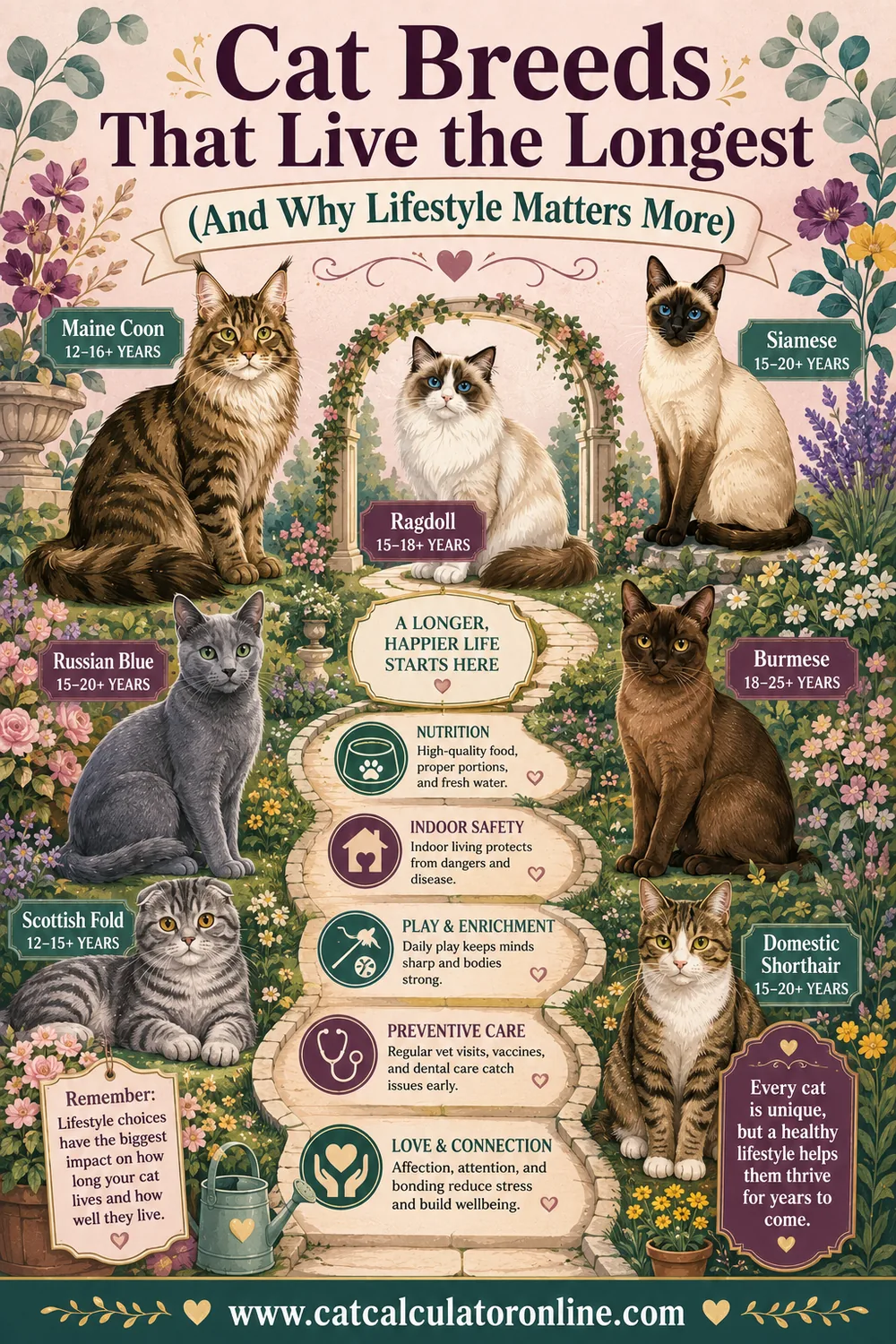
Some breeds are actively long-lived. Siamese, Balinese, Burmese and Russian Blues turn up repeatedly among the longest-lived cats, as our guide to the cat breeds that live the longest covers. A well-bred Siamese is not making a longevity sacrifice.
And a screened pedigree beats an unscreened one by more than the pedigree-versus-mixed-breed cat gap. Where you buy from matters more than what you buy. A Ragdoll from parents with DNA results and a recent cardiac scan is in a different risk category from a Ragdoll bought from an advert, even though both are the same breed on paper.
Insurance is worth thinking about in the same breath. Pedigree premiums are often higher, and some policies exclude conditions known to run in a breed. A mixed-breed cat is usually cheaper to insure precisely because the insurer cannot predict what she will develop. That is the same underlying fact seen from the other side.
What Mixed-Breed Cats Still Get
Hybrid vigor is not immunity, and it would be misleading to suggest otherwise.
The conditions that kill most cats are not inherited at all. Chronic kidney disease, an overactive thyroid, diabetes, dental disease, arthritis and cancer affect mixed-breed cats and pedigrees alike. They are age-related, and by definition a long-lived cat gets more exposure to them.
Some breed genes are in the mixed-breed cat pool too. Domestic cats and pedigrees have exchanged genes for centuries. A random shorthair can carry a heart mutation that originated in a pedigree line, which is why an ordinary cat is still occasionally diagnosed with a breed-associated disease.
Obesity does not care about pedigree. It is the commonest health problem in owned cats in wealthy countries, and it drives diabetes and arthritis in both groups equally.
And an outdoor mixed-breed cat is not protected by her genes. Cars, fights and infections take healthy young cats regardless of their ancestry. Details are in our page on how long indoor cats live.
There is also a survivorship effect worth naming. A mixed-breed kitten with a serious inherited fault often dies very young, sometimes before anyone records her existence. Pedigree kittens are registered, sold and followed, so their problems get counted. Some of the apparent gap is bookkeeping rather than biology, though not all of it.
What The Data Cannot Prove
It is worth naming the weak points, because they are real.
Pedigree and mixed-breed cats are not kept the same way. Owners who pay a few thousand dollars for a kitten are often more likely to insure, to visit vets, and to keep the cat indoors. Every one of those shifts the comparison, some in favor of pedigrees and some against.
Cause of death is recorded loosely. In practice records, "old age" and "found deceased" cover a lot of ground, which blurs the very differences the studies are trying to measure.
Breed labels in records are unreliable. A fluffy tabby of unknown parentage gets entered as a Maine Coon surprisingly often, which contaminates both groups.
None of that overturns the finding. The direction has held across countries, decades and data sources, and it lines up with basic population genetics. It just means the size of the advantage should be held loosely.
How To Stack The Odds, Whichever Cat You Have
The practical part, and it is the same list for both groups.
Keep her indoors, or make outside safe. A catio, cat-proof fencing or supervised time gives most of the enrichment with almost none of the risk. This lever is worth more than every genetic factor on this page combined.
Keep her lean. You should feel the ribs easily under a flat palm, with a visible waist from above. Never withhold food from a cat to slim her down — sudden food restriction can trigger a serious liver condition. Any weight-loss plan should come from your vet.
Brush her teeth and get dentals when advised. Most cats have some gum disease by three, and they keep eating straight through the pain.
From about eleven, move to twice-yearly vet checks with bloodwork. Kidney disease, thyroid disease and high blood pressure are common, treatable and silent. Our page on how to help your cat live longer ranks all of it by how much it actually matters.
If you are buying a pedigree, ask for the test results before you meet the kittens. A breeder who cannot produce them is the risk, not the breed.
Frequently Asked Questions
Do mixed-breed cats really live longer than pedigrees?
Yes, on average. Large veterinary and insurance datasets consistently show mixed-breed cats outliving pedigree cats, typically by around one to two years. The effect comes from greater genetic diversity, which makes inherited recessive diseases far less likely to pair up.
What is hybrid vigor in cats?
Hybrid vigor is the health advantage that comes from genetic diversity. Most inherited feline diseases are recessive and need two faulty gene copies. Unrelated parents rarely carry the same fault, so mixed-breed cats are much less likely to be affected than closed-population pedigrees.
How long do domestic shorthair cats live?
Domestic shorthairs typically live 13 to 17 years, and indoor ones commonly reach 18 to 20. They benefit from wide genetic diversity, so their lifespan is shaped mainly by lifestyle: indoor living, healthy weight, dental care and senior health screening.
Are pedigree cats unhealthy?
Not as a group, but each breed carries its own known risks, from heart disease in Maine Coons and Ragdolls to breathing problems in flat-faced breeds. Buying from a breeder who DNA tests and screens removes much of that risk before you take a kitten home.
Does a mixed-breed cat still need health screening?
Yes. The conditions that shorten most cats' lives are age-related rather than inherited: kidney disease, hyperthyroidism, diabetes, dental disease and arthritis. Twice-yearly vet checks with bloodwork from around age eleven catch them long before symptoms appear.
Should I choose a mixed-breed cat over a pedigree for longevity?
Longevity alone is a weak reason to decide. The average advantage is one to two years, while keeping a cat indoors is worth considerably more. Choose on temperament, coat care and household fit, then control the factors that matter most.
Hybrid vigor is one of the few pieces of pet folklore that turns out to be true, and the genetics behind it are straightforward: closed breeding populations concentrate rare faults, mixed populations scatter them. So the mixed-breed cat from the rescue center really does start with a small advantage. Keep it in proportion, though. One to two years is a modest edge, and it disappears completely if she spends her days crossing a road. Choose the cat you actually want, then spend your effort where the returns are largest — indoors or a catio, ribs you can feel with a flat hand, clean teeth, and two vet visits a year once she passes eleven. Work out her age in human years with our cat age calculator, and see how the breeds compare in our domestic shorthair lifespan guide.