Can Cats Get Pregnant While Nursing?
Yes — and considerably sooner than almost anyone expects. A queen can come back into heat while she is still feeding a litter, sometimes within two to four weeks of giving birth, and she can conceive during that heat. Lactation does not reliably suppress cycling in cats the way it does in some other species, so "she is nursing, she is safe" is one of the most costly assumptions in cat ownership. Combine that with induced ovulation, a long breeding season and any outdoor access, and you have the standard route to a cat producing two or even three litters in a single year. The cat pregnancy calculator is worth bookmarking rather than closing.
How Soon After Birth Can a Cat Come Back Into Heat?
Faster than the equivalent in most other companion species, and that is the whole story.
Within two to four weeks of giving birth is entirely possible, while the kittens are still wholly dependent on her milk.
Some queens wait until weaning at around six to eight weeks, and that is also common. The range is wide and unpredictable, which is the point — you cannot plan around an average.
Season influences it heavily. Cats are seasonally polyoestrous, cycling repeatedly through the lighter months. A queen who gives birth in spring is far more likely to cycle quickly than one who gives birth in late autumn, when the season may be closing. Indoor cats under artificial light can cycle almost year-round.
Litter size and body condition play a part. A queen with one kitten and good condition tends to return sooner than one nursing six and losing weight.
Breed and individual variation are real. Some lines cycle notably quickly.
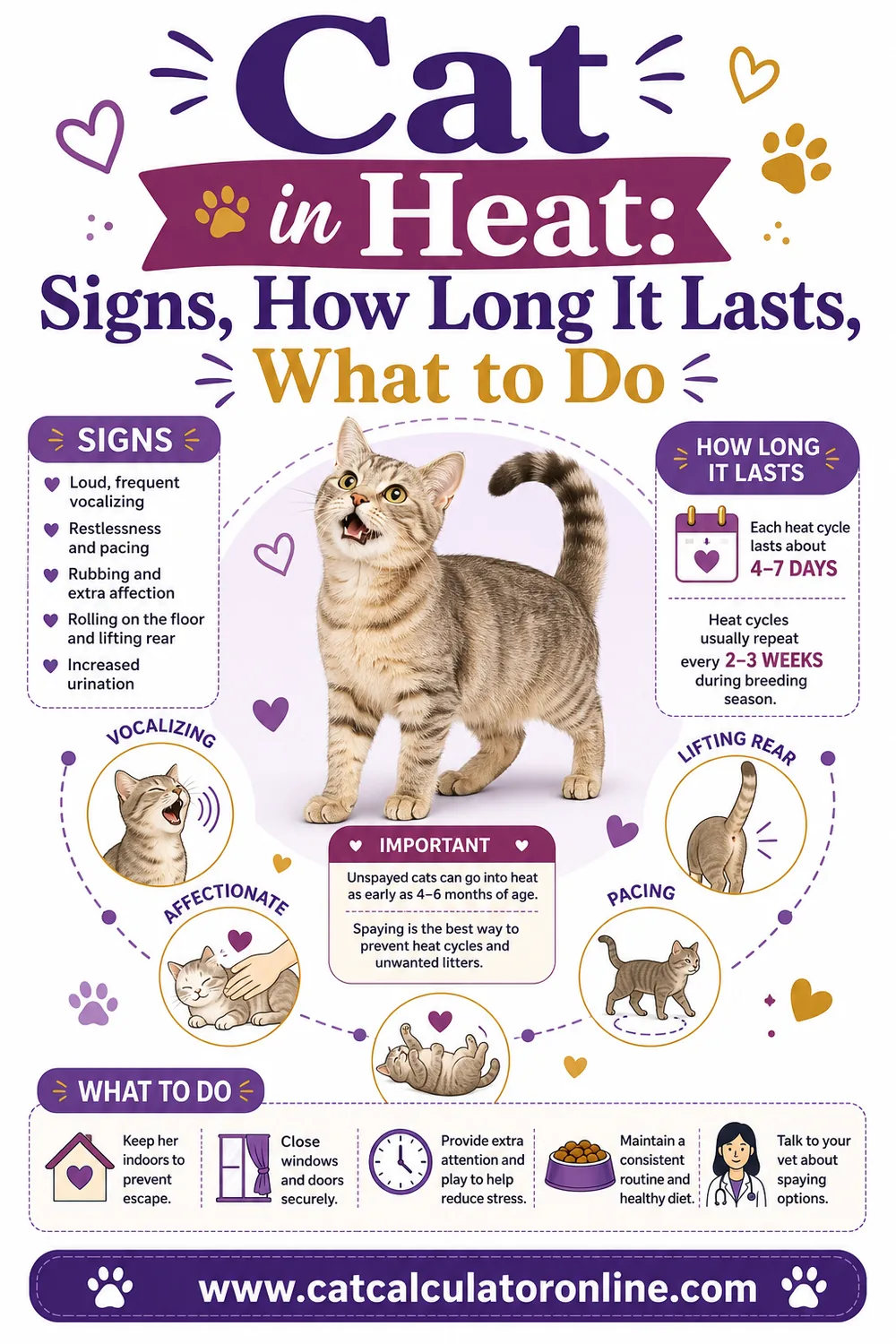
She may not show it obviously. A postpartum heat in a queen busy with kittens can be subdued, and silent heats happen. "She has not been calling" is weaker evidence than it feels. What a heat normally looks like is set out in cat in heat, and the cycle pattern in how often do cats go into heat.
Why Does Nursing Not Prevent Pregnancy in Cats?
The mechanism that makes lactation contraceptive elsewhere is simply weaker here.
Lactational suppression is incomplete in cats. Suckling raises prolactin, which suppresses the hormones that drive ovarian cycles — but in cats that suppression is neither reliable nor long-lasting. Enough queens escape it that it cannot be treated as protection.
Cats are induced ovulators. There is no fixed monthly ovulation waiting to be blocked. A queen comes into heat, and if she mates, the act itself triggers ovulation roughly 24 to 48 hours later. That makes the system responsive rather than scheduled, and it means a single opportunity is often enough.
Repeated matings raise the odds further. A queen in heat will typically mate several times, and multiple matings increase the chance ovulation is triggered.
The breeding season is long. In temperate regions it runs from roughly January or February through to autumn, and can be effectively continuous for indoor cats.
Heat cycles repeat quickly. If she does not conceive, a queen may cycle again in as little as one to three weeks.
Human intuition points the wrong way. People carry across a folk belief about breastfeeding and fertility, which is unreliable even in humans and considerably less reliable in cats.
What Does This Mean in Practice?
The arithmetic is what makes this matter rather than merely being interesting.
Gestation is roughly 63 to 65 days. About nine weeks.
Add a return to heat within two to four weeks of birth, and a queen can theoretically be pregnant again while her first litter is still nursing.
That produces two to three litters a year in a free-roaming unspayed cat, which is precisely the pattern seen in feral and semi-feral populations.
Average litter size is around four, ranging from one to eight or more — see how many kittens are in a litter.
Kittens reach sexual maturity early, often at four to six months and occasionally sooner, so a spring litter can be breeding by autumn.
| Event | Typical timing |
|---|---|
| Gestation | 63–65 days (range ~61–72) |
| Return to heat after birth | 2–8 weeks, sometimes sooner |
| Heat length | ~4–10 days if not mated |
| Gap between heats in season | 1–3 weeks |
| Ovulation after mating | 24–48 hours |
| Weaning complete | ~8 weeks |
| Kittens sexually mature | 4–6 months |
| Possible litters per year | 2–3 |
The compounding is the real issue. One unspayed queen, left to it, contributes far more to local cat numbers over a few years than most people imagine, because her daughters begin doing the same before their first birthday.
What Is Superfecundation?
A related fact that surprises people and explains a lot of mixed-looking litters.
One litter can have more than one father. A queen in heat may mate with several toms over the few days she is receptive. Because she is an induced ovulator releasing several eggs across that window, different eggs can be fertilised by different males.
The term is superfecundation, and in cats it is common rather than exotic.
It is why litters look mismatched. Four kittens with four distinct coat types and body shapes is not a genetic oddity; it is often several fathers.
It has practical consequences for breeders. A pedigree queen who slips outside during a heat can produce a litter of mixed parentage, and pedigree registration then requires DNA testing.
There is a separate, rarer phenomenon called superfetation — conception during an existing pregnancy, producing kittens at two different developmental stages. It is reported in cats but is uncommon and sometimes disputed. Superfecundation is the everyday one.
None of this changes the practical advice, but it makes clear how efficient feline reproduction is once a queen has outdoor access during a heat.
What Are the Risks of Back-to-Back Litters?
This is why the answer to the question matters beyond the arithmetic.
Body condition falls. Lactation is the highest energy demand a cat ever faces — up to two to three times maintenance calories at peak. Layering a new pregnancy on top of that draws on reserves she has not rebuilt.
Milk supply can suffer, and the existing kittens may gain weight more slowly. Daily weighing is the way this gets caught early.
Nutritional deficits accumulate, including the calcium demands that make eclampsia — dangerously low blood calcium, usually one to four weeks after a birth — more likely. Tremors, stiffness, restlessness or collapse in a nursing queen is a true emergency at any hour.
She may wean early, sometimes abruptly, leaving kittens needing supplementary feeding sooner than planned.
Litter quality can decline. Repeated closely spaced pregnancies are associated with smaller and less robust litters over time.
Feeding her properly is essential but not sufficient. She should be on a kitten or growth diet throughout, with free access to food while nursing, and never have food withheld — cats risk hepatic lipidosis within days of not eating, and a queen carrying and feeding at once has the least margin of anyone.
The queen's own health is the limiting factor, and a vet who knows she is pregnant again while nursing can monitor condition properly. How soon it is reasonable for her to conceive again is covered in how soon can a cat get pregnant again.
How Do You Prevent It?
Three practical layers, in order of how quickly they can be applied.
Keep her indoors from the moment she gives birth. This is the immediate, free, effective measure. A nursing queen with no access to a tom cannot conceive, however fertile she becomes.
Do not assume a subdued heat is not a heat. Rolling, treading, an elevated rear end and increased affection can all appear without the classic yowling, particularly in a queen preoccupied with kittens.
Separate any entire male in the household immediately. Related toms do not care that they are related, and a male kitten from a previous litter reaching four to five months is already a risk to his own mother.
Talk to your vet about spay timing. Many practices will spay while a queen is still lactating; others prefer to wait until the kittens are weaned at around eight weeks. It depends on her condition, the litter's age, and the practice's approach. The decision points are in when to neuter a cat.
Spay the kittens on schedule too. Four to six months is when they become capable of breeding, which is well before most owners think of it.
Note that a lactating queen is still a surgical candidate — enlarged mammary tissue complicates the operation slightly, which is one reason some vets prefer to wait, but pregnancy risk may outweigh that.
What If She Is Already Pregnant Again?
It happens, and it is manageable with support.
Get her checked. A vet can confirm the pregnancy by ultrasound from around day 21 to 25 and assess her body condition, which is the number that actually matters here.
Feed hard. Kitten or growth diet, free access, several stations, plenty of fresh water. She is doing two jobs at once and cannot do either on a maintenance ration.
Weigh her weekly and weigh the nursing kittens daily. Kitten weight gain is the earliest sign that her milk is keeping up or is not.
Consider supporting weaning. If the existing litter is approaching four weeks, introducing solids on schedule reduces her load meaningfully. The process is in how to wean kittens.
Do not supplement calcium on your own initiative. It increases eclampsia risk rather than reducing it.
Discuss the options honestly with your vet, including whether continuing the pregnancy is appropriate given her condition. That is a veterinary conversation, and a legitimate one to have.
Plan the homes early. Two litters within a few months is a serious undertaking, and kittens should not leave before eight weeks, ideally ten to twelve.
What About Male Cats and Timing?
The other half of the equation, usually the forgotten half.
Toms reach sexual maturity at around five to six months, sometimes earlier, and are fertile continuously thereafter.
A single entire male affects a wide area. Toms roam considerable distances during the breeding season and will find a calling queen.
Neutering the male helps everyone. It reduces spraying, roaming, fighting and the abscesses that follow, alongside the obvious.
Post-neutering fertility does not vanish instantly. A recently neutered tom can remain fertile for a period afterwards while residual sperm clears, so keep him away from an in-season queen for several weeks after surgery.
A male kitten in the litter counts. By four to five months he can mate his mother or his sisters, which is a genuinely common route to an unplanned second-generation litter in one household.
Indoor-only status is not a guarantee. Doors open, windows get left ajar, and a calling queen is remarkably motivated. Confinement needs to be deliberate rather than assumed.
Frequently Asked Questions
Can a cat get pregnant while still feeding kittens?
Yes. Queens can return to heat and conceive while still nursing, sometimes within two to four weeks of giving birth. Lactation does not reliably suppress cycling in cats, so a nursing queen with access to an entire male should be treated as fully fertile.
How soon after giving birth can a cat get pregnant?
Possibly within two to four weeks, though some queens wait until the kittens are weaned at six to eight weeks. The range is wide and unpredictable, and it is influenced by season, litter size and body condition, so it cannot be relied on as contraception.
Does nursing stop a cat from ovulating?
Not reliably. Suckling raises prolactin, which does suppress ovarian activity to a degree, but the effect is incomplete and short-lived in cats. Cats are also induced ovulators, so mating itself triggers egg release rather than a fixed cycle being interrupted.
How many litters can a cat have in a year?
Two to three is realistic for a free-roaming unspayed queen. Gestation is about nine weeks, she can return to heat within weeks of giving birth, and the breeding season runs for most of the year in temperate regions and effectively year-round indoors.
Can kittens in one litter have different fathers?
Yes. Superfecundation is common in cats. A queen mating with several toms during one heat can carry kittens fertilised by different males, which is why litters often contain kittens that look nothing like each other.
Can a cat be spayed while nursing?
Often, though practices differ. Some vets will spay a lactating queen; others prefer to wait until the kittens are weaned at around eight weeks, because enlarged mammary tissue makes surgery slightly more complex. Discuss the timing with your own vet, weighing the risk of another pregnancy.
Nursing is not contraception in cats, and treating it as such is how households end up with two litters in one spring. A queen can return to heat within two to four weeks of giving birth, cats ovulate in response to mating rather than on a schedule, and the breeding season is long enough to allow two or three litters in a year. Add superfecundation and a single litter may have several fathers. The practical response is straightforward: keep her indoors from the day she gives birth, separate any entire male including a maturing son, feed her a growth diet with free access while she nurses, and book the spay conversation with your vet rather than waiting to see what happens.