Kitten Weight by Age Chart
Kittens are born at around 100 g and gain roughly 100 g a week through the first five or six months, reaching 1.7–2 lb by eight weeks, 4 lb by four months, and 8–10 lb by their first birthday. The handy shortcut for the middle stretch is that a kitten's age in months roughly matches its weight in pounds. These figures describe a typical domestic shorthair — large breeds run above them and oriental breeds below — and the trend of steady weekly gain matters far more than hitting any exact number. Check your own kitten against its age with the kitten weight calculator.
Quick Answer: Kitten Weight at Key Ages
Looking for one number? Here are typical weights for a domestic shorthair at the ages people search for most. Use the full charts below for every week and month.
| Age | Typical weight (metric) | Typical weight (imperial) |
|---|---|---|
| Newborn | 90–110 g | 3–4 oz |
| 4 weeks | 400–550 g | ~1 lb |
| 8 weeks | 800–900 g | 1.7–2 lb |
| 12 weeks | 1.3–1.5 kg | 2.8–3.3 lb |
| 16 weeks | 1.55–1.85 kg | 3.4–4.1 lb |
| 20 weeks | 1.95–2.3 kg | 4.3–5.1 lb |
| 6 months | 2.5–3.0 kg | 5.5–6.6 lb |
| 12 months | 3.6–4.5 kg | 8.0–10.0 lb |
Rule of thumb: about 100 g (3.5 oz) of gain per week, and age in months roughly equals weight in pounds from two to six months.
Kitten Weight Chart: Week by Week
The first twelve weeks, where change is fastest and weekly weighing is most useful.
| Age | Weight (grams) | Weight (oz / lb) |
|---|---|---|
| Birth | 90–110 g | 3–4 oz |
| 1 week | 150–200 g | 5–7 oz |
| 2 weeks | 200–300 g | 7–10 oz |
| 3 weeks | 350–450 g | 12–16 oz |
| 4 weeks | 400–550 g | ~1 lb |
| 5 weeks | 500–650 g | ~1.2 lb |
| 6 weeks | 600–750 g | ~1.5 lb |
| 7 weeks | 700–850 g | ~1.6 lb |
| 8 weeks | 800–900 g | 1.7–2 lb |
| 10 weeks | 1.0–1.2 kg | 2.2–2.6 lb |
| 12 weeks | 1.3–1.5 kg | 2.8–3.3 lb |
The pattern to notice is the steady 100 g per week from about week two onward. That consistency is the point — a kitten adding roughly that much every week is thriving, whichever end of the range it sits at.
Newborns are the exception in both directions: they gain proportionally faster (roughly doubling birth weight in two weeks) and they're far more fragile. Daily weighing is worthwhile in the first two weeks.
Kitten Weight Chart: Weeks 13 to 24
Many owners weigh weekly well past the twelve-week mark, and questions like "how much should a 16-week-old kitten weigh?" are some of the most common. This table fills the gap between the weekly and monthly charts. The figures are smoothed from the monthly ranges below, so treat them as a guide rather than exact targets.
| Age | Weight (kg) | Weight (lb) |
|---|---|---|
| 13 weeks | 1.3–1.6 kg | 2.9–3.5 lb |
| 14 weeks | 1.4–1.7 kg | 3.1–3.7 lb |
| 15 weeks | 1.5–1.8 kg | 3.3–4.0 lb |
| 16 weeks | 1.55–1.85 kg | 3.4–4.1 lb |
| 17 weeks | 1.65–1.95 kg | 3.6–4.3 lb |
| 18 weeks | 1.75–2.05 kg | 3.9–4.5 lb |
| 19 weeks | 1.85–2.2 kg | 4.1–4.9 lb |
| 20 weeks | 1.95–2.3 kg | 4.3–5.1 lb |
| 21 weeks | 2.05–2.4 kg | 4.5–5.3 lb |
| 22 weeks | 2.1–2.55 kg | 4.6–5.6 lb |
| 23 weeks | 2.2–2.65 kg | 4.9–5.8 lb |
| 24 weeks | 2.3–2.75 kg | 5.1–6.1 lb |
Two things stand out in this stretch. First, weekly gain is still close to 100 g, so a kitten that gains far less than that for a week or two deserves a closer look. Second, the ranges keep widening as individual size, sex, and breed start to show. A sixteen-week-old male from big parents can sit comfortably above this table and be perfectly healthy.
Kitten Weight Chart: Month by Month
From three months to a year, when monthly checks are sufficient.
| Age | Weight (kg) | Weight (lb) |
|---|---|---|
| 3 months | 1.3–1.6 kg | 3–3.5 lb |
| 4 months | 1.7–2.0 kg | 3.7–4.4 lb |
| 5 months | 2.1–2.5 kg | 4.6–5.5 lb |
| 6 months | 2.5–3.0 kg | 5.5–6.6 lb |
| 7 months | 2.8–3.3 kg | 6.2–7.3 lb |
| 8 months | 3.0–3.6 kg | 6.6–7.9 lb |
| 9 months | 3.2–3.8 kg | 7.0–8.4 lb |
| 10 months | 3.4–4.1 kg | 7.5–9.0 lb |
| 11 months | 3.5–4.3 kg | 7.7–9.5 lb |
| 12 months | 3.6–4.5 kg | 8.0–10.0 lb |
The age in months ≈ weight in pounds shortcut works well from about two to six months, then starts to overstate as growth slows. A six-month-old is around 6 lb; a ten-month-old is not 10 lb.
Note how the ranges widen with age. At four weeks the spread is a couple of hundred grams; at twelve months it's nearly two pounds. That's individual variation accumulating, and it's entirely normal.
How Do Breeds Change the Numbers?
Substantially, and applying the standard chart to a large or small breed causes needless worry.
| Breed group | Adjustment to chart | Adult weight |
|---|---|---|
| Oriental (Siamese, Devon Rex, Abyssinian) | ~15–25% below | 6–10 lb |
| Domestic shorthair / longhair | Chart as written | 8–12 lb |
| Semi-large (British Shorthair, Bengal) | ~10–20% above | 10–15 lb |
| Large (Maine Coon, Ragdoll, Norwegian Forest) | ~25–40% above, growing far longer | 12–20 lb |
Three practical notes.
Large breeds keep going. Maine Coons, Ragdolls and Norwegian Forest Cats continue filling out until three or four years, so a twelve-month reading captures perhaps two-thirds of the final cat. Any adult target calculated at a year will understate them.
Sex matters from about four months. Male kittens start outpacing females around then and finish 2–4 lb heavier. Littermates diverging at this age is expected, not a sign one is struggling.
Mixed-breed kittens of unknown parentage almost always track the standard chart reasonably well. Use it unless there's a clear reason not to. Breed-specific growth timelines are covered in how big will my kitten get.
Estimating a Kitten's Age From Its Weight
Found a stray, or adopted a kitten with no birth date? Weight can give a rough first estimate of age, especially in the first two months. Read the chart in reverse:
| Weight | Likely age (domestic shorthair) |
|---|---|
| About 100 g (3–4 oz) | Newborn to a few days |
| 200–300 g (7–10 oz) | Around 2 weeks |
| About 450 g (1 lb) | Around 4 weeks |
| About 900 g (2 lb) | Around 8 weeks |
| About 1.4 kg (3 lb) | Around 12 weeks |
| About 1.8 kg (4 lb) | Around 4 months |
| About 2.3 kg (5 lb) | Around 5 months |
| About 2.7 kg (6 lb) | Around 6 months |
Weight alone becomes unreliable after a few months, and a kitten that has been underfed will look younger than it is. Combine the scale with other clues such as eyes, ears, teeth, and walking ability, covered in how to tell how old a kitten is. A vet can usually narrow the estimate further during the first checkup.
Weight Chart or Growth Chart: Which Do You Need?
This page is a weight lookup: find your kitten's age, read off a typical weight, and compare. If you want to know what your kitten should be doing at each age, such as when the eyes open, when teeth come in, or when play and litter habits develop, the milestone-focused kitten growth chart is the better companion. Most owners end up using both: this chart for the scale, that one for everything else.
Turning the Chart Into a Feeding Plan
Weight and food go hand in hand. Once you know where your kitten sits on the chart, the next question is usually how much to feed.
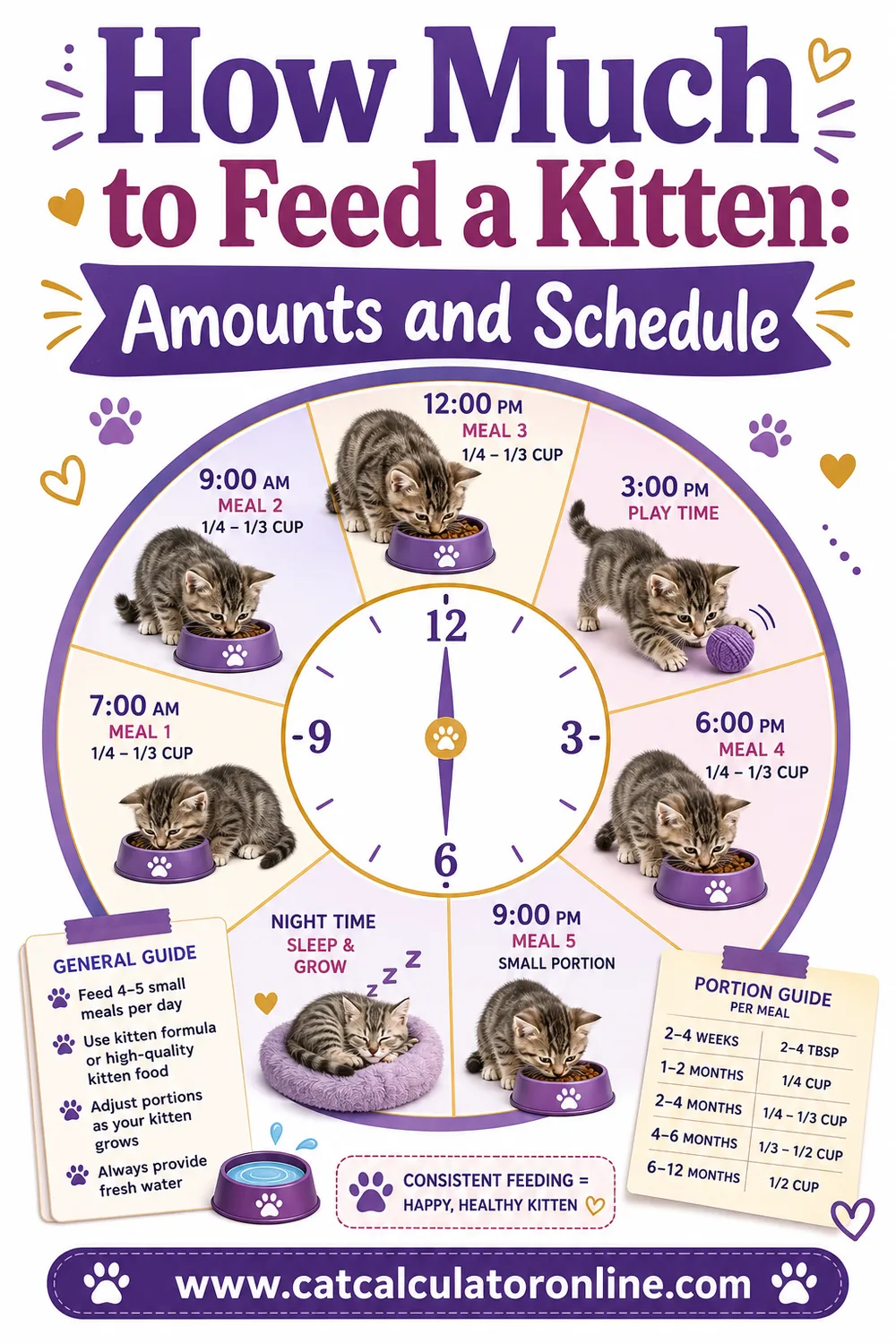
- Gaining steadily on the chart: keep portions growing gradually as your kitten grows. Our kitten feeding chart sets out meals per day by age.
- Below the chart but gaining: no change needed beyond making sure the food is a complete kitten formula.
- Stalled or losing: see your vet before changing food, since more food rarely fixes a growth problem on its own.
- Approaching one year: plan the switch to adult food, and recheck calorie needs with how many calories does my cat need.
After the first birthday, adult weight guidance takes over. Our cat weight chart by age and the cat ideal weight calculator carry on where this chart stops.
How Should You Read the Chart?
As a curve to track parallel to, not a set of targets to hit.
The most common mistake is treating a single reading as a verdict. A kitten 15% below the chart that has gained 100 g every week for a month is doing fine — it's simply a smaller kitten on its own curve. A kitten comfortably above the chart that gained nothing last week is the one to worry about.
So the question to ask each time you weigh is not "is my kitten the right weight?" but "did my kitten gain what it should have since last time?"
Two supporting points:
Ranges are wide for a reason. Kittens vary by frame, breed, litter size and sex. Being 10–20% either side of typical is ordinary.
The direction of drift matters. Tracking steadily 15% below the chart is fine. Falling progressively further behind — 5% below, then 12%, then 20% — is not, because that pattern means the growth rate itself is dropping. The rate of gain is covered in how fast do kittens grow.
Why Do Kittens Vary So Much?
Five factors, and most kittens have several working at once — which is why the ranges in any chart have to be wide.
Genetics. Adult size is largely inherited, and a kitten from two small parents will track below a kitten from two large ones from very early on. This is the single biggest source of variation and there's nothing to correct.
Litter size. Kittens from large litters are often smaller at birth and through the early weeks, simply because they shared limited resources in utero and compete at feeding time afterward. Many catch up substantially once weaned.
Birth order and position. Within a litter, kittens that consistently secure a productive teat gain faster. The differences this creates in the first month are real but usually even out.
The queen's condition. A well-nourished mother in good health produces more milk, and her kittens grow faster. Kittens from a queen in poor condition, or one nursing a very large litter, often start slower.
Sex. From around four months, males pull ahead and finish 2–4 lb heavier. Before that, the difference is minimal.
None of these are things to act on directly — you can't change a kitten's genetics or its birth order. What they explain is why two healthy kittens of the same age can differ by 30% and both be entirely normal. The chart describes a population; your kitten is an individual within it.
What Do the Numbers Look Like in Practice?
Three realistic scenarios, showing how to read the same chart in different situations.
A kitten tracking below the chart. A twelve-week-old domestic shorthair at 1.1 kg, against a chart range of 1.3–1.5 kg. It's roughly 15% light. But it gained 95 g last week and 105 g the week before, and it's bright, playful and eating well. Verdict: fine. This is a smaller kitten following its own curve, and it will most likely be a smaller adult. No action beyond continuing to weigh.
A kitten that has stalled. A ten-week-old at 1.15 kg, comfortably inside the chart range. But it weighed 1.14 kg last week and 1.10 kg the week before — gains of 10 g and 40 g against an expected 100 g. Verdict: see a vet. Being within the range is irrelevant; the growth rate has collapsed, and that's the signal. Parasites are the most likely explanation and are easily treated.
A kitten well above the chart. A sixteen-week-old at 2.6 kg against a range of 1.7–2.0 kg — around 35% heavy. It's a male, both parents were large, and it has tufted ears and a long body. Verdict: probably a large breed. Apply the large-breed adjustment and expect an adult around 14–18 lb. Keep it on kitten formula longer than twelve months.
The pattern across all three: the rate of gain decides the answer, and position on the chart only provides context. That's why recording the weekly difference matters more than recording the weight.
What Should You Track Alongside Weight?
Weight is the best single indicator, but four other things are worth a glance each time you weigh.
Body condition. Even in a kitten, you should be able to feel ribs easily under a thin covering, with a visible waist from above. Kittens are meant to look lean and slightly leggy rather than rounded. A pot-bellied kitten that's otherwise thin is a classic sign of a worm burden rather than good condition.
Energy and play. A healthy kitten is active in bursts and sleeps hard in between. Persistent lethargy, or a kitten that stops playing, is meaningful even when the weight looks acceptable.
Coat quality. Should be soft and even. A dull, sparse or greasy coat often accompanies poor nutrition, parasites or illness.
Appetite and toileting. Steady interest in food and normal, formed stools. Diarrhea in a kitten is more serious than in an adult cat, because dehydration develops quickly at that size.
Taken together these turn a number into a picture. A kitten slightly below the chart that's bright, playful, well-coated and eating enthusiastically is almost certainly fine. A kitten squarely on the chart that's lethargic with a dull coat is worth a call regardless of what the scale says.
What If a Kitten Is Below the Chart?
First establish whether it's small or slowing — they need different responses.
Consistently small but gaining steadily is usually just a smaller cat. Common causes are genetics, being a runt, a large litter, or oriental breed ancestry. Runts in particular often catch up substantially once they're no longer competing for a feeding position.
Was on track and has now stalled is the situation that needs a vet. Common causes:
- Parasites, especially roundworms, which are very common in kittens and compete directly for nutrition
- Inadequate food, or adult food fed to a kitten that needs a growth formula
- Competition from littermates at feeding time
- Illness, since growth is the first thing a body sacrifices when resources are short
Book promptly if there's no gain over a full week in a kitten under four months, any weight loss at any age, or poor growth alongside lethargy, diarrhea, vomiting or a dull coat.
The general principle: poor growth is a symptom rather than a diagnosis, and feeding more rarely fixes it on its own. Portion guidance is in how much to feed a kitten.
What If a Kitten Is Above the Chart?
Usually nothing to worry about, and less of a concern than being below it.
Common explanations: large-breed ancestry, a male kitten, a small litter with no competition, or simply a big-framed individual. None of these need intervention.
Where it does warrant attention is from around six months, when growth slows but appetite and portions often don't. Beyond that point extra calories stop producing growth and start producing fat. A kitten becoming genuinely overweight is uncommon before six months and increasingly possible afterward.
The transition to watch is twelve months. Most cats move to adult food then, and calorie needs drop substantially — especially after neutering, which lowers requirements by roughly 20–30%. Keeping kitten-sized portions past this point is one of the most common routes to an overweight two-year-old.
What you should not do is calorie-restrict a growing kitten without veterinary advice. Kittens need the energy, and cats in general are vulnerable to hepatic lipidosis if intake drops sharply — a serious liver condition that can be triggered by a cat refusing unfamiliar food for even a couple of days. Any dietary change in a kitten should be made gradually over about a week.
It's also worth separating large from overweight, since the chart alone can't distinguish them. A kitten well above the chart with easily felt ribs and a visible waist is simply a big kitten. A kitten above the chart whose ribs are hard to find under a layer of fat is carrying excess. The hands-on check settles in seconds what the number can't answer at all.
How Should You Weigh and Record?
Weekly through the first four months, monthly after that.
Use a kitchen scale for young kittens. Bathroom scales can't resolve a week's gain at 300 g, whereas a digital kitchen scale reading in grams shows it clearly. Most kittens will sit in a bowl or small box — tare it empty first. For older kittens, weigh yourself, then yourself holding the kitten, and subtract.
Weigh at the same time of day, ideally before a meal. A kitten weighed straight after feeding reads noticeably heavier, which produces phantom gains and losses.
Record date, weight, and the gain since last time. That third column is the one that matters. "1.6 kg" tells you little on its own; "gained 95 g this week, 105 g last week" tells you everything is fine.
Keep the twelve-month reading permanently. It becomes your cat's adult reference weight — the figure against which every future gain or loss is judged, for the rest of its life. It's more useful than any breed average, because it describes your actual cat.
A note on your phone is entirely sufficient, and vets genuinely appreciate it. Bringing a short weight history to an appointment is far more informative than an impression. The complementary developmental milestones are in kitten growth stages week by week and the broader growth reference in the kitten growth chart.
Frequently Asked Questions
How much should a kitten weigh at 8 weeks?
Around 800–900 g, or 1.7–2 lb, for a typical domestic shorthair. Large breeds will be heavier and oriental breeds lighter. Steady weekly gain of roughly 100 g matters more than hitting the exact figure.
How much should a 3-month-old kitten weigh?
Roughly 1.3–1.6 kg, or 3–3.5 lb. The useful shortcut through this period is that a kitten's age in months approximately matches its weight in pounds — so a three-month-old is around 3 lb and a four-month-old around 4 lb.
Is my kitten underweight?
Judge the trend rather than a single reading. A kitten consistently 10–20% below the chart but gaining steadily is usually just a smaller cat. A kitten that has stopped gaining, or is falling progressively further behind, should be seen by a vet.
How much weight should a kitten gain each week?
About 100 g, or 3.5 oz, from the first week through to five or six months. Newborns gain proportionally faster, roughly doubling their birth weight in the first two weeks. Gain slows noticeably from six months onward.
When do kittens reach their adult weight?
Most cats reach near-adult weight between ten and twelve months, then fill out slightly with muscle into their second year. Large breeds such as Maine Coons and Ragdolls continue growing until three or four years old.
Do male kittens weigh more than female kittens?
Yes, typically from around four months, finishing 2–4 lb heavier within the same breed. Littermates diverging in size at that age is normal sexual dimorphism rather than a sign that either is growing abnormally.
How much should a 16-week-old kitten weigh?
About 1.55–1.85 kg, or roughly 3.4–4.1 lb, for a typical domestic shorthair. That fits the age-in-months rule, since sixteen weeks is close to four months and about 4 lb. Large breeds and males can sit above this range without any problem.
What is the average kitten weight at 6 months?
Around 2.5–3.0 kg, or 5.5–6.6 lb, for a domestic shorthair. Growth is slowing by this age, so portions should be watched as calorie needs begin to level off.
How much does a kitten weigh in kg at each age?
Roughly 0.1 kg at birth, 0.5 kg at four weeks, 0.85 kg at eight weeks, 1.4 kg at twelve weeks, 1.85 kg at four months, 2.75 kg at six months, and 3.6–4.5 kg at twelve months. The tables above give the full ranges week by week and month by month.
How much does a newborn kitten weigh?
Usually 90–110 g, or about 3–4 oz. A healthy newborn should roughly double that weight in its first two weeks, so daily weighing on a kitchen scale is worthwhile during that period. Our newborn kitten care week by week guide covers the early days in detail.
Why does warmth matter for a newborn kitten's weight gain?
Newborn kittens can't regulate their own body temperature for the first few weeks, so they depend on their mother and a warm nest. A chilled kitten feeds poorly and stops gaining, which is why warmth comes first in orphan care. See how to care for orphaned kittens.
Does spaying or neutering affect a kitten's weight?
It lowers calorie needs afterward, by roughly 20–30%, so a neutered cat can gain unwanted weight if portions stay the same. Keep weighing after the procedure and adjust food gradually. Your vet will advise on the best timing for your kitten.
A weight chart is most useful as a curve to follow rather than a set of numbers to match. Weigh weekly through the early months, record the gain rather than just the weight, and adjust the chart upward or downward for breed. If your kitten tracks its own line steadily, it's doing well whatever the absolute figure — and if the line flattens, that's the moment to call your vet rather than reach for a bigger bowl. Check your kitten against its age using the kitten weight calculator.