Can Cats Eat Dairy? Milk, Cheese and Yoghurt
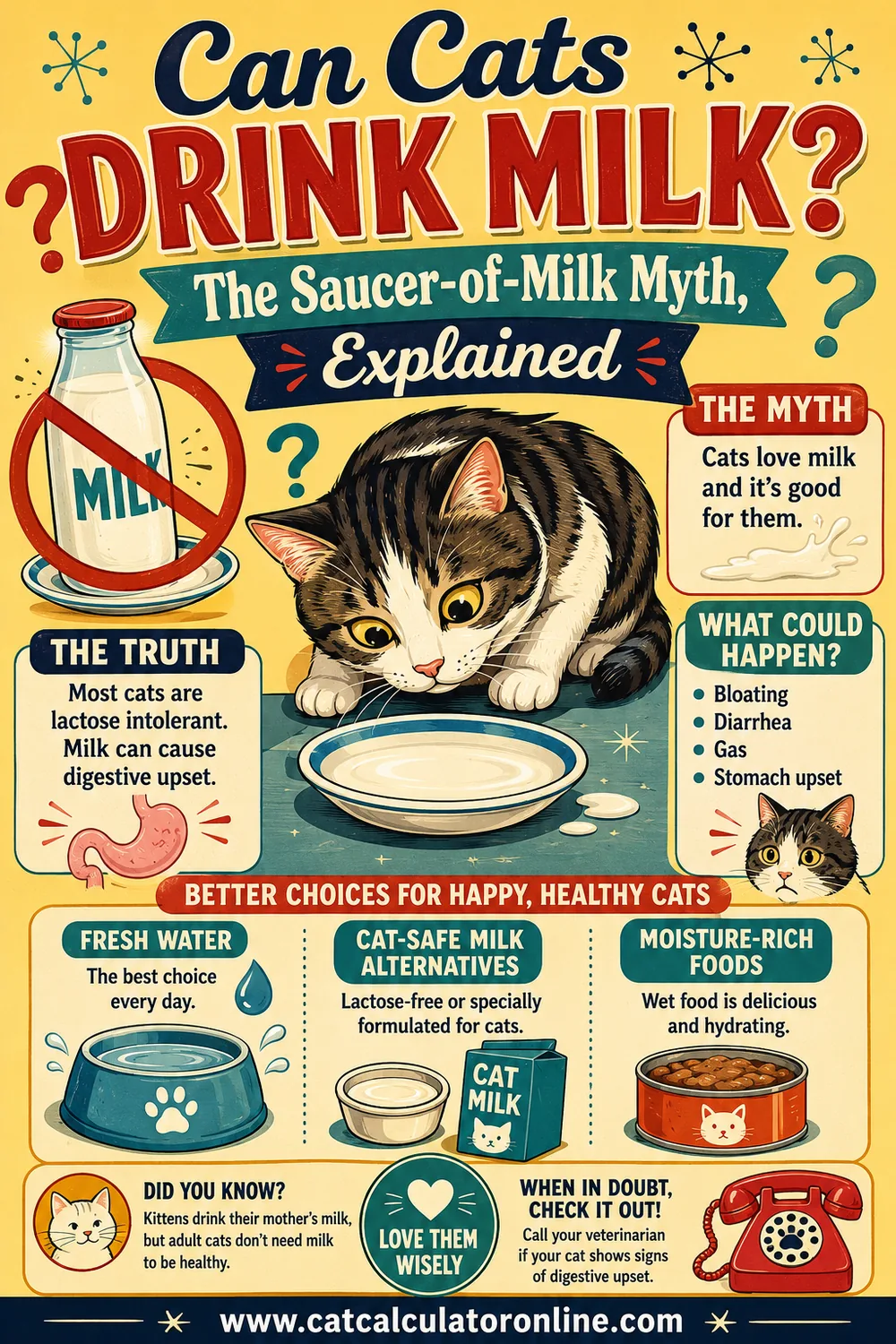
Dairy is not toxic to cats. It is simply indigestible for most of them, because the enzyme that breaks down milk sugar switches off after weaning. That is the whole story in one sentence, and it explains why the saucer of milk on the doorstep — which generations of us were taught was a kindness — usually ends in a very unhappy cat about eight to twelve hours later. Not every dairy product is equal, though. Hard aged cheese contains almost no lactose, cream contains less than milk, and a lick of plain yoghurt is often tolerated. A few dairy items are riskier than intolerance alone. Here is how the category actually sorts out, and what to do if she has already had some. To size everything else properly, use the free cat food calculator.
The Short Answer
Four sentences that cover almost every version of this question.
Most adult cats are lactose intolerant, and cow's milk gives them gas, bloating and loose, watery stools (diarrhea) rather than any benefit.
Lactose content is what separates the products. Milk and cream are high, soft cheeses moderate, aged hard cheeses almost zero, butter negligible.
Nothing in dairy is nutritionally necessary for a cat. She needs taurine, arachidonic acid and preformed vitamin A from animal tissue, and complete cat food already contains them. Dairy adds calories and nothing else.
A few dairy items are more than an intolerance problem: blue cheese, anything sweetened with xylitol, chocolate milk, and very fatty cream in quantity.
A small amount is not an emergency. A cat who has lapped some milk will be uncomfortable, not poisoned. What she needs is water available, a clean tray and a day of watching.
The one to actually worry about is diarrhea that lasts beyond 24 to 48 hours, or a kitten with diarrhea at all, because small animals dehydrate quickly.
Why Milk Stops Working After Weaning
The mechanism explains everything else, including why some products are fine and some are not.
Kittens digest milk perfectly well. They produce an enzyme called lactase in the small intestine, which splits milk sugar (lactose) into two simple sugars the body can absorb.
Lactase production falls away after weaning. This is normal mammalian biology, not a defect. Once a kitten is eating solid food, the machinery for digesting milk is no longer needed and the body stops investing in it. By around twelve weeks most cats produce very little.
Undigested lactose cannot be absorbed, so it travels on into the large intestine still intact.
There, two things happen. It draws water into the bowel by osmosis, which makes stools loose. And the gut bacteria ferment it, which produces gas.
That is why the timing is delayed. The discomfort is not from the stomach; it is from the far end of the gut, and it takes roughly eight to twelve hours to get there. People often miss the connection because the milk was breakfast and the accident is at bedtime.
And it is why quantity matters. A single lick may pass unnoticed. A full saucer — around 100 ml, carrying about 5 g of lactose — is a substantial dose for a 9 lb (4 kg) animal with no way of processing it.
Some individual cats do tolerate dairy better than others. That is real, but it is the exception, and finding out by experiment costs your cat a bad night. The saucer-of-milk story in full is in can cats drink milk.
Dairy Ranked by Lactose
The single most useful table in this article. Figures are approximate per 100 g or 100 ml of the human product.
| Dairy product | Rough lactose | Verdict for cats |
|---|---|---|
| Cow's milk, whole or semi | ~4.7–5 g | Skip it |
| Goat's milk | ~4.4 g | No better than cow's milk |
| Single or heavy cream | ~2.5–3 g | Less lactose, far more fat; skip |
| Ice cream | ~5 g plus sugar | No — and never chocolate or sugar-free |
| Plain yoghurt | ~4 g, partly pre-digested | A lick is usually tolerated |
| Greek yoghurt, plain | ~3 g | A lick is usually tolerated |
| Cottage cheese | ~2.5 g | Small amounts, plain only |
| Soft cheeses (brie, mozzarella) | ~0.5–1 g | Occasional tiny piece; fatty |
| Cream cheese | ~2–3 g | Better used to hide a pill than as a treat |
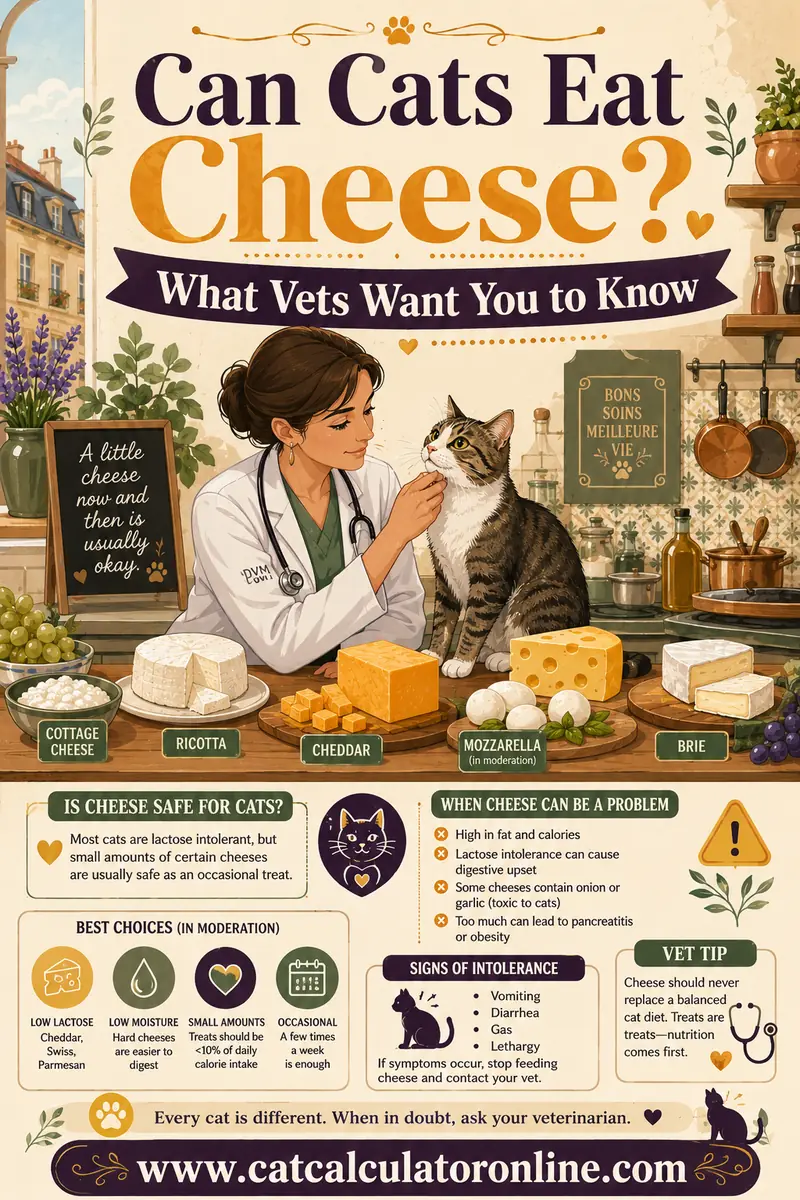
| Cheddar, aged | ~0.1 g or less | Usually tolerated; salty and fatty |
| Parmesan | Trace | Usually tolerated; very salty |
| Butter | ~0.1 g | Nearly pure fat; no reason to give it |
| Blue cheese | Low lactose | Never — mold toxin risk |
| Lactose-free "cat milk" | Negligible | Safe but unnecessary liquid calories |
Notice the pattern. The more a product has been aged or fermented, the less lactose it holds, because bacteria consumed it during production. That is why a mature cheddar is easier on a cat than a glass of milk despite being far richer.
But low lactose is not the same as good for her. Cheese is salty and fatty, and a pea-sized piece is genuinely the ceiling for a cat. The detail is in can cats eat cheese.
Portion is the real control. Everything on the tolerated end of that table should sit inside the 10% of daily calories allowed for treats, which for a typical 9 lb (4 kg) adult cat is about 20–25 kcal in total.
The Dairy That Is More Than Intolerance
Most dairy is a comfort problem. These few are a safety problem, and they are worth knowing by name.
Blue cheese is the important one. Roquefort, Stilton, Gorgonzola and Danish blue are made with Penicillium roqueforti, which can produce a substance called roquefortine C. It is toxic to pets and can cause vomiting, tremors and seizures. Treat blue cheese as off limits entirely, not as a small-portion food.
Anything labeled sugar-free. Xylitol, sometimes sold as birch sugar, turns up in sugar-free yoghurts, flavored milk drinks and ice creams. It is dangerous to pets and there is no safe amount.
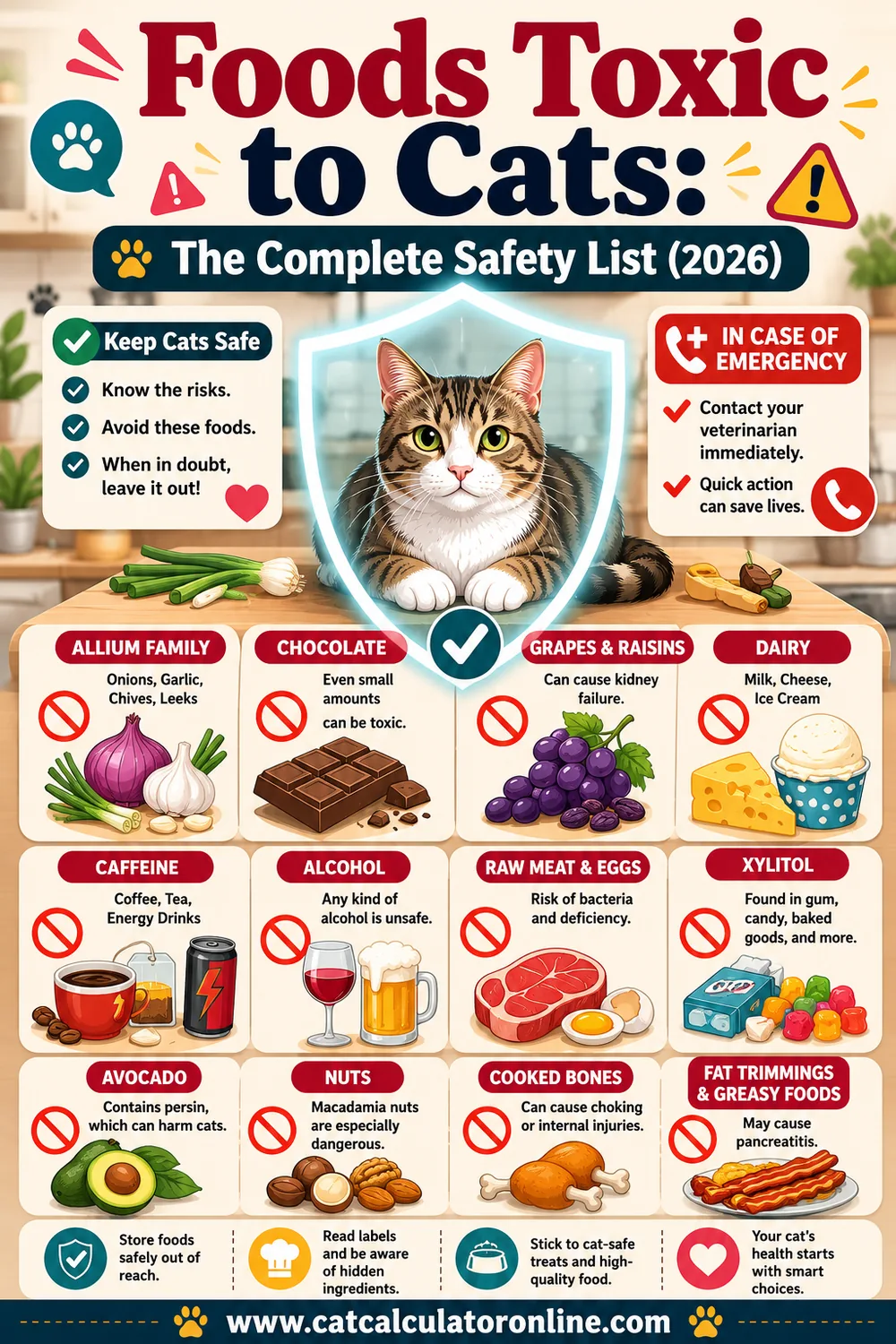
Chocolate milk, milkshakes and chocolate ice cream. Chocolate contains theobromine and caffeine, which cats process slowly. This is a genuine poisoning risk, not an upset stomach, and it belongs with the rest of the list in foods toxic to cats.
Very fatty dairy in quantity. A cat who gets into a tub of clotted cream or a block of butter is at risk of a painful pancreas inflammation as well as vomiting and diarrhea. Small licks are not the concern; a substantial fatty binge is.
Flavored yoghurts carry sugar, and often fruit purée, artificial sweeteners or chocolate. Plain and unsweetened is the only version worth considering.
Raw or unpasteurised milk adds a bacterial risk on top of the lactose, including salmonella and campylobacter, which infected cats can shed into a household.
"Cat Milk" and Lactose-Free Milk
These come up constantly, and the honest answer is more boring than the marketing.
Cat milk products are lactose-reduced and safe. They are cow's milk with the lactose broken down or removed, sold in small cartons in the pet aisle.
They are also unnecessary. They deliver calories your cat does not need, and cats do not require milk in any form after weaning. A carton is not a treat with benefits; it is a treat with a nicer label.
They still count against the treat budget. A 200 ml carton can carry a meaningful share of a small cat's daily calories, and it is easy to pour without thinking of it as food.
Human lactose-free milk is likewise not harmful, but it still carries the fat and the calories, and it is not a substitute for water.
Water is the only drink a cat needs. If she is not drinking enough, the answers are more bowls, wider bowls filled higher, water away from her food, and more wet food in the diet — not milk.
Plant milks are not an alternative. Soy, oat and almond milks are not toxic in small amounts but supply nothing a carnivore needs, and sweetened versions add sugar. Check any of them for xylitol before assuming they are harmless.
Kittens: Different Enzymes, Same Wrong Answer
The one group who can digest milk is also the group most often harmed by the wrong milk.
Kittens do produce lactase, so milk sugar is not the problem for them. The problem is that cow's milk is the wrong composition entirely.
Queen's milk is far richer than cow's milk in protein and fat, and different in mineral balance. A kitten fed cow's milk gets diluted nutrition at the exact stage where growth is fastest, and typically gets diarrhea too.
Diarrhea in a young kitten is serious. They have very little reserve, dehydrate within hours, and can drop their blood sugar dangerously. A kitten under eight weeks with watery stools needs a vet the same day, not overnight observation.
Use a proper kitten milk replacer if a kitten needs feeding, made up exactly to the instructions and fed warm. Never cow's milk, goat's milk or human infant formula.
Weaning normally begins around four weeks and is usually complete by seven to eight. Once she is eating solid food properly, she does not need milk of any kind — the sequence is set out in how to wean kittens.
And after weaning, the lactase fades. The kitten who happily drank milk at five weeks is the cat who cannot at five months, which surprises a lot of people.
If She Has Already Had Some
The reassuring bit, and the point at which it stops being reassuring.
A lick or a small amount usually causes nothing, or mild wind. No treatment needed.
A saucerful will often cause loose stools 8 to 12 hours later, sometimes with urgency, wind and a sore-looking cat. Uncomfortable, not dangerous.
Keep fresh water available and the tray clean. Diarrhea loses fluid, and a cat who is put off by a dirty tray may hold on and make things worse.
Do not withhold food. Fasting a cat is outdated advice and genuinely risky — cats who go without food for more than about a day can develop a serious liver condition. Offer her normal food in smaller amounts.
Call your vet if the diarrhea lasts beyond 24 to 48 hours, there is blood in it, she is vomiting repeatedly, she will not eat, or she seems flat, dehydrated or painful. The general picture on vomiting is in why is my cat throwing up.
Ring the same day for any kitten, any senior cat, any cat with a known illness, and any cat who ate blue cheese, chocolate dairy or something labeled sugar-free.
Never try to make her vomit at home. There is no safe household method in cats, and the products people reach for cause real harm.
Hidden Dairy, and Sharing Safely
Dairy turns up in more places than the fridge door, which is how a cat who is never given milk still ends up with a sore stomach.
Buttered toast crusts, mashed potato, creamy pasta sauces and cheese-topped leftovers are the usual suspects on a plate.
Cream cheese used to hide a tablet. It works well and a small amount is usually tolerated, but if your cat reacts badly to dairy, ask your vet for a proper pill paste instead.
Milk in the bottom of a cereal bowl left on a coffee table. Very common, very easy to fix.
Whey and dried milk powder in some treats. Worth checking the ingredients if your cat has recurring soft stools of no obvious cause.
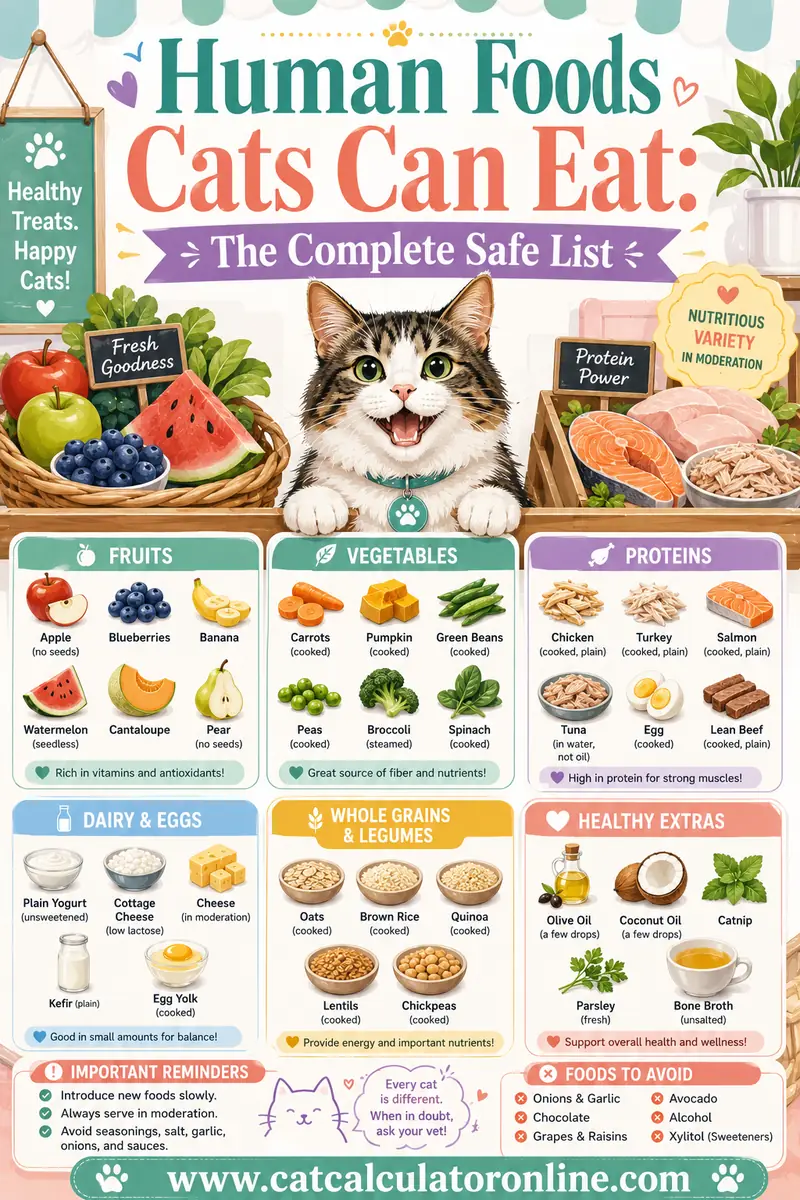
Better things to share, if she is asking: a thumbnail-sized piece of plain cooked chicken, turkey or white fish, or a little plain cooked egg. All unseasoned, boneless and skinless.
Whatever you give, take the calories out of her meal rather than adding them on top — the counting method is in cat treats: how many are too many, and the whole safe-and-unsafe map is in human foods cats can eat.
Frequently Asked Questions
Can cats eat dairy products?
Most adult cats are lactose intolerant, so dairy causes gas, bloating and loose stools rather than harm. Aged hard cheeses and butter contain almost no lactose and are usually tolerated in tiny amounts, while milk, cream and ice cream are high in it. Dairy provides nothing a cat nutritionally needs.
Why is milk bad for cats if kittens drink it?
Kittens make lactase, the enzyme that digests milk sugar, but production falls away after weaning at around eight to twelve weeks. In an adult cat the undigested lactose draws water into the bowel and ferments, producing gas and diarrhea roughly eight to twelve hours after drinking.
Can cats eat yoghurt?
A small lick of plain, unsweetened yoghurt is usually tolerated, because the live cultures have already broken down some of the lactose. Never give flavored or sweetened yoghurt, and never anything labeled sugar-free, since xylitol is dangerous to pets. Keep it to a teaspoon at most.
Is cheese safe for cats?
Aged hard cheeses such as cheddar and parmesan contain almost no lactose and most cats tolerate a pea-sized piece. They are still high in fat and salt, so they should be occasional. Blue cheese is the exception and should never be given, because the mold can produce a toxin dangerous to pets.
What should I do if my cat drank a bowl of milk?
Expect gas and loose stools about eight to twelve hours later, and keep fresh water available and the litter box clean. Do not withhold food. Call your vet if the diarrhea lasts beyond 24 to 48 hours, contains blood, or if she is vomiting repeatedly, will not eat or seems flat.
Is lactose-free cat milk worth buying?
It is safe but unnecessary. Cats have no need for milk of any kind after weaning, and these products simply add calories that count against the roughly 20–25 kcal of daily treats a 9 lb cat can have. Water is the only drink a cat actually requires.
Dairy sits in an awkward middle place: not poisonous, not useful, and uncomfortable for most adult cats because the enzyme that digests milk sugar switches off after weaning. The ranking is what to remember — milk, cream and ice cream are high in lactose and best skipped; plain yoghurt and cottage cheese are tolerated in tiny amounts; aged cheddar and parmesan carry almost none but bring salt and fat instead. Blue cheese, chocolate dairy and anything sugar-free are genuine hazards rather than intolerance. If she has already had some, expect loose stools around eight to twelve hours later, keep water available, do not fast her, and call your vet if it lasts past a day or two — sooner for a kitten. And if you want to give her something, plain cooked chicken beats a saucer of milk every time. Set the rest of her diet with the free cat food calculator.