1 Cat Year in Human Years
A one-year-old cat is roughly 15 in human years — not seven. The "multiply by seven" rule is one of the most persistent myths in pet ownership, and for a cat's first birthday it's wrong by more than double. That first year covers everything from newborn to fully sexually mature adult, which in human terms is birth through the mid-teens, so 15 is the figure veterinary bodies use. This page explains where the number comes from, what a one-year-old cat is actually like, and why cats and dogs age so differently. For your own cat's exact figure, the cat age calculator does it in one tap.

Why Is One Cat Year 15 Human Years?
Because the first year of a cat's life covers an enormous amount of development, and human years are being used as a rough measure of life stage rather than elapsed time.
Think about what a cat achieves in twelve months. It's born blind and deaf, weighing around 100 grams. Its eyes open at 7 to 10 days. It's weaned by about 8 weeks. It reaches sexual maturity somewhere between 4 and 6 months — capable of producing kittens of its own before it's half a year old. By twelve months it's essentially at adult size, adult weight and adult behavior.
Now map that onto a human. A one-year-old child can't walk reliably, can't feed itself, and is fourteen years from sexual maturity. The developmental equivalent of a one-year-old cat is not a human toddler — it's a human somewhere in the mid-teens. Hence 15.
That's the whole logic of the conversion. It isn't a claim about biological ageing rate; it's a translation of life stage into terms people already understand. Once you see it that way, the number stops looking arbitrary.
What Is the Actual Formula?
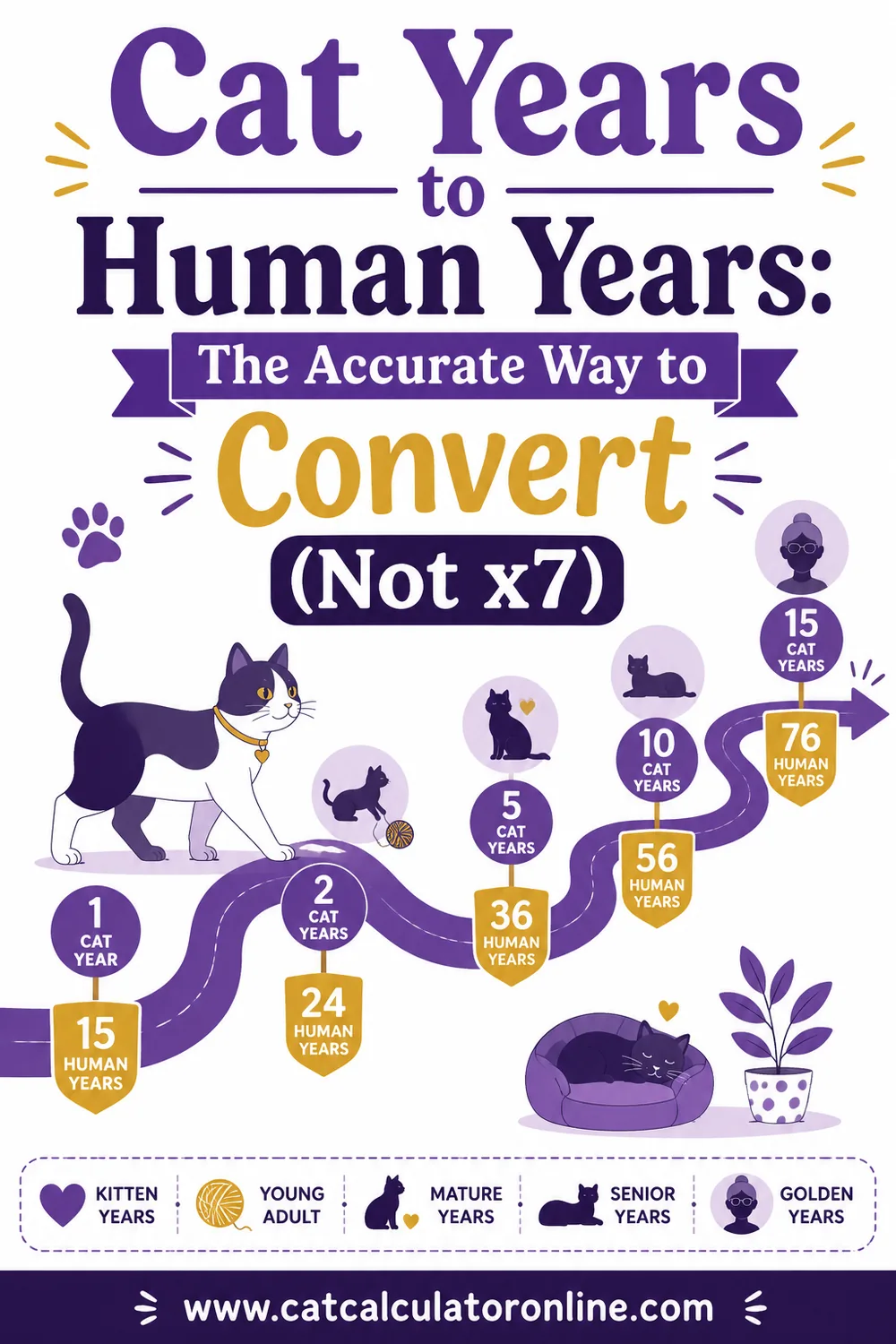
The method most veterinary sources use is straightforward, and it front-loads the early years:
| Cat's age | Add | Human-year equivalent |
|---|---|---|
| Year 1 | +15 | 15 |
| Year 2 | +9 | 24 |
| Year 3 | +4 | 28 |
| Year 4 | +4 | 32 |
| Year 5 | +4 | 36 |
| Year 6 | +4 | 40 |
| Year 7 | +4 | 44 |
| Year 10 | +4/yr | 56 |
| Year 15 | +4/yr | 76 |
| Year 20 | +4/yr | 96 |
Year one is worth 15. Year two adds 9. Every year after adds 4. That's the entire calculation, and it's why a one-year-old cat and a two-year-old cat are further apart in human terms than a ten-year-old and a twelve-year-old.
Why the front-loading? Because development is fastest at the start and then plateaus. The same pattern shows up in most mammals — a great deal happens quickly, then the rate of change slows and stays slow for years.
The full table across every age is in cat years to human years, and the reasoning behind the method is set out in how a cat age calculator works.
What Is a One-Year-Old Cat Actually Like?
Physically an adult, behaviourally not quite. The gap between those two things is what surprises most owners.
Physically: at full or near-full size for most breeds. A typical domestic cat has reached its adult weight, its adult coat has come through, and its adult teeth are all in place. Large breeds are the exception — a Maine Coon, Ragdoll or Norwegian Forest Cat keeps filling out until three or four years old, so a one-year-old of those breeds still has noticeable growing to do.
Behaviourally: somewhere between adolescent and adult. Play is still frequent and can be rough. Many one-year-olds test boundaries, climb things they shouldn't, and have bursts of energy that owners of older cats have forgotten about. The famous cat "zoomies" are at their peak around this age.
Socially: personality is largely settled by now. A cat that was well socialized as a kitten is generally confident with people at one year; a cat that wasn't is unlikely to become dramatically more outgoing without deliberate work.
Medically: the first-year vaccination course is complete, and this is the point at which most cats move to an annual check-up rhythm. It's also when the initial kitten food should be transitioning to adult food, since growth has essentially finished.
What it isn't: a cat that's "done" developing mentally. Most cats settle noticeably between one and two years, and that second year is where the wild adolescent edge softens into adult temperament — covered in 2 cat years in human years.
Why Doesn't the "Multiply by Seven" Rule Work?
It's the most common thing people believe about pet ageing, and it fails at both ends of a cat's life.
At year one it drastically undercounts. Seven would make a one-year-old cat the equivalent of a seven-year-old child. But a seven-year-old child cannot reproduce, is nowhere near full size, and is a decade from adulthood — while a one-year-old cat is a fully mature adult that could already have had two litters. The gap isn't small; it's the difference between a primary-school child and a teenager.
At the other end it overcounts. A 20-year-old cat under the ×7 rule would be 140, which is beyond any documented human lifespan. Using the proper method it comes out at 96 — remarkable, plausible, and consistent with the fact that plenty of cats do reach twenty.
Where the myth came from is not entirely clear, though the most common explanation is that it was a rough marketing simplification from the mid-twentieth century, based on dividing average human lifespan by average pet lifespan. It stuck because it's easy to do in your head, not because it's accurate.
What replaced it is the staged approach: a large jump for year one, a smaller jump for year two, then a steady annual increment. It's barely harder to remember and it's far closer to reality.
Do Cats and Dogs Age the Same Way?
No, and this is where most cross-species confusion comes from.
Cats age remarkably uniformly. A Siamese, a Maine Coon and an ordinary domestic shorthair all follow essentially the same curve. Size and breed make only a marginal difference to the conversion.
Dogs do not. A dog's ageing rate is strongly tied to size. A small terrier at seven is roughly 44 in human years; a giant breed at the same age is nearer 59. Any dog conversion has to ask what the dog weighs; a cat conversion doesn't.
| Cats | Dogs | |
|---|---|---|
| Does size change the math? | Barely | Substantially |
| Year 1 equivalent | ~15 human years | 12–15, varies by size |
| Typical lifespan | 13–17 indoor | 8–16 by size |
| Breed variation | Small | Large |
One important caution. There's a well-known 2019 study that produced a DNA-methylation "epigenetic clock" for translating dog years into human years. That study was on dogs, not cats. There is no equivalent validated formula for cats, and any source presenting one should be treated sceptically. For cats, the AAHA feline life-stage guidelines and the Cornell Feline Health Center are the reliable references.
Where cats do vary is in lifespan rather than ageing rate — indoor cats average 13 to 17 years while outdoor cats average far less, which affects how many years a cat gets rather than how fast it passes through them.
How Does Age One Fit Into the Life Stages?
The AAHA feline life-stage framework gives the practical context that a single number can't.
| Stage | Age | What it means |
|---|---|---|
| Kitten | 0–1 year | Rapid growth, socialization, vaccinations |
| Young adult | 1–6 years | Physically mature, settling behaviourally |
| Mature adult | 7–10 years | Middle age; weight and dental issues appear |
| Senior | 10+ years | Twice-yearly checks; kidney and thyroid screening |
A one-year-old cat is right at the boundary — the day it leaves kittenhood and enters young adulthood. That transition is why the first birthday carries so much practical change: food switches from kitten to adult, the vaccination schedule moves to boosters, and the growth chart stops being relevant.
What to focus on at this age: establishing the adult feeding routine and portion size, getting weight monitoring into a habit before middle-age creep starts, keeping up dental care from the beginning rather than after problems appear, and maintaining the play and enrichment that a young adult cat still very much needs.
What not to worry about: a cat that still behaves like a kitten at one year is entirely normal. The behavioral settling happens across the second year, not on the first birthday. Full detail on the stages is in cat life stages explained, and the growth side is in kitten growth chart.
If you'd rather work backwards — from a human age to the cat equivalent — that reverse conversion is in human years to cat years.
How Accurate Is the Number Anyway?
Worth being honest about, because a single figure implies more precision than exists.
It's a convention, not a measurement. Nobody has established that a one-year-old cat is biologically identical to a fifteen-year-old human. What the number does is map two developmental timelines onto each other so people can reason about their cat's stage of life. Treated that way it's genuinely useful; treated as a measurement it isn't.
Individual cats vary. Two cats of the same age can be in visibly different condition depending on genetics, diet, weight, dental health and whether they've lived indoors or out. A well-kept indoor cat of twelve may be in better shape than a neglected cat of eight, and no formula captures that.
The early figures are the firmest. Development in the first two years is fast and well documented, so 15 and 24 are reasonably solid. The later increments are smoother approximations, which is why every source uses a flat +4 rather than pretending to more precision.
Different sources give slightly different numbers. You'll see a one-year-old cat given as 15 in most places and occasionally as 12 or 18. The variation reflects where each source draws the line on "maturity" rather than any real disagreement, and the differences are small enough not to matter practically.
What the number is genuinely good for: understanding that your cat's first year is developmentally enormous, recognizing when a cat crosses into middle age and old age, and knowing when to change food, vaccination rhythm and check-up frequency. Those are all real decisions, and the conversion helps with all of them.
Frequently Asked Questions
How many human years is 1 cat year?
About 15. The first year of a cat's life covers development from newborn to fully sexually mature adult, which corresponds roughly to a human's first fifteen years. It is not seven — that rule undercounts the first year by more than half.
Why is a 1-year-old cat 15 in human years?
Because the conversion translates life stage rather than elapsed time. A one-year-old cat has reached adult size, adult teeth and sexual maturity, all of which a human reaches in the mid-teens.
Is a 1-year-old cat still a kitten?
Technically it has just stopped being one. Under AAHA guidelines, kittenhood runs from birth to one year, after which a cat is a young adult. Behaviourally, though, many one-year-olds still act like kittens well into their second year.
Do big cat breeds age more slowly?
Not meaningfully. Unlike dogs, cats age at a fairly uniform rate regardless of breed or size. Large breeds such as Maine Coons keep growing until three or four years old, but their ageing curve is much the same.
What should change when a cat turns one?
Kitten food transitions to adult food, the vaccination schedule moves to boosters, and check-ups typically become annual. It's also a sensible point to start monitoring weight regularly, since middle-age weight gain is common.
Can I use the dog DNA age formula for my cat?
No. The 2019 epigenetic clock study that produced that formula was conducted on dogs, and there's no validated feline equivalent. For cats, use the AAHA life-stage guidelines rather than any DNA-based formula.
One cat year is about fifteen human years, because the first twelve months take a cat from newborn to fully mature adult. That single fact is what makes the multiply-by-seven rule fail so badly at the start of a cat's life. Get your own cat's exact number, at any age, with the cat age calculator.