Cat Weight Chart by Age: Kitten to Adult (With Breed Ranges)
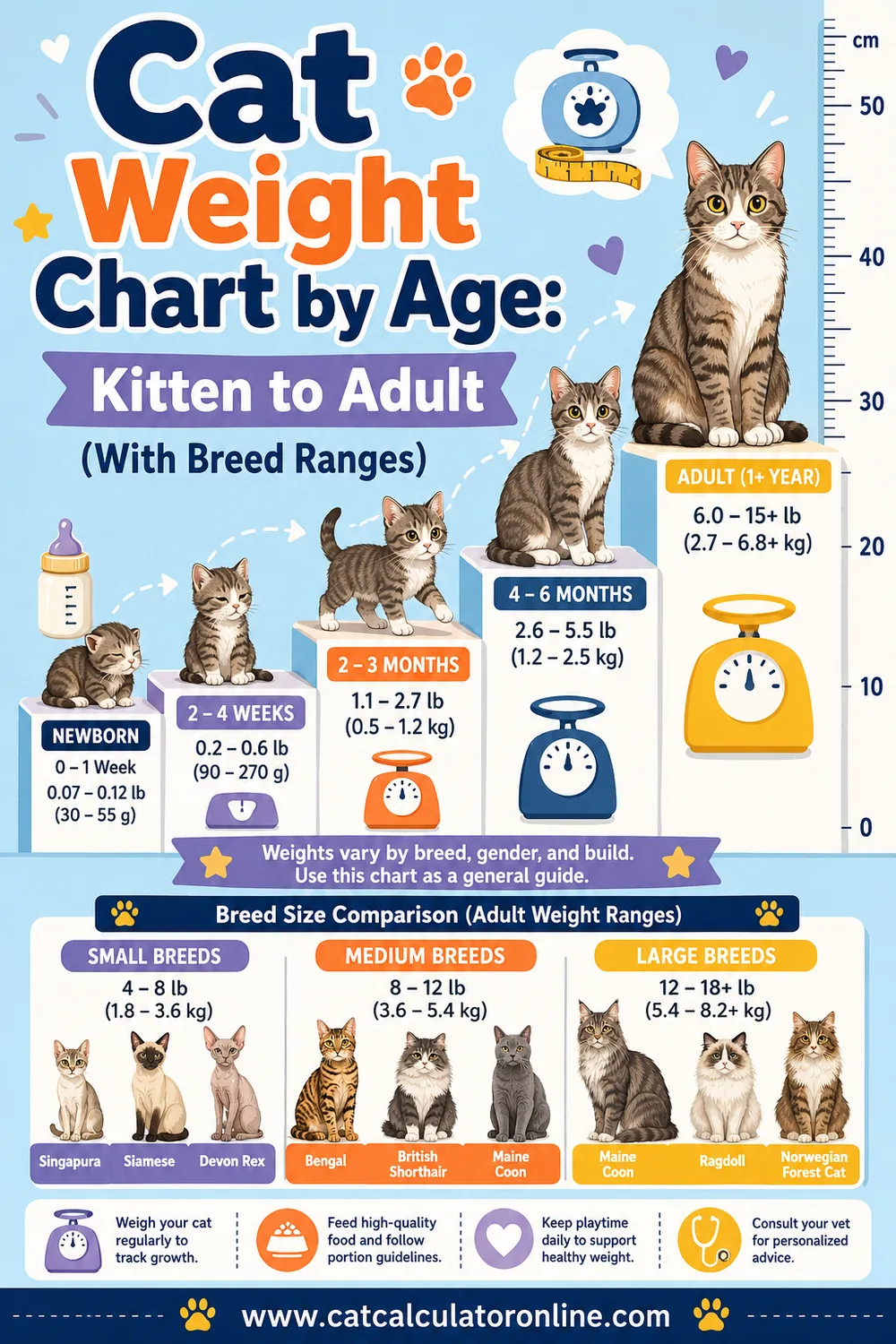
A healthy kitten roughly gains a pound a month for the first six months, so a good rule of thumb is that a kitten's age in months matches its weight in pounds — 3 months ≈ 3 pounds, 5 months ≈ 5 pounds. Growth then slows, and most cats reach their adult weight of 8 to 12 pounds somewhere around 10 to 12 months old.
The charts below give you the full picture, from newborn grams to adult ranges by breed size. If you'd rather just find out whether your cat's current weight is where it should be, our free cat ideal weight calculator gives you a personalized target in a few taps.
📈 What should my cat weigh at this age?
Tap an age for the typical healthy weight:
Tap an age above to see the typical healthy weight.
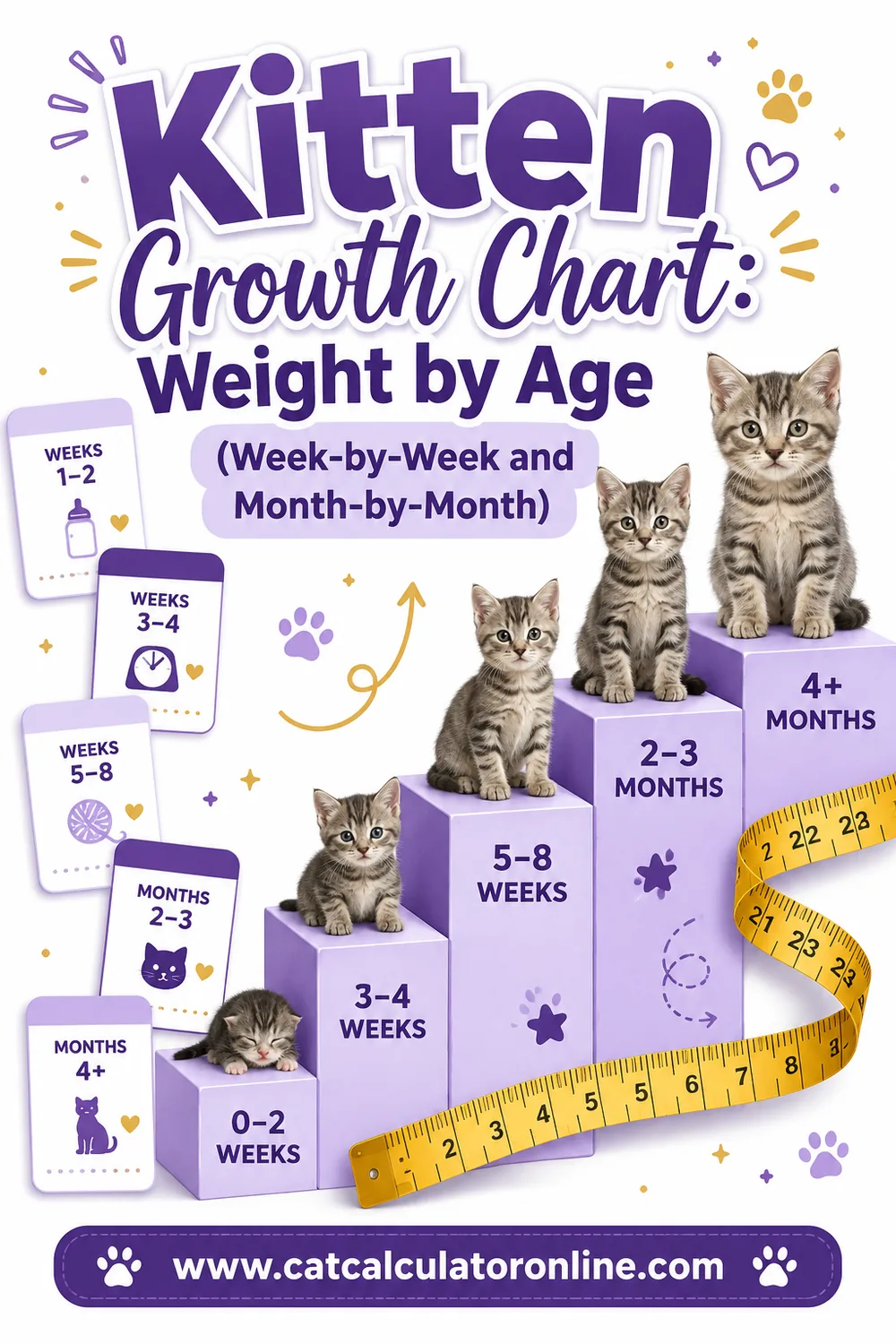
Kitten Weight Chart: Birth to 12 Months
Kittens grow fast and predictably, which makes weight one of the best early health indicators you have. A kitten who stops gaining is telling you something before any other symptom shows up.
| Age | Typical weight | What's happening |
|---|---|---|
| Newborn | 3–4 oz (85–115 g) | Eyes closed; nursing constantly |
| 1 week | 5–7 oz (140–200 g) | Eyes opening around days 7–10 |
| 2 weeks | 7–10 oz (200–280 g) | Starting to wobble around |
| 3 weeks | 10–13 oz (280–370 g) | Baby teeth coming in |
| 4 weeks | 13–16 oz (370–450 g) | First taste of solid food |
| 6 weeks | 1.3–1.8 lb (600–800 g) | Eating mostly solids |
| 8 weeks | ~2 lb (900 g) | Fully weaned; ready to rehome |
| 3 months | ~3 lb | Vaccination series underway |
| 4 months | ~4 lb | Adult teeth start replacing baby teeth |
| 5 months | ~5 lb | Spay/neuter window for many vets |
| 6 months | ~6 lb | Growth rate begins slowing |
| 8 months | ~7 lb | Filling out rather than lengthening |
| 10 months | 7–10 lb | Near adult size |
| 12 months | 8–12 lb | Adult weight for most breeds |
The "one pound per month" rule
Through the first six months, a healthy kitten gains roughly 1 pound per month, or about 4 ounces (110 g) per week. That makes the month-equals-pound shortcut surprisingly reliable for average-sized kittens.
It breaks down in two places: very young neonates (measure in grams and expect about half an ounce of gain per day), and large breeds after six months, which keep growing well past the point where the rule stops.
For a more detailed week-by-week breakdown with feeding amounts, see the kitten growth chart.
Adult Cat Weight Chart by Breed Size
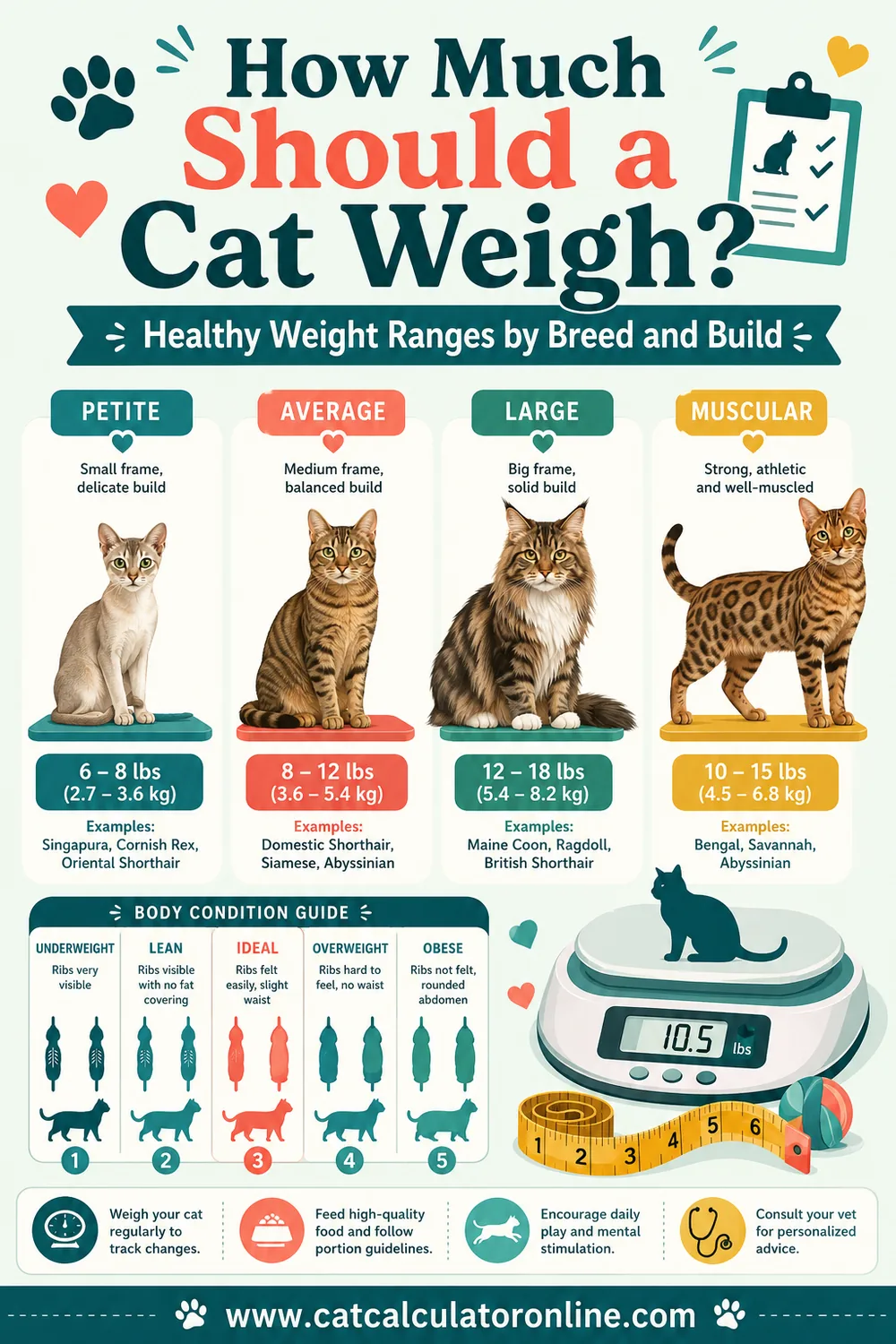
Once a cat is grown, age stops being the useful variable and frame takes over. Here's how adult ranges sort out by build.
| Build | Typical adult weight | Example breeds |
|---|---|---|
| Small / fine-boned | 5–9 lb | Singapura, Devon Rex, Cornish Rex |
| Slender / oriental | 6–10 lb | Siamese, Abyssinian, Balinese, Oriental Shorthair |
| Medium (most cats) | 8–12 lb | Domestic shorthair, domestic longhair, Persian, Russian Blue |
| Sturdy / cobby | 9–15 lb | American Shorthair, British Shorthair, Bengal |
| Large | 10–18 lb | Norwegian Forest Cat, Siberian, Ragdoll |
| Extra large | 12–20+ lb | Maine Coon (males), Ragdoll (males), Savannah |
Two takeaways from this table. First, the ranges overlap heavily — a 12-pound cat could be a slightly chubby domestic shorthair or a lean Ragdoll. Second, sex matters: males typically run 2 to 4 pounds heavier than females of the same breed.
If you want to know where your specific cat should sit, how much should a cat weigh walks through the breed ranges in more detail.
Senior Cat Weight: What Changes After 10
Weight charts almost always stop at "adult," which leaves out a stage where weight matters most.
Older cats commonly lose weight as muscle mass declines, even when they're eating normally. Some of that is expected aging. But unexplained loss in a senior cat is one of the most common early signs of hyperthyroidism, chronic kidney disease, diabetes, and dental pain — all of which are far more treatable when caught early.
Practical guidance for cats 10 and up:
- Weigh monthly instead of a few times a year.
- Treat a loss of more than about 5% of body weight as worth a vet call — that's just half a pound on a 10-pound cat.
- Don't assume a thinning senior is "just old." Get bloodwork.
What the Chart Can't Tell You
A weight chart gives you a reference point, not a verdict. Three reasons the number alone can mislead:
- Frame size varies enormously. A small-boned cat at 12 pounds is overweight; a big-boned cat at 12 pounds may be lean.
- Coat hides everything. Long-haired cats look substantial even when they're underweight. Assess by hand, not by silhouette.
- Muscle weighs more than fat. An athletic cat and a sedentary cat at the same weight are in very different shape.
This is why vets use body condition score (BCS) — a 9-point hands-on scale where 4 to 5 is ideal. Each point above 5 means roughly 10% over ideal body weight, so ideal weight = current weight ÷ (1 + 0.10 × (BCS − 5)). A 13-pound cat at BCS 7 has a target around 10.8 pounds.
Our cat ideal weight calculator runs that formula and gives you a target you can actually work toward.
What If Your Kitten Is Off the Chart?
Plenty of perfectly healthy kittens sit above or below these numbers, and a single reading rarely means much on its own. What matters is the direction of travel.
Reasons a kitten might weigh less than the chart suggests:
- She was the runt of the litter, or came from a large litter where food was shared thin
- She's a small or fine-boned breed — a Devon Rex kitten will never track a Maine Coon's curve
- Her exact age is a guess, which is common with rescues and strays
- She's carrying intestinal parasites, which are extremely common in young kittens and easily treated
Reasons she might weigh more:
- She's a large or slow-maturing breed
- She's male — male kittens usually outpace their sisters from a few weeks old
- She's simply big-framed
The signals that actually warrant a call to the vet are these: no weight gain at all over a week in a kitten under six months, any weight loss, or a kitten who's lethargic, has a poor coat, or isn't interested in food. A kitten who's a little under the chart but gaining steadily, playing hard, and has bright eyes and a clean coat is almost always fine.
One practical tip: rather than comparing your kitten to a chart every week, compare her to herself. Plot her weight on a piece of paper and look at the line. A steady upward slope is what you want. A flat stretch is the thing to act on.
How to Weigh Your Cat Accurately
Cats rarely sit still on a bathroom scale, and most home scales won't register small changes well. Use the subtraction method:
- Step on the scale alone and note the reading.
- Pick up your cat and step on again.
- Subtract the first number from the second.
For kittens, that's not precise enough. Use a digital kitchen scale with a bowl or basket on top — you need to detect gains of a few ounces. Zero the scale with the empty basket, then add the kitten.
Consistency helps more than precision: weigh at the same time of day, before a meal, and write it down. A trend over three months tells you far more than any single reading.
Weight Milestones Worth Watching
| Milestone | Why it matters |
|---|---|
| Doubling birth weight by ~1 week | The clearest early sign a neonate is thriving |
| ~2 lb at 8 weeks | Standard readiness marker for rehoming |
| Steady gain through 6 months | A plateau in a kitten warrants a vet visit |
| Stable weight at 1–6 years | Weight creep here is the usual start of feline obesity |
| Any drop after age 10 | Common early signal of treatable senior illness |
The pattern to look for is simple: kittens should gain steadily, adults should hold steady, and seniors shouldn't drop unexplained.
Feeding to Hit the Right Weight
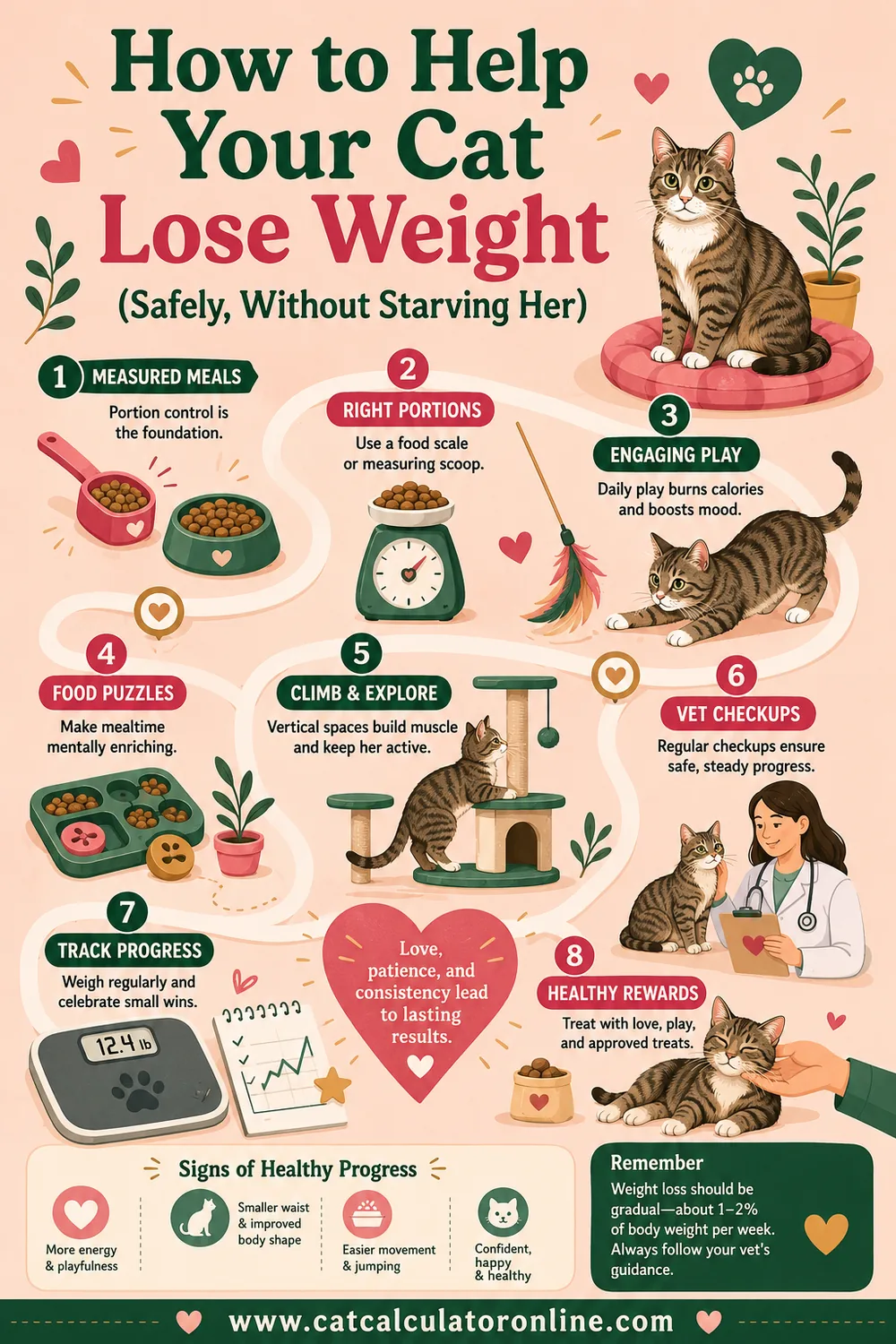
Portion size is the biggest lever most owners have. A rough guide for adults is about **20 kcal per pound of ideal body weight per day** — note that it's ideal weight, not current weight, that sets the target.
A few things that keep cats on track:
- Measure portions. Free-feeding dry food is the most common cause of slow weight gain in indoor cats.
- Count treats. They add up faster than owners expect.
- Adjust after neutering. Neutered cats need noticeably fewer calories, and portions often don't get adjusted.
- Recheck annually. Needs change with age and activity.
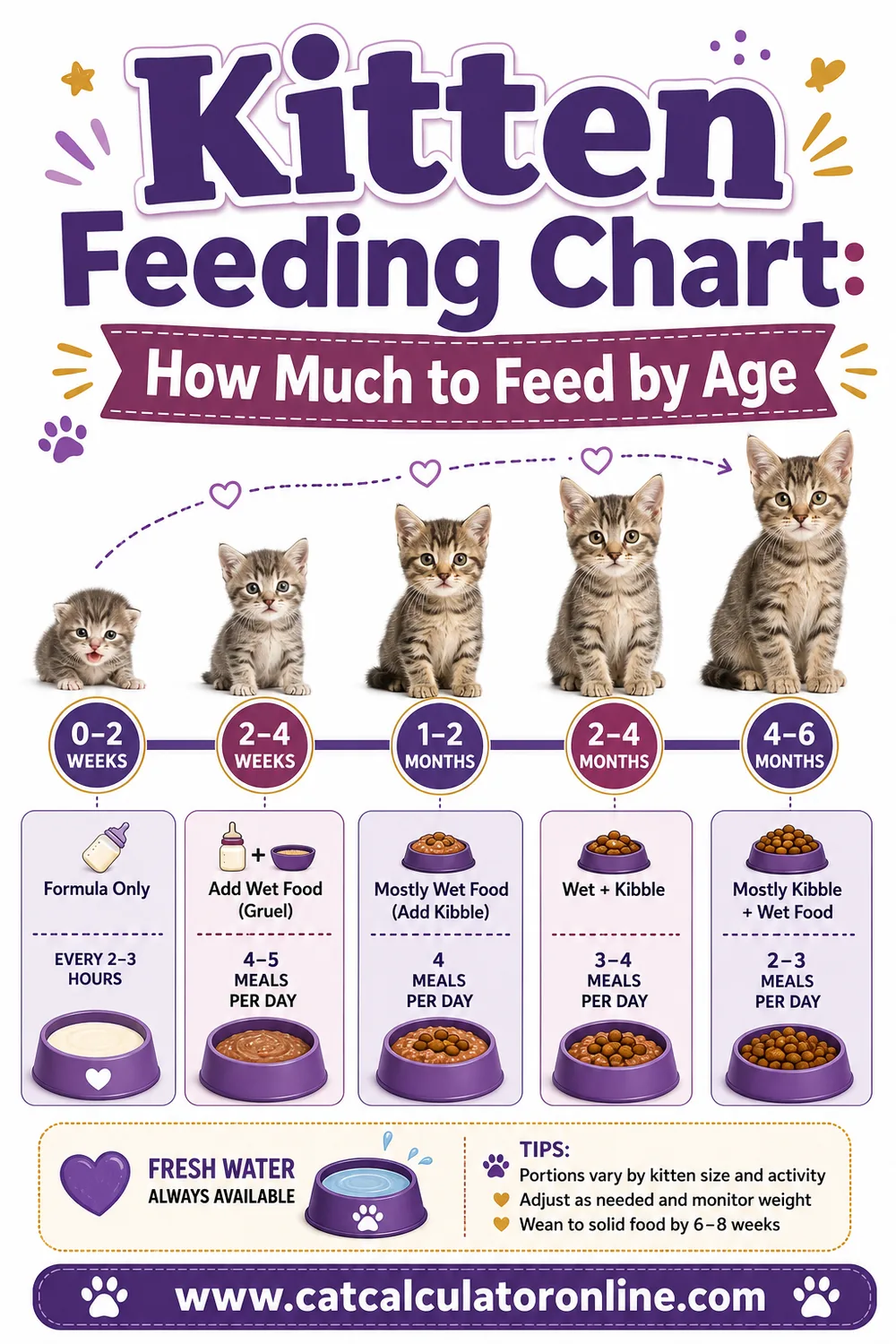
Our cat food calculator turns your cat's target weight into a daily calorie and portion figure. For kittens, the kitten feeding chart gives amounts by age.
FAQ
How much should a 6-month-old kitten weigh?
About 6 pounds for an average-sized kitten, following the rough rule of one pound per month of age. Large breeds like Maine Coons will already be heavier, and small breeds lighter.
When do cats stop growing?
Most cats reach their adult weight around 10 to 12 months old. Large slow-maturing breeds such as Maine Coons, Norwegian Forest Cats, and Ragdolls keep filling out until three or four years of age.
Is 14 pounds overweight for a cat?
For an average domestic shorthair, yes — that's meaningfully above the typical 8 to 12 pound range. For a Maine Coon or Ragdoll male, 14 pounds can be perfectly healthy. Check body condition rather than the scale.
How often should I weigh my cat?
Every few months for a healthy adult, monthly for kittens and for cats over 10, and weekly if your vet has you on a weight-loss plan.
My cat lost weight but is eating normally. Should I worry?
Yes, that combination is worth a vet visit, especially in an older cat. Weight loss with a normal or increased appetite is a classic pattern for hyperthyroidism and diabetes.
Does neutering make cats gain weight?
Neutering lowers a cat's calorie needs, so cats gain if portions stay the same. It's not inevitable — it just means resetting the food amount after surgery.
The Bottom Line
Kittens should gain about a pound a month until six months, most cats settle at 8 to 12 pounds by their first birthday, and breed frame explains almost all the variation after that. Use the charts as a reference, but let your hands make the final call — ribs easy to feel, a visible waist from above.
For a target tailored to your cat instead of an average, run her numbers through the free cat ideal weight calculator, then use the cat food calculator to match her daily portions to that goal.