Cat Birth Complications: When to Call a Vet
Most cats give birth without help, which is exactly why the warning signs need to be memorized rather than looked up mid-panic. The one number to hold onto is 20 to 30 minutes: strong, purposeful straining for that long with no kitten produced means phone the vet, not wait for the next push. The second is two hours — the longest gap between kittens that is acceptable while she is actively straining with more still due. Everything else on this page is either an extension of those two rules or a post-birth problem that appears in the following days and weeks. If you want to know how close she is to any of this, the cat pregnancy calculator gives you the date.

Which Signs During Labor Mean Call Now?
Learn these before the night they matter. Any one of them is a phone call, not a discussion.
Strong, purposeful straining for 20 to 30 minutes with no kitten produced. The definitive obstruction sign.
More than two hours between kittens while she is actively straining and more are still expected.
A kitten visible at the vulva and not advancing after a few minutes. Do not pull. Traction on a stuck kitten causes serious injury to the queen and the kitten.
Green, black or foul-smelling discharge before the first kitten arrives. This means placental separation without delivery, and the kitten's oxygen supply is already compromised. After a kitten has been born, greenish material is expected.
Heavy or continuous bleeding, as opposed to the blood-tinged fluid that accompanies each birth.
Extreme lethargy, collapse, pale or bluish gums, or a queen who has become detached from what is happening around her.
Stage one running beyond 24 hours without progressing to visible straining.
Pregnancy past about day 70 with no labor at all. Gestation is roughly 63 to 65 days, commonly quoted as nine weeks, with about 61 to 72 days being the normal range.
Obvious severe distress — screaming rather than the loud vocalising many queens do routinely.
The sequence these interrupt is described in cat labor signs.
What Is Dystocia and Why Does It Happen?
Dystocia simply means difficult birth, and knowing the categories helps you understand what the vet is deciding between.
Obstructive dystocia. Something physically blocks delivery: an oversized kitten, an abnormal presentation such as a head turned back or a leg tucked, two kittens presenting together, or a maternal pelvis that is too narrow — often the legacy of an old pelvic fracture.
Uterine inertia. The uterus fails to contract effectively. Primary inertia means labor never gets going properly, and is more likely in very large litters, very small ones with a single big kitten, obesity, and older queens. Secondary inertia is exhaustion after a long or obstructed labor.
Fetal death part-way through a litter can stall the process and is one reason a green-black discharge before delivery is taken seriously.
Breed matters. Flat-faced (brachycephalic) breeds such as Persians and Exotic Shorthairs have measurably higher cesarean rates, because kitten head shape sits awkwardly against the maternal pelvis. If you have one, discuss the plan with your vet before the due date.
Age and body condition matter. Both very young queens and obese queens carry more risk, which is one reason feeding matters so much through pregnancy — the specifics are in what to feed a pregnant cat.
Dystocia is genuinely uncommon in cats overall, at a few percent of births in the general population, but far higher in some pedigree lines.
What Will the Vet Actually Do?
Knowing this reduces the reluctance to call, which is the main reason owners wait too long.
Assessment first. History (how long, how hard, how many kittens so far), a physical examination, and usually an X-ray or scan to see how many remain and where they are.
Medical management may be tried where there is no obstruction and the queen is not exhausted: oxytocin to strengthen contractions, sometimes with calcium, under veterinary supervision. Never give oxytocin or calcium at home. Given into an obstructed uterus, oxytocin can rupture it.
Manual assistance for a kitten sitting in the birth canal, performed with proper lubrication and technique.
Cesarean section where obstruction cannot be relieved or the queen is deteriorating. Recovery in cats is usually quick and most queens can nurse within hours.
Time is the variable that decides the outcome. Kittens still inside an obstructed uterus lose viability steadily, so a call at 30 minutes and a call at four hours are different conversations with different results.
Cost is a fair question to ask on the phone. Out-of-hours caesareans are expensive, and knowing roughly what to expect is better established before the emergency than during it.
What Are the Warning Signs After the Birth?
The birth ends and a new watch list begins. These are the four that matter most.
Retained placenta. Suspect it when the placenta count did not match the kitten count. Signs appear over the following days: dullness, fever, loss of appetite, an unpleasant discharge.
Metritis — infection of the uterus, often in the first week. Fever, a foul-smelling vaginal discharge, lethargy, refusing food, reduced milk, and neglected kittens. Urgent veterinary treatment.
Mastitis — infection or inflammation of one or more mammary glands. The gland is hot, hard, swollen, sometimes discoloured, and clearly painful. Milk may look abnormal. She may resist nursing. Needs treatment, usually antibiotics, and kittens may need supplementary feeding while it resolves.
Eclampsia — dangerously low blood calcium, most often one to four weeks after birth when milk demand peaks. It starts as restlessness, panting and a slightly odd gait, then progresses to muscle tremors, stiffness, staggering, collapse and seizures. This is a true emergency, it moves quickly, and it responds well to prompt treatment. It is also the reason not to supplement calcium during pregnancy on your own initiative — over-supplementing beforehand suppresses the queen's own calcium-regulating machinery and makes eclampsia more likely, not less.
Normal lochia — a reddish-brown discharge — continues for up to about three weeks and should not smell foul.
| Sign | Likely meaning | Urgency |
|---|---|---|
| Hard straining 20–30 min, no kitten | Obstruction | Call immediately |
| Over 2 hours straining between kittens | Obstruction or inertia | Call immediately |
| Kitten visible, not advancing | Obstruction | Call immediately, do not pull |
| Green/black discharge before kitten one | Placental separation | Call immediately |
| Heavy continuous bleeding | Hemorrhage | Emergency |
| Collapse, pale gums, unresponsive | Shock or hemorrhage | Emergency |
| Past day 70, no labor | Overdue or wrong dates | Same-day call |
| Fewer placentas than kittens | Possible retention | Call within 24 hours |
| Fever, foul discharge, off food | Metritis | Same-day, urgent |
| Hot, hard, painful gland | Mastitis | Same-day |
| Tremors, stiffness, restlessness | Eclampsia | Emergency, any hour |
| Kitten losing weight 2 days running | Failing to thrive | Same-day call |
Which Signs Are Normal and Do Not Need a Call?
Just as useful, because unnecessary panic burns the energy you need later.
Loud vocalising during contractions. Queens can be theatrical. Noise alone is not a complication.
Panting between contractions. Normal. Persistent labored breathing with pale or blue gums is not.
Eating the placentas. Instinctive and harmless, occasionally followed by a day of loose stools.
Kittens born tail first. About a third arrive backwards and in cats this is a normal presentation.
Blood-tinged fluid accompanying each birth.
Greenish discharge after a kitten has been delivered. It is the separating placenta and it is expected.
A calm pause mid-litter. Interrupted labor is a real and normal feline pattern and can last 24 to 36 hours. The queen must be bright, warm, comfortable, nursing and not straining — those conditions are what make it benign. Details are in how long does cat labor last.
Refusing food during labor itself. Expected in the final 24 hours. Keep food available regardless, and never withhold food from a cat deliberately at any point — cats that stop eating can develop hepatic lipidosis within days.
What Complications Affect the Kittens?
The litter has its own failure modes, and they show up fast.
Failing to breathe at birth. Usually because the sac was not opened. If a kitten is still enclosed after about a minute, tear the membrane at the nose and rub it briskly with a towel. Do not swing it.
Chilling. Newborns cannot regulate their own temperature and a cold kitten stops feeding, which makes it colder. Keep the nest area around 72 to 77°F (22 to 25°C). Never feed a chilled kitten — warm it slowly first, because a cold gut cannot digest.
Failing to latch. Colostrum in the first 24 hours carries the antibodies that protect a kitten for weeks. A kitten not nursing in the first few hours is a same-day veterinary call.
Fading kitten syndrome. A kitten that is quiet, limp, cool and losing weight. Daily weighing is how you catch it early — two consecutive days of weight loss is the trigger.
Cleft palate and other defects. Milk appearing at the nose during feeding is the classic sign and needs checking.
Rejection. Sometimes because the queen is unwell, sometimes because she has detected a problem in that kitten. Either way it is a reason to involve a vet rather than simply pushing the kitten back. What normal early development looks like is set out in newborn kitten care week by week.
How Do You Reduce the Risk Before the Birth?
Most of the useful work happens weeks earlier.
Get an X-ray from day 40 to 45. Knowing the kitten count is the difference between "she has finished" and "there is one left inside". It is the single most useful piece of preparation available.
Keep her lean and correctly fed. Obesity raises the risk of uterine inertia. Underfeeding a late-pregnancy queen is equally unhelpful.
Move to a growth diet around week four or five and keep her on it through lactation.
Do not supplement calcium during pregnancy without veterinary direction.
Discuss any medication with the vet. Many worming and flea products are not licensed for pregnancy, and live vaccines are avoided entirely.
Keep her indoors from around week eight so she does not give birth somewhere you cannot reach.
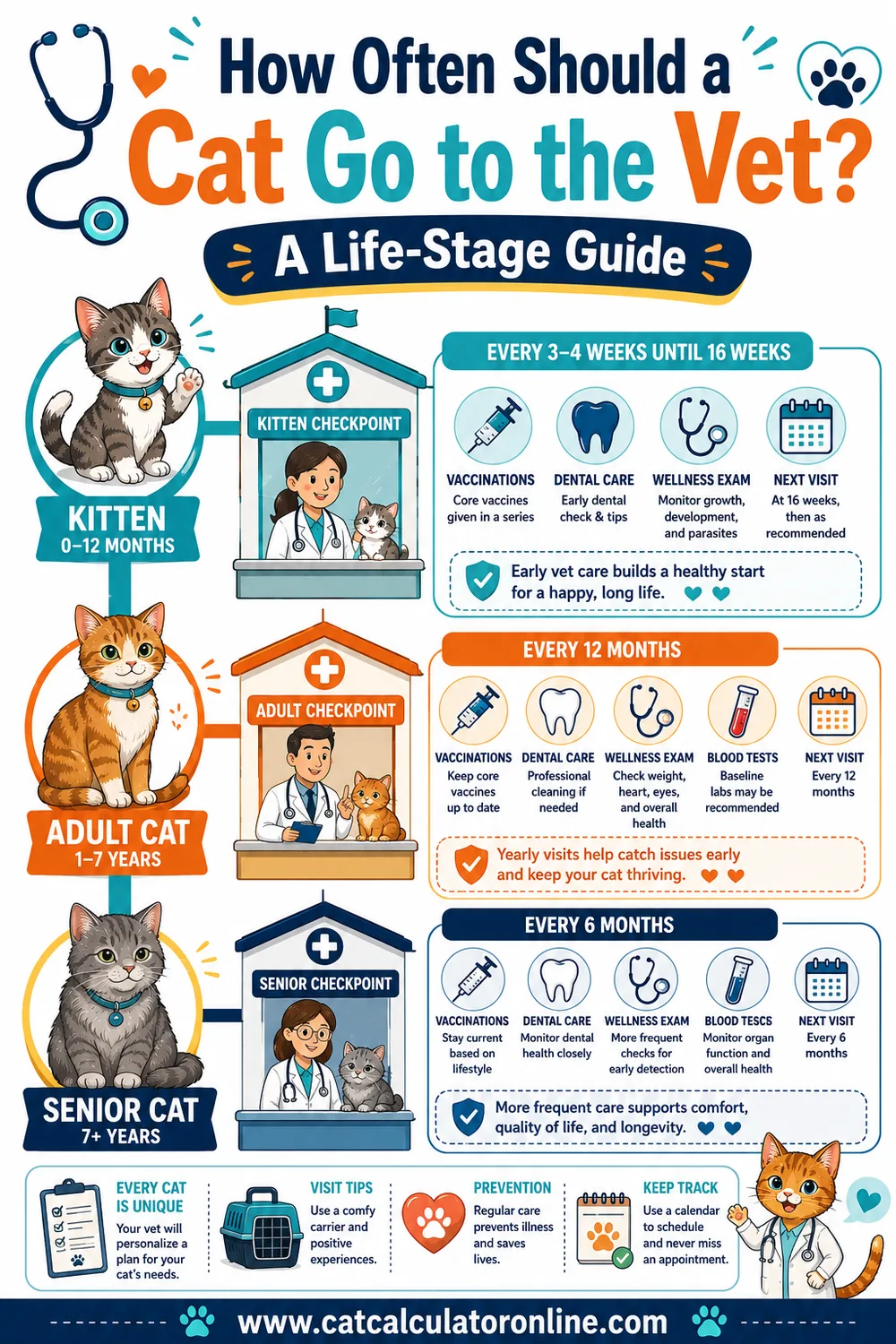
Know your out-of-hours provider before the day — which practice, how far, and roughly what an emergency cesarean costs. Regular preventive care generally is covered in how often should a cat go to the vet.
What Should You Have Ready to Tell the Vet?
A good phone call is short and factual, and it starts triage sooner.
How far into the pregnancy she is, or the mating date if you have one.
When straining started, and whether it is strong and purposeful or intermittent.
How many kittens so far, and at what times. A written log beats memory every time.
How many placentas, and whether she ate them.
Whether there is discharge, and its color and smell.
Her general state — bright and alert, or dull, cold, panting, unresponsive.
Expected litter size if you had an X-ray.
Her breed, age, and whether she has had litters before. A three-year-old moggie on her second litter and a two-year-old Persian on her first are assessed differently.
Any medication or supplement she has had. Including anything given with good intentions. What normal support looks like during the birth itself is in what to do when your cat gives birth.
Frequently Asked Questions
How long can a cat strain without producing a kitten?
Strong, purposeful straining should produce a kitten within 20 to 30 minutes. Beyond that, treat it as an obstruction and call your vet. Weak, intermittent straining is less alarming, but if the first kitten has not arrived within about an hour of pushing beginning, phone the practice.
Is green discharge normal when a cat gives birth?
After a kitten has been delivered, greenish material from the separating placenta is normal. Green, black or foul-smelling discharge before the first kitten is not — it indicates placental separation without delivery and needs immediate veterinary attention.
What is eclampsia in cats?
Dangerously low blood calcium, usually appearing one to four weeks after birth when milk demand peaks. Signs run from restlessness and panting to tremors, stiffness, staggering and seizures. It is a true emergency requiring immediate treatment, and calcium supplements should never be given at home.
Do cats need a cesarean often?
Not usually. Dystocia affects only a small percentage of feline births overall. Rates are considerably higher in flat-faced breeds such as Persians, where kitten head shape complicates delivery, so those queens are worth planning for with your vet in advance.
What happens if a placenta is retained?
It can cause metritis, a uterine infection, over the following days. Watch for fever, a foul-smelling discharge, lethargy, loss of appetite and neglected kittens. Count placentas against kittens during the birth and report a mismatch to your vet within 24 hours.
Should I take my cat to the vet after she gives birth?
A check within 24 to 48 hours is worth booking. It confirms nothing has been retained, assesses her mammary glands, and gives the kittens a first once-over. Bring your written log of birth times, kitten weights and placenta count.
Feline birth complications are uncommon but unforgiving, and the difference between a good and bad outcome is usually measured in how long someone waited. Memorize the two numbers: 20 to 30 minutes of hard straining with no kitten, and two hours of straining between kittens while more are due. Add green or black discharge before the first kitten, heavy bleeding, collapse, and any pregnancy running past day 70. After the birth, the watch list is retained placenta, metritis, mastitis and eclampsia — the last being a genuine emergency that typically arrives one to four weeks in. Get an X-ray count from day 40 to 45, keep a written log on the night, and use the cat pregnancy calculator so you know exactly where she is.