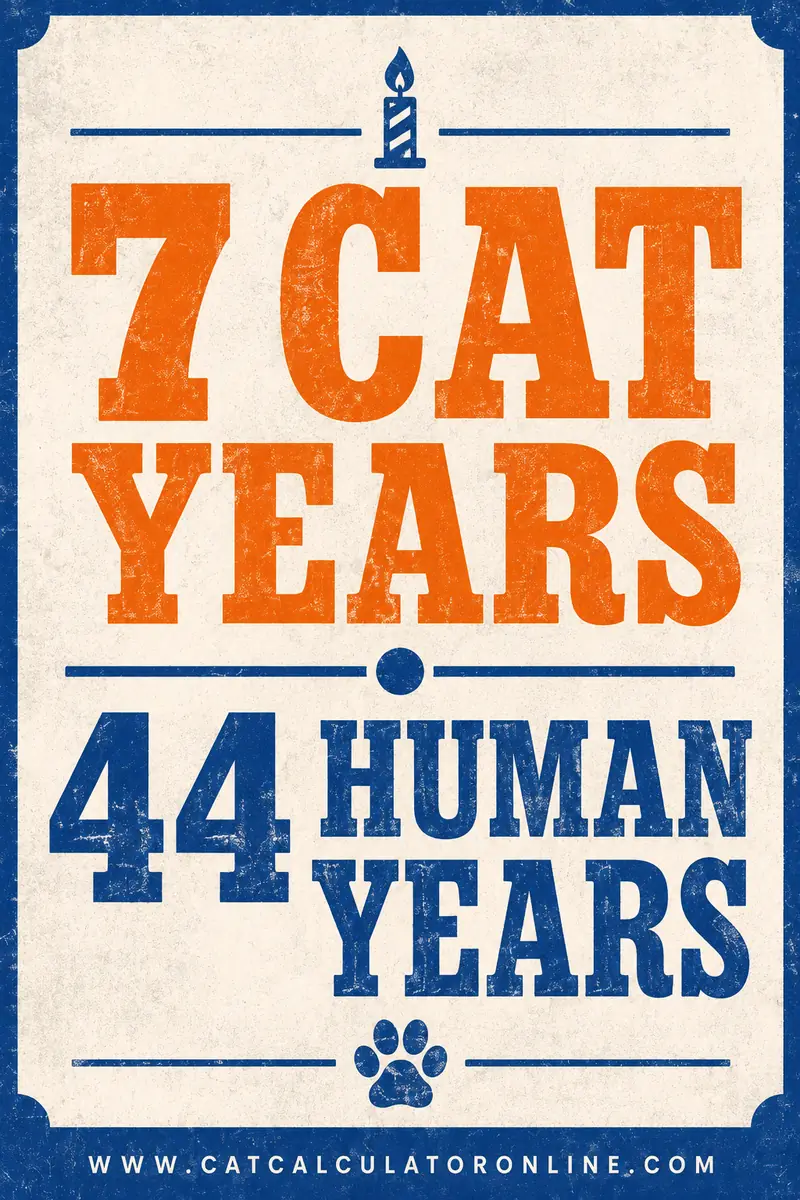
7 Cat Years in Human Years
A seven-year-old cat is about 44 in human years, and seven is the birthday where something genuinely changes. Under the AAHA feline life-stage guidelines a cat becomes a mature adult at seven — the feline equivalent of middle age — and that's the point at which routine screening starts being worth doing. Nothing visible happens. Your cat looks and behaves exactly as it did at six. What changes is the medicine: the conditions that define feline old age begin appearing in this decade, and they are all far more treatable when caught before symptoms. This page covers the math, the stage boundary, and what a sensible seven-year check-up should include. Any age converts with the cat age calculator.
How Do You Get 44?
The same arithmetic that has applied since the second birthday.
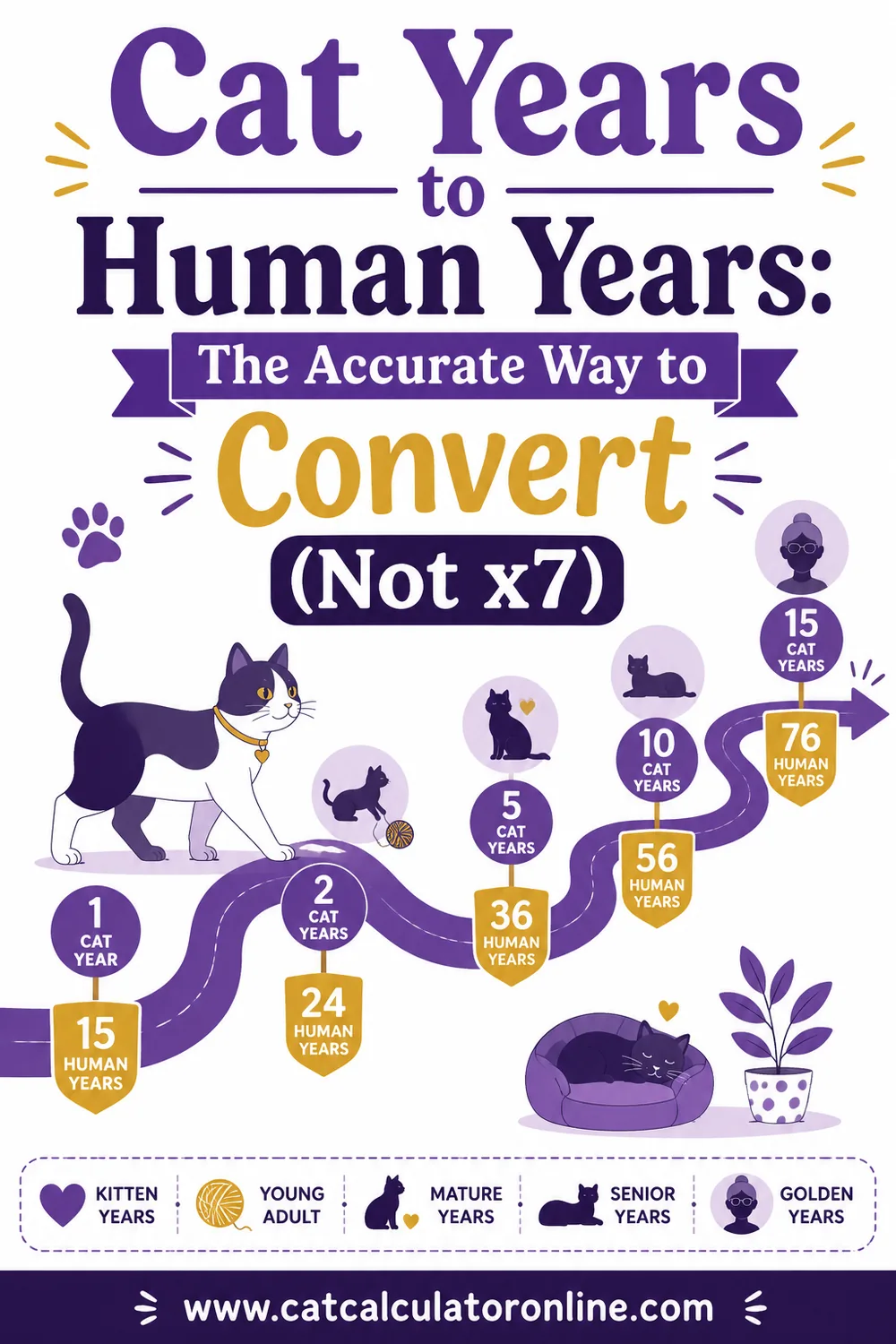
15 for year one, 9 for year two, 4 for every year after. By seven: 24 + (5 × 4) = 44.
| Cat's age | Human years | Life stage |
|---|---|---|
| 5 | 36 | Young adult |
| 6 | 40 | Young adult |
| 7 | 44 | Mature adult — middle age |
| 8 | 48 | Mature adult |
| 9 | 52 | Mature adult |
| 10 | 56 | Senior |
| 12 | 64 | Senior |
| 15 | 76 | Senior |
Forty-four is a fair description. A person in their mid-forties is not old, is generally in good health, and is at precisely the age where sensible medicine shifts from treating problems to looking for them. The same logic applies here.
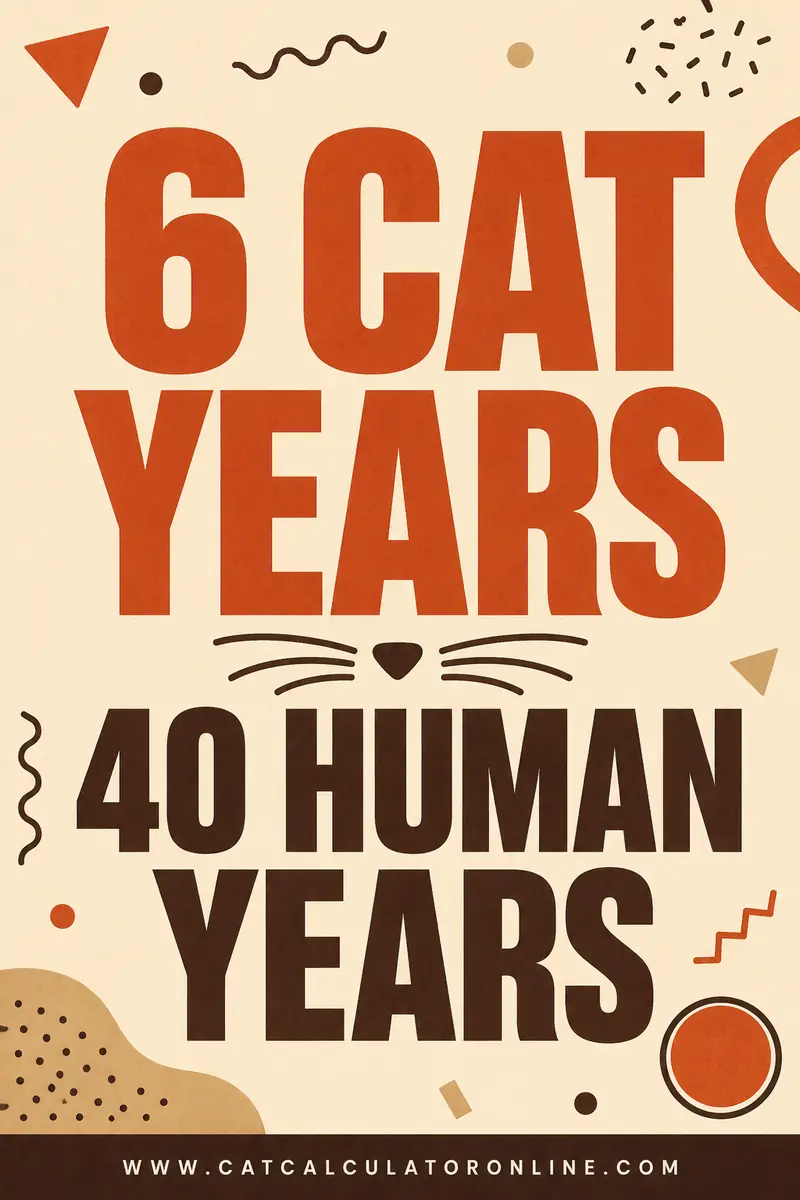
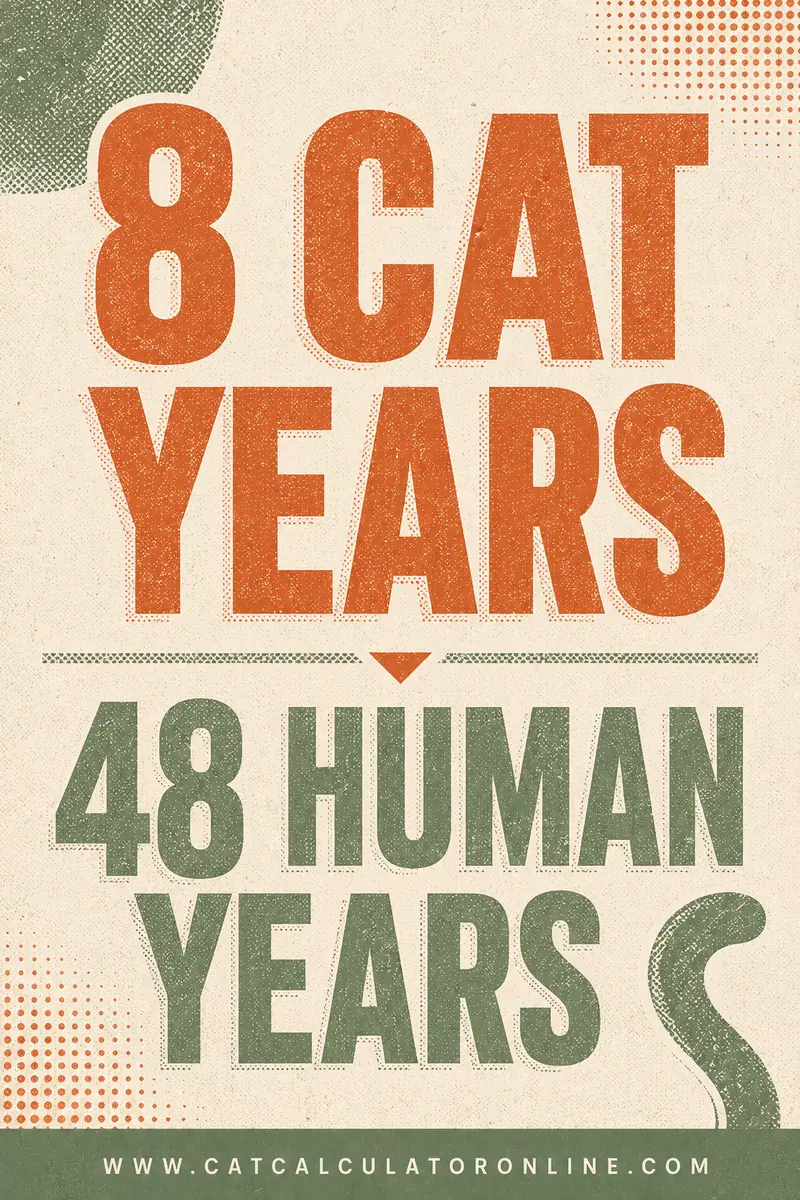
The years on either side are in 6 cat years in human years and 8 cat years in human years, the complete table in cat years to human years, and the method in how a cat age calculator works.
What Does the Mature Adult Stage Actually Mean?
It's a clinical boundary rather than a visible one, and understanding that difference matters.
Nothing about your cat changes on its seventh birthday. It doesn't slow down, look older, or need different food. Owners who expect a visible transition are rightly puzzled when nothing happens.
What changes is the prior probability of disease. The conditions that dominate feline old age — chronic kidney disease, hyperthyroidism, diabetes, hypertension, dental disease and arthritis — all start becoming meaningfully more likely from around this age. At four, screening a healthy cat finds almost nothing. At seven, it starts finding things, and finding them early is the entire point.
The clinical shift, in practice:
- Annual bloodwork becomes a reasonable default rather than optional
- Blood pressure measurement enters the routine
- Urine testing alongside blood, because early kidney disease often shows in urine concentration before blood values move
- Dental treatment becomes a matter of when, not whether
- Weight is watched in both directions, where previously only gain mattered
Why early detection matters so much here. Chronic kidney disease is the clearest example: a cat typically loses a large share of kidney function before any outward sign appears, and by the time an owner notices increased drinking, the disease is already established. Catching it a stage earlier changes management from crisis to routine, and it materially affects how long the cat lives comfortably. The condition is covered in chronic kidney disease in cats.
What Should the Seven-Year Check-Up Include?
Worth asking for specifically, because not every practice runs the full set unprompted.
A full physical examination — weight and body condition, teeth and gums, heart and lungs, abdominal palpation, thyroid gland palpation, lymph nodes, coat, eyes and ears.
Blood panel. Kidney values including creatinine and urea, and ideally SDMA, which rises earlier than creatinine in kidney disease. Liver enzymes. Blood glucose. Electrolytes. A complete blood count.
Total T4 (thyroid). Hyperthyroidism is one of the most common endocrine conditions in middle-aged and older cats, and it's eminently treatable when caught.
Urinalysis. Specific gravity — how concentrated the urine is — is one of the earliest indicators of declining kidney function, often changing before blood values do. This is the test most commonly skipped and among the most informative.
Blood pressure. Feline hypertension is common, silent, and causes retinal damage and kidney injury before anything visible occurs. Some cats go blind from it with no prior warning.
Dental assessment, with a direct question about what grade of disease is present and whether a scale and polish is warranted this year.
Weight compared against the trend, not just recorded.
What to bring: your own weight log, an honest account of appetite and drinking, and anything that's changed however small. A year of owner observation is more informative than a fifteen-minute exam, and the vet has no access to it unless you provide it.
What Should You Watch For at This Age?
The signals change subtly from what mattered at five, and the direction of the weight signal reverses.
Weight loss becomes the more urgent sign. Up to now, gain was the concern. From seven onward, unexplained loss is the signal that matters more — and the classic pattern is losing weight while eating more, which is close to textbook hyperthyroidism. It's a condition that responds very well to treatment, and the detail is in hyperthyroidism in cats.
Increased thirst and urination. The cardinal early sign of kidney disease and diabetes both. Larger clumps in the litter box, more frequent trips, or a water bowl that empties faster than it used to.
Appetite changes in either direction, and particularly a cat that is hungrier than usual without gaining.
Vomiting that becomes regular. Occasional hairballs are normal; vomiting more than about once a month is not, and shouldn't be dismissed as a cat thing.
Jumping and perching behavior. Cats with early arthritis stage their jumps, choose lower spots, and stop using the top of the wardrobe. It reads as preference and is usually discomfort.
Grooming quality. A coat that starts looking slightly unkempt over the back and hips generally means either joint pain or dental pain — both make grooming harder.
Litter box position. Going beside the box rather than in it frequently means the sides have become uncomfortable to climb rather than that the cat has developed an opinion.
Night vocalisation. Worth investigating rather than accepting. Hyperthyroidism, hypertension, hearing loss and early cognitive change can all present this way.
Does Anything About Daily Care Change?
Less than the medical picture suggests, and the changes that do help are cheap.
Food: a healthy seven-year-old doesn't need a senior diet. What matters is the portion, the protein quality, and — increasingly — the moisture. If your cat is entirely on dry food, this is a sensible age to introduce wet, because hydration matters more as kidneys age.
Water: more access points, ideally a fountain. Cats have a weak thirst drive and hydration is one of the few kidney-relevant things an owner directly controls.
Play: unchanged. Two short interactive sessions a day. A seven-year-old cat that has stopped playing entirely is not "getting older" — it's usually uncomfortable somewhere.
Home setup: if you haven't already, add a step or stool to favorite high spots and put a low-sided litter box in. Neither is needed yet. Both are much better learned before they're needed.
Warmth: older cats seek heat, and this starts earlier than most people expect. A warm bed in a draught-free spot is appreciated well before a cat looks old.
Weighing: monthly, recorded. From here, the trend line is a genuine diagnostic tool, and a cat that has quietly lost 300 grams over six months is telling you something no examination will catch as early.
What not to do: start supplements, switch to a prescription diet, or make changes in response to the birthday rather than to the cat. Seven is a screening milestone, not a treatment milestone.
Is Seven Old for a Cat?
No — and the framing matters, because the wrong answer leads to both complacency and unnecessary gloom.
In lifespan terms, a seven-year-old indoor cat is roughly at the midpoint. Indoor cats average 13 to 17 years and a good number reach 20, so seven leaves the majority of life still ahead.
In clinical terms, seven is when the medicine starts changing — not because the cat is old but because it's now old enough for the odds to shift.
What the number is genuinely useful for: at 44, most people accept that a check-up is sensible even when they feel fine. Applying the same reasoning to a cat is exactly the right instinct, and "he's only seven" is precisely the thought that delays a diagnosis by two years.
The encouraging part. Almost everything on the screening list is treatable and manageable when found early. Hyperthyroidism is very treatable. Early kidney disease is managed with diet and monitoring for years. Hypertension responds to medication. Dental disease is fixable. The reason to screen at seven isn't that something is wrong; it's that if something is, this is when finding it changes the outcome.
What Does Middle Age Look Like Across a Whole Year?
Useful framing, because the changes at this stage are gradual enough to miss month to month.
Over twelve months at seven, a healthy cat should barely change. Weight steady within a hundred grams or so. Same appetite, same drinking, same litter box output, same jumping ability, same coat condition. Boring is exactly right.
What drifts, quietly: activity declines a little each year from about two, so a seven-year-old plays somewhat less than it did at four. Sleep creeps up. Muscle mass begins a very slow decline that accelerates later. None of it is visible across a month; all of it is visible across three years.
Which is why the record matters more than the observation. Your impression of whether your cat has changed is unreliable, because you see it daily and the change is slow. A weight log and a couple of photographs from the same angle each year are far more honest than memory.
What a year of good middle-aged care looks like: twelve monthly weights recorded, one full veterinary screen, teeth brushed most days, two play sessions most days, and a note of anything that shifted. That's the whole program, and it costs one appointment plus a few minutes a week.
And the payoff is specific. Cats whose kidney disease is caught at an early stage live substantially longer and more comfortably than those diagnosed when symptoms appear. Same for hyperthyroidism, diabetes and hypertension. The screening isn't defensive medicine — it's the difference between managing a condition and reacting to a crisis.
Frequently Asked Questions
How many human years is 7 cat years?
About 44. The method is 15 for the first year, 9 for the second, then 4 for each year after — giving 24 at age two plus five further years at four each.
Is a 7-year-old cat a senior?
No. Under AAHA feline life-stage guidelines, seven marks the start of the mature adult stage — the feline equivalent of middle age. The senior stage begins at ten.
What tests should a 7-year-old cat have?
A full blood panel including kidney values and ideally SDMA, total T4 for thyroid, blood glucose, a urinalysis with specific gravity, and a blood pressure reading, alongside a physical exam and dental assessment.
Why is weight loss more concerning than weight gain at seven?
Because unexplained loss in a middle-aged cat often signals hyperthyroidism, kidney disease or diabetes. The classic pattern is losing weight while eating more, which strongly suggests an overactive thyroid.
Does a 7-year-old cat need senior food?
Not routinely. A healthy seven-year-old does well on good adult food in the right portion. Increasing the proportion of wet food is worth considering, since hydration becomes more important as kidneys age.
How often should a 7-year-old cat see a vet?
Annually as a minimum, moving to twice yearly from the senior stage at ten. Any change in drinking, appetite, weight or litter box habits warrants an appointment regardless of when the last one was.
Seven cat years is about 44 human years, and it's the birthday where the medicine changes even though the cat doesn't. Ask for bloods, a urine test, a thyroid level and a blood pressure reading — not because anything is wrong, but because this is the decade when finding things early genuinely changes what happens next. Convert any age with the cat age calculator.