Why Is My Cat Meowing So Much?
There is one question that sorts this out faster than anything else: is the meowing new, or has she always been like this? A cat who has been noisy for years is doing something learned — adult cats barely meow at each other, so meowing at you is a behavior she developed because it works on you, and behavior that works can be changed. But a cat who was quiet and has suddenly become vocal, particularly one over ten, is a medical question until proven otherwise. Hyperthyroidism, high blood pressure and age-related confusion all announce themselves this way. Knowing her age in human terms helps you judge which camp she is in — the free cat age calculator does it in one tap.
Start Here: Is This New, or Has She Always Been Loud?
Everything else follows from this one answer, so be honest about it before you read on.
A lifelong talker is a personality, not a problem. Some cats have been holding conversations since kittenhood. That is temperament and, often, breeding — and the useful work is managing it rather than curing it.
A quiet cat who has become noisy is giving you information. Cats do not develop new habits for no reason. Something changed: her body, her routine, her household, or what happens when she vocalises.
Timescale matters more than volume. A gradual increase over two years in an aging cat and a sudden change over ten days are different stories with different answers.
Write down when it happens for three days. Times, situations, what you did, whether it stopped. It sounds fussy, and it is the single most useful thing you can hand a vet.
Age tips the odds heavily. Under seven, behavioral causes dominate. Over eleven, medical causes climb fast, and the sensible order is vet first.
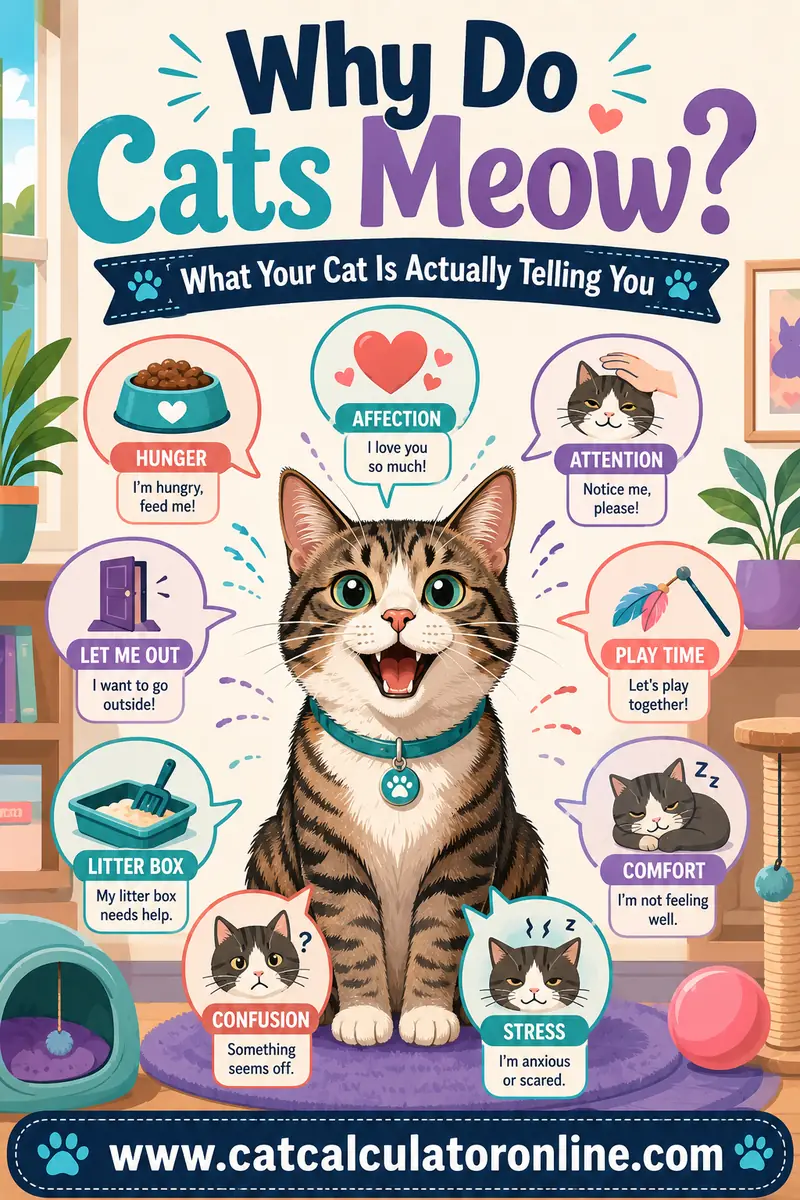
If you want the plain explanation of why cats vocalise at all, the wider picture is in why cats meow — this page is about the cat doing it too much.
Why Meowing Works On You (And Why That Matters)
This is the mechanism behind most non-medical excessive meowing, and understanding it is what makes the fix obvious.
Adult cats hardly meow at each other. Between themselves they use scent, posture, tail position and a different set of sounds. Meowing is largely something kittens do to their mothers — and something adult cats keep doing at humans, because we respond.
Every response is a lesson. Getting up, opening a door, putting food down, or even saying "no" teaches her that the sound produces a result. Attention counts as a result, and irritated attention counts too.
Intermittent rewards are the strongest kind. If you hold out nine times and cave on the tenth, you have not taught her to stop. You have taught her to keep going for longer, because persistence pays. This is why demand meowing gets worse in households that try to ignore it half-heartedly.
She is not being manipulative. She has simply learned which noise operates the human. That is closer to a light switch than to spite.
Which is why the fix is timing, not volume. You change what you reward and when, rather than trying to stop the sound directly.
And it is why punishment fails. Shouting, spraying water or shutting her out adds fear without removing the reward, and a frightened cat vocalises more.
The Medical Causes Worth Ruling Out First
Some conditions produce vocalising early and obviously, which makes a noisy cat a genuinely useful early warning.
| Cause | Typical cat | Other signs to look for |
|---|---|---|
| Overactive thyroid | Usually over 10 | Eating well but losing weight, restless, poor coat, sometimes vomiting |
| High blood pressure | Senior, often alongside kidney or thyroid disease | Night yowling, disorientation, sudden blindness, bumping into things |
| Kidney disease | Middle-aged to senior | Drinking and urinating more, weight loss, patchy appetite |
| Pain, often arthritis | Any age, common over 8 | Reluctance to jump, stiffness after sleep, grumpy when handled |
| Cognitive decline | Usually over 12 | Yowling at night, staring at walls, litter box lapses, altered sleep |
| Hearing loss | Older cats, white cats | Loud, oddly pitched meowing because she cannot hear herself |
| Being genuinely hungry | Any age, often on a diet | Food-focused, thin, hunting the bin — see below |
The thyroid one deserves emphasis. An overactive thyroid speeds everything up: appetite, heart rate, restlessness, voice. It is common, it is very treatable, and it is diagnosed with a blood test rather than a guess. The full picture is in hyperthyroidism in cats.
Blood pressure is the one most often missed at home, because the early signs look like behavior. A senior cat wandering and calling at 3am should have her blood pressure checked.
Pain rarely looks like crying. Cats in pain more often become vocal in a general, irritable way — and they usually change something else too, like where they sleep.
Ask for the boring tests. Bloods, urine, blood pressure and a thorough physical will find or exclude nearly all of it. That is a diagnosis for your vet to make, not you.
Night Yowling: The Version That Wakes the House
Vocalising after dark has its own short list of causes, and they skew medical in older cats.
In a senior cat, treat it as a symptom. Thyroid disease, blood pressure, pain and cognitive decline all peak at night, when the house is quiet and there is nothing else to focus on.
Cognitive decline has a recognizable shape. She stands in a doorway or at the bottom of the stairs, calls into an empty room, and settles once you appear and touch her. It is disorientation rather than a demand.
In a young cat it is usually simpler. Boredom, an empty stomach at 4am, or the habit of being fed by a person who once got up.
Cats are naturally most active at dawn and dusk, so a burst of noise at 5am is not abnormal behavior — it just collides badly with human sleep.
Practical night measures help either way. A night light for an elderly cat, a late meal split from the evening portion, a warm bed near where you sleep, and a solid play session in the hour before bed.
Never lock a confused older cat out of reach of you. It reliably makes the calling worse. Managing an aging cat well is covered in caring for a senior cat.
Could She Be Calling?
If your cat is not neutered, this explanation outranks all the others.
A female in season yowls, loudly and for days. It is a long, rolling, almost mournful sound that owners frequently mistake for pain. She will also roll, rub everything, raise her rear and try hard to get outside.
It comes back every two to three weeks through the breeding season until she is mated or spayed, so it is not a one-off.
Entire males are noisy for the opposite reason. They call, spray, roam and fight, especially if there is a female in season anywhere nearby.
Cats can start young. A first season at five months is normal, and four months happens, so "she is only a kitten" is not a reason to rule it out.
Neutering resolves it. The full sign-by-sign description is in cat in heat behavior.
Spayed cats do not call. If a neutered cat starts making that sound, it is worth a vet visit rather than an assumption.
Boredom, Loneliness and the Under-Stimulated Indoor Cat
This is the biggest non-medical cause after learned demand meowing, and the most fixable.
Watch the pattern. Boredom meowing follows you around the house, starts when you sit down at a laptop, and stops the moment something interesting happens.
Indoor cats need the hunt, not just the toy. Short bursts that end in a catch and a small meal mirror the natural cycle and settle a cat far better than a toy left on the floor.
Two sessions of ten to fifteen minutes beats one long one. Cats hunt in short, intense episodes and then sleep — a marathon play session just tires you out. There is more detail in how much playtime a cat needs.
Food puzzles change the day. Making her work for part of her ration gives her something to do and slows down the meal, which reduces the between-meal complaining.
Vertical space and a window seat matter. A cat with somewhere high to sit and something moving to watch has a job.
Loneliness is real but not automatic. A second cat sometimes helps and sometimes creates a worse problem, so it is a decision to make slowly rather than a fix for noise.
How to Reduce Demand Meowing Without Being Cruel
Here is the part people get wrong, and the one rule that must never be broken.
Never withhold food to quieten a cat. Cats that stop eating for even a day or two can develop a serious liver problem (hepatic lipidosis), and it is far more dangerous than the noise. Feed her properly. Change the timing, not the amount.
Reward the silence, not the sound. Feed, greet or open the door in a quiet moment. If she is mid-meow, wait for the two-second gap and then act. That gap is the thing you are teaching.
Expect it to get worse before it gets better. When a reliable strategy suddenly stops working, animals try harder first. This burst is normal, it usually lasts a few days, and giving in during it is the one thing that undoes the whole plan.
Everyone in the house has to do the same thing. One person caving keeps the habit alive for everybody.
Use a timed feeder to break the association with you. If the machine delivers breakfast at 6am, you stop being the button she presses.
Give her a better way to ask. Some cats settle brilliantly once they have a taught alternative — sitting by the bowl, or a mat you reward her on.
If she is genuinely hungry, that is a different problem. A cat who is thin, food-obsessed or on a reduced ration needs the ration reviewed, not ignored — see why your cat is always hungry.
Some Cats Are Simply Loud
Before you treat a talkative cat as broken, check whether she was ever going to be quiet.
Oriental breeds are famously vocal. Siamese, Balinese, Oriental Shorthairs, Tonkinese and Burmese talk constantly, at volume, with unusual range. It is a well-known breed characteristic rather than a fault.
Bengals and Sphynx cats also tend toward noisy. Active, people-focused breeds usually are.
Persians and British Shorthairs are typically quiet. So are many mixed-breed cats, which is why a chatty domestic shorthair surprises people.
Kittens and adolescents talk more. Vocalising often settles somewhat between one and three years.
Some cats get louder with age simply because they hear less. A deaf cat cannot moderate her own volume.
Managing is a legitimate goal. With a genuinely vocal breed, aim to reduce demand meowing and accept the commentary.
When to Call the vet
Vocalising is a symptom often enough that it is worth knowing exactly where the line sits.
Book an appointment if the meowing is new or noticeably increased over weeks, if your cat is over ten, or if it comes with weight change, drinking more, appetite change or altered sleep.
Book sooner if she yowls at night, seems disoriented, bumps into furniture, or calls while using the litter box.
Treat it as an emergency if a cat cries while straining in the tray and passes little or nothing — in male cats especially, this can be a blocked bladder and it becomes life-threatening within hours. Sudden, distressed howling with hiding, panting or a dragged back leg also needs same-day attention.
Ask for the full workup rather than a spot check. Bloods, urine and blood pressure together are what actually catch the common culprits.
Take a phone video. Vocalising is the classic symptom that stops the moment you reach the consulting room.
Do not accept "she is just old" without tests. Age is not a diagnosis, and most of the causes on this list are treatable. Routine check-up timing is covered in how often a cat should see the vet.
Frequently Asked Questions
Why is my cat meowing so much all of a sudden?
A sudden increase in vocalising is a symptom until a vet says otherwise, especially in a cat over ten. Overactive thyroid, high blood pressure, kidney disease, pain and cognitive decline all present this way. Book a check with bloods, urine and blood pressure before treating it as behavior.
Should I ignore my cat when she meows for food?
Do not ignore the meal — never withhold food from a cat, as even a day or two without eating risks serious liver problems. Instead, feed on a fixed schedule or a timed feeder so the food no longer arrives in response to noise, and give attention during quiet moments.
Why does my cat meow at night?
In a young cat, usually boredom, hunger or a learned habit, made worse because cats are naturally most active at dawn and dusk. In a cat over ten, night yowling is commonly linked to thyroid disease, high blood pressure or cognitive decline and should be checked by a vet.
Do cats meow to each other?
Rarely. Adult cats communicate with each other mainly through scent, body language and other sounds such as hissing or growling. Meowing is largely kitten-to-mother behavior that cats keep using on humans, because humans respond to it. It is essentially a human-directed sound.
Will getting a second cat stop the meowing?
Sometimes, if the cause is boredom in a young, playful cat. But a badly matched or badly introduced second cat creates territorial stress that can make vocalising worse permanently. Treat it as a decision about your household, not a quick fix for noise.
Is excessive meowing a sign of pain?
It can be. Cats in pain more often become generally vocal and irritable than obviously distressed, and they usually change something else too — where they sleep, how they jump, how they react to being touched. Any new vocalising with a change in movement deserves a vet visit.
The honest summary is that excessive meowing splits neatly into two piles. The learned kind is a conversation your cat has been having with you for years, and it responds to changing what gets rewarded — feed on a schedule, answer the quiet not the noise, expect a few worse days in the middle, and never try to solve it by withholding food. The other kind is new, and new is a symptom: a cat who was quiet and now is not, especially past ten, needs bloods, urine and a blood pressure reading before anyone calls it behavior. Start by working out where your cat sits on the age curve with the free cat age calculator, then decide which of the two you are dealing with.