Best Litter Box Size for Cats
The rule that solves most litter box problems is simple: the box should be at least 1.5 times the length of your cat, measured nose to the base of the tail. For an average adult cat that means somewhere around 24 inches long, and almost nothing sold as a "cat litter tray" comes close. Too-small boxes are one of the most common reasons cats start going elsewhere, and it's a fix that costs less than a vet visit — plenty of owners solve months of frustration with a large plastic storage tub. This page covers the sizing rule, covered versus open, entry height, and what changes for kittens, seniors and big breeds. If you're pricing up the ongoing side of cat ownership, the cat cost calculator puts litter in context.

What Size Should a Litter Box Be?
Length: at least 1.5 times your cat's body length, nose to the base of the tail — not including the tail itself.
Width: at least the cat's body length, so they can turn around comfortably.
Depth of sides: 5–7 inches for an adult cat that digs, less if entry is a problem.
| Cat | Body length | Box should be at least |
|---|---|---|
| Kitten (3 months) | 8–10 in | 12–15 in |
| Small adult | 14 in | 21 in |
| Average adult | 16–18 in | 24–27 in |
| Large adult | 20 in | 30 in |
| Maine Coon / Ragdoll | 22–24 in | 33–36 in |
Now compare that with what's in the shops. A typical open tray is 15 to 18 inches long, and a covered box is often smaller inside than its external dimensions suggest. Most cats in most homes are using a box that's too small, which is why this is such a productive thing to check first.
How to measure your cat: stand them up, measure from the nose to where the tail meets the body, multiply by 1.5. If your cat is 17 inches, you want a 25-inch box.
A cat should be able to get in, turn around fully, dig a hole, position itself, cover up afterwards, and get out — without touching the sides or standing in a previous deposit. That's a lot of manoeuvring, and it needs room.
Why Does Size Matter So Much?
Because cats are fastidious, and a cramped box fails them in several ways at once.
They can't dig and cover. Burying waste is instinctive. A box too small to dig in leaves a cat unable to complete a behavior it's strongly driven to perform.
They can't avoid soiled areas. In a small box, a cat is standing in yesterday's business. Most cats will tolerate that for a while and then simply stop using the box.
They hang over the edge. A cat that's too long for its box ends up with its back end past the rim — so urine lands on the floor. Owners read this as spraying or bad behavior when it's a geometry problem.
It's uncomfortable. Awkward positioning, especially in older or arthritic cats, is enough to make the box aversive.
The pattern to watch for: a cat that uses the box for one thing but not the other, goes right beside the box, or has started using a particular spot elsewhere. All three point at the box rather than at the cat, and the reasons are covered more fully in why is my cat not using the litter box and cat peeing outside litter box.
Should the Box Be Covered or Open?
Most cats prefer open, most owners prefer covered, and that tension is worth resolving in the cat's favor.
| Covered | Open | |
|---|---|---|
| Odor for you | Contained | More noticeable |
| Odor for the cat | Concentrated inside | Dissipates |
| Escape routes | One — a problem in multi-cat homes | Open on all sides |
| Litter scatter | Less | More |
| Internal space | Smaller than it looks | Full footprint |
| Owner cleaning habits | Easier to neglect | Visible, so cleaned more |
| Suits | Shy cats, some scatterers | Most cats |
The ambush problem is the one to know about in multi-cat households. A covered box has a single exit, and a cat that's been cornered in one may stop using it entirely. In homes with several cats, or where one bullies another, open boxes are markedly safer.
Top-entry boxes contain litter well and suit some cats, but they're unsuitable for kittens, seniors, arthritic cats and anything that struggles to jump.
A practical test: if your cat is having accidents, take the lid off for two weeks. It's free, and it resolves a surprising number of cases.
Automatic boxes are worth a note. They keep things clean, they're expensive, and the noise and movement frighten a fair number of cats. They also make it much harder to notice changes in urine volume or frequency — often the earliest sign of kidney disease or a urinary blockage, as covered in urinary blockage in cats. Watching the box is genuinely useful health monitoring.
What About Entry Height?
Underrated, and the single most common fixable cause of accidents in older cats.
High sides help contain litter and urine. They also make the box hard to enter for anything less than a fully mobile adult.
Recommended entry heights:
| Cat | Entry height |
|---|---|
| Kitten | 2–3 in |
| Healthy adult | 5–6 in |
| Senior (10+) | 3–4 in |
| Arthritic or mobility problems | 2–3 in |
| Large breed | 6–8 in |
Arthritis is far more common in cats than most owners realize — a large majority of cats over twelve have degenerative joint changes, and they hide it well. A cat that used to use the box and now goes beside it may be finding the step in painful rather than making a point.
The cheap fix: cut a U-shaped entry into one side of a plastic tub and sand the edge smooth. You get full floor area with a low step, which no shop-bought box offers. This is covered further in how to care for a senior cat.
What Should You Actually Buy?
The storage tub option, which is what most experienced owners end up using. An under-bed plastic storage box is typically 30 to 36 inches long, costs under £15, and is larger than almost any purpose-made tray. Leave the sides high for a digger, or cut an entry for an older cat. It looks less tidy and it works considerably better.
Purpose-made boxes worth looking at are the jumbo or XL open trays, which get you to 24 inches or so. Read the internal dimensions rather than the external ones, and ignore the size names — "large" means very little.
What to avoid: small covered boxes, anything with a narrow entrance, top-entry for any cat that isn't a fit adult, and self-cleaning units for nervous cats.
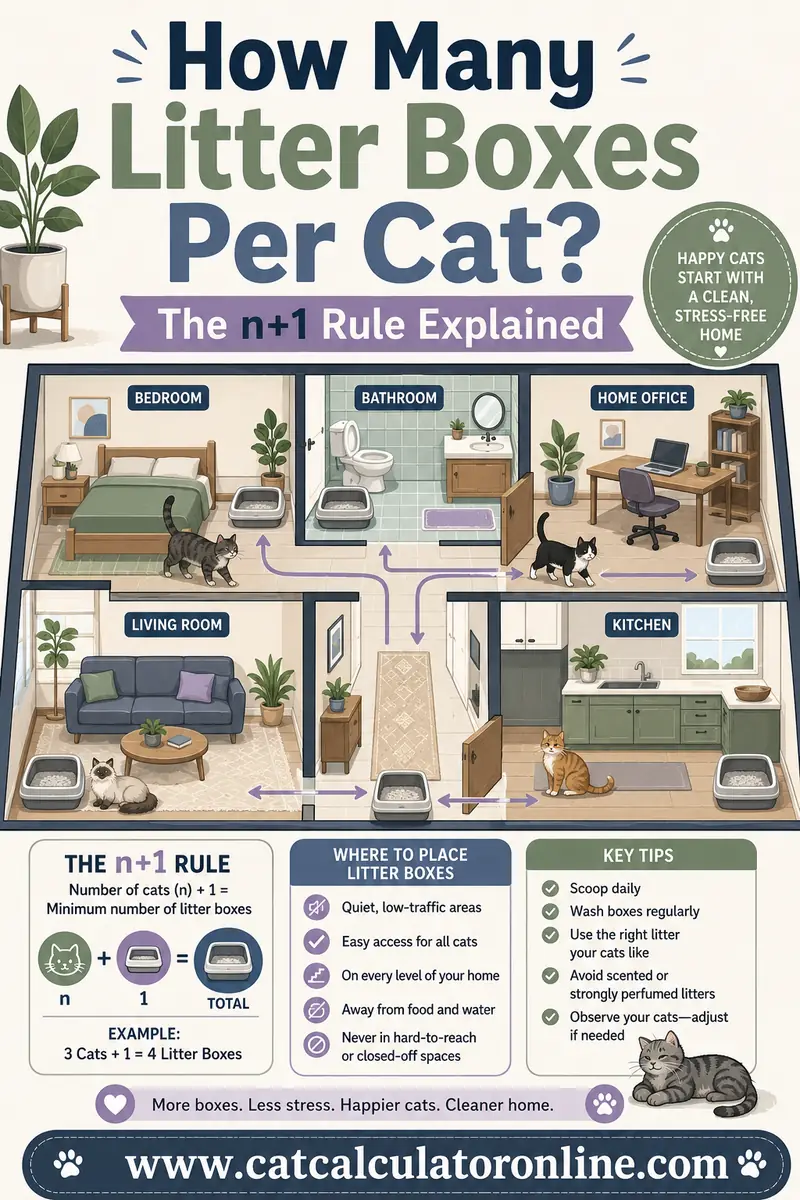
How many? The standard guidance is one per cat plus one, spread across different locations rather than lined up in a row — see how many litter boxes per cat.
Litter depth matters alongside size: 2 to 3 inches is right for most cats. Too shallow and they can't dig; too deep and it feels unstable underfoot. What you fill it with makes a difference too, and the options are compared in types of cat litter compared, while how often to change it is in how often to change cat litter.
What Changes for Kittens, Seniors and Large Breeds?
Kittens need a box they can climb into — 2 to 3 inch sides — and they grow fast. A box that fits a twelve-week-old kitten is too small by six months, and that transition is a common point for accidents to start. Size up as they grow rather than waiting for a problem.
Seniors need full floor area with a low entry. Also worth checking: is the box up a flight of stairs, or somewhere that requires jumping? An older cat may simply be unable to get there in time. Add a box on each floor.
Large breeds — Maine Coons, Ragdolls, Norwegian Forest Cats, Bengals — need genuinely big boxes, 30 inches and up. This is the group most likely to be using something far too small, because shop-bought trays are sized for an average cat and these are not average cats.
Long-haired cats benefit from extra width, and often from litter that doesn't stick to fur.
Overweight cats need more room to maneuver and a lower entry, and they're more likely to give up on an awkward box.
Where Should the Box Go?
Size gets you most of the way; placement decides whether a correctly sized box actually gets used.
Quiet, but not banished. Cats want somewhere they won't be startled. What they don't want is a cold utility room at the end of a corridor, behind a cat flap, three floors from where they spend their time. A quiet corner of a room the household uses works better than genuine isolation.
Away from food and water. Cats won't toilet where they eat, and a box next to the food bowls is one of the more common reasons a cat quietly stops using it. Different rooms if possible; at minimum, opposite ends of one.
Not next to noisy appliances. A washing machine hitting its spin cycle while a cat is mid-use is enough to create a lasting aversion to that spot. Boilers and tumble dryers cause the same problem.
Two exits, no dead ends. Cats dislike being cornered. A box wedged into an alcove where the only way out is past whatever startled them is a box that gets abandoned in a multi-cat house.
Spread them out. Two boxes side by side count as one location to a cat. If you have several, put them in genuinely different places — ideally on different floors — as set out in how many litter boxes per cat.
Don't move it suddenly. If a box has to move, shift it gradually — a metre or so every couple of days — or leave the old one in place until the new location is being used reliably.
Frequently Asked Questions
What size litter box do I need for my cat?
At least 1.5 times your cat's body length, measured nose to the base of the tail, and at least as wide as the cat is long. For an average adult that's around 24 inches. Most shop-bought trays are 15 to 18 inches, which is too small.
Is a covered litter box better?
Usually not, from the cat's perspective. Covers concentrate odor inside, offer only one exit — a real problem in multi-cat homes — and are smaller inside than they appear. If your cat is having accidents, removing the lid for two weeks is a free thing to try.
Why is my cat's bottom hanging out of the litter box?
The box is too short. When a cat's back end extends past the rim, urine lands on the floor beside it. Owners often mistake this for spraying or bad behavior — it's a sizing problem, and a longer box solves it.
Can I use a plastic storage box as a litter tray?
Yes, and many experienced owners do. An under-bed storage box is typically 30 to 36 inches, costs under £15, and is larger than nearly any purpose-made tray. Cut a low U-shaped entry in one side for kittens or older cats.
How deep should the litter be?
Two to three inches for most cats. Shallower than that and they can't dig properly; much deeper and it feels unstable underfoot, which puts some cats off entirely.
What litter box is best for a senior cat?
Full floor area with a low entry of two to three inches, since arthritis is common and often hidden in older cats. Put a box on every floor so they don't need to manage stairs, and keep it somewhere easy to reach.
If you change one thing after reading this, measure your cat and then measure the box. The 1.5× rule sorts out a remarkable proportion of litter box problems, and the cheapest solution — a plastic storage tub — is usually the best one available. See how litter and the rest of the running costs add up with the cat cost calculator.