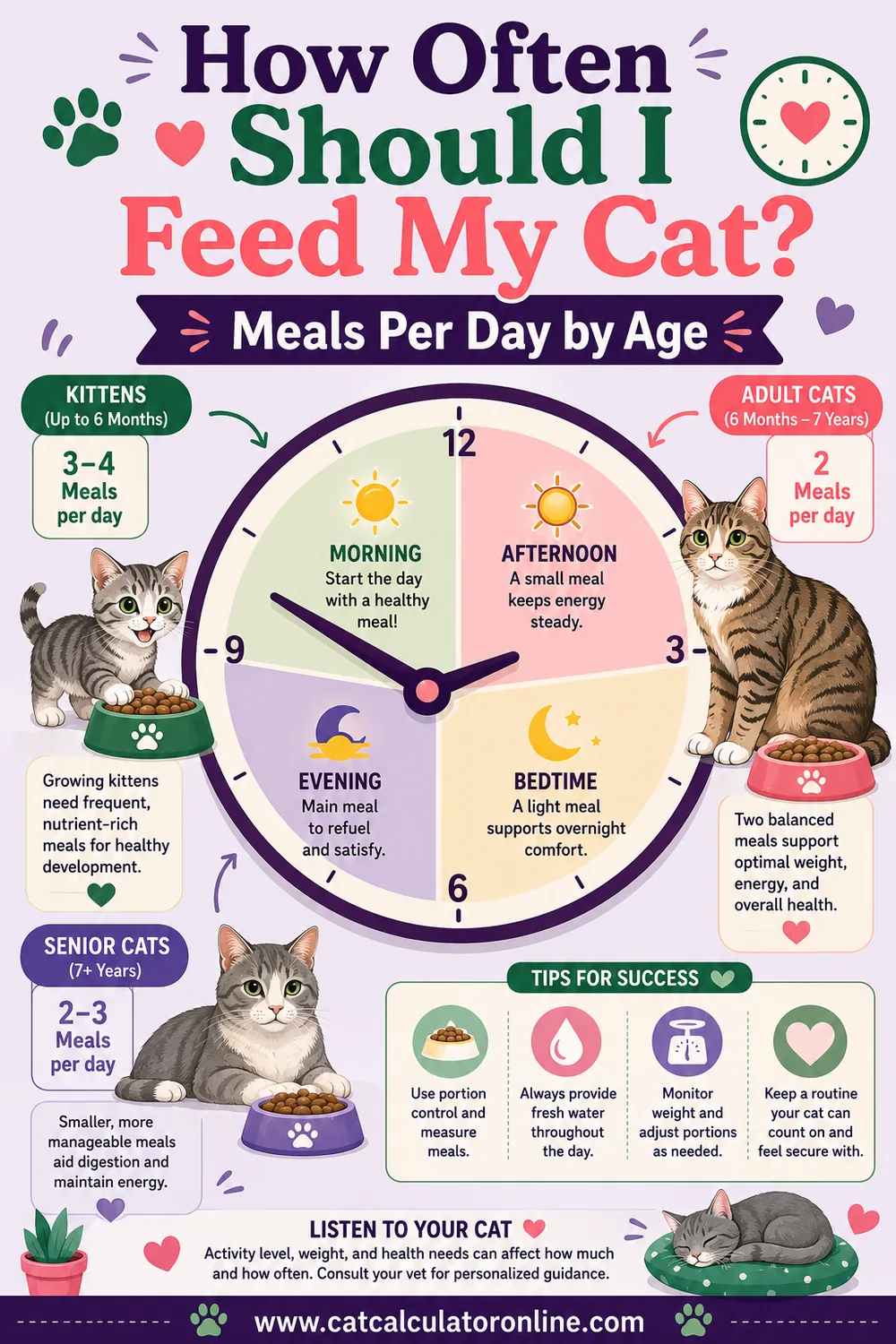
How Often Should I Feed My Cat? Meals Per Day by Age
Most adult cats do well on two meals a day, roughly 12 hours apart. Kittens need more — three to four meals daily up to about six months — and some adults do better with three or four smaller portions, since cats are natural small-frequent eaters. What matters more than the number of meals is the total daily amount, split across however many servings suit your schedule and your cat.
Before you settle on a schedule, it helps to know how much food you're actually dividing up. Our free cat food calculator gives you a daily calorie target from your cat's weight, then you can split it however you like.
🐾 How many meals a day?
Tap your cat’s stage to see the usual feeding frequency:
Tap a stage above to see how often to feed.
Meals Per Day by Life Stage
| Life stage | Age | Meals per day | Notes |
|---|---|---|---|
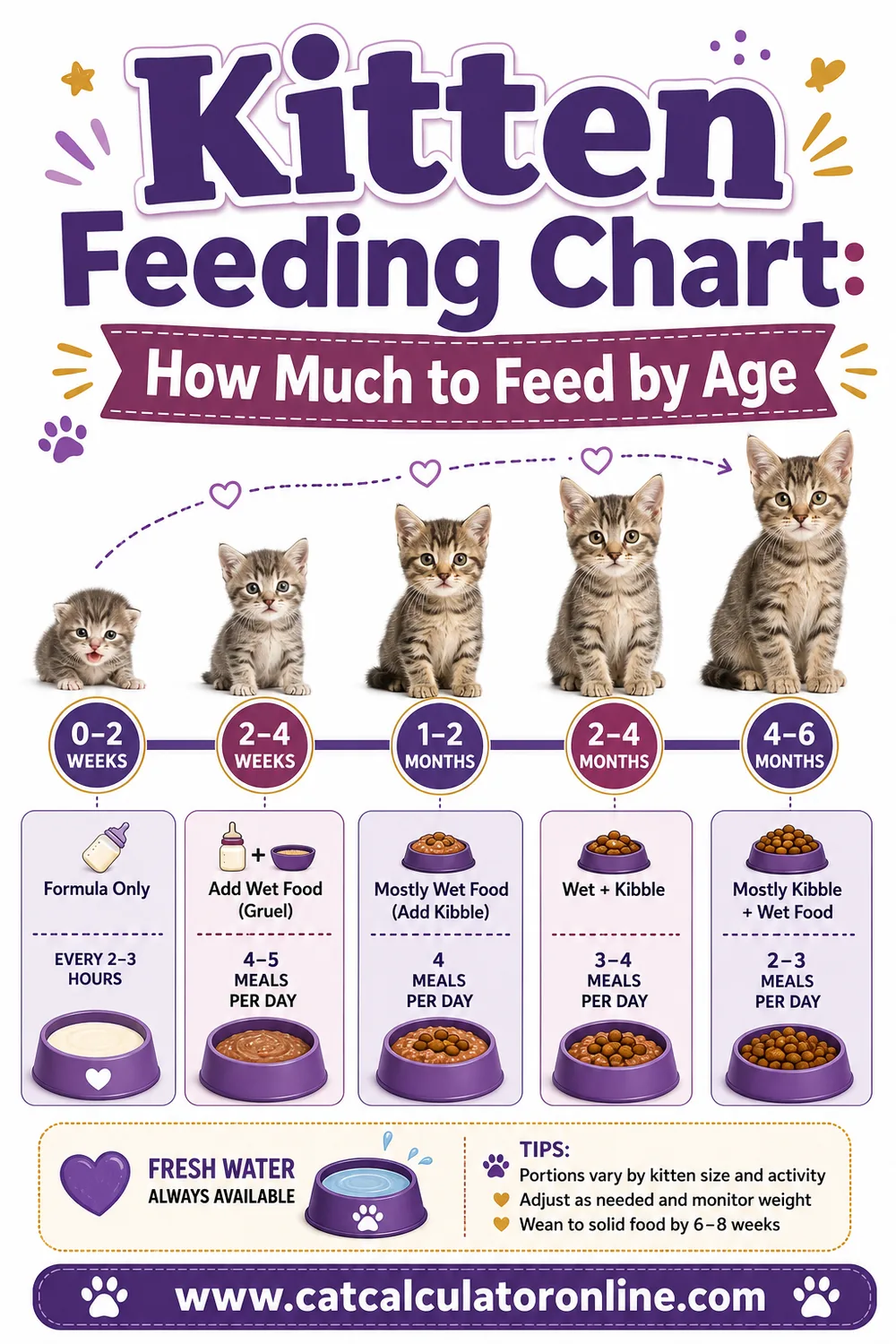
| Young kitten | 8 weeks – 4 months | 4 | Small stomach, huge energy needs |
| Kitten | 4 – 6 months | 3 – 4 | Growth still rapid |
| Adolescent | 6 – 12 months | 2 – 3 | Ease toward adult routine |
| Adult | 1 – 7 years | 2 (some do 3 – 4) | Standard 12-hour split |
| Mature adult | 7 – 10 years | 2 – 3 | Watch for creeping weight gain |
| Senior | 10+ years | 2 – 4 smaller | Smaller portions often easier |
| Pregnant or nursing | — | 3 – 4, or free access | Needs increase sharply; ask your vet |
Treat these as starting points. A cat who vomits bile in the early morning may do better with a late-night portion. A cat who gulps and then throws up may do better with smaller, more frequent servings. Your cat's behavior is real data.
Why Two Meals a Day Became the Standard
Twice-daily feeding is popular for good reasons. It fits a human schedule — before work and after work — and it makes portion control simple. You measure once, split it in two, and you know exactly what your cat ate.
It also builds a rhythm cats seem to like. Cats are creatures of routine, and predictable meals reduce the anxious, all-day counter-surfing you sometimes see with hungry free-fed cats.
The one thing to watch: a 12-hour gap is a long time for a small stomach. Some cats vomit yellow bile in the early morning after an overnight fast. If that's your cat, adding a small third portion late in the evening often fixes it — and it's worth mentioning to your vet, since morning vomiting can have other causes too.
What Cats Would Do on Their Own
Left to themselves, cats eat like hunters, not like people. A wild cat eats many small meals — a mouse is only about 30 calories, so catching eight to twelve small prey animals a day is roughly a full day of food.
That's the argument for three or four small meals instead of two big ones. It matches natural behavior, keeps a cat from getting ravenously hungry between servings, and can reduce the gulp-and-vomit problem some cats have.
The catch is practical: most people can't serve four meals a day. Two workarounds get you close:
- An automatic feeder with a timer can dispense two extra portions while you're out. Dry food works best in these; wet-food feeders exist but need ice packs.
- Puzzle feeders and foraging toys spread the same portion over more time and more effort. Scatter a portion of dry food into a treat ball and your cat "hunts" for it across an hour instead of inhaling it in ninety seconds.
Neither adds calories. They just change the pacing.
Free-Feeding vs Scheduled Meals
Free-feeding means leaving food out all day for the cat to graze. Scheduled feeding means measured portions at set times.
| Free-feeding | Scheduled meals | |
|---|---|---|
| Portion control | Poor — easy to overeat | Precise |
| Works with wet food | No (spoils in a few hours) | Yes |
| Multi-cat homes | Hard to tell who ate what | Easy to monitor |
| Appetite monitoring | Very hard | You notice a skipped meal immediately |
| Convenience | High | Moderate |
| Weight risk | Higher | Lower |
The honest verdict: free-feeding dry food makes overeating easy, and it hides the single most useful health signal you have — a change in appetite. When a cat grazes from a bowl that's always full, you might not notice she's off her food for two or three days. With scheduled meals you notice the same evening.
Free-feeding does work for some cats: a naturally lean, self-regulating cat at a healthy weight who's the only cat in the house. If that's yours and her weight is stable, you don't need to change anything. But if your cat is overweight, if you have multiple cats, or if you're feeding wet food, scheduled meals are the better system.
A middle option: measured free-feeding. Put out the day's measured portion in the morning and let your cat graze from that. Once it's gone, it's gone. You get the grazing pattern with a hard calorie ceiling.
Sample Feeding Schedules
Adult cat, two meals, wet-and-dry combo
- 7:00 am — one 3 oz can of wet food
- 7:00 pm — one 3 oz can of wet food, plus a small measured scoop of dry in a puzzle feeder
Adult cat, three meals, working owner
- 6:30 am — wet food before you leave
- 1:00 pm — automatic feeder dispenses a small dry portion
- 7:00 pm — wet food
Kitten, 3 months old
- 7:00 am, 12:00 pm, 5:00 pm, 9:00 pm — four small kitten-food meals
- Kittens need roughly double the calories per pound that adults do, so portions are generous for their size. Our kitten feeding chart has amounts by age.
Senior cat with a small appetite
- 7:00 am, 12:00 pm, 6:00 pm — three smaller wet meals, slightly warmed to boost the smell
Cat on a vet-guided weight-loss plan
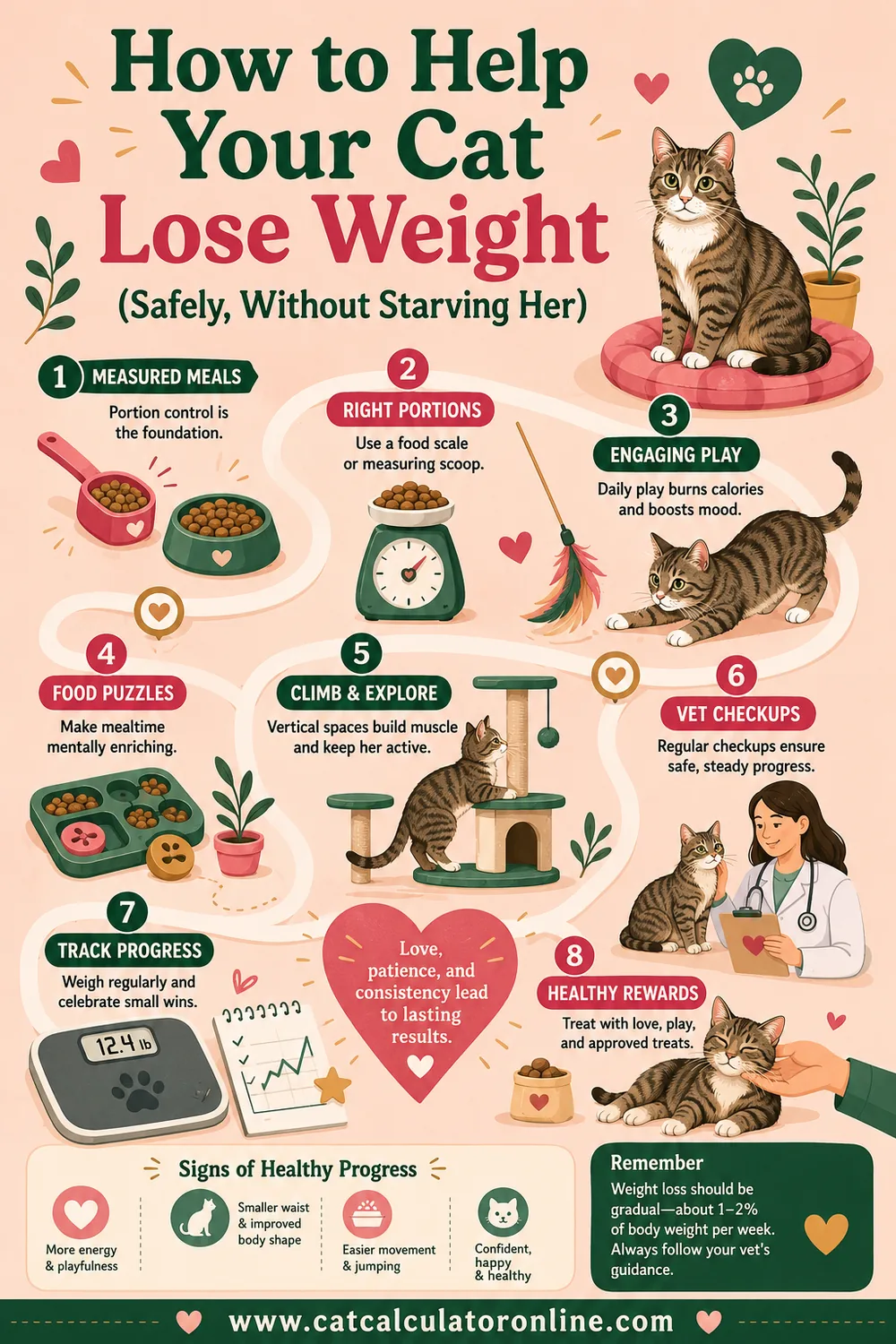
- Four small measured meals spread across the day, from a single pre-portioned daily total. Frequency helps the cat feel fed while calories stay down. See how to help your cat lose weight.
The 24-Hour Rule: Never Let a Cat Stop Eating
This is the most important safety point on this page.
A cat should not go without food for more than 24 hours. When a cat stops eating, the body starts sending fat to the liver for energy faster than the liver can process it. Fat accumulates in the liver and can cause hepatic lipidosis — fatty liver disease. It's serious, it can develop within a few days, and overweight cats are at the highest risk because they have the most fat to mobilize.
This is why you never try to "wait out" a picky cat by withholding food. If your cat refuses a new food, go back to the old one and transition more slowly.
Call your vet if:
- Your cat hasn't eaten in 24 hours
- Your cat is eating noticeably less for more than a couple of days
- Your cat suddenly seems much hungrier than usual (this can signal hyperthyroidism or diabetes)
- Weight loss appears even though eating looks normal
- Eating is paired with vomiting, hiding, or lethargy
A change in appetite is one of the earliest signs of illness in cats, and cats are famously good at hiding everything else. Scheduled meals make that signal much easier to see.
Common Feeding-Frequency Mistakes
- Feeding on demand. A cat who yowls at 5 am and gets fed has learned that yowling works. Feed on your schedule, not on the complaint. An automatic feeder is a great way to break that loop, because the machine becomes the thing being yelled at.
- Adding meals without subtracting calories. Going from two meals to four is fine. Going from two full portions to four full portions is how cats gain weight. Split the same total.
- Forgetting treats count. Treats and table scraps should stay under about 10% of daily calories. A few treats can quietly add up to a meaningful chunk of a small cat's day.
- Leaving wet food out for hours. Wet food spoils. Serve it, give your cat 20 to 30 minutes, then refrigerate or discard what's left.
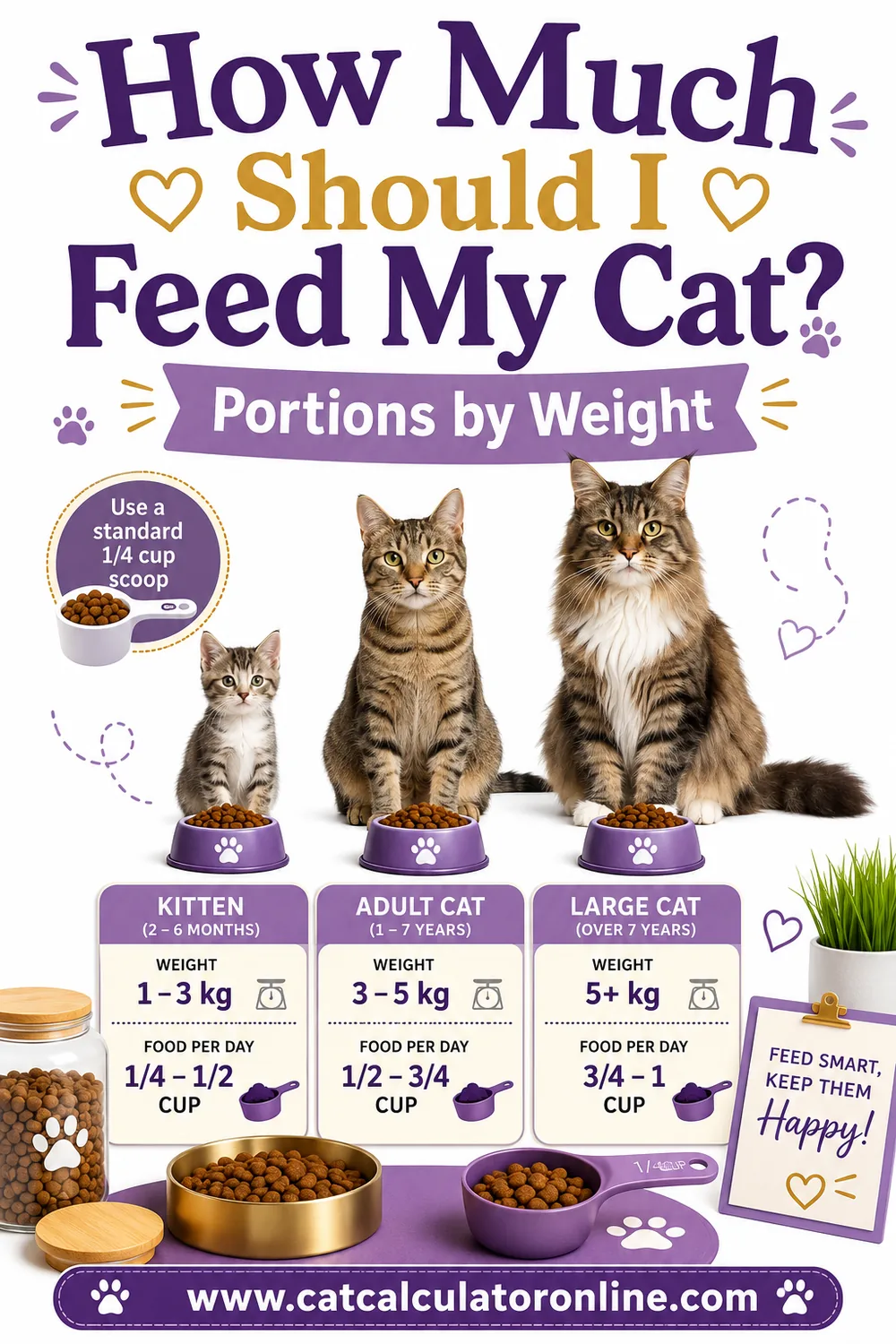
- Trusting the bag guide. Package feeding charts tend to assume active, intact cats and typically overfeed an indoor neutered housecat. Start from your cat's healthy body weight instead — our how much should I feed my cat guide shows how.
Feeding Multiple Cats
Multi-cat homes are where free-feeding really breaks down. One cat eats fast, one eats slow, and the fast one finishes both portions. You end up with one overweight cat and one underweight cat eating from the same bowl.
What helps:
- Separate rooms at mealtime. Simple, and it works.
- Distance and height. Feed one cat on a counter or shelf if the other can't jump.
- Microchip-activated feeders. Expensive, but they solve the problem completely, especially if one cat is on a prescription diet.
- Watch, don't assume. Stand there for a few meals. You'll learn more in three days than in three months of guessing.
FAQ
How many times a day should I feed my cat?
Two meals a day about 12 hours apart is the standard for adult cats. Three to four smaller meals also works well and is closer to how cats naturally eat. Kittens under six months need three to four meals a day.
Is it better to feed a cat once or twice a day?
Twice is better for most cats. Once-a-day feeding means a very long gap that can cause early-morning bile vomiting and leaves your cat hungry for hours. Splitting the same total into two or more servings is easier on the stomach.
Can I leave dry food out all day?
You can — dry food stays safe at room temperature. But free-feeding makes overeating easy and hides changes in appetite that are often the first sign of illness. If you do it, put out a measured daily portion rather than keeping the bowl permanently full.
How long can a cat go without eating?
Not more than 24 hours without a vet call. Cats that stop eating risk hepatic lipidosis, a serious liver condition that develops quickly and hits overweight cats hardest. Never withhold food to force a picky cat to accept a new diet.
Should I feed my cat at the same time every day?
Yes, if you can. Cats thrive on routine, and consistent mealtimes reduce anxiety and food-related pestering. It also makes a skipped meal much more obvious.
Do senior cats need to eat more often?
Often yes. Older cats may have smaller appetites, dental discomfort, or slower digestion, so two to four smaller meals can be easier than two large ones. Slightly warming wet food helps if their sense of smell has faded.
The Bottom Line
Two meals a day works for most adult cats, three to four is closer to natural behavior, and kittens need more. Pick the frequency that fits your life, keep the times consistent, split one measured daily total rather than adding portions, and never let a cat go a full day without eating.
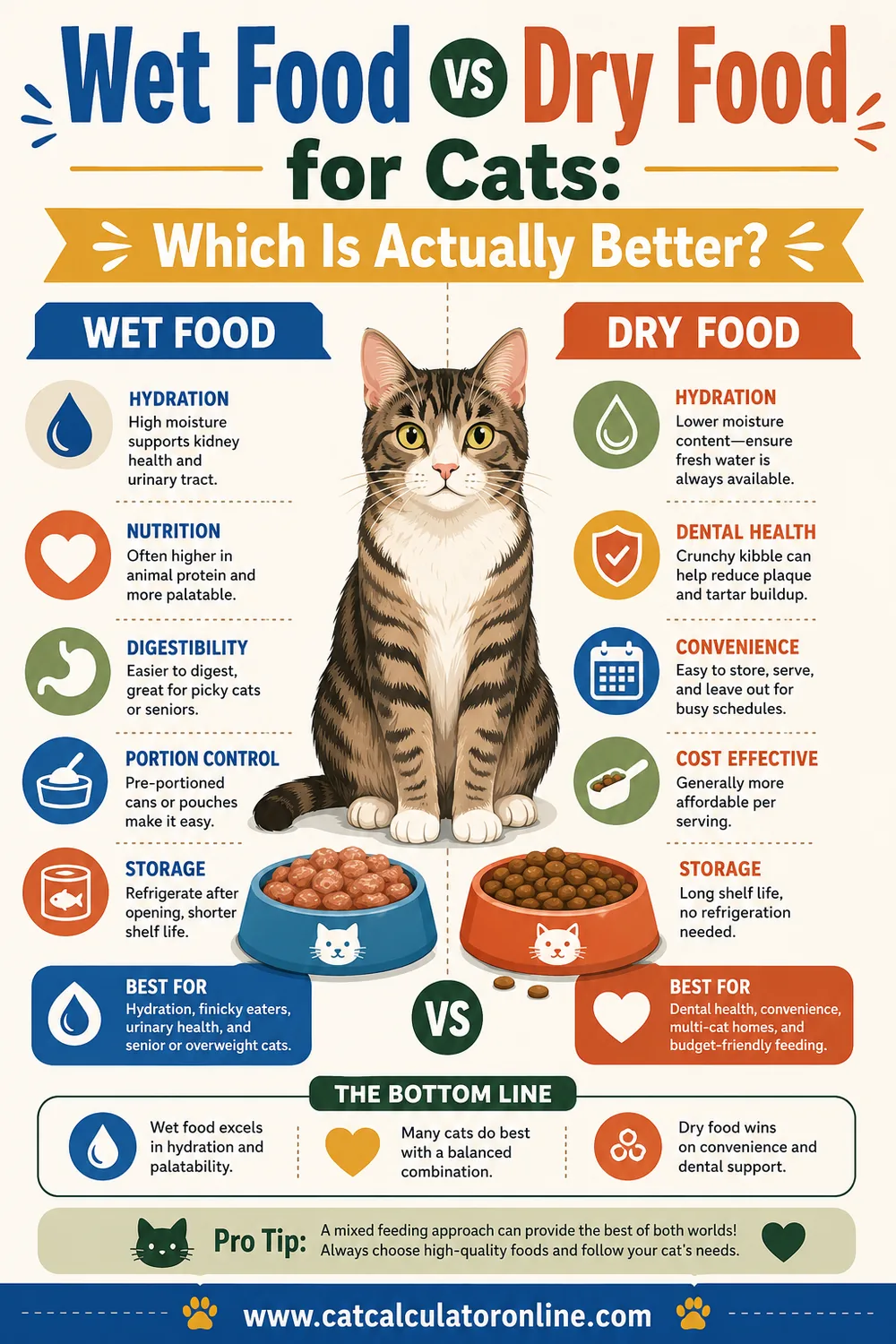
Get the total right first and the schedule gets easy. Our free cat food calculator gives you the daily number, and the wet food vs dry food guide helps you decide what to put in each bowl.