How Often Do Cats Go Into Heat?
Roughly every two to three weeks, over and over, for as long as the season lasts. That short gap is the fact that surprises almost every owner of an unspayed cat, and it is not a sign that anything has gone wrong. Cats only release eggs when they mate, so a cat who is not mated never completes the cycle — her body simply resets and starts again two weeks later. Add in the fact that indoor cats under household lighting often cycle right through winter, and a single unspayed cat can be in heat a dozen or more times a year. Our free cat age calculator will tell you what life stage she is in.
The Short Answer: Every Two to Three Weeks
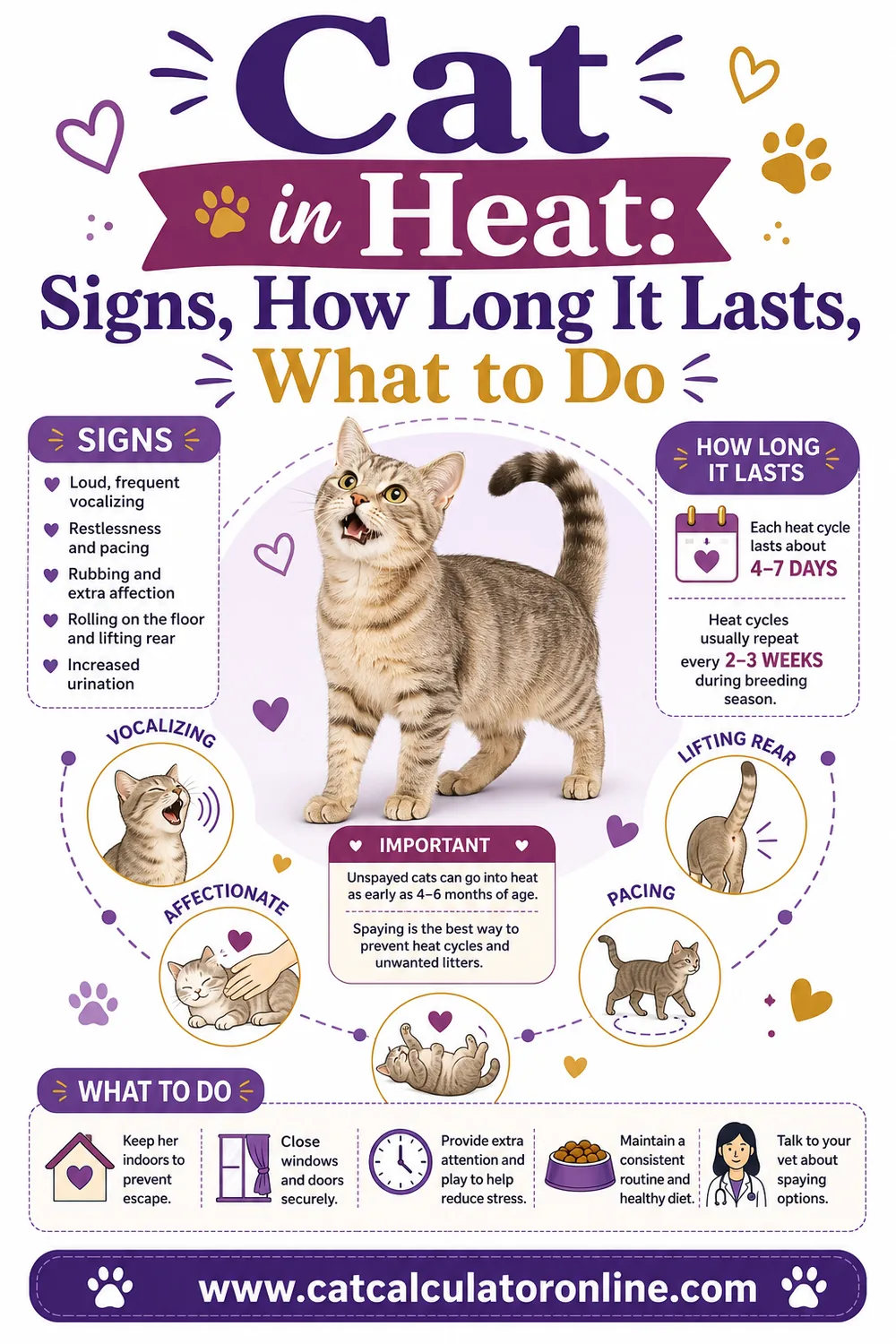
A heat lasts about four to ten days. After it ends, there is a gap — usually one to three weeks — and then she comes back into heat. Measured start to start, that is a cycle of roughly two to three weeks in most cats.
Some cats have almost no gap at all. A minority go back into calling within a few days of the last heat finishing, which makes it look like one endless heat rather than a series of separate ones. That is at the fast end of normal rather than abnormal.
Others space them out more. Three weeks between heats is common, particularly at the start and end of the season when day length is changing.
The pattern is not fixed for life. A young cat in her first season may cycle irregularly for a few months before settling into a rhythm.
Nothing about this is a health problem. A repeating cycle in an unmated cat is exactly what feline reproduction is designed to do. It is only relentless from the household point of view.
The full picture of what a heat looks like — the signs, what to do, what not to do — is in the main guide to a cat in heat.
Why Does the Cycle Repeat So Quickly?
The mechanism behind that short gap is the single most useful thing to understand here.
Cats are induced ovulators. Unlike humans and dogs, a cat does not release eggs on a schedule. Ovulation is triggered by the physical act of mating, and usually by several matings over a day or two rather than one.
No mating means no ovulation. Without ovulation there is no corpus luteum, no sustained progesterone, and none of the hormonal brake that would normally hold the cycle quiet for weeks afterwards.
So the cycle simply restarts. Estrogen falls, a short lull follows, a new wave of follicles develops, and she is calling again. There is no rest phase to sit through.
This is why the calling seems endless. Owners often describe a cat as being "in heat for two months". What is actually happening is four or five separate heats with brief, easily missed gaps between them.
It is also why she is so determined to get outside. Every cycle is a fresh attempt to achieve the thing her body is asking for, and a cat in heat is far more likely to bolt through an open door than at any other time.
When Is Cat Breeding Season?
Day length drives it, which is why the answer differs so much between an indoor cat and one with real outdoor access.
Cats are long-day breeders. Increasing daylight switches the cycle on. In the northern hemisphere the natural season runs from roughly February to October, peaking in spring and early summer.
A natural pause follows in late autumn and winter. A cat living mostly by natural light usually goes quiet from around November until the days lengthen again.
Indoor cats often skip that pause entirely. Household lighting in the evening is enough to keep the system convinced the days are long, and plenty of indoor cats cycle in December and January exactly as they do in May. If your cat is calling in midwinter, she is not ill — she is responding to your lamps.
It is not only about the lights. Warmth, good body condition and the presence of other cats all nudge the cycle along, which is another reason indoor life tends to produce more heats rather than fewer.
Kitten season follows directly from this. The flood of kittens that rescues see from spring onwards is the population-level consequence of a species that cycles every two weeks for eight months of the year.
How Many Heats Will She Have in a Year?
It depends almost entirely on her light exposure and whether she ever mates.
| Situation | Season length | Typical heats per year |
|---|---|---|
| Indoor only, artificial light | Effectively all year | 12 or more |
| Mostly indoors, some daylight cues | About 9 months | 10 to 14 |
| Real outdoor access, natural light | February to October | 8 to 12 |
| Mated, does not conceive | Broken by ~6-week gaps | 4 to 6 |
| Mated and conceives | Broken by pregnancy and nursing | 2 to 3 |
| Spayed | None | 0 |
Those numbers are ranges, not promises. A cat at the fast end of the interval and cycling year-round can pass twenty heats in twelve months.
Pregnancy is the only natural interruption of any length. Cat gestation runs about 63 to 67 days, and a queen who conceives in February can realistically raise two or even three litters before the season closes.
Which is why the arithmetic on unplanned litters escalates so fast. One unspayed cat and her descendants produce a genuinely alarming number of kittens within a few years, and that is arithmetic rather than rhetoric.
What Changes the Interval?
Several things shift the gap between heats, sometimes noticeably.
Time of year. Cycles tend to be closer together at the peak of the season and more spread out at either end of it.
Age. Very young cats in their first year and older queens both tend to be more erratic. Middle-aged cats in good condition are the most regular.
Breed. Siamese, Burmese and other oriental types are known for cycling frequently, starting young and being extremely vocal about it. Long-haired breeds such as Maine Coons and Persians often cycle later and less often.
Body condition. A cat who is underweight or unwell may cycle less often or stop altogether. Reproduction is the first thing the body economises on.
Other cats in the house. Queens living together often synchronise, and the presence of an entire tom nearby stimulates cycling.
Nothing you feed her will change it. No diet, supplement or over-the-counter remedy alters the interval, and hormonal drugs to suppress it carry real risks and are rarely used now.
Does the Cycle Ever Just Stop?
Only for specific reasons, and waiting it out is not one of them.
Mating and conception stop it for the length of the pregnancy and usually through early nursing, though not reliably — a nursing queen can come back into heat while she still has kittens.
Mating without conception stops it for about five to six weeks. Ovulation happens, progesterone rises, and she enters a false pregnancy. She goes quiet, may even seem a bit maternal, and then cycles again as though nothing happened. This is covered in more detail in how long a cat stays in heat.
The end of the season stops it, if she gets enough natural darkness for that to happen at all.
Illness or weight loss can stop it, which is worth mentioning to your vet rather than being relieved about.
Spaying stops it permanently, and it is the only method that does. Timing the operation is now usually recommended before the first heat rather than after it.
Age does not stop it. Cats have no menopause. An unspayed cat of twelve or fourteen can still come into heat, and her risk of pyometra and mammary tumours rises every year she stays entire.
When the Frequency Is a Reason to Call the Vet
Most of the time frequent heats are just frequent heats. A few patterns are worth a conversation.
Heat that genuinely never stops. Constant calling for weeks with no discernible break at all — as opposed to short heats close together — can point to ovarian cysts or a follicular problem. Keep a simple diary of calling days before you ring; it makes the pattern obvious.
Heat signs in a cat who has been spayed. This usually means a fragment of ovarian tissue was left behind, known as ovarian remnant syndrome. It is fixable but needs investigating.
Any vaginal bleeding. Cats do not bleed during heat the way dogs do. Blood is not part of a normal cycle and warrants a call.
Cycling that stops abruptly with other changes — weight loss, a swollen abdomen, lethargy, discharge, or drinking more than usual. A pus-filled uterus (pyometra) is an emergency in an unspayed cat, and it is most likely in the weeks after a heat.
Not eating. A cat in heat may pick at her food, but a cat who eats nothing for a day or two needs veterinary attention regardless of the reason. Never withhold food to try to influence her behavior; cats develop serious liver problems quickly without calories.
Living With a Cat Who Cycles Every two weeks
The practical reality, if spaying is not immediately possible.
Assume she will try to escape. Heat is when indoor cats bolt. Door discipline, closed windows, secured screens and a collar with an ID tag matter more during these weeks than at any other time.
Expect vocal males outside. Entire toms will find her, spray around your doors and yowl at your windows. Securing the house protects both of them.
Track the dates. Writing down the first day of calling each time tells you her personal interval, which makes the next one far less alarming and helps you book surgery sensibly.
Do not punish the noise. It is hormonal and she cannot help it. Practical soothing is covered in how to comfort a cat in heat.
Book the spay for a quiet phase if you can. Many vets prefer to operate when a cat is not actively in heat, as the reproductive tract is less engorged, though it is not a strict rule and an urgent case will not be turned away.
And know when the first one is likely. If you have a kitten rather than an adult, the age cats go into heat is earlier than most people expect — sometimes four months.
Frequently Asked Questions
How often does a cat come in heat?
About every two to three weeks if she is not mated. A heat lasts roughly four to ten days, then there is a gap of one to three weeks, then it repeats. Cats only ovulate when they mate, so an unmated cycle simply restarts.
Can a cat be in heat all the time?
It can look that way. Short gaps between heats often go unnoticed, so several separate cycles read as one long one. Genuinely continuous calling for many weeks with no break at all is worth a vet check for ovarian cysts.
Do cats go into heat in winter?
Indoor cats frequently do. The cycle is driven by day length, and household lighting is enough to keep it running through winter. Cats living mostly by natural light usually pause from about November until February.
How many times a year does a cat go into heat?
An indoor unspayed cat commonly has twelve or more heats a year, and sometimes many more. A cat living by natural daylight typically has eight to twelve across a February-to-October season.
Does a cat come into heat after having kittens?
Yes, often sooner than expected. Nursing suppresses cycling only partially, and some queens come back into heat within a few weeks of giving birth, while still feeding kittens. She can conceive again at that point.
Do cats stop going into heat when they get old?
No. Cats have no menopause, so an unspayed cat can cycle into her teens. Cycles may become less regular, but the risks of leaving her entire — pyometra and mammary tumours — rise with every year.
The short version is that an unmated cat comes back into heat every two to three weeks, because she never ovulates and so never completes the cycle her body has started. Indoor lighting removes the natural winter pause, which is why a December heat is normal rather than alarming. Expect somewhere between eight and twenty heats a year in an entire cat, plan around the escape risk while she is calling, and treat constant calling, bleeding or a sudden loss of appetite as reasons to call your vet. Spaying is the only thing that ends the pattern for good. Check where your cat sits in her life so far with the free cat age calculator.