Is Dog Food Harmful to Cats?
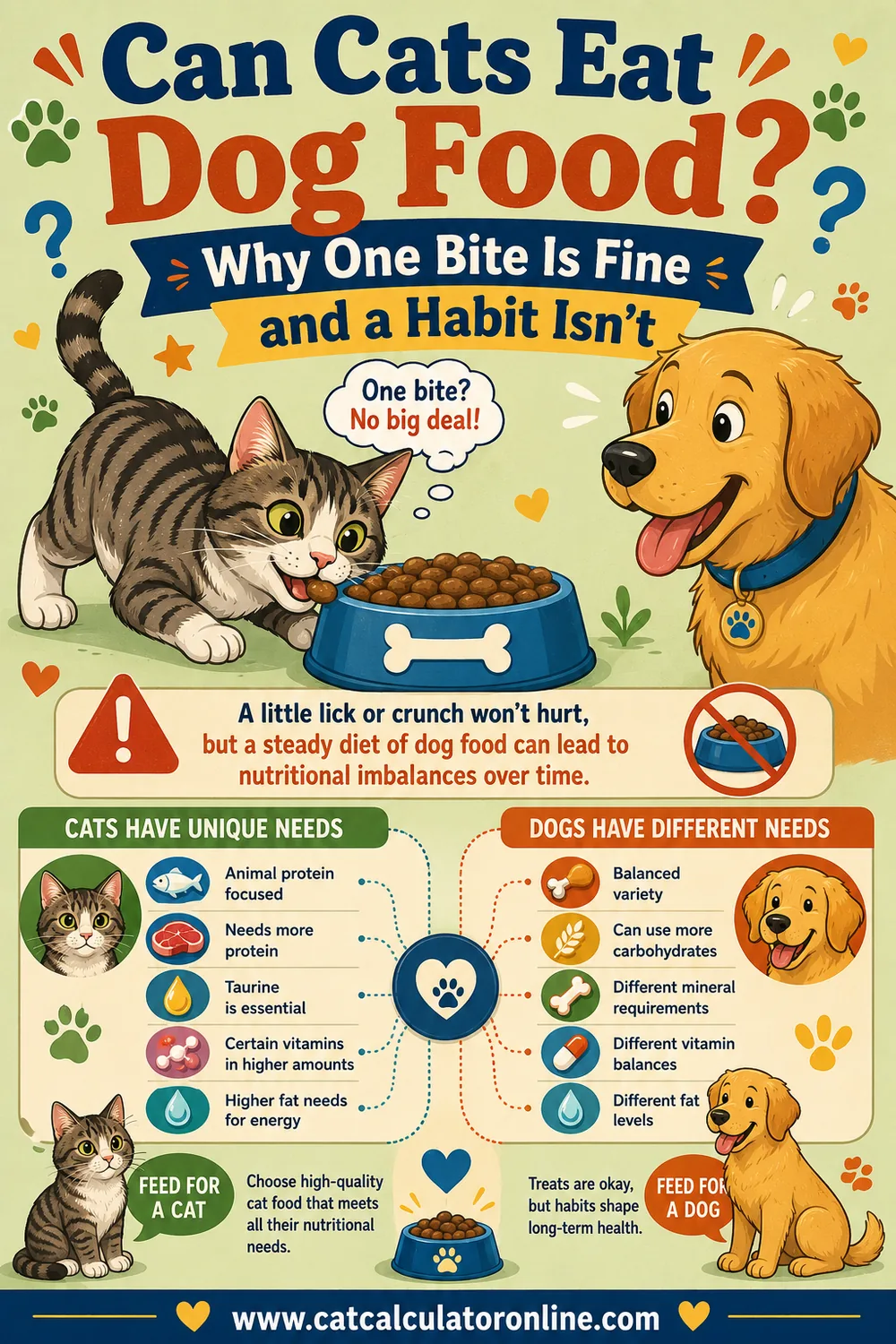
The honest answer has two halves. A mouthful of dog food is not dangerous — if your cat has just raided the dog's bowl, nothing bad is going to happen, and you do not need to do anything. A diet of dog food genuinely is harmful, because cats have nutritional requirements that dog food is not formulated to meet, and the deficiencies that follow are serious rather than theoretical. The distinction matters because most people asking this question are in the first situation and worrying about the second. This page covers what is actually missing from dog food, how long it takes to matter, and what to do in a household with both animals. Portion figures for a proper cat diet are in the cat food calculator.
One Mouthful Versus a Diet
The distinction that answers most people's actual question.
Dog food is not toxic to cats. It contains no ingredient that poisons a cat, in the way that chocolate, onions or lilies do. A cat that eats some dog food has not been poisoned.
The problem is what dog food lacks, not what it contains — and a deficiency takes weeks to months of consistent feeding to develop, not a single meal.
So if your cat has just stolen a mouthful: nothing needs to happen. The most likely consequence is mild digestive upset, and often not even that. What to watch for is in my cat ate dog food — what now.
If a cat has been eating dog food as its main diet for weeks or months, that is a different conversation and worth raising with a vet, who can check for the specific deficiencies below.
And if dog food is all you have tonight, feeding it once is better than a cat going without — cats tolerate fasting badly, so a single unusual meal beats an empty bowl.
What Cats Need That Dog Food Lacks
Four specific gaps, and they are the reason the two foods are not interchangeable.
Taurine. An amino acid cats cannot synthesise in adequate amounts. Deficiency causes dilated cardiomyopathy, a serious heart condition, and retinal degeneration, which leads to blindness. Both are serious, the retinal damage is generally permanent, and the heart disease is often only partly reversible. Cat food is required to contain taurine; dog food is not, because dogs make their own.
Vitamin A. Dogs convert beta-carotene from plant sources into vitamin A. Cats cannot do this efficiently and need preformed vitamin A from animal sources. Dog foods frequently rely on the plant precursor.
Arachidonic acid. An essential fatty acid that dogs can make from other fats and cats largely cannot. Deficiency affects skin, coat, kidney function and reproduction.
Protein levels. Cats are obligate carnivores with a continuous protein requirement — they break down protein for energy whether or not there is any in the diet, which means a low-protein diet causes them to break down their own muscle. Dog foods are formulated at meaningfully lower protein levels because dogs do not have this requirement. The detail is in high-protein cat food explained.
Niacin is a further difference — cats cannot make it from tryptophan the way dogs can.
The common thread: cats have lost several metabolic conversions that other mammals retain, because their ancestors ate nothing but meat and never needed them. Dog food is formulated for an omnivore; a cat is not one.
How Long Before It Matters?
A reasonable question, and the answer is reassuring at the short end.
| Exposure | Risk |
|---|---|
| A single mouthful | None nutritionally; possible mild upset |
| One meal | Negligible |
| A few days | Very low |
| Several weeks | Deficiencies beginning to develop |
| Months | Real risk of taurine-related heart and eye disease |
Taurine deficiency is the clock that matters, and it typically takes months of a deficient diet to produce clinical disease — though the exact timing varies with the cat and how much taurine the food happens to contain.
Kittens are affected faster and more severely, because they are growing and their requirements are proportionally higher.
Pregnant and nursing cats are also at higher risk.
And a cat that is already unwell has less margin than a healthy adult.
The practical read: occasional theft is not something to worry about. A pattern of the cat regularly eating the dog's food instead of its own is worth fixing, and a cat that has been on dog food for months should see a vet.
Signs of a Problem
What to look for if a cat has been eating dog food for a prolonged period.
Related to taurine deficiency: lethargy, weakness, breathing difficulty or coughing (heart), and vision problems — bumping into things, dilated pupils, reluctance to move in dim light (retina).
Related to protein deficiency: muscle loss, particularly over the spine and hips, and a poor, dull or greasy coat.
Related to vitamin A deficiency: poor coat, skin problems, and in severe cases night blindness.
General signs: weight loss, reduced appetite, poor growth in a kitten.
None of these are specific to dog food — they overlap with many other conditions — which is exactly why a vet visit is the right response rather than guessing. Blood taurine levels can be measured, and an echocardiogram will show whether the heart has been affected.
The encouraging part: taurine-related heart disease often improves substantially with supplementation and a proper diet, if caught before it is advanced. Retinal damage generally does not reverse, which is why catching it early matters.
Why Cats Want the Dog's Food
Usually nothing to do with nutrition.
It is somewhere else. Cats are drawn to novelty and to food that is not theirs.
Dog food is often left down. Many dogs are free-fed or eat slowly, so there is an available bowl for much of the day while the cat's own food has been eaten and cleared.
It smells different, and a cat that is bored with its own food will investigate anything new.
The cat may be hungry. Worth ruling out — check the portion against your cat's actual requirement rather than assuming it is greed.
Or the cat may be blocked from its own bowl by the dog, which happens more often than owners notice.
And it can simply be habit once established, which is the most common reason it persists.
How to Stop It
Practical, and it works in almost every household.
Feed them in separate rooms, with the door closed while they eat.
Feed at set times rather than leaving bowls down. This is the single most effective change — a bowl that is only present for fifteen minutes cannot be raided later.
Pick up whatever is left as soon as the meal is over.
Feed the cat somewhere high. Cats climb and most dogs do not; a worktop, shelf or cat tree solves the problem in one move and is usually easier than managing timing.
Use a microchip feeder if the arrangement is difficult — it opens only for the registered animal and is the reliable answer where one pet is on a prescription diet.
Check the cat's own portion is adequate, since a genuinely underfed cat will keep seeking food.
And feed the dog after the cat, so the cat is not hungry while the dog's bowl is out.
The wider question of running a two-species household — bowl placement, timing, water, treats — is covered in feeding cats and dogs in the same house.
What About Dog Treats and Chews?
The same logic applies, with one extra consideration.
A dog biscuit is not toxic to a cat, and an occasional stolen one is no more a problem than a mouthful of dog food.
But treats are calorie-dense, and a cat is a small animal. A dog treat sized for a Labrador can be a substantial share of a cat's entire daily allowance — treats should stay under about 10% of daily calories, and a single large dog biscuit can exceed that on its own.
Rawhide, dental chews and long-lasting chews are a different matter. They are not designed for a cat's mouth or digestive tract, and pieces can be swallowed whole. A cat working at a dog chew is worth interrupting.
Bones of any kind should be kept away from cats, cooked especially, for the same splintering reasons they are a poor idea for dogs.
And check what is in flavored dog products. Some contain onion or garlic powder for palatability, both of which are genuinely toxic to cats in sufficient quantity — a small amount is unlikely to cause harm, but it is a reason not to let a cat share dog treats habitually.
The practical rule: treat dog treats the way you would any human food — occasional accidental access is fine, deliberate sharing is not.
The Reverse: Dogs Eating Cat Food
Worth knowing, because the risk profile is different.
Cat food is not dangerous to dogs in the same way dog food is to cats — cat food contains everything a dog needs and more.
But it is too rich. Cat food is higher in protein and fat, and a dog eating it regularly can gain weight and, in some dogs, develop digestive upset or pancreatitis.
So the direction of harm differs: cats on dog food face nutritional deficiency; dogs on cat food face excess. Neither is a good long-term arrangement, and both are solved by the same separation.
Dogs are also more determined about it, being generally larger and less fussy, which is why feeding the cat somewhere high works so well.
The full picture from the dog's side is in can cats eat dog food, which covers both directions.
Frequently Asked Questions
Is dog food toxic to cats?
No. Dog food contains nothing that poisons a cat. The problem is what it lacks — taurine, preformed vitamin A, arachidonic acid and sufficient protein — which causes deficiency over weeks to months rather than harm from a single meal.
What happens if my cat eats dog food once?
Almost certainly nothing. At most, mild digestive upset. Nutritional deficiencies take a prolonged period of eating dog food as the main diet to develop, not a single mouthful.
Can I feed my cat dog food in an emergency?
For one meal, yes — it is better than a cat not eating at all, since cats tolerate fasting badly. It is not suitable for more than a day or two, and plain cooked meat is a better stopgap if you have it.
What is missing from dog food for cats?
Taurine is the most important, because cats cannot make enough and deficiency causes heart disease and blindness. Dog food also relies on plant-source vitamin A that cats cannot convert, lacks arachidonic acid, and has lower protein than cats require.
How long can a cat eat dog food before it causes harm?
Days are unlikely to matter; weeks begin to. Taurine-related disease typically takes months of a deficient diet to appear, and develops faster in kittens and pregnant cats.
How do I stop my cat eating the dog's food?
Feed them in separate rooms at set times rather than leaving bowls down, pick up leftovers immediately, and feed the cat somewhere high that the dog cannot reach. A microchip feeder solves difficult cases.
The answer depends entirely on quantity. A stolen mouthful of dog food is not dangerous and needs no action. A diet of it genuinely is harmful, because cats cannot make their own taurine, cannot convert plant-source vitamin A, cannot produce arachidonic acid, and need more protein than dog food provides — and taurine deficiency causes heart disease and permanent blindness. Fix it by feeding at set times in separate rooms, or simply by feeding the cat somewhere high. Then check the cat's own portion is right with the free cat food calculator.