British Shorthair Lifespan
British Shorthairs usually live 12 to 17 years, and as pedigree breeds go they are one of the sturdier ones — but the thing most likely to shorten your cat's life is not in her genes, it is in her bowl. This is a calm, heavy-boned, food-motivated cat whose breed standard describes her as cobby and whose plush double coat hides three extra pounds without a trace. Add a temperament that would rather sleep than chase anything and you have the classic profile for feline obesity, which drives diabetes and arthritis. The genetics are comparatively kind. The lifestyle is where the risk lives. Work out your cat's age in human terms with our cat age calculator.

How Long Do British Shorthairs Live?
A reasonably encouraging range, with the usual caution about where these numbers come from.
Twelve to seventeen years is the figure most sources agree on, and healthy indoor British Shorthairs frequently reach 16 or 17. Some breed sources quote 14 to 20, which is optimistic; veterinary record studies tend to land lower than breed sources for every pedigree breed.
All feline breed lifespan figures are estimates drawn from small datasets. Insurance claims, practice records and breeder surveys each capture a different slice of the population. A range with reasons behind it is more trustworthy than a precise-looking single number.
Where the breed genuinely scores well is the shortness of its problem list. No flat face, no exaggerated limbs, no giant frame, and only two significant inherited conditions — one of which has a definitive DNA test. Our cat breed lifespan chart shows how that compares with other breeds.
Which puts the outcome largely in your hands. Weight, indoor living, dental care and senior screening account for most of the difference between a British Shorthair who reaches twelve and one who reaches seventeen.
The Biggest Threat Is The Food Bowl
Every breed has one dominant risk. For this one it is not a gene.
British Shorthairs are built to look substantial, and the breed standard rewards that. Round face, broad chest, heavy bone, dense coat. It is genuinely difficult to look at one and judge whether she is well covered or overweight, and most owners get it wrong in the same direction.
The temperament compounds it. This is a calm, undemanding, notably unathletic cat. She is not going to burn off a generous bowl by tearing around the house at midnight the way a Bengal would.
Neutering lowers energy needs by a noticeable margin, and portions rarely come down to match. A cat who gains a pound a year for four years has put on around 40 percent of her body weight without a single dramatic moment.
The consequences are specific and well established. Excess body fat drives insulin resistance, and overweight cats develop diabetes at several times the rate of lean ones. It loads the joints, bringing arthritis forward in a heavy-boned cat. And it makes anaesthesia and any illness harder to manage.
Measured portions do most of the work. A typical lean adult cat needs roughly 200 to 250 kcal a day depending on size and activity, and treats should stay under about ten percent of that. Weigh or measure the food rather than filling the bowl by eye.
What A Healthy British Shorthair Feels Like
Because you cannot judge this breed by looking, here is the hands-on version.
Run a flat palm along her side. You should feel the ribs easily under a thin covering, roughly like feeling the bones on the back of your own hand. If you have to press to find them, she is carrying too much.
Look down at her from above. There should be a visible narrowing behind the ribcage. A British Shorthair is broad, but broad is not the same as rectangular.
Look at her from the side. The belly should tuck up slightly toward the back legs rather than hanging level or swinging.
A primordial pouch — the loose flap of skin along the belly — is normal and is not fat. It swings when she trots and it exists on lean cats too. Do not diet a cat because of it.
Typical lean weights are 12 to 17 lb (5.4 to 7.7 kg) for males and 8 to 12 lb (3.6 to 5.4 kg) for females, with a fair spread. Our page on telling whether your cat is overweight walks through the full check.
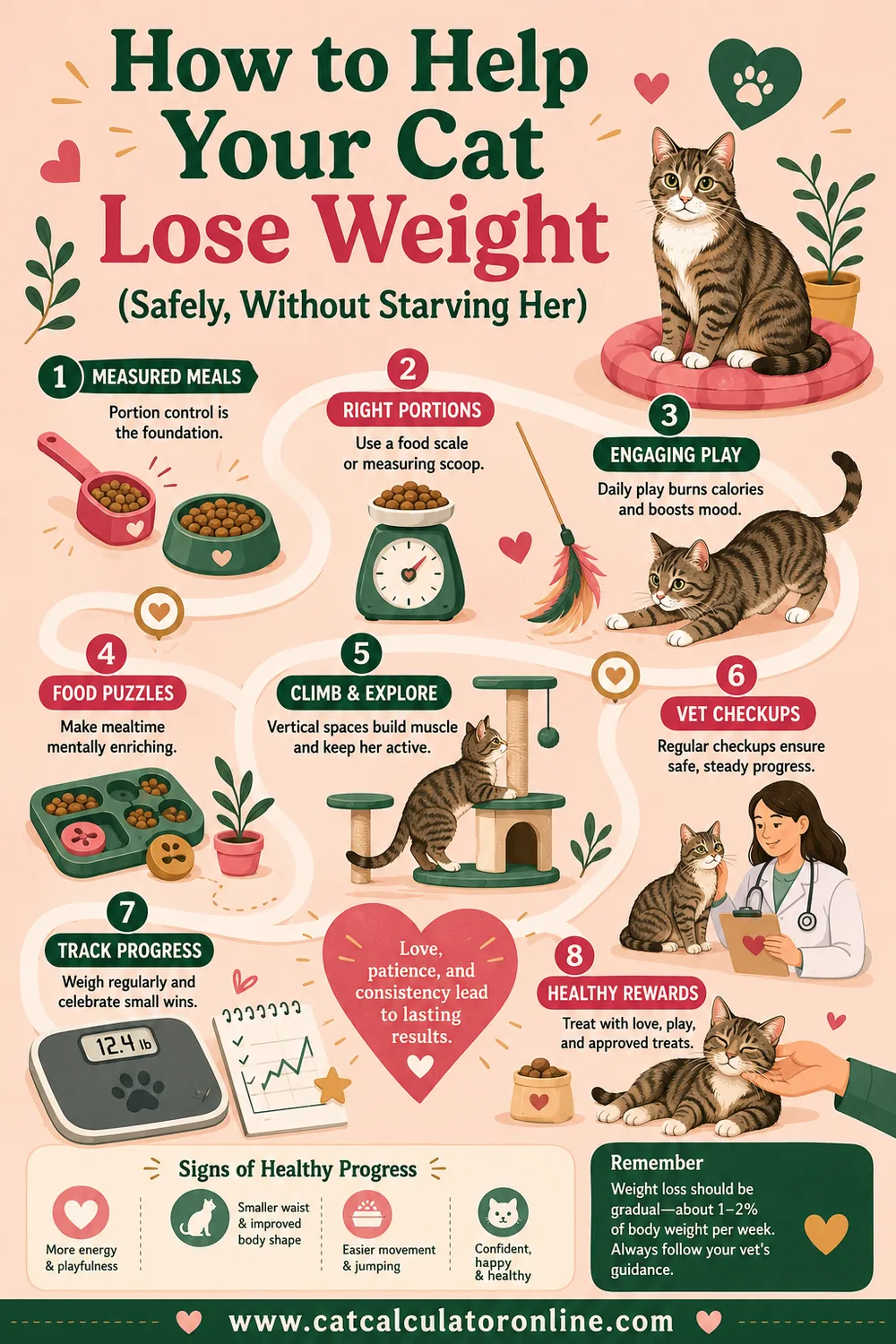
If she needs to lose weight, go slowly and never by withholding food. A cat who stops eating can develop a serious liver condition within days. Aim at roughly 0.5 to 2 percent of body weight per week with a plan from your vet — our guide on helping your cat lose weight has the practical steps.
HCM: The Heart Disease With No Breed Test
The most serious inherited concern in the breed, and unfortunately the least testable.
Hypertrophic cardiomyopathy thickens the wall of the heart's main pumping chamber, so it holds less blood and fills poorly. It is the commonest heart disease in cats overall, and British Shorthairs are among the breeds where it is recognized as running in families.
No validated British Shorthair mutation exists. Maine Coons and Ragdolls each have their own identified gene fault with a reliable DNA test. Some laboratories sell British Shorthair heart panels based on those other breeds' mutations, and a clear result from one of those means very little.
Cardiac ultrasound is what actually screens for it. Responsible breeders scan their breeding cats, typically annually, and will show you the reports without being asked twice.
HCM is usually silent until it is advanced. Two presentations are emergencies: sudden hind-leg weakness or paralysis with crying and cold back paws, which is a blood clot, and fast, labored or open-mouthed breathing at rest, which suggests fluid on the lungs. Both need a vet the same day.
The free home check is worth doing monthly. With your cat properly asleep, count chest rises for 30 seconds and double it. Under about 30 breaths a minute is normal, and consistently higher deserves a phone call.
PKD: The Persian Legacy You Can Test For
This one has a clean answer, which makes it the easiest risk to remove.
Polycystic kidney disease fills the kidneys with cysts that slowly replace working tissue, leading to chronic kidney failure, usually from middle age onwards rather than in youth.
It entered the British Shorthair through Persian outcrossing. Persians were used in developing the modern British Shorthair's rounder head and denser coat, and the PKD1 gene came along with the type.
It is dominant, so one copy is enough to cause disease. That is unusual and it is why the gene spread so effectively — an affected cat passes it to roughly half of its kittens.
The DNA test is definitive and cheap. A cheek swab gives a yes or no, and ultrasound also detects cysts from around ten months old. Ask any breeder for written PKD1 results on both parents.
If your cat does have it, early management matters enormously. Kidney disease picked up on routine bloods before any symptoms responds far better than kidney disease found in a cat who is already thin and drinking constantly. Our guide to chronic kidney disease in cats covers diet, fluids and monitoring.
One other testable condition worth naming: hemophilia B, an inherited clotting disorder documented in the breed, causing prolonged bleeding after injury or surgery. It has a DNA test and is on most British Shorthair panels.
Blood Type B And Why It Matters
An unusual detail for this breed, and one with real consequences.
Most domestic cats are blood type A. British Shorthairs have an unusually high proportion of type B. It is one of the highest rates of any breed.
For breeders it matters urgently. If a type B queen is mated to a type A tom, her colostrum contains antibodies that attack her kittens' red blood cells. Kittens who nurse normally can fade and die within the first few days — a condition called neonatal isoerythrolysis. Blood typing before mating prevents it entirely.
For pet owners it matters if your cat ever needs a transfusion. Giving type A blood to a type B cat causes a severe, potentially fatal reaction. Any vet will cross-match first, but knowing your cat's type in advance saves time in an emergency.
It costs very little to find out. If you are having bloods taken for something else anyway, ask whether typing can be added.
The Care Timeline
| Age | What matters most |
|---|---|
| Kitten to 12 months | Vaccinations, neutering, microchip, setting portion habits early |
| 1 to 3 years | Still growing; do not overfeed to reach the chunky look faster |
| 3 to 6 years | Fully mature; weight creeps up quietly after neutering |
| 7 to 10 years | Annual bloodwork baseline; weight often peaks in this window |
| 11 to 14 years | Twice-yearly checks with bloods, urine and blood pressure |
| 15 and over | Comfort, mobility, appetite; weight loss now is a symptom |
British Shorthairs mature slowly, reaching full size at around three to five years. A lanky adolescent is entirely normal, and feeding her up to fill out faster is one of the more common ways owners create a weight problem that never goes away.
What To Watch At Home
This is a stoic, undemonstrative breed, so the signals are subtle.
Weigh her monthly and write it down. Half a pound is about five percent of body weight and is completely invisible under a plush coat. In an older cat, unexplained loss is a symptom to investigate rather than a success.
Count sleeping breaths monthly, as described above — under about 30 a minute at rest.
Notice what she has stopped doing. British Shorthairs are not big jumpers at the best of times, so a cat who quietly stops using the windowsill is easy to miss. Abandoned high places usually mean joints.
Watch the litter box. Larger or more frequent urine clumps point toward kidney disease, diabetes or thyroid trouble before anything else shows. Straining without producing urine, particularly in a male, is an emergency.
Keep her indoors or give her a catio. Indoor cats commonly live 12 to 18 years while cats with free outdoor access average dramatically less — traffic, disease and predation rather than old age, as our page on how long indoor cats live explains.
From about eleven, book two vet visits a year with bloods, urine and blood pressure. Our page on how to help your cat live longer ranks every lever by how much it is actually worth.
Frequently Asked Questions
How long do British Shorthair cats live?
British Shorthairs typically live 12 to 17 years, which is good for a pedigree breed. They have a short list of inherited conditions, so lifespan is shaped mainly by body weight, indoor living, dental care and twice-yearly veterinary screening after about age eleven.
Are British Shorthairs a healthy breed?
Comparatively yes. They have no exaggerated features, and only two significant inherited concerns: hypertrophic cardiomyopathy, which needs ultrasound screening, and polycystic kidney disease, which has a definitive DNA test. Obesity is a bigger practical threat than either.
Why do British Shorthairs get overweight so easily?
A cobby build, a dense plush coat and a placid, unathletic temperament combine to hide extra weight and to burn fewer calories. Neutering lowers energy needs further while portions usually stay the same. Judge condition by feel rather than appearance.
How much should a British Shorthair weigh?
Lean adult males typically weigh 12 to 17 lb (5.4 to 7.7 kg) and females 8 to 12 lb (3.6 to 5.4 kg). Ribs should be easy to feel under a flat palm, with a visible waist from above. A loose belly flap is normal and is not fat.
Do British Shorthairs get heart disease?
Yes. Hypertrophic cardiomyopathy is recognized in the breed, and no validated British Shorthair DNA test exists, so screening depends on cardiac ultrasound. Counting your cat's sleeping breaths once a month is a useful free warning system at home.
Why does blood type matter in British Shorthairs?
The breed has an unusually high proportion of blood type B cats. A type B queen mated to a type A tom can lose newborn kittens through an immune reaction to her own colostrum, and type matters again if a cat ever needs a transfusion.
The British Shorthair is one of the easier pedigree cats to own well, because the genetics are comparatively forgiving and the two conditions that matter are both addressable — a DNA test for the kidney gene and an ultrasound for the heart. Ask any breeder for both. The real work afterwards is unglamorous: measured portions rather than a topped-up bowl, hands on her ribs once a month rather than a glance across the room, and the discipline to weigh her and write it down. Keep her indoors or build a catio, brush her teeth, and from about eleven book two vet visits a year with bloods and urine. Check her age in human terms with the cat age calculator.