Do Cats Get Lonely?
Yes — many cats do, and the reason the opposite belief is so stubborn is that it comes from the wrong animal. The domestic cat is what biologists call facultatively social: solitary living is an option, not a requirement. Her ancestor, the African wildcat, really does live alone. She doesn't have to. Given enough food in one place, domestic cats form colonies, share sleeping spots, groom each other and raise kittens communally — and they extend that same social machinery to the people they live with. So the honest answer is that cats form real attachments and some of them feel the gap when you're gone, while others genuinely don't. Which one you've got is knowable. Start with her life stage on the free cat age calculator, because age changes the answer more than anything else.

Where the "Cats Are Solitary" Line Came From
It isn't invented. It's just borrowed from an animal that isn't sitting on your sofa.
The ancestor is genuinely solitary. The African wildcat, Felis lybica, hunts small prey alone at night and defends a territory alone. One mouse feeds one cat, so there is no advantage in company and a clear cost. That is the biology every "cats don't need anyone" article is quoting.
Domestication changed the food, and the food changed the society. Cats moved in alongside stored grain and the rodents it attracted, roughly 10,000 years ago in the Near East. Concentrated food means several cats can eat in one place without starving each other, and that single fact is what makes group living possible.
What appeared was a real social structure, not a crowd. Farm and feral colonies are typically built around related females who share nursing, defend a communal den and groom one another. Males are looser and more peripheral. It isn't a dog pack with a hierarchy — it's a matriline, held together by familiarity and scent.
Facultative is the key word. Cats can live alone and cope. They can also live in groups and bond. Both are normal for the species, which is exactly why owners argue about this so much: everyone has met a cat that proves their point.
Domestic cats treat humans as social partners. Not as substitute cats, but as something to bond with. Cats show a preference for human interaction over food in some choice tests, and they direct their greeting behaviors — the upright tail, the cheek rub, the trill — at people the way colony cats direct them at each other.
So Do Cats Actually Get Lonely, or Is That Us Projecting?
A fair question, and the honest answer has two halves.
Cats form attachment bonds, and that part is reasonably solid. Studies adapting the "strange situation" test used with human infants and with dogs have found that most cats show a secure attachment style toward their owner — they use the person as a base, explore while she's there, and settle again when she returns. A minority show insecure patterns and don't settle. Those proportions look broadly similar to what is seen in dogs and in human infants.
An attachment bond is what makes separation possible. You can only be lonely for someone you're attached to. This is the mechanism: it isn't that cats are sad in the abstract, it's that a specific relationship is disrupted, and disruption of a specific relationship is what "lonely" actually means in animals.
But separation-related behavior in cats is badly under-studied. Compared with the enormous literature on dogs, there is very little on cats, and most of what exists relies on owner questionnaires rather than filmed observation. Owner reports are useful but they are not neutral — people notice the puddle on the bedspread and don't notice the twelve quiet hours.
Most of what circulates online is dog research wearing a cat costume. If an article describes pacing, drooling, door-scratching and destruction on a fixed timeline after departure, that is dog separation anxiety. Cats do show separation-related signs, but the picture is quieter and more variable, and the dog framework fits it poorly.
Where that leaves you. It's well supported that cats bond, that some show distress when the bonded person leaves, and that under-stimulated indoor cats develop behavior problems. It's not well supported that there's a single feline "separation anxiety" syndrome with a known prevalence. Anyone quoting you a precise percentage is guessing.
What Loneliness Actually Looks Like in a Cat
It rarely looks like sadness. It looks like a routine coming apart, or like friction.
Vocalizing that is tied to your movements. Crying at the door, calling in the empty house, meowing more in the hour before you leave and the hour after you get back. Location and timing are what make it meaningful rather than the volume.
Clinginess that doesn't switch off. A cat who follows you from room to room is normal and affectionate. A cat who can't settle when you sit down, who wakes when you move, who plants herself between you and the door, is doing something different.
Over-grooming into thin patches or bald skin, usually on the belly, inner thighs or forelegs. Grooming is self-soothing, so stress raises it. Fleas, allergy and pain also cause exactly this pattern, which is why it needs a vet before it needs a behavior plan.
Urinating or defecating in significant places — your bed, your side of the sofa, a bag you carry, a doorway. This is not damage and it is not revenge. Cats deposit their own scent onto yours when they're anxious, because a shared scent profile is how a cat colony says "we belong together."
Withdrawal, which is the one people miss. Sleeping more, hiding more, playing less, greeting you less. It's undramatic and it gets read as "she's just getting older." A cat who has stopped coming to the door has told you something — why cats hide covers when that crosses into a warning sign.
A greeting that has changed shape. Frantic, prolonged, hard-to-interrupt attention on your return, or the opposite: a pointed few hours of ignoring you. Both are departures from her own normal, and her own normal is the only baseline that matters.
Appetite changes around your absences. Eating nothing all day and then eating everything at 7pm. This is the sign with a hard medical edge on it, covered further down.
Loneliness, Boredom, Stress and Illness Look Almost Identical
This is the single most useful table on the page, because the four causes need four different responses.
| What you see | Loneliness or attachment distress | Boredom / under-stimulation | Illness or pain |
|---|---|---|---|
| Timing | Tied to your departures and returns | Constant, worst in the evening | Unrelated to your schedule |
| Vocalizing | At doors, in empty rooms, when you leave | Demanding, at you, often at night | New, odd-sounding, or when using the litter box |
| Grooming | Over-grooming in stress patterns | Usually normal | Over-groomed over one painful spot, or stopped entirely |
| Litter box | Goes on your things, your bed, your scent | Usually normal | Straining, blood, going just outside the box |
| Play | Wants play, especially with you | Wants play with anything, frantic zoomies | Play has disappeared |
| Appetite | Eats when you are home, not when you are out | Normal or begging from boredom | Reduced, fussy, or dropping weight |
| Responds to | More contact, routine, a companion | Enrichment, hunting play, height | Treatment |
Read it as a cluster, never as one row. One symptom means very little. Three that line up in the same column means something.
Timing does more work than any other clue. Behavior that tracks your comings and goings points at the relationship. Behavior that ignores your schedule entirely does not.
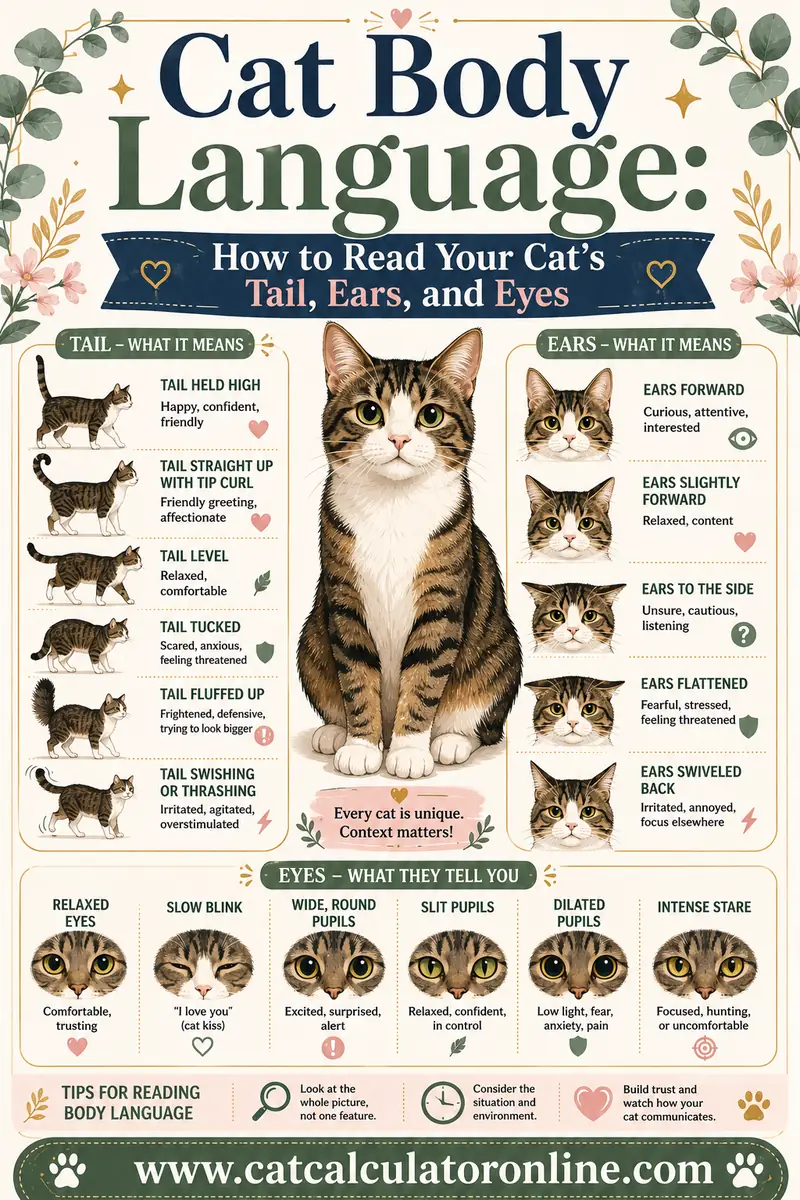
When two columns fit, the vet column wins. Cats conceal illness by instinct, so behavior change is often the only symptom on offer. The full picture is in cat body language, which is genuinely worth learning before you start diagnosing feelings.
The Myths Worth Killing
Four beliefs cause most of the harm here, and all four are worth saying plainly.
Myth: cats don't care whether you're there. They form attachment bonds, they recognize their own name, they distinguish their owner's voice from a stranger's, and they change their behavior when their person leaves. "Independent" describes how a cat copes; it says nothing about whether she noticed.
Myth: peeing on your bed is punishment. Cats have no mechanism for spite, which requires modeling your mental state and choosing to injure it. What they do have is scent-based social bonding — and depositing urine on the most human-smelling object in the house is stress signalling, not sabotage. It is also, very often, cystitis. Stress-linked bladder inflammation is real and common in cats, so this behavior sits in both boxes at once; cat peeing outside the litter box works through the medical side first, which is the correct order.
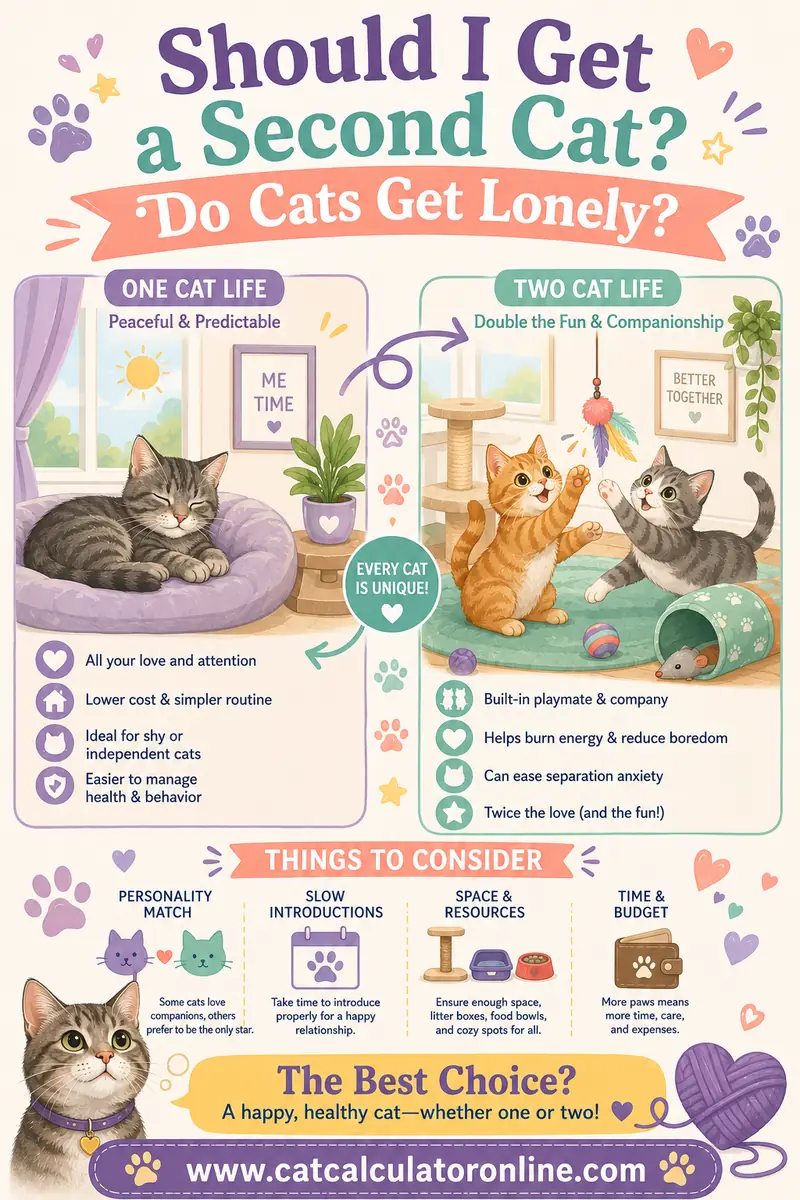
Myth: every lonely cat is fixed by a second cat. Often it makes things worse. A resident adult cat who is bonded to you, not to cats in general, does not want a roommate — she wants you. Adding a stranger to her territory can turn a manageable attachment problem into a chronic tension problem, complete with blocked litter boxes and redirected aggression. Some cats are transformed by a companion; the ones who are tend to be young, playful and already relaxed around other cats. Should I get a second cat walks that decision through properly.
Myth: a lonely cat will show it dramatically. The dog version of separation distress is loud and destructive. The cat version is frequently just less — less play, less greeting, more sleeping, more hiding. Quiet is not the same as fine.
Which Cats Are Most Likely to Feel It
Risk is not evenly spread, and knowing where your cat sits changes what you should do.
| Cat | Loneliness risk | Why |
|---|---|---|
| Kitten under 6 months | High | Social learning peaks now; kittens raised alone often develop poor cat-to-cat skills |
| Single kitten taken from the litter too early | High | Missed the 2–7 week socialization window with siblings |
| Young adult, 1–3 years, indoor only | High | Peak energy, no outlet, long empty days |
| Hand-reared or orphaned cat | High | Strongly human-bonded, often poorly cat-bonded |
| Confident adult, 4–9 years, established routine | Low to moderate | Copes well with predictable absences |
| Cat who recently lost a bonded companion | High, temporarily | A real grief-like response lasting weeks |
| Senior cat, 11+ | Moderate to high | Cognitive decline raises night-calling and clinginess, and mimics loneliness exactly |
| Cat with outdoor access and a territory | Lower | Environment supplies stimulation that indoor cats need supplied by you |
Breed matters less than people claim, but not nothing. The oriental breeds — Siamese, Bengal, Abyssinian, Burmese — are generally more people-directed and more vocal, and their owners report more separation-linked behavior. Take that as a tendency, not a rule.
Early life beats breed. Kittens handled by several people between two and seven weeks old grow into more confident adults. Kittens who spent that window alone tend to struggle both with people and with other cats.
A single long absence isn't the risk factor. A pattern of long, unstructured, unpredictable days is. The duration question — how many hours is genuinely too many, by age — is covered separately in how long you can leave a cat alone.
What Actually Helps a Lonely Cat
If you work long hours you already feel bad about this, and you should stop — the fix is almost never "be home more." It's almost always "make the empty hours worth something."
Two short hunting-style play sessions beat one long one. Ten to fifteen minutes each, with a wand toy that moves like prey: away from her, hiding, pausing, then letting her catch it. End on a catch, then feed. That sequence — hunt, catch, eat, groom, sleep — is the natural cycle, and completing it is what actually settles a cat. More ideas in keeping an indoor cat entertained.
Play before you leave, not after you get home. A cat who has hunted and eaten at 7am sleeps through the morning. The bedtime session matters too, because it heads off the 3am wake-up call.
Make the food take time. Puzzle feeders, a portion scattered in a snuffle mat, a few kibbles hidden around the house. Foraging is a job, and a job fills an afternoon. Never do this by cutting her total daily food — divide the same amount differently.
Build vertical territory and a window. A cat tree at the window with a bird feeder outside is the single highest-value thing most owners can add. Height plus a view turns a static room into something to monitor.
Keep the routine predictable. Cats read time by pattern. Feeding, play and greeting at consistent points give a day a shape, and shape is what makes an absence tolerable rather than open-ended.
Leave your scent behind, deliberately. A worn t-shirt in her favorite bed is not sentimental — it's the same scent-mixing mechanism that drives the bed-peeing, used constructively.
Consider a companion only for the right cat. Young, playful, already sociable with cats, and you have the space for separate resources. Not for a bonded, territorial adult who has never liked another cat.
And ask for a synthetic pheromone diffuser if she's clearly anxious. Evidence is mixed rather than strong, but it is cheap and harmless, and some cats respond well.
When It's a Vet Call, Not a Behavior Problem
This is the escalation point, and it comes before the enrichment plan, not after it.
Any cat who stops eating needs a vet, fast. This is the hard rule on this site. Cats that go without food for around 2–3 days — and sooner if they're overweight — can develop hepatic lipidosis, a serious liver condition where fat floods a liver that can't process it. Call your vet if she has eaten nothing for 24 hours, and treat 48 hours as urgent. Never withhold food from a cat for any behavioral reason, and never try to wait out a hunger strike. Why won't my cat eat covers the causes.
Straining in the litter box is an emergency, especially in a male cat. A blocked bladder can kill within about 24 hours. Frequent trips producing little or nothing, crying in the box, or blood in the urine means the same day, out of hours if necessary.
Get over-grooming looked at before you treat it as stress. Fleas, food allergy, and pain under the skin all produce identical bald patches, and a stress diagnosis is what's left after those are excluded — not what you start with.
Sudden night-calling in a cat over 11 is a specific thing. It's often cognitive dysfunction, high blood pressure or an overactive thyroid, all of which are treatable and none of which are loneliness.
A personality change in either direction deserves an appointment. More clingy or more withdrawn, both count. Cats mask pain, so the behavior is often the only symptom you'll ever be given.
Behavior medication exists and is not a failure. For genuinely distressed cats, a vet or a veterinary behaviorist can prescribe alongside a behavior plan. It's uncommon in cats, and it works when it's warranted.
Frequently Asked Questions
Do cats get lonely when left alone all day?
Some do. Domestic cats are facultatively social and form real attachment bonds, so a cat bonded to you can find long absences difficult — most often young, indoor-only cats aged 1–3. Confident adults with a predictable routine usually cope well. Signs tied to your departures and returns are the ones that matter.
Is my cat lonely or just bored?
Timing separates them. Loneliness tracks your comings and goings: crying at the door, over-grooming, urinating on your bed. Boredom is constant and aimed at anything — night zoomies, demanding meows, knocking objects off shelves. Boredom responds to enrichment and hunting play; attachment distress also needs routine and contact.
Do cats need another cat for company?
Not universally. Kittens, young playful cats and cats already relaxed around other cats often do far better in pairs. A bonded, territorial adult who has never liked other cats usually does worse, because the newcomer is a territorial threat rather than a friend. Match on age, energy and existing cat-tolerance.
Is my cat peeing on my bed out of spite?
No. Cats have no spite mechanism. Urinating on the most human-smelling place in the house is anxiety-driven scent mixing, or stress-linked bladder inflammation, which is common in cats. Both are real problems and neither is aimed at you. Book a vet check first, because the medical cause is treatable.
Do cats miss their owners?
Evidence says yes for most cats. Attachment tests show the majority use their owner as a secure base — exploring while she's present and settling on her return. Cats also recognize their owner's voice and their own name. How visibly a cat shows it varies enormously, and quiet cats are not indifferent cats.
Do cats grieve when another cat dies?
Many show a clear change: calling, searching the house, appetite drop, more sleeping, more clinginess. It typically eases over a few weeks. Keep routines and feeding constant, add play, and don't rush a replacement cat. Any appetite loss lasting more than 24 hours needs a vet, not time.
The useful correction here is the one at the top: your cat is not a small solitary wildcat, she's a facultatively social animal who can live alone and often would rather not. That means loneliness is possible without being universal, and the sensible move is to read your own cat rather than the stereotype. Watch for signs that track your leaving and returning, rule out the medical causes first — especially any change in eating or litter box behavior — and then fix the empty hours with hunting play, puzzle feeding, height and a window, all of which do more than simply being home more would. And if you're carrying guilt about your work hours, put it down. A well-set-up day matters far more than the number of hours in it. Start by placing her on the life-stage map with the free cat age calculator.