Average Cat Weight by Breed
Most adult cats weigh somewhere between 8 and 12 lb (3.6–5.5 kg) — but that average hides a range wider than almost any owner expects. A Singapura can be a perfectly healthy adult at 5 lb (2.3 kg) while a male Maine Coon can be equally healthy at 22 lb (10 kg), and both are normal cats. The single most useful thing to know is that within any breed, males typically run 20–25% heavier than females, which is why so many breed charts look wrong when you check them against your own cat. Below is a breed-by-breed chart split by sex, along with the thing the chart cannot tell you. To turn it into an actual target, use the cat ideal weight calculator.
What Is the Average Weight of an Adult Cat?
A single number exists, and it is less useful than the ranges around it.
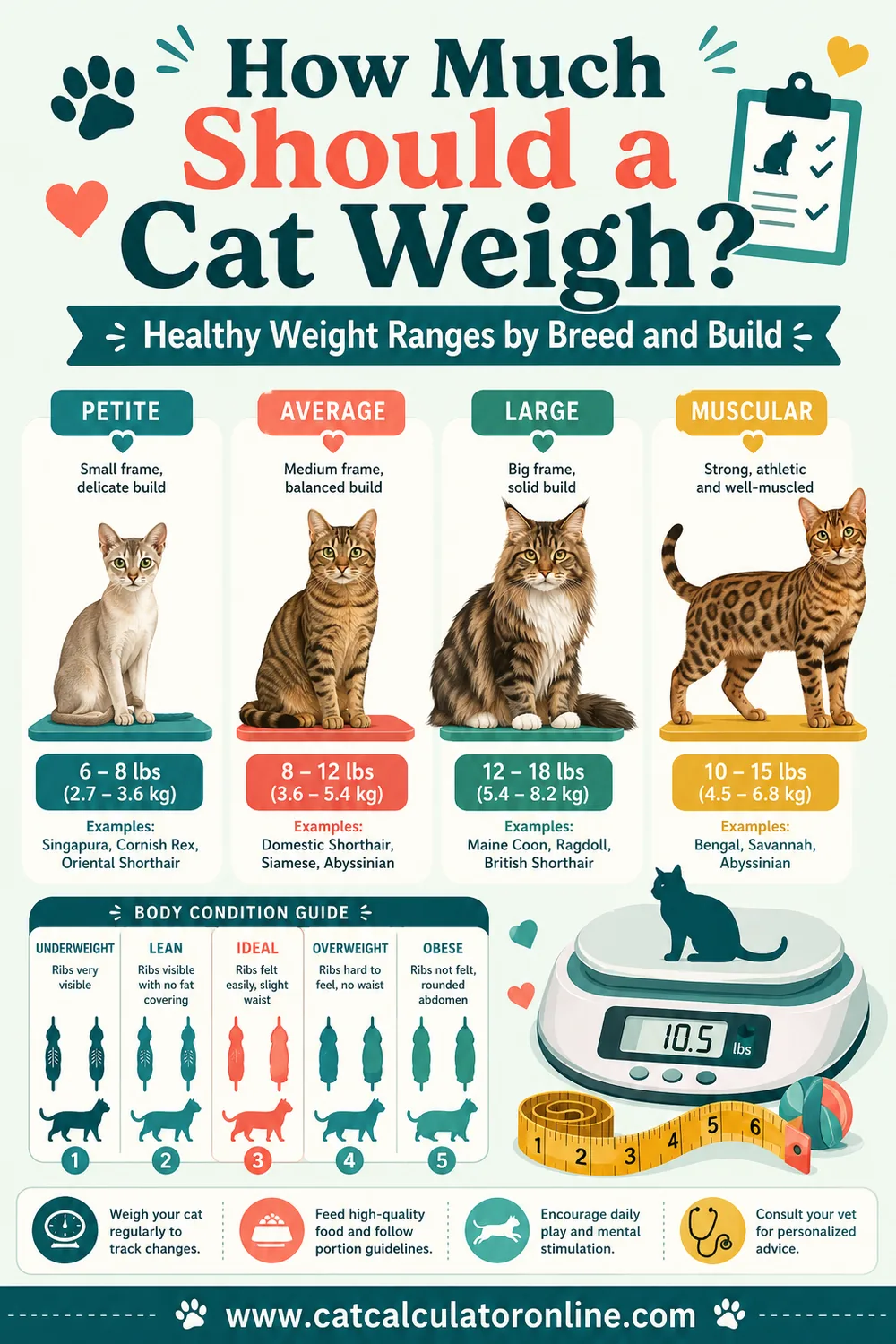
The typical adult domestic cat weighs 8–12 lb (3.6–5.5 kg). That covers most mixed-breed cats and most medium-sized pedigrees, and it is the figure behind almost every "average cat weight" claim you will read.
But pedigree cats spread that range from about 4 lb to 25 lb. A healthy adult Singapura may weigh 5 lb (2.3 kg); a healthy adult male Maine Coon may weigh 22 lb (10 kg). Both are normal. The average is a midpoint, not a standard.
Sex is the biggest single variable inside a breed. Males typically weigh 20–25% more than females of the same breed, and the gap is widest in the large breeds — a male Ragdoll can be 5 lb heavier than his sister.
Neutering changes the math but not the frame. Neutered cats have lower energy requirements, often by 20–30%, so they gain weight more easily on the same food. That is a feeding adjustment, not a different target weight.
The average has drifted upwards, and not in a good way. A large proportion of pet cats in developed countries now carry excess weight, so "average" and "ideal" are not the same thing any more. Our page on how much a cat should weigh covers what ideal actually means.
Average Cat Weight by Breed
Ranges below are for healthy adult cats at good body condition, not for cats carrying extra weight.
| Breed | Female | Male | Frame |
|---|---|---|---|
| Singapura | 4–6 lb (1.8–2.7 kg) | 6–8 lb (2.7–3.6 kg) | Smallest breed |
| Munchkin | 5–7 lb (2.3–3.2 kg) | 6–9 lb (2.7–4 kg) | Short-legged |
| Devon Rex | 5–8 lb (2.3–3.6 kg) | 7–9 lb (3.2–4 kg) | Fine-boned |
| Cornish Rex | 6–8 lb (2.7–3.6 kg) | 8–10 lb (3.6–4.5 kg) | Slender, racy |
| Abyssinian | 6–8 lb (2.7–3.6 kg) | 8–10 lb (3.6–4.5 kg) | Athletic |
| Tonkinese | 6–9 lb (2.7–4 kg) | 8–12 lb (3.6–5.5 kg) | Surprisingly dense |
| Sphynx | 6–9 lb (2.7–4 kg) | 8–12 lb (3.6–5.5 kg) | Medium, muscular |
| Siamese | 6–10 lb (2.7–4.5 kg) | 9–12 lb (4–5.5 kg) | Long and lean |
| Oriental Shorthair | 6–10 lb (2.7–4.5 kg) | 9–12 lb (4–5.5 kg) | Long and lean |
| Russian Blue | 7–10 lb (3.2–4.5 kg) | 10–12 lb (4.5–5.5 kg) | Fine-boned, dense coat |
| Persian | 7–10 lb (3.2–4.5 kg) | 9–13 lb (4–6 kg) | Cobby |
| Balinese | 6–10 lb (2.7–4.5 kg) | 8–12 lb (3.6–5.5 kg) | Long and lean |
| Domestic Shorthair | 8–11 lb (3.6–5 kg) | 10–13 lb (4.5–6 kg) | Highly variable |
| Burmese | 8–10 lb (3.6–4.5 kg) | 10–12 lb (4.5–5.5 kg) | Deceptively heavy |
| Scottish Fold | 6–9 lb (2.7–4 kg) | 9–13 lb (4–6 kg) | Rounded, cobby |
| Manx | 8–10 lb (3.6–4.5 kg) | 10–12 lb (4.5–5.5 kg) | Compact, muscular |
| Birman | 8–10 lb (3.6–4.5 kg) | 10–14 lb (4.5–6.4 kg) | Semi-cobby |
| Exotic Shorthair | 7–10 lb (3.2–4.5 kg) | 10–14 lb (4.5–6.4 kg) | Cobby |
| Bombay | 8–11 lb (3.6–5 kg) | 11–15 lb (5–6.8 kg) | Solid, muscular |
| American Shorthair | 8–12 lb (3.6–5.5 kg) | 11–15 lb (5–6.8 kg) | Sturdy |
| Bengal | 8–12 lb (3.6–5.5 kg) | 11–15 lb (5–6.8 kg) | Long, muscular |
| British Shorthair | 9–12 lb (4–5.5 kg) | 12–17 lb (5.5–7.7 kg) | Very cobby |
| Chartreux | 9–12 lb (4–5.5 kg) | 12–16 lb (5.5–7.3 kg) | Heavy-boned |
| Siberian | 8–12 lb (3.6–5.5 kg) | 12–17 lb (5.5–7.7 kg) | Big, slow-maturing |
| Turkish Van | 10–14 lb (4.5–6.4 kg) | 14–18 lb (6.4–8 kg) | Long-bodied |
| Norwegian Forest | 12–16 lb (5.5–7.3 kg) | 14–18 lb (6.4–8 kg) | Large, sturdy |
| Ragamuffin | 10–15 lb (4.5–6.8 kg) | 15–20 lb (6.8–9 kg) | Large, heavy |
| Ragdoll | 10–15 lb (4.5–6.8 kg) | 15–20 lb (6.8–9 kg) | Large, long |
| Maine Coon | 10–15 lb (4.5–6.8 kg) | 15–25 lb (6.8–11 kg) | Largest domestic breed |
| Savannah | 12–20 lb (5.5–9 kg) | 15–25 lb (6.8–11 kg) | Varies hugely by generation |
Read your own cat's row and its own sex column. Using the breed midpoint is the commonest mistake, and it makes half of all female cats look underweight and half of all males look overweight.
Maine Coon and Ragdoll figures cause the most confusion. Both breeds are genuinely large, both are slow to mature, and both attract exaggerated online claims. Our pages on how big Maine Coons get and how big Ragdolls get give the detail.
Savannah is the wildest spread because generation matters more than breed. An F1 Savannah is a very different animal from an F5, and the weights differ accordingly.
Why Are Male Cats So Much Heavier?
Because they are built differently, and neutering changes it less than people assume.
Males have larger skeletal frames and more muscle mass. The difference is structural rather than a matter of condition, which is why it shows up even in a lean cat.
The gap widens in large breeds. In a Singapura, the male-female difference might be 2 lb. In a Maine Coon it can be 8 lb or more.
Neutering does not remove the difference. It reduces some hormone-driven muscle development if done early, but a neutered male still finishes larger than his sisters. What it does change is metabolism — a neutered cat needs roughly 20–30% fewer calories, which is why so many gain weight in the year after surgery.
Entire tom cats develop heavier jowls and thicker skin over the neck and shoulders. Some of what looks like extra weight in an unneutered male is that structural difference rather than fat.
Compare like with like, always. If you are checking your cat against a chart, use the column for its sex and, if it is a pedigree, its breed. If it is a mixed-breed cat, the domestic shorthair row is the right starting point.
Which Breeds Weigh More Than They Look?
Several, and it catches out owners and vets alike.
Burmese are famously dense. The description used by breeders is "a brick wrapped in silk". A Burmese that looks slim can weigh 12 lb (5.5 kg) with perfectly normal body condition.
Russian Blues carry a very dense double coat. They look substantial and often weigh less than expected — the reverse trap.
Longhaired breeds hide condition in both directions. A Persian or a Norwegian Forest Cat can lose 20% of its body weight before it looks thin, and can carry a significant amount of excess before it looks fat. Hands, not eyes.
British Shorthairs are heavy without being overweight. The cobby build, broad chest and thick coat mean a lean male can genuinely weigh 15 lb (6.8 kg). They are also a breed with a real tendency to gain, so this one needs judging carefully rather than assumed either way.
Sphynx cats feel heavier than they are. With no coat you feel dense muscle directly, so people consistently overestimate their weight.
Which is the whole argument for body condition scoring. Feel the ribs, look for a waist from above and a belly tuck from the side. The cat body condition score works identically on a 6 lb Devon Rex and a 20 lb Maine Coon, where no chart can.
When Does a Cat Reach Its Adult Weight?
Later than most owners assume, and much later in the large breeds.
Most cats reach adult weight between 10 and 12 months. That covers the majority of mixed-breed cats and medium-sized pedigrees.
Large and slow-maturing breeds take two to five years. Maine Coons commonly fill out until three or four, Siberians until around five, and Ragdolls until three. A kitten from one of these breeds will look leggy and gangly for a long time before it fills in, and that is normal.
Growth is not steady. Kittens gain fastest in the first few months, then the rate slows sharply. A plateau at eight months does not mean the cat has finished.
Neutering timing has a small effect on final size. Early neutering can slightly delay growth-plate closure, which sometimes produces marginally taller, leggier cats. It does not produce an unhealthy cat and it is not a reason to delay.
Do not use adult charts for a growing kitten. Our page on when cats stop growing covers the timeline properly, and kitten weight should be tracked against a growth curve rather than an adult target.
Why Isn't a Breed Average Your Cat's Target?
Because a chart describes a population and your cat is an individual.
Frame size varies substantially within every breed. Two pedigree Siamese from different lines can differ by 3 lb at identical body condition. Neither is wrong.
Mixed-breed cats — most cats — have no chart at all. A mixed-breed cat that looks like a British Shorthair may have the frame of a domestic shorthair. Guessing the breed and then applying its numbers compounds two errors.
Condition is the better question. Rather than "does my cat match the chart", ask "can I feel the ribs easily under a thin layer of fat, is there a waist from above, is there a tuck from the side". That works on any cat.
A vet's assessment sets a personal target. Vets combine weight, body condition and frame to give an ideal weight for that specific cat, and they will have historic weights to compare against. Our page on the healthy weight range for cats explains how those two things fit together.
Use the chart for orientation, not for judgement. It tells you whether you should be expecting a 9 lb cat or a 17 lb one. It does not tell you whether the cat in front of you is right.
What If Your Cat Is Well Outside Its Breed Range?
It depends entirely on which direction, and one direction is far more urgent than the other.
Above the range with poor body condition means overweight. Ribs hard to find, no waist from above, a rounded belly. This is extremely common and worth addressing, because excess weight in cats is linked to diabetes, arthritis and a shorter life.
But weight loss in a cat must be slow. This is the rule that matters most: aim for around 0.5–2% of body weight per week and never starve a cat into losing weight. Rapid fat mobilisation can overwhelm the liver and cause hepatic lipidosis, a serious and sometimes fatal condition. Our guide on how to help your cat lose weight sets out a safe plan, and any diet is better done with your vet's input.
Below the range needs a vet, not more food. Unexplained weight loss in a cat is a medical finding. Hyperthyroidism, kidney disease, diabetes, dental pain and cancer all present this way, and a cat that is eating well and still losing weight is the classic overactive thyroid picture.
A 5% change either way is worth a phone call. On a 10 lb (4.5 kg) cat that is only 8 oz (225 g).
Call the vet the same day if: your cat has not eaten for 24 hours, is drinking noticeably more, is lethargic or hiding, or is vomiting repeatedly. Never withhold food from a cat for any reason.
How Do You Weigh a Cat Accurately?
It takes about thirty seconds and it is the most useful habit in this article.
A digital baby scale is the best home option. It reads in small increments, which matters when a meaningful change is 8 oz.
Otherwise use the subtraction method. Weigh yourself, weigh yourself holding the cat, subtract. Bathroom scales are coarse, so be consistent about how you round.
Weigh at the same time of day, before a meal. A cat that has just eaten a large wet meal can read several ounces heavier.
Monthly for an adult, every two weeks for a senior or a cat on a plan. More often than that just measures noise.
Write it down. A trend across six months catches disease that a single reading never will.
Pair it with a hands-on check every few weeks. Weight plus condition together tell you whether a steady number is hiding a swap of muscle for fat. Feed to the cat in front of you, and use the cat ideal weight calculator to convert your reading into a target.
Frequently Asked Questions
What is the average weight of an adult cat?
Most adult domestic cats weigh 8–12 lb (3.6–5.5 kg). Breed widens that considerably: a healthy Singapura may weigh 5 lb (2.3 kg) and a healthy male Maine Coon 22 lb (10 kg). Within any breed, males typically weigh 20–25% more than females.
Which cat breed is the heaviest?
The Maine Coon, with males commonly 15–25 lb (6.8–11 kg) and females 10–15 lb (4.5–6.8 kg). Savannahs can match or exceed that depending on generation, and Ragdolls, Ragamuffins and Norwegian Forest Cats follow closely with males often reaching 18–20 lb (8–9 kg).
Which cat breed is the smallest?
The Singapura, with adult females typically 4–6 lb (1.8–2.7 kg) and males 6–8 lb (2.7–3.6 kg). Munchkins, Devon Rex and Cornish Rex are also small, generally 5–10 lb (2.3–4.5 kg). Small frames mean a single pound is a large proportion of body weight.
Do male cats weigh more than female cats?
Yes, typically 20–25% more within the same breed, because males have larger skeletal frames and more muscle. The gap is small in fine-boned breeds and can exceed 8 lb (3.6 kg) in Maine Coons. Always compare your cat to the figures for its own sex.
At what age do cats reach their adult weight?
Most cats reach adult weight between 10 and 12 months. Large, slow-maturing breeds take much longer — Maine Coons often fill out until three or four years, Ragdolls until around three, and Siberians until around five. Growth slows sharply after the first few months.
Is my cat overweight if it is above its breed range?
Possibly, but check body condition rather than the chart. Frame size varies within every breed and most cats are mixed breed anyway. If you cannot easily feel the ribs, cannot see a waist from above and there is no belly tuck from the side, your cat is likely carrying excess weight.
Use the chart above the way a vet would: as orientation rather than as a verdict. It tells you whether to expect a 9 lb cat or a 17 lb one, and it reminds you to read your cat's own sex column instead of the breed midpoint. What it cannot tell you is whether your particular cat, with its particular frame, is at the right weight — for that, put your hands on the ribs, look for a waist from above and a tuck from the side, and weigh monthly so you have a trend rather than a snapshot. Treat a 5% change in either direction as worth a phone call, remember that weight loss must always be slow and vet-supervised, and use the cat ideal weight calculator to turn all of it into one number to aim at.