How Much Should a Cat Weigh? Healthy Weight Ranges by Breed and Build
Most adult cats land between 8 and 12 pounds, and that's the number you'll see quoted everywhere. But that's an average, not a target — a slender Siamese at 8 pounds and a Maine Coon at 17 pounds can both be perfectly healthy. Breed and frame move the goalposts, which is why vets judge a cat's weight by feel, not by the scale alone.
The fastest way to see where your cat sits is our free cat ideal weight calculator — it uses body condition score to estimate the healthy weight for your cat rather than a generic average. Below, we'll cover the real ranges, why the number on the scale can mislead you, and how to check your cat with your hands in about thirty seconds.
⚖️ Is that weight in the typical range?
Tap a weight to see how it reads for an average-framed adult cat:
Tap a weight above. Remember: frame matters more than the number.
The Short Answer: 8 to 12 Pounds for an Average Cat
A typical adult domestic shorthair or domestic longhair — the mixed-breed cats most of us live with — should weigh somewhere between 8 and 12 pounds once fully grown, usually around 10 to 12 months old.
Within that band:
- Females tend to sit toward the lower end, often 8 to 10 pounds.
- Males tend to sit toward the upper end, often 10 to 12 pounds.
- Neutered and spayed cats need fewer calories than intact cats, so they drift upward if portions don't change.
That's the shorthand. Now here's why treating 10 pounds as a universal goal gets a lot of cats mismanaged.
Why One Number Doesn't Work
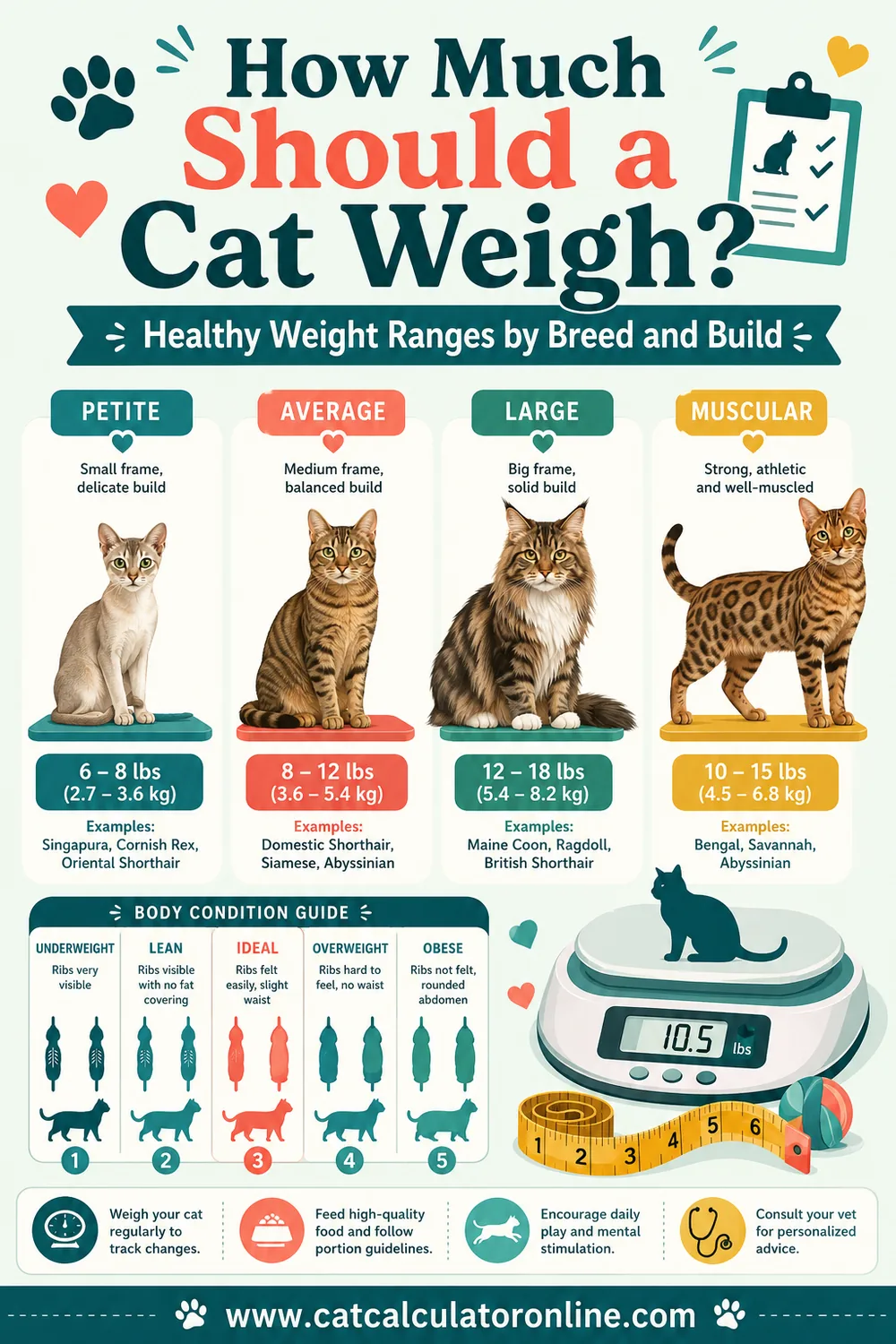
Cats vary in skeleton size far more than people expect. Put a petite Singapura next to a Maine Coon and you're looking at two animals that can differ by 12 pounds while both being in great shape.
Three things make the "right" number personal:
- Breed. Some breeds are built long and lean; others are genuinely large-framed cats with heavy bone.
- Frame within a breed. Even among domestic shorthairs, some cats are small-boned and some are stocky. A cat with a wide ribcage carries more healthy weight.
- Muscle vs. fat. A muscular, active 13-pound cat is a completely different animal from a sedentary 13-pound cat, even though the scale reads the same.
This is exactly why veterinary practices don't diagnose obesity from weight alone. They use body condition scoring — a hands-on assessment — and so should you.
Healthy Cat Weight by Breed
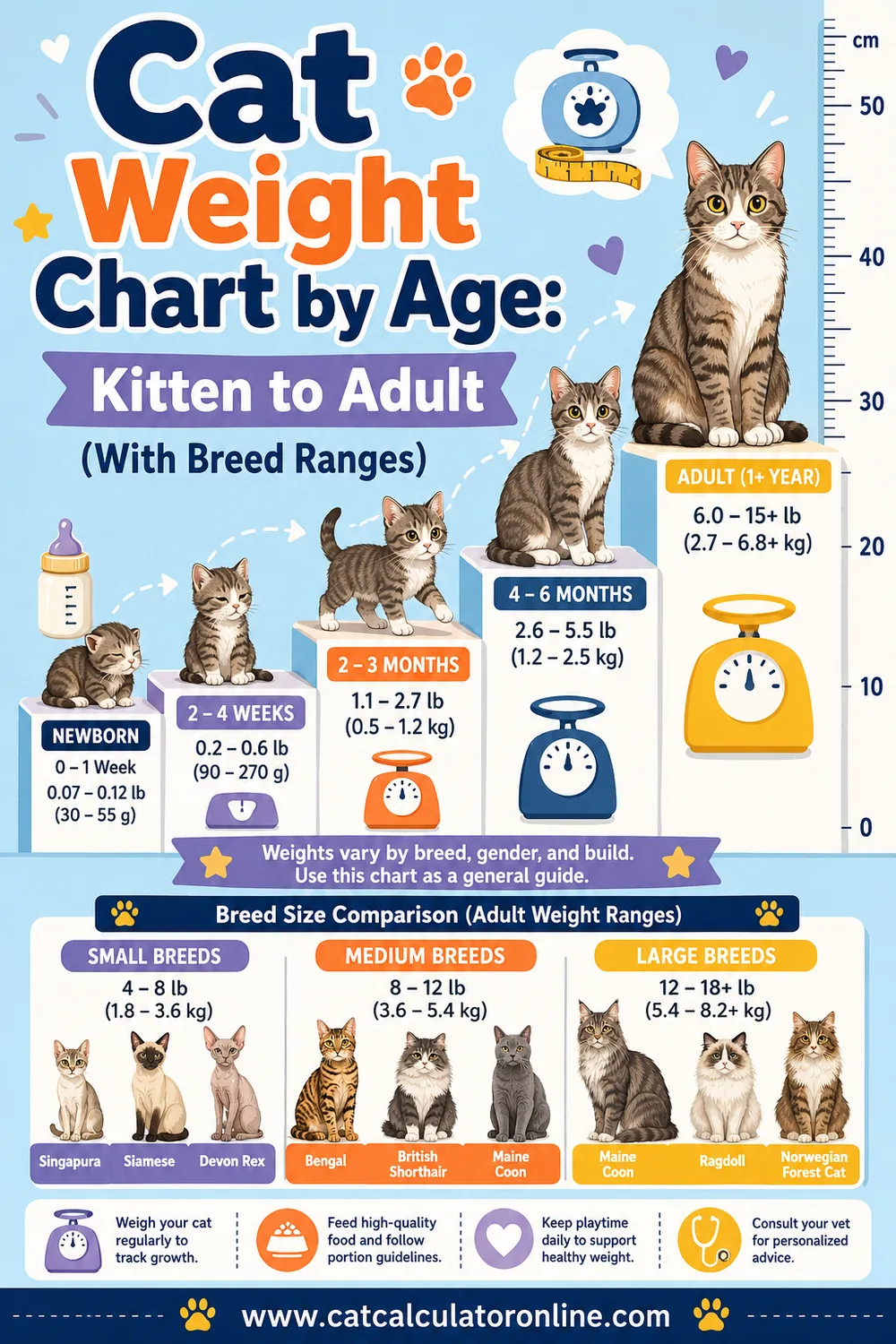
Here are typical healthy adult ranges for common breeds. Treat these as guidance, not rules; individual cats fall outside them and are still fine.
| Breed | Typical healthy adult weight | Notes |
|---|---|---|
| Singapura | 4–8 lb | One of the smallest breeds |
| Siamese | 6–10 lb | Long, lean, fine-boned |
| Abyssinian | 6–10 lb | Athletic and slender |
| Devon Rex | 6–9 lb | Small, light frame |
| Russian Blue | 7–12 lb | Dense coat hides a slim body |
| Domestic shorthair (mixed) | 8–12 lb | The most common house cat |
| Domestic longhair (mixed) | 8–12 lb | Coat adds bulk, not weight |
| American Shorthair | 8–15 lb | Sturdy, broad-chested |
| British Shorthair | 9–17 lb | Cobby build, heavy bone |
| Persian | 7–12 lb | Coat exaggerates size |
| Bengal | 8–15 lb | Very muscular |
| Norwegian Forest Cat | 10–16 lb | Large, slow to mature |
| Ragdoll | 10–20 lb | Males considerably larger |
| Maine Coon | 10–18+ lb | Males 12–18+, still growing at 3–4 yrs |
Notice how much overlap there is. A 14-pound cat could be a lean Maine Coon adolescent or an obese domestic shorthair. The scale can't tell the difference — your hands can.
A note on fluffy breeds
Long-haired cats look heavier than they are. A Persian or a Norwegian Forest Cat can carry an enormous coat and still be underweight underneath it. Always assess these cats by touch, ideally after a good brush-out, and don't let the silhouette fool you.
Body Condition Score: What Vets Actually Use
Body condition score (BCS) is a 9-point scale that rates how much fat a cat is carrying. Ideal is 4 or 5 out of 9. Below 4 is underweight; above 5 is overweight.
The useful part: each point above 5 works out to roughly 10% over ideal body weight. That gives you a simple formula.
Ideal weight = current weight ÷ (1 + 0.10 × (BCS − 5))
So a 15-pound cat scoring a 7 is carrying about 20% extra: 15 ÷ 1.2 = 12.5 pounds as the target. Our cat ideal weight calculator runs this math for you and gives you a realistic goal instead of a guess.
| BCS (out of 9) | What it means | Roughly |
|---|---|---|
| 1–3 | Underweight | Ribs, spine, hips easily visible |
| 4–5 | Ideal | Ribs felt easily, clear waist, slight belly tuck |
| 6 | Overweight | Ribs need light pressure to find, waist fading |
| 7 | Overweight | ~20% over ideal; no waist from above |
| 8 | Obese | ~30% over ideal; fat pads over ribs and spine |
| 9 | Obese | ~40%+ over ideal; heavy abdominal fat |
The 30-Second Hands-On Check
You don't need equipment. Stand your cat on a flat surface and do these three things.
1. Feel the ribs
Run your fingertips along her side with light pressure — the same pressure you'd use on the back of your own hand. You should be able to feel each rib without pressing in, but not see them clearly. If you have to dig, she's carrying extra. If the ribs feel sharp and bare, she's too thin.
2. Look from above
Stand over her and look down. You want a visible narrowing behind the ribcage — a waist. A straight line from ribs to hips means she's overweight; a bulge that's wider than her ribs is a clear sign.
3. Look from the side
There should be a gentle upward tuck from the ribcage to the hind legs. A belly that hangs level with or below the ribcage is a red flag.
The primordial pouch is not fat
Nearly every cat has a loose flap of skin hanging under the belly, between the hind legs. It swings a little when she trots. This is the primordial pouch and it's completely normal — it's skin and a little fat, present even on lean, athletic cats, and it's more obvious in some breeds. Don't put your cat on a diet because of it. Judge by ribs and waist instead.
What Happens When a Cat Is Overweight
Extra weight isn't cosmetic. Carrying too much fat raises a cat's risk of:
- Diabetes mellitus — one of the most strongly weight-linked conditions in cats.
- Arthritis and joint pain — heavier cats stop jumping, which owners often mistake for "just getting older."
- Reduced mobility and grooming — overweight cats can't reach their lower back, so the coat gets greasy or matted.
- Higher anesthetic and surgical risk.
- A shorter life overall.
The reassuring part: even a modest loss makes a difference, and cats respond well to careful portion control. If you're aiming to trim your cat down, read how to help your cat lose weight first — cats must lose slowly, and rapid weight loss is genuinely dangerous for them.
What About Underweight Cats?
Being too thin matters just as much, and it's more often a symptom than a habit. Unexplained weight loss in cats — especially older ones — can point to hyperthyroidism, kidney disease, diabetes, dental pain, or intestinal problems.
Signs to take seriously:
- Ribs, spine, and hip bones that are visible, not just easily felt
- Weight dropping while appetite stays normal or increases
- Any loss of more than a few percent of body weight without a diet change
Don't try to fatten a thin cat with extra food and hope for the best. Book a vet visit — the underlying cause is what needs treating.
Weight Changes Across a Cat's Life
Healthy weight isn't a fixed number forever. It shifts predictably with age.
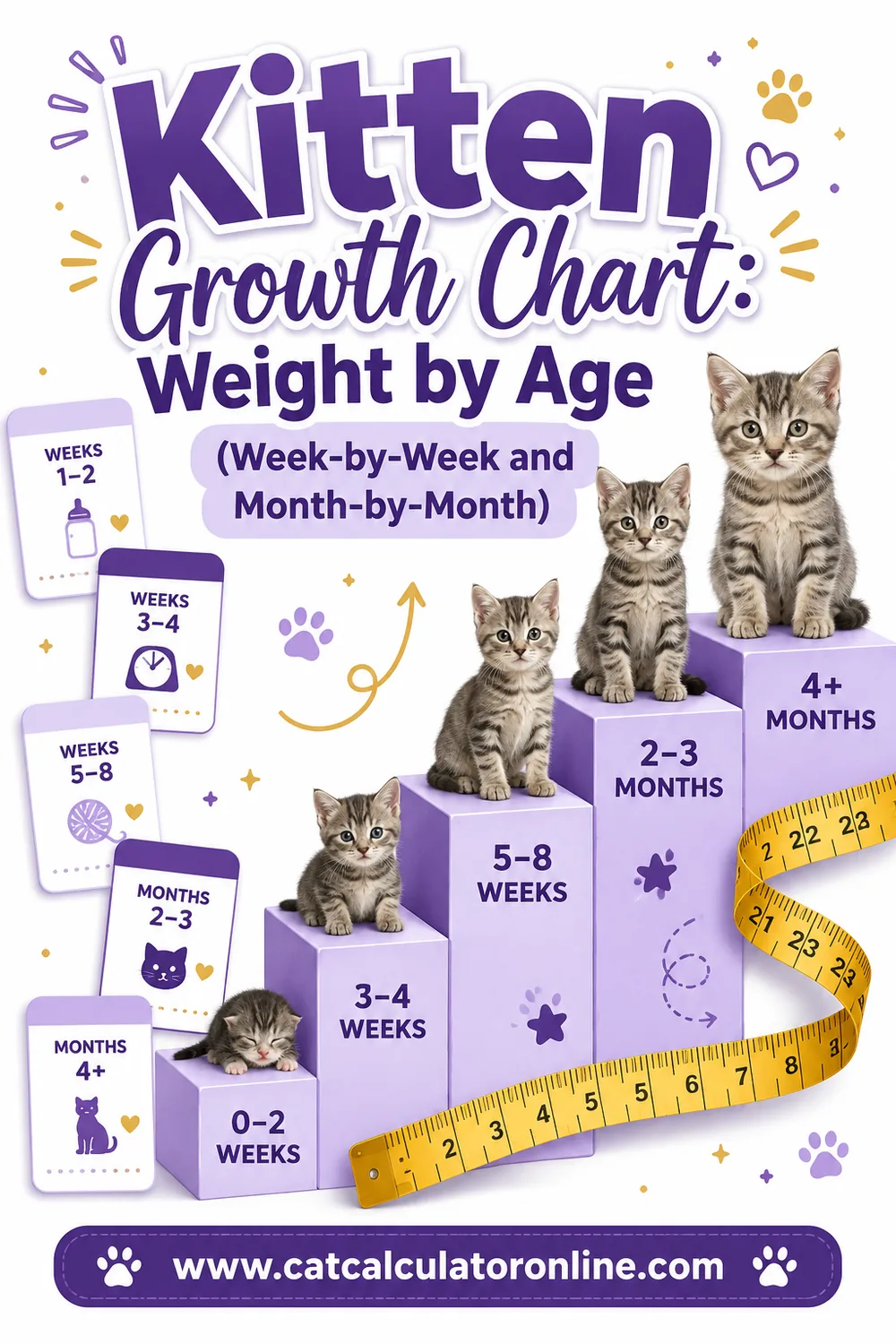
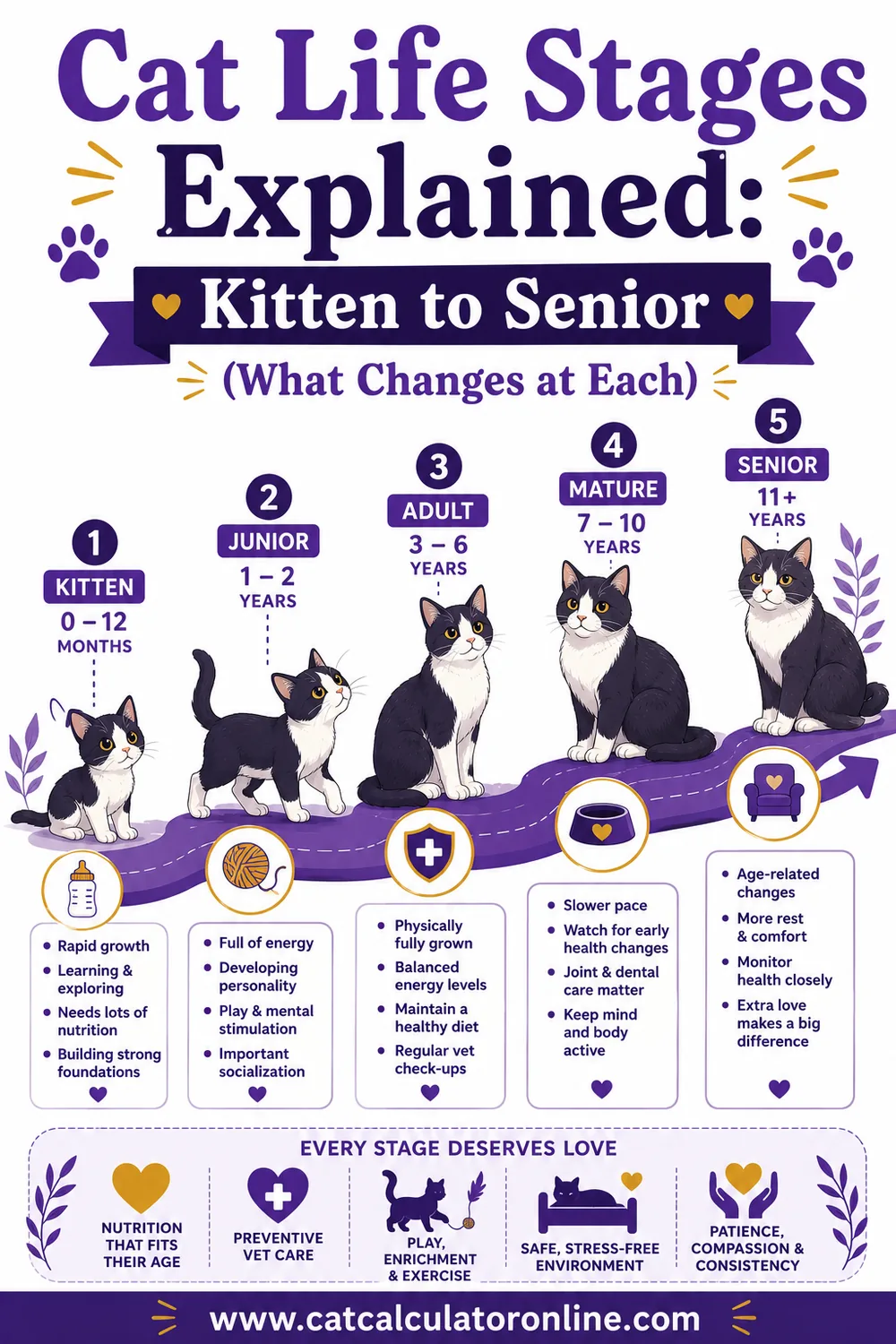
- Kittens (0–12 months): gaining constantly. Roughly a pound a month early on. See the kitten growth chart for what to expect week by week.
- Young adults (1–6 years): should hold steady. This is the stretch where post-neutering weight creep quietly sets in.
- Mature adults (7–10 years): activity drops but appetite often doesn't. The most common age to tip into overweight.
- Seniors (10+ years): many cats lose weight naturally as muscle mass declines. In a senior, unexpected loss deserves a vet visit rather than a shrug.
Weigh your cat every few months and write it down. A trend tells you far more than a single reading. More on what changes with age in cat life stages explained.
How to Weigh Your Cat at Home
Bathroom scales rarely register a cat accurately, so use the subtraction trick:
- Weigh yourself alone and note the number.
- Pick up your cat and weigh yourself again.
- Subtract. The difference is your cat's weight.
A digital baby scale or a kitchen scale with a basket works even better for kittens, where small changes matter. Weigh at the same time of day, ideally before a meal, for consistent numbers.
FAQ
Is 15 pounds too heavy for a cat?
It depends entirely on the cat. For a Maine Coon or Ragdoll male, 15 pounds can be perfectly healthy. For an average domestic shorthair whose ideal is around 10 pounds, 15 is roughly 50% overweight. Check body condition rather than the number.
How much should a female cat weigh?
Female domestic cats typically sit at the lower end of the range, around 8 to 10 pounds. Females of large breeds like the Maine Coon commonly reach 10 to 14 pounds and are still in good shape.
Is my cat's saggy belly a sign she's fat?
Usually not. The loose skin flap under a cat's belly is the primordial pouch, and it's normal anatomy on lean cats too. Judge weight by whether you can easily feel her ribs and see a waist from above.
At what age does a cat reach its adult weight?
Most cats reach near-adult size around 10 to 12 months. Large breeds like Maine Coons and Norwegian Forest Cats keep filling out until three or four years old.
How do I calculate my cat's ideal weight?
Divide her current weight by (1 + 0.10 × (BCS − 5)), where BCS is her body condition score out of 9. A 14-pound cat at BCS 7 works out to about 11.7 pounds. Our cat ideal weight calculator does it instantly.
Should I change food if my cat is overweight?
Talk to your vet before switching. Portion size usually matters more than the food itself, and our cat food calculator can show you what her daily amount should look like at her target weight.
The Bottom Line
Eight to twelve pounds is the honest average for an adult cat, but your cat's right number depends on her breed, her frame, and how much of that weight is muscle. Feel for the ribs, look for the waist, and ignore the belly pouch — that hands-on check beats any chart.
Ready for a number that's actually tailored to your cat? Run her through our free cat ideal weight calculator, then use the cat food calculator to match her daily portions to that target. If you want more detail on feeding amounts, how much should I feed my cat breaks it down by weight and activity level.