How to Help Your Cat Live Longer
If you only change one thing, make it this: from about age eleven, take your cat for a check-up and blood test twice a year instead of once. Cats are hardwired to hide illness, and the three conditions that quietly end most cats' lives — kidney disease, an overactive thyroid and high blood pressure — are all common, all treatable, and all detectable on a routine test months before your cat looks unwell. Everything else on this page matters too: keeping her indoors, keeping her lean, brushing her teeth. But that six-monthly appointment is the one that buys whole years. Curious where your cat sits right now? The cat age calculator will tell you in a tap.
What Actually Adds Years, In Order
Not every piece of cat advice is worth the same. Some changes shift a cat's life expectancy by years; some shift it by weeks.
Lifestyle beats genetics by a wide margin. A mixed-breed cat who lives indoors, stays lean and sees a vet twice a year in old age will usually outlive a pedigree cat with excellent bloodlines who roams. You cannot choose your cat's genes after you have her. You can choose almost everything else.
Here is the honest ranking. Indoor living first, healthy weight second, senior screening third, then dental care, neutering and parasite control. Diet brand, supplements and water fountains all matter far less than the internet suggests.
| Change | Realistic effect | Effort |
|---|---|---|
| Keeping her indoors or supervised outdoors | Very large — years | One-off decision |
| Healthy weight through adulthood | Large | Daily, small |
| Twice-yearly vet checks after age 11 | Large | Two visits a year |
| Dental care and vet dentals when advised | Moderate to large | A minute a day |
| Neutering | Moderate to large | One appointment |
| Parasite prevention and vaccines | Moderate | Quarterly to yearly |
| Premium food brand over standard complete food | Small | Ongoing cost |
| Supplements without a diagnosed need | Negligible | Ongoing cost |
Note what is missing from the top of that table. Nothing you buy is on it. The things that work are decisions and habits, and most of them are cheap or free.
Keep Her Indoors, Or Make Outside Safe
This is the biggest single number in feline longevity, and it is uncomfortable to read if your cat already goes out.
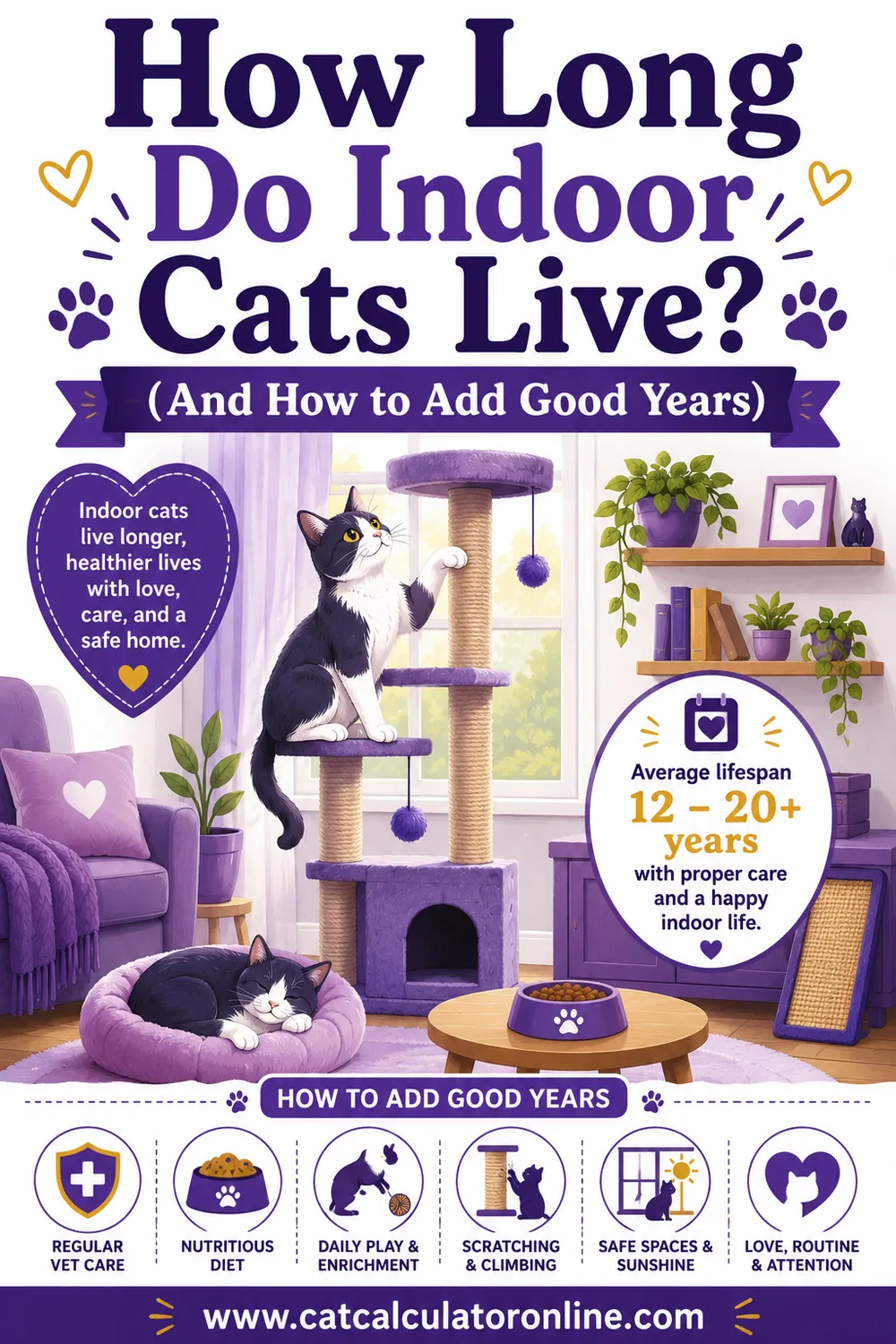
Indoor cats commonly live 12 to 18 years. Cats with free outdoor access average dramatically less. The gap is not caused by indoor cats aging more slowly. It is caused by outdoor cats dying young — roads, fights, infectious disease passed cat to cat, poisons, dogs and predators. Most of those deaths happen to healthy young cats who would otherwise have had a decade left. The full comparison is laid out in our guide to how long indoor cats live.
A bored indoor cat is a solvable problem; a dead outdoor cat is not. That is the blunt version. Indoor cats do need more from you: vertical space, a window with a view, two or three short play sessions a day, and a scratching post that is actually tall enough to stretch on.
The middle path is genuinely good. A secure catio, a cat-proofed garden fence or harness walks give most of the enrichment with almost none of the risk. If your cat already roams and loves it, moving her indoors is still worth doing — it takes a few noisy weeks, and cats adapt better than owners expect.
If she must go out, cut the risk where you can. Keep her in from dusk to dawn, when road deaths and fights peak. Microchip her and keep the details current. Stay on top of vaccinations, because outdoor cats meet other cats.
Why Weight Is The Second-Biggest Lever
Most owners cannot tell whether their own cat is overweight, which is exactly why this one is worth spelling out.
Run a flat palm along her side. You should feel the ribs easily, under a thin covering — a bit like the back of your hand. If you have to press to find them, she is carrying too much. Looked at from above, an adult cat should have a visible waist behind the ribs. From the side, the belly should tuck up slightly, not swing.
A typical adult domestic shorthair sits around 8 to 12 lb (3.6 to 5.4 kg), but breed changes that enormously — a Maine Coon at 16 lb (7.3 kg) can be lean and a Siamese at 12 lb (5.4 kg) can be fat. That is why body shape beats the number on the scale. Our guide on telling whether your cat is overweight walks through the hands-on check.
The mechanism matters. Excess body fat in cats is not inert padding. It behaves like an active tissue that drives insulin resistance, which is why overweight cats get diabetes at several times the rate of lean ones. It loads the joints, so arthritis arrives earlier. And it makes every anaesthetic and every illness harder to manage.
Weight loss must be slow. Never withhold food from a cat to make her lose weight. A cat who stops eating can develop a serious liver condition called hepatic lipidosis within days, and it can be fatal. Any weight-loss plan should be built with your vet, aiming for roughly 0.5 to 2 percent of body weight lost per week, with food measured rather than eyeballed.
The Twice-Yearly Vet Check After Eleven
This is the section to act on if you skim the rest.
Cats are prey animals as well as predators, and a cat who looks ill is a cat who gets picked off. So they mask it — completely, and for a long time. By the time you notice weight loss or increased thirst, chronic kidney disease has usually already destroyed around three-quarters of working kidney tissue. That is not a failure of attention on your part. It is a failure that is built into the species.
Blood and urine tests see through the mask. A senior panel is not exotic: kidney values, thyroid hormone, blood sugar, liver values, red and white cells, plus a urine sample and a blood pressure reading. Together they catch the big three of old age months to years before anything is visible at home.
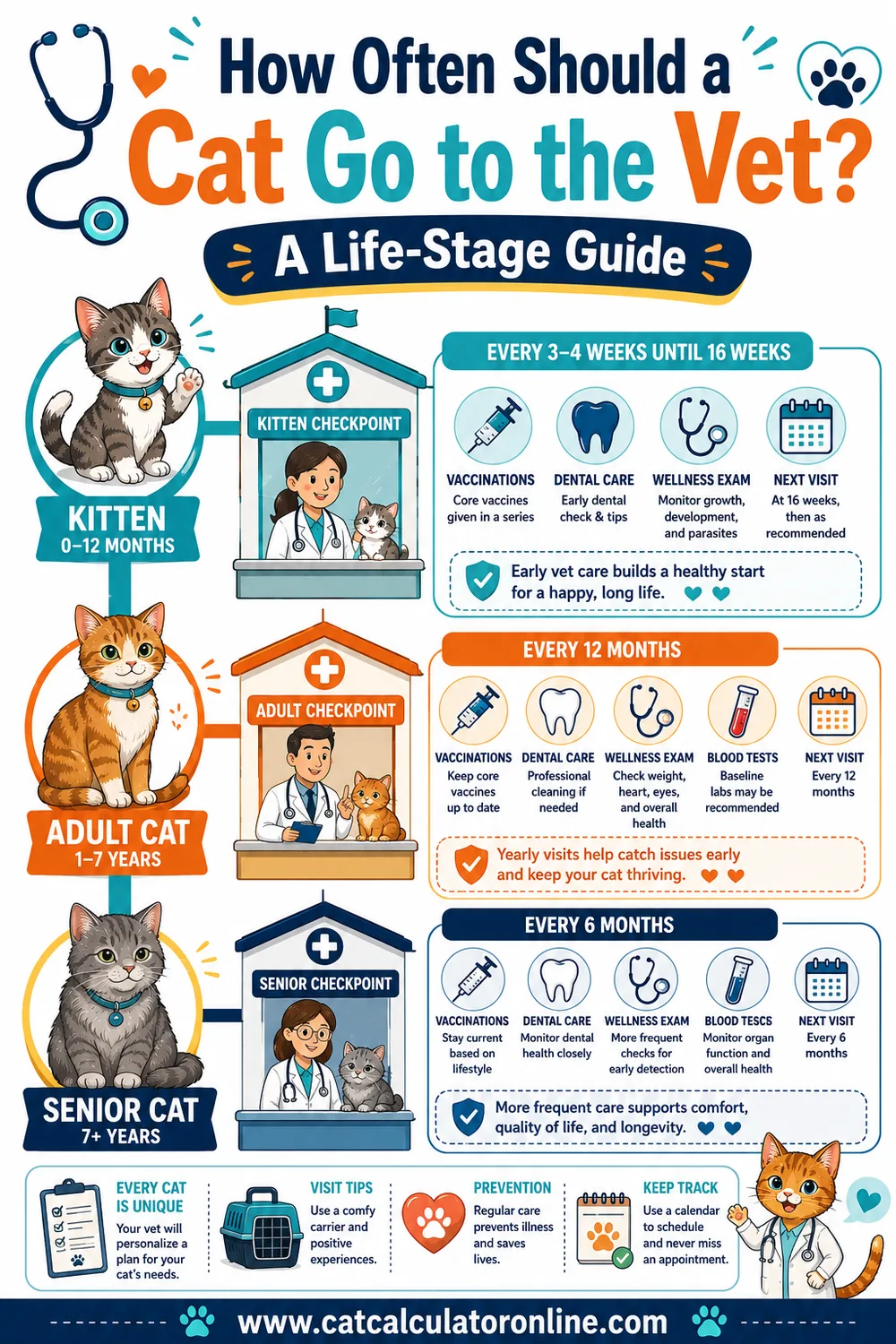
Why twice a year and not once. A cat at eleven is roughly a person of sixty, and each subsequent cat year is worth about four human ones. Twelve months between checks in a senior cat is like a person in their seventies going four or five years without seeing a doctor. Six-monthly visits catch changes while they are small. Our page on how often a cat should see the vet has the full schedule by age.
What the three big conditions actually look like when caught early. Chronic kidney disease shows up as dilute urine and rising kidney values, and early diet change plus fluid support can add years. An overactive thyroid shows as a raised hormone level, and treatment ranges from daily tablets to a radioiodine injection that is usually curative. High blood pressure often has no signs at all until a cat goes suddenly blind from a detached retina — a catastrophe that a two-minute cuff reading prevents.
Call the vet the same day if: your cat stops eating for 24 hours, a male cat strains in the litter box without producing urine, she breathes with an open mouth, or she suddenly cannot see. Those are emergencies, not wait-and-see problems.
Dental Care Is Not Cosmetic
By three years old, the majority of cats have some degree of gum disease. Most owners have never looked.
Lift her lip and look at the gum line. A thin red band where gum meets tooth is gingivitis, and at that stage it is reversible. Brown tartar, receding gums and a smell that makes you pull back are further along. A cat with painful teeth almost always keeps eating, which is why the pain goes unnoticed for years.
Daily brushing is the only home measure with strong evidence behind it. A soft brush or a finger brush and cat-safe enzymatic paste, ten seconds a side, once a day. Build up over a two weeks rather than wrestling her on day one. Dental diets and water additives help a little; they do not replace brushing.
Professional dentals happen under general anaesthetic, and that is not a reason to avoid them. A cat with chronic dental infection is running a low-grade inflammatory load every day of her life, and modern feline anaesthesia in a healthy cat is much safer than leaving that in place. Our guide to dental disease in cats explains what a dental involves and what it costs.
One condition worth naming: tooth resorption, where the tooth structure breaks down from the inside. It is extremely common, genuinely painful, invisible without dental X-rays, and the fix is extraction. If your cat chatters or drops food from one side, ask about it.
Neutering, Parasites And Vaccines
The unglamorous middle of the list, and all of it is settled science.
Neutered cats of both sexes outlive intact ones, and the gap is not small. For males, neutering removes the drive to roam and fight, which removes most road deaths and most bite-abscess infections, including the viruses spread by bites. For females, spaying removes the risk of pyometra — a womb infection that is a surgical emergency in older intact cats — and, done before the first seasons, cuts the lifetime risk of mammary cancer dramatically. Feline mammary tumours are usually malignant, which makes prevention worth a great deal. Timing is covered in our guide on when to neuter a cat.
Parasite control is about more than worms. Fleas carry tapeworm and cause miserable skin allergies; in kittens and frail seniors a heavy burden can cause real anemia. Lungworm and roundworm matter more in hunters. An indoor-only adult cat with no other pets needs less than a garden hunter — ask your vet to set a schedule for your cat's actual life, not a generic one.
Vaccines are a lifestyle question too. Core protection against cat flu and panleukopenia is sensible for every cat, since flu viruses arrive on your shoes and in boarding catteries. Feline leukaemia vaccination matters most for cats who meet other cats. Boosters after the initial course are often less frequent than people assume, so it is worth a conversation rather than an automatic annual.
Food, Water And The Things People Overrate
Diet is where most owners spend their effort, and where the returns are smallest — with two real exceptions.
Any complete, life-stage-appropriate food is fine. Cats are obligate carnivores and need animal-based protein, plus taurine, which they cannot make in useful amounts. Every reputable complete food already handles that. Beyond it, brand differences are marketing far more often than medicine.
Portion size is the exception that matters. How much you feed outweighs what you feed by a long way. A typical lean adult cat needs roughly 200 to 250 kcal a day, though that varies with size, age and activity. Weigh or measure the food and count treats — ten percent of daily calories is the usual ceiling, and a few dental sticks blow past it.
Water intake is the second exception, especially in seniors. Cats evolved from desert ancestors and have a weak thirst drive, so a dry-food-only cat often runs slightly dehydrated. Wet food, extra bowls away from the food, and a wide shallow dish that does not touch her whiskers all help. This matters more once kidney values start drifting.
What to stop worrying about: grain-free labels for a cat with no diagnosed problem, raw feeding as a longevity strategy, and joint or immune supplements bought without a reason. Spend that money on the senior blood panel instead.
Watch For The Small Changes At Home
Between vet visits, you are the monitoring system — and a very good one, if you know what you are looking at.
Weigh her monthly and write the number down. Kitchen scales plus a carrier, or stand on the bathroom scales holding her and subtract. A cat losing half a pound has lost roughly five percent of her body weight, which is significant and invisible by eye. In an older cat, unexplained weight loss is a symptom to investigate, never a success.
Watch the litter box. Bigger or more frequent urine clumps point toward kidney disease, diabetes or thyroid problems. Straining, blood, or a cat going in and out repeatedly needs a same-day call — in a male cat it may be a blockage, which is fatal within a day or two if untreated.
Watch what she has stopped doing. Cats rarely limp with arthritis; they just stop jumping onto the worktop, or start using the stairs sideways. Abandoned high spots are one of the most reliable arthritis signs there is, and arthritis is very treatable.
Watch her water bowl, her appetite and her voice. Drinking noticeably more, eating ravenously while losing weight, or yowling at night in an older cat are all worth a blood test rather than a wait. Breed background shifts what is most likely, and our cat breed lifespan chart sets out which conditions run in which breeds.
Frequently Asked Questions
What is the single best thing I can do to help my cat live longer?
Keep her indoors, or restrict outdoor access to a secure catio or supervised time. Indoor cats commonly live 12 to 18 years while cats with free outdoor access average far less, mostly through road traffic, fights and infectious disease rather than old age.
At what age should my cat start having senior health checks?
Start annual blood and urine screening around age seven, and move to twice-yearly checks from about eleven. Cats hide illness extremely well, so screening catches kidney disease, hyperthyroidism and high blood pressure months or years before you would see anything at home.
Does neutering really make cats live longer?
Yes. Neutered cats of both sexes outlive intact cats in large veterinary datasets. Neutering removes roaming and fighting in males, and prevents pyometra and most mammary cancer in females. The effect is bigger than any difference between male and female cats.
Will expensive cat food help my cat live longer?
Rarely. Any complete, life-stage-appropriate food meets a cat's needs, including taurine and animal protein. Portion size matters far more than brand. The money is better spent on senior blood panels and dental care, which have a much clearer effect on lifespan.
How do I know if my cat is overweight?
Run a flat palm along her ribs. You should feel them easily under a thin covering, with a visible waist from above and a slight belly tuck from the side. If you have to press to find ribs, she is overweight. Never crash-diet a cat.
Can moving an outdoor cat indoors add years to her life?
Yes, at any age. The risks that kill outdoor cats are removed the day she stops going out. Expect two to four unsettled weeks, and compensate with vertical space, window views, puzzle feeders and two or three short play sessions a day.
None of this is complicated, which is the frustrating part — most cats who die early die of something ordinary and preventable. Keep her in, or make outside safe. Keep her lean enough that you can feel her ribs with a flat hand. Brush her teeth. Weigh her once a month and write it down. And from about eleven, book two check-ups a year with bloodwork, because the conditions that shorten most cats' lives give you no warning until they are advanced. Do those five things and you have done nearly everything that can be done. Work out how old she is in human years with our cat age calculator, then put the next vet appointment in the diary today.